
When we talk about microgravity, a near-weightless environment created by continuous freefall around Earth, not the absence of gravity. Also known as zero-g, it’s what astronauts experience orbiting the planet—every 90 minutes, they’re falling toward Earth but moving sideways fast enough to miss it. This isn’t just a fun trick for floating astronauts. Microgravity is a powerful force that reshapes physics, biology, and engineering in space.
It’s the reason NASA trains astronauts underwater in the Neutral Buoyancy Laboratory—to mimic how their bodies move when there’s no up or down. It’s why formation flying satellites need ultra-precise sensors to stay locked in position, because even tiny drifts add up without gravity to anchor them. And it’s why detector cooling systems on telescopes like JWST have to work harder: without natural convection, heat doesn’t rise, so heat pipes and cryostats become lifelines for infrared sensors. Microgravity doesn’t just remove weight—it removes the rules we take for granted on Earth.
It also messes with your brain. Astronauts report changes in spatial awareness, slower reaction times, and even shifts in how they process information. NASA tracks this with real-time cognitive tests because a misjudged hand movement in space can mean a broken tool—or worse. Even something as simple as drinking water becomes a challenge: liquids don’t pour, they cling. That’s why fluid management systems on the ISS are designed around surface tension, not gravity. Microgravity forces engineers to rethink everything—from how rockets land to how we grow food in orbit.
And it’s not just about surviving in space. Microgravity is becoming a tool. Scientists use it to test new materials, grow protein crystals for drug development, and study how cells behave without the pull of Earth. The same conditions that make spacewalks dangerous also make them necessary—because only in microgravity can we see what happens when gravity’s influence vanishes.
What you’ll find below isn’t just a list of articles. It’s a window into how microgravity shapes real missions. From how astronauts train for spacewalks to how satellites fly in perfect formation, from the cooling systems that keep space telescopes alive to the cognitive challenges pilots face when their brains lose their sense of direction—you’ll see how this one condition drives innovation across space tech. These aren’t abstract ideas. They’re solutions built to work when the ground disappears.
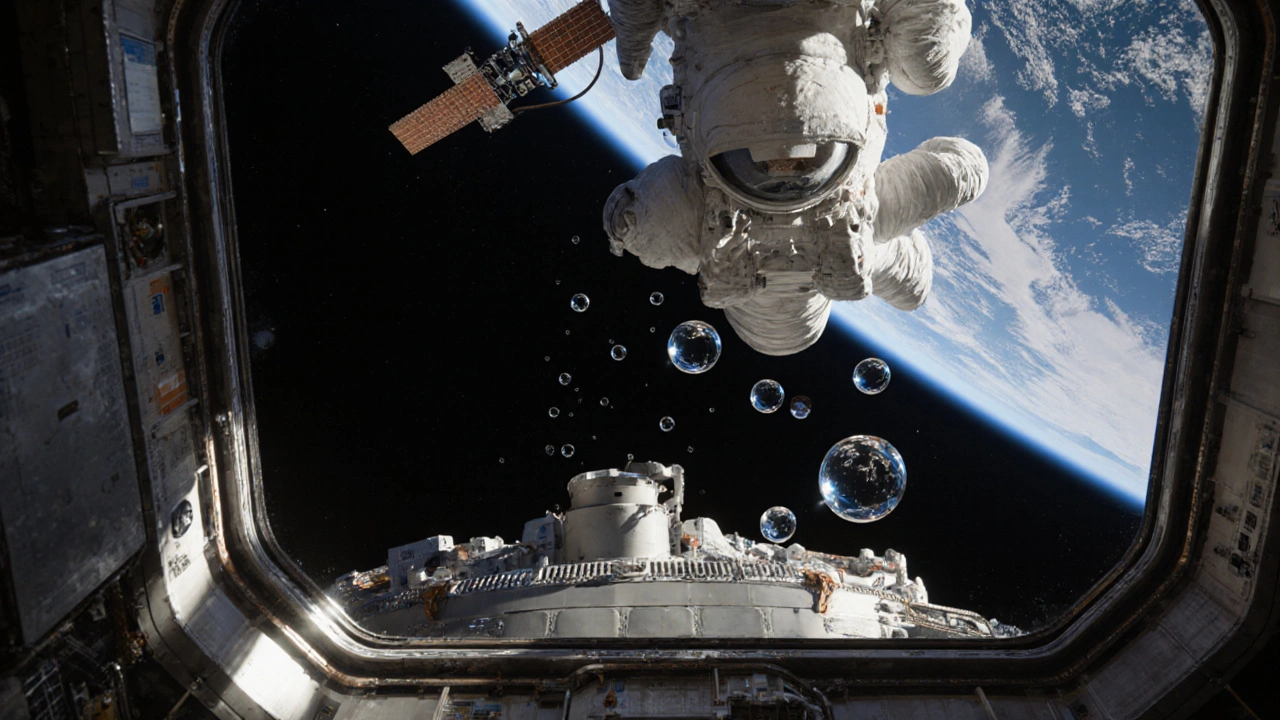
Microgravity isn't zero gravity-it's falling together. Learn how orbital motion creates weightlessness, why NASA rejects the term 'zero gravity,' and how this environment drives breakthroughs in medicine, materials, and science.
Learn More