
When you hear Merkle tree, a cryptographic structure that verifies large sets of data using hashed pairs. Also known as a hash tree, it’s the reason your Bitcoin transaction can be confirmed without downloading the whole blockchain. It’s not magic—it’s math. Every piece of data gets turned into a unique hash, like a digital fingerprint. Then those hashes get paired up, hashed again, and stacked into a tree. The top hash—the root—becomes a single signature for everything below. Change one letter in one transaction? The whole root changes. That’s how nodes know something’s been tampered with, even if they’ve never seen the original data.
This isn’t just for Bitcoin. hash function, a one-way algorithm that turns any input into a fixed-size string of characters. Also known as cryptographic hash, it’s the backbone of every Merkle tree. Without it, you couldn’t verify satellite telemetry from a probe 100 million miles away, or confirm that your GPS signal hasn’t been spoofed. NASA uses similar systems to validate data packets from Mars rovers. SpaceX checks rocket telemetry logs using Merkle-like structures to catch errors before landing. Even your phone’s secure boot uses this idea—just smaller. The beauty? You only need the root hash and a few branch hashes to prove a single file is real. No need to transfer gigabytes. Just a few hundred bytes.
That’s why data integrity, the assurance that information remains accurate and unaltered from source to destination. Also known as data consistency, it’s the core promise of Merkle trees. In space missions, where signals get noisy and bandwidth is tight, you can’t afford to re-send a full dataset. A Merkle tree lets you ask: "Is this one file correct?" and get a yes or no in seconds. In blockchain, it lets wallets verify your balance without syncing the whole ledger. In satellite networks, it helps detect if a sensor reading was corrupted by radiation. This isn’t theory—it’s built into the systems you rely on every day.
Below, you’ll find real-world examples of how Merkle trees power everything from Bitcoin mining to spacecraft telemetry. No fluff. Just how it works, where it’s used, and why it’s silent but essential.

The Merkle root is a cryptographic hash that secures all Bitcoin transactions in a block by binding them to the proof-of-work. It enables lightweight wallets to verify payments without downloading the full blockchain, making Bitcoin scalable and secure.
Learn More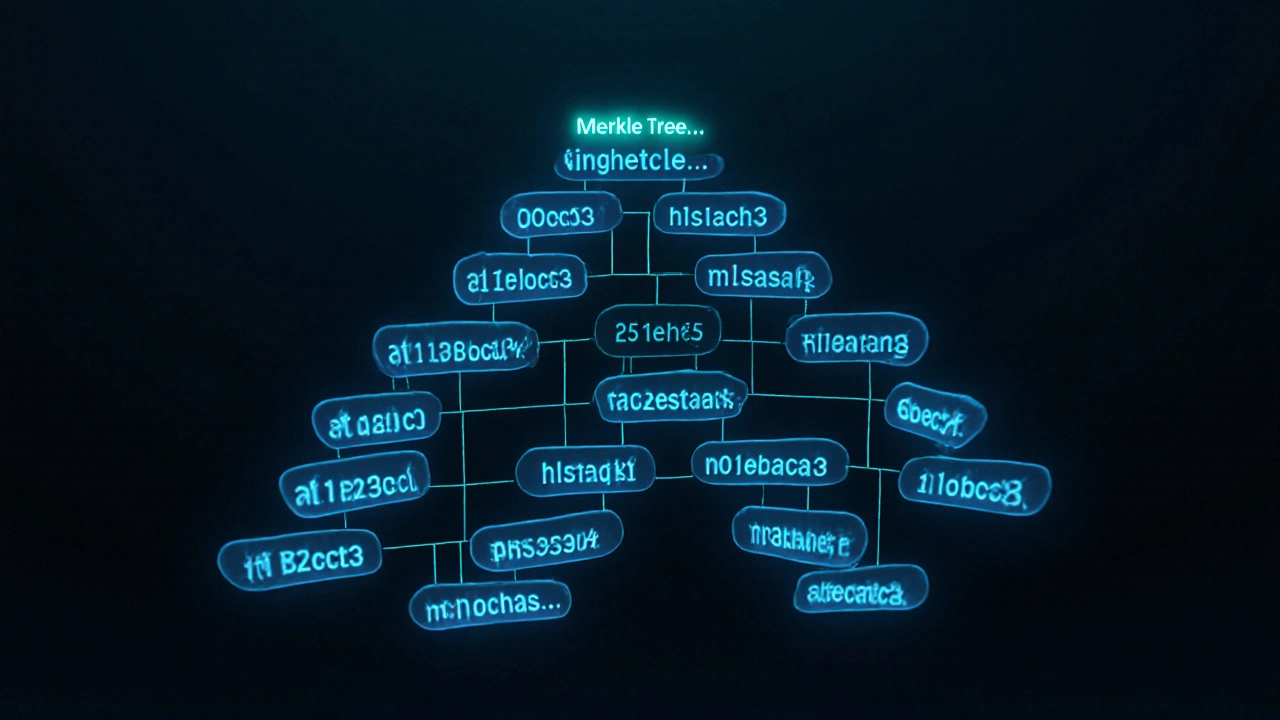
A Merkle tree is a cryptographic structure that lets blockchains verify thousands of transactions instantly using just one hash. It’s the reason your phone wallet can check your balance without downloading the whole blockchain.
Learn More