
When we talk about Mars sample return, a mission to collect Martian rocks and soil and bring them back to Earth for detailed analysis. Also known as Mars sample return mission, it’s the most complex robotic expedition ever planned — and it’s not just about bringing back dirt. It’s about answering one of humanity’s oldest questions: Did life ever exist on Mars?
This mission isn’t a single spacecraft flying to Mars and back. It’s a chain of carefully timed events involving multiple vehicles: the Perseverance rover, the NASA rover currently collecting sealed rock cores on Mars, a future sample retrieval lander, a robotic lander that will carry a small rocket and a robotic arm to pick up the samples, and a Mars ascent vehicle, a tiny rocket that will launch the samples into orbit around Mars. Once in orbit, an Earth return orbiter, a spacecraft built by ESA to catch the samples and bring them home will grab them and head back to Earth. All of this has to work perfectly — no second chances.
Why go through all this trouble? Because Earth labs have tools far beyond anything we can send to Mars. A rock studied on Earth can be sliced, scanned, heated, and tested with machines that weigh tons — none of which fit on a rover. Scientists want to look for organic molecules, trace minerals, and signs of ancient microbial life that no instrument on Mars can detect with certainty. The samples Perseverance is collecting right now could rewrite textbooks — or prove that Mars was never alive. Either way, we’re about to learn something new.
It’s not just about science. This mission is a test run for human exploration. If we can land a rocket on Mars, launch it into orbit, and catch it from space, we’re proving the tech needed to bring astronauts home. The same systems that return samples will one day return people. And that’s why NASA, ESA, and private partners are investing billions — not just for knowledge, but for survival.
Below, you’ll find detailed breakdowns of how each part of this mission works — from the robotic arms that collect samples to the heat shields that protect them during re-entry. You’ll see how the technology built for Mars is already improving Earth-based systems, and how a single rock from another planet could change everything we know about life in the universe.
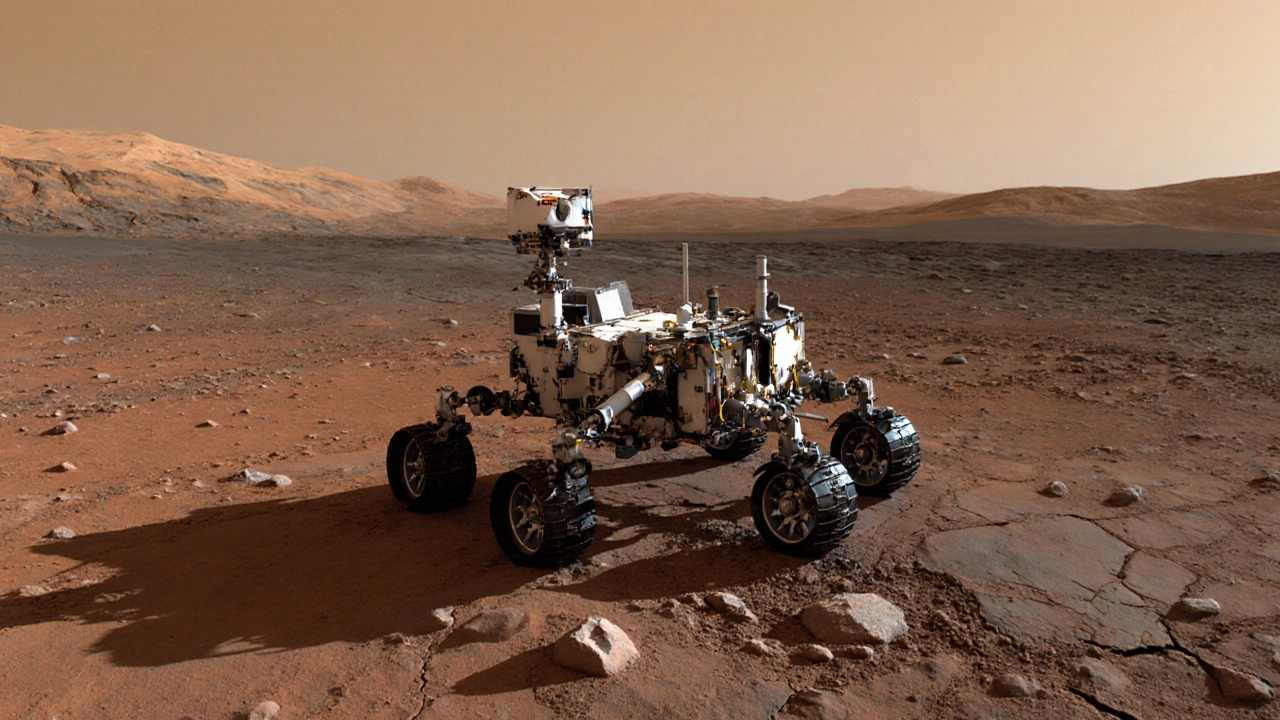
Curiosity and Perseverance are NASA's most advanced Mars rovers, each with distinct missions. Curiosity proved Mars once had habitable conditions. Perseverance now searches for signs of ancient life and collects samples for return to Earth.
Learn More