
When we talk about Mars rovers, autonomous robotic vehicles sent to explore the surface of Mars. Also known as Martian surface explorers, they’re not just machines—they’re our eyes, hands, and scientists on a planet we haven’t set foot on yet. These rovers don’t just drive around. They dig, drill, analyze soil, listen to wind, and even turn Martian air into oxygen. Every wheel track they leave is a step toward human missions.
Behind every Mars rover is a team of engineers who had to solve problems no one had faced before. How do you make a robot survive dust storms that last months? How do you keep its electronics working when temperatures drop to -100°C? How do you send commands to something 200 million miles away with a 20-minute delay? NASA and its partners built Perseverance rover, the most advanced Mars rover ever built, launched in 2020 to answer these questions. It carries a drill that collects core samples for future return to Earth, a helicopter named Ingenuity that proved flight is possible on Mars, and an instrument called MOXIE that turned carbon dioxide into breathable oxygen. That last one? It’s not science fiction—it’s a prototype for how future astronauts will survive.
Before Perseverance, there was Curiosity, a nuclear-powered rover that landed in 2012 and is still active. It found ancient riverbeds, confirmed Mars once had liquid water, and detected organic molecules—building blocks of life. Even older rovers like Spirit and Opportunity, designed for 90-day missions, lasted years. Opportunity ran for 15 years. That’s longer than most smartphones last. These machines weren’t just tools—they were endurance champions. And now, with Mars sample return missions, planned joint efforts between NASA and ESA to bring Martian soil back to Earth in the 2030s, we’re moving from observation to action. The rovers aren’t just exploring. They’re preparing.
What you’ll find in this collection isn’t just a list of rover missions. It’s the story of how robots changed the rules of space exploration—how they turned Mars from a distant red dot into a place we can map, measure, and one day, call home. You’ll read about the tech that keeps them alive, the science they’ve uncovered, and the next steps that could put humans on the surface within a decade. No fluff. Just the facts these machines have sent back—and what they mean for us.
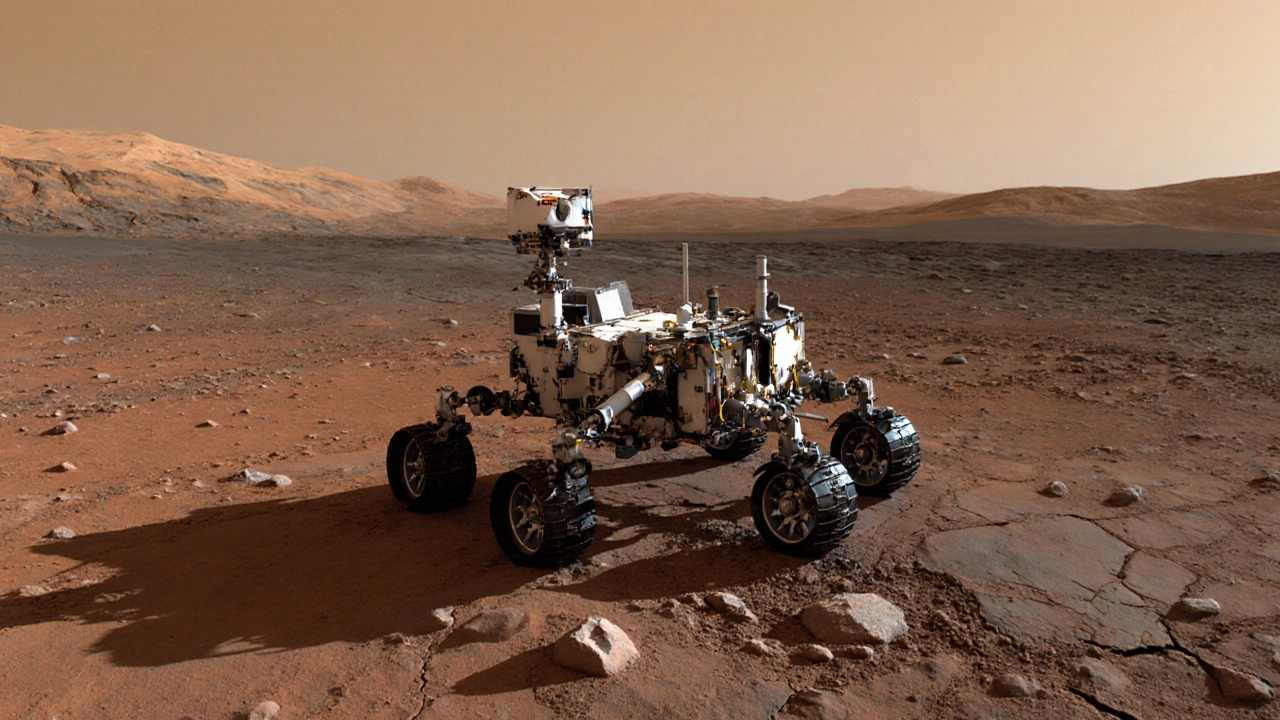
Curiosity and Perseverance are NASA's most advanced Mars rovers, each with distinct missions. Curiosity proved Mars once had habitable conditions. Perseverance now searches for signs of ancient life and collects samples for return to Earth.
Learn More