
When we talk about Kirkpatrick-Baez optics, a type of X-ray focusing system that uses two perpendicular, grazing-incidence mirrors to collect and direct high-energy photons. Also known as KB mirrors, it’s the reason we can see black holes, supernova remnants, and superheated gas clouds that ordinary lenses can’t capture. Unlike visible light, X-rays don’t bounce off mirrors the way light does—they slip right through unless they hit at a near-flat angle. That’s where Kirkpatrick-Baez optics come in. They’re designed to catch these high-energy photons just barely, like skipping stones across water, and focus them onto a detector. This isn’t theory—it’s how NASA’s Chandra X-ray Observatory sees the universe’s hottest and most violent events.
These mirrors are part of a broader family called grazing incidence optics, a class of mirror systems used in X-ray astronomy because they reflect X-rays at very shallow angles, typically less than one degree. The Kirkpatrick-Baez design is special because it uses two separate elliptical mirrors—one horizontal, one vertical—stacked at 90 degrees to correct focus in both directions. This gives sharper images than older single-mirror systems. It’s the same principle used in X-ray telescopes, space-based instruments built to detect and image high-energy radiation from cosmic sources. Without this tech, we’d have no detailed views of the gas swirling around black holes, no maps of supernova shockwaves, and no way to study the million-degree plasma in galaxy clusters.
What makes Kirkpatrick-Baez optics so critical is that they work where other lenses fail. Earth’s atmosphere blocks X-rays, so these telescopes have to fly in space. And they need to be precise—mirrors are polished to within a few atoms of perfection. The mirrors on Chandra, for example, are coated with iridium and shaped with nanometer-level accuracy. This isn’t just engineering; it’s art with physics. And while newer designs like Wolter telescopes are common, Kirkpatrick-Baez systems still power key missions because they’re simpler to align and maintain high resolution over wide fields.
You’ll find this tech in the background of nearly every major X-ray discovery since the 1990s. It’s why we know how fast neutron stars spin, why we can track how black holes eat stars, and how we map the invisible structure of the hot universe. The posts below cover related breakthroughs—from how detectors are cooled to near absolute zero to how space telescopes are built to survive radiation and thermal swings. You’ll also see how similar precision engineering shows up in satellite sensors, space materials, and even how we keep astronauts alive on long missions. This isn’t just about mirrors. It’s about seeing the unseen—and turning impossible observations into real science.
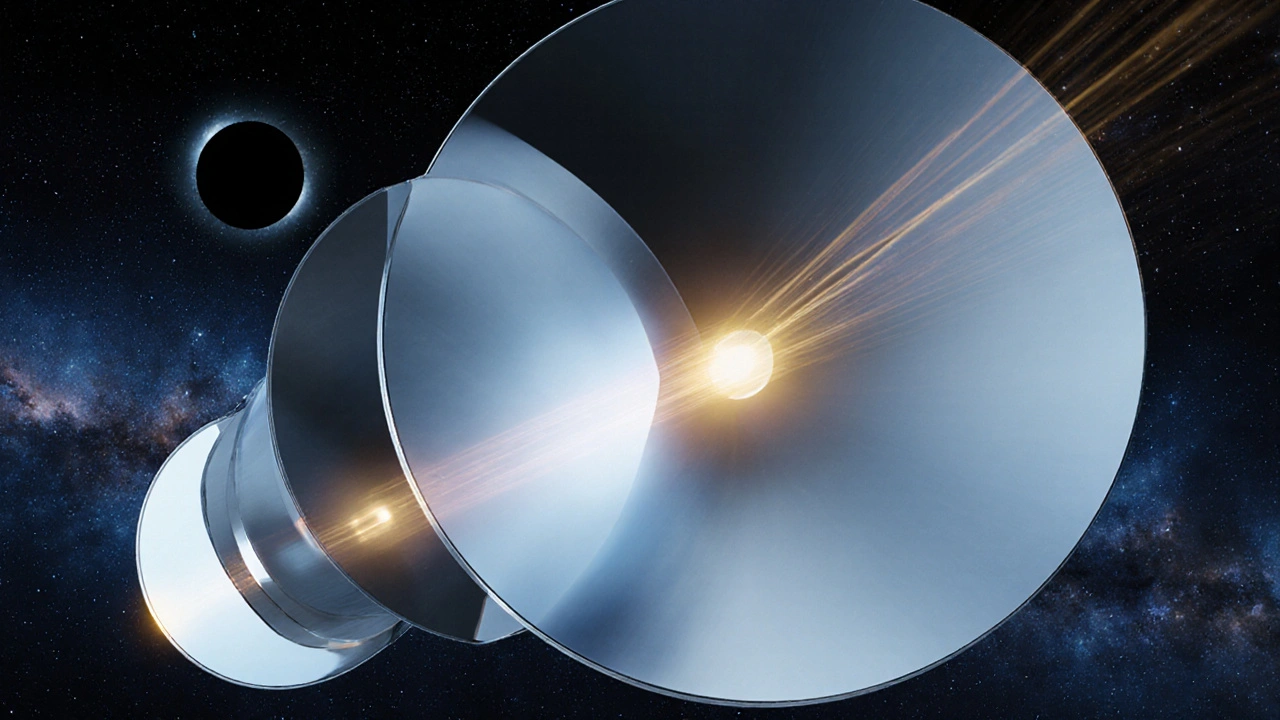
Grazing incidence optics enable X-ray space telescopes to focus high-energy radiation by reflecting it at shallow angles. This technology powers missions like Chandra and the upcoming ATHENA telescope, revealing black holes and galaxy clusters invisible to optical telescopes.
Learn More