
When you hear hash tree, a data structure that chains cryptographic hashes to verify large sets of data efficiently. Also known as Merkle tree, it's the quiet hero behind secure transactions, satellite telemetry, and lunar mission logs. It doesn’t store the full data—just the fingerprint of it. One small change anywhere in the chain flips that fingerprint, and the system knows something’s wrong. That’s why NASA uses it to confirm that data from Mars rovers hasn’t been corrupted during transmission, and why Bitcoin uses it to prove your transaction is real without downloading the whole blockchain.
Hash trees aren’t just about security—they’re about efficiency. Imagine sending a 10GB file from a satellite to Earth. You don’t want to resend the whole thing if one bit got flipped. With a hash tree, you only need to send a few small hash values to prove the file is intact. This saves bandwidth, cuts delays, and reduces power use—critical for deep space missions. The same logic applies to ground stations verifying software updates for satellites before they’re uploaded. If the hash chain matches, the code is trusted. If not, it’s blocked. Companies like SpaceX and Rocket Lab rely on this for mission-critical firmware rolls.
It also connects to how your crypto wallet works. Every transaction in Bitcoin is hashed and grouped into a Merkle tree, so your wallet can confirm you received funds without downloading every single transaction ever made. This same structure is now being adapted for space-based networks, where satellites act as nodes in a decentralized verification system. Think of it like a digital ledger floating in orbit, where each satellite checks the hashes from others to keep the whole system honest. That’s why you’ll find hash trees in papers about lunar base communications, interplanetary internet prototypes, and even the next-gen GPS systems that need to resist hacking.
What you’ll find in this collection aren’t abstract theories—they’re real-world applications. From how NASA verifies data from the James Webb Space Telescope to how blockchain-based satellite tracking avoids spoofing, every article here shows how hash trees quietly hold together systems you depend on. No fluff. Just how it works, why it matters, and where it’s headed next.
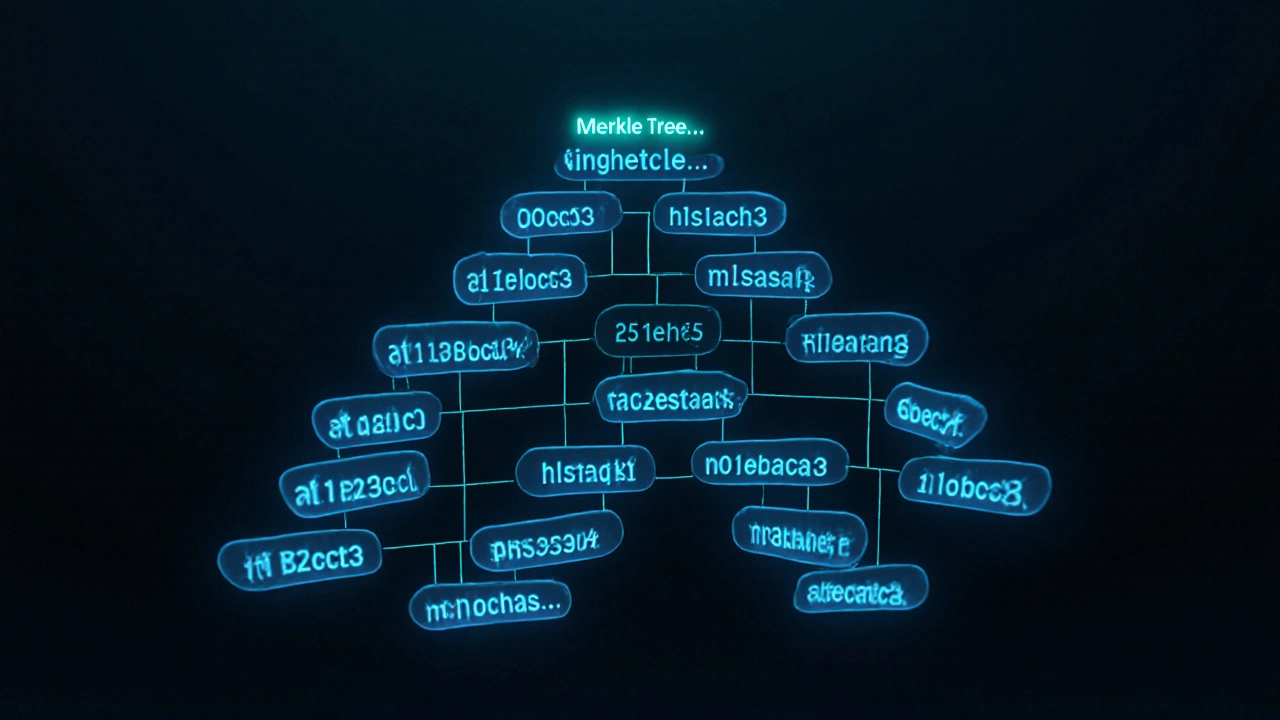
A Merkle tree is a cryptographic structure that lets blockchains verify thousands of transactions instantly using just one hash. It’s the reason your phone wallet can check your balance without downloading the whole blockchain.
Learn More