
When we talk about grazing incidence optics, a specialized mirror system that captures high-energy X-rays by reflecting them at shallow angles. Also known as X-ray mirrors, it’s the reason we can see the hottest, most violent places in the universe—like black holes and exploded stars—that light can’t reach from Earth. Normal mirrors don’t work for X-rays. If you shine an X-ray straight at a mirror, it doesn’t reflect—it just punches right through or gets absorbed. But if you tilt the mirror so the X-ray barely skims the surface, like a stone skipping on water, it bounces. That’s the core idea behind grazing incidence optics.
This isn’t just theory. It’s what powers telescopes like Chandra and XMM-Newton. These space observatories use nested, barrel-shaped mirrors made of ultra-smooth materials like gold or iridium, arranged so each one catches X-rays at angles less than 1 degree. The X-rays bounce off the first mirror, then off a second, and finally hit the detector. Without this design, we’d be blind to the high-energy universe. And it’s not just for astronomy. The same principle helps in medical imaging and materials analysis on Earth, where scientists need to study tiny structures without damaging them.
What makes grazing incidence optics even more impressive is how they solve a problem that seems impossible: focusing X-rays without lenses. Glass lenses absorb X-rays, so you can’t use them like you would for visible light. Mirrors are the only option, and only if you angle them just right. That’s why these systems are incredibly complex to build—each mirror must be polished to within a few atoms of perfection, and aligned with precision that’s harder than threading a needle from a mile away.
When you look at the posts below, you’ll see how this technology connects to bigger things: how NASA designs space instruments, how satellites survive extreme environments, and how we’re pushing the limits of what we can observe from orbit. You’ll find articles on space-based sensors, satellite design, and the engineering behind seeing the unseen—all rooted in the same physics that makes grazing incidence optics work. These aren’t just technical specs. They’re the quiet breakthroughs that let us map the invisible.
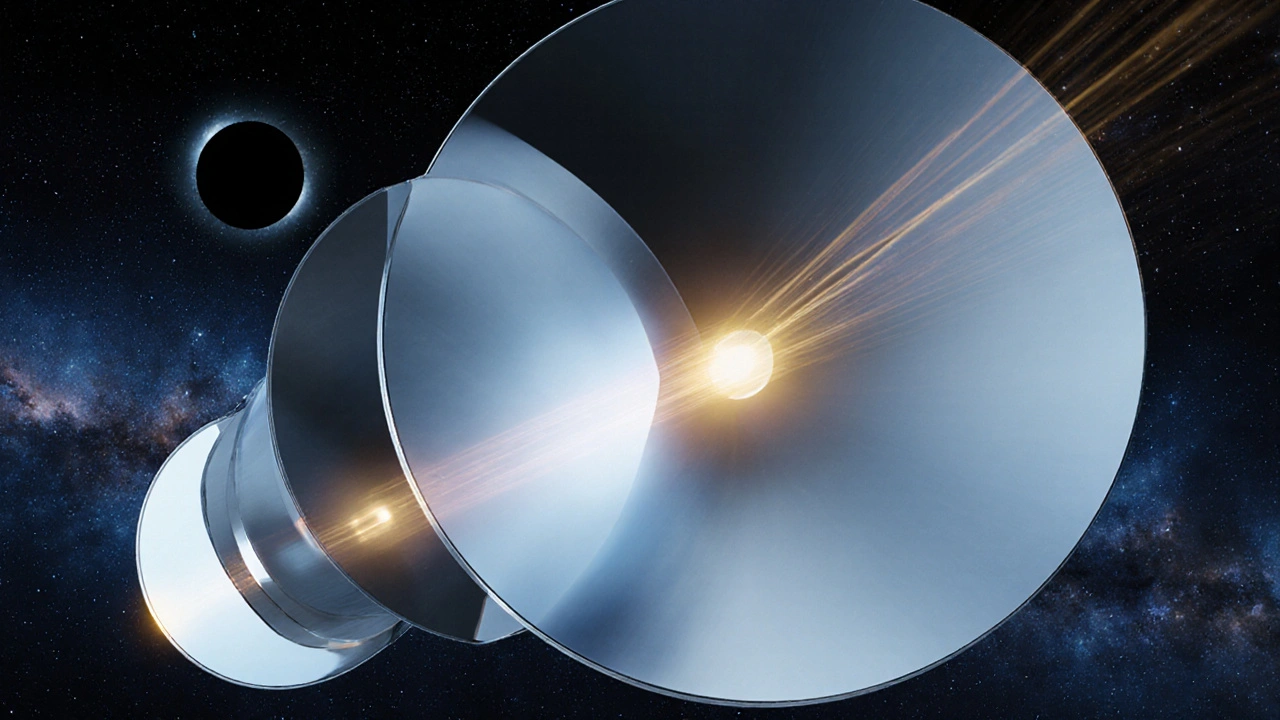
Grazing incidence optics enable X-ray space telescopes to focus high-energy radiation by reflecting it at shallow angles. This technology powers missions like Chandra and the upcoming ATHENA telescope, revealing black holes and galaxy clusters invisible to optical telescopes.
Learn More