
When the sun lets out a massive burst of charged particles, it can trigger a geomagnetic storm, a temporary disturbance in Earth’s magnetic field caused by solar wind interacting with our magnetosphere. Also known as space weather events, these storms don’t just create pretty auroras—they can knock out satellites, scramble GPS signals, and even blackout power grids. It’s not science fiction. In 1989, a single storm took down Quebec’s entire power grid in 90 seconds. Today, with everything from smartphones to air traffic control relying on space-based tech, these events matter more than ever.
These storms start with the sun. When solar flares or coronal mass ejections blast out from the sun’s surface, they send a wave of plasma and magnetic fields toward Earth. If the timing and direction line up right, that plasma slams into our magnetic shield. That’s when the real chaos begins. The interaction distorts the magnetosphere, sending electric currents racing through the ground and up into power lines. This is what causes transformers to overload. It’s also why your GPS might drift a few meters or why your satellite radio cuts out during a strong storm. Even astronauts on the ISS have to take shelter in shielded parts of the station during major events.
Scientists track these storms using satellites like NOAA’s DSCOVR and NASA’s ACE, which sit between Earth and the sun, giving us 15 to 60 minutes of warning. The strength of a storm is measured on a scale from G1 (minor) to G5 (extreme). A G5 storm? That’s the kind that could fry undersea cables, knock out long-distance radio, and leave millions without electricity for days. And they’re not rare—during peak solar cycles, they happen every few months. The last big one was in 2023, when auroras were seen as far south as Florida and Texas. That wasn’t just a show—it was a reminder that our tech is vulnerable to something as distant as a star.
What you’ll find in the articles below isn’t just theory. These posts cover real-world impacts: how satellites are designed to survive solar blasts, why space agencies are building better early-warning systems, and how industries from aviation to agriculture are adapting. You’ll see how NASA and private companies are using sensors to monitor the magnetosphere in real time, how GPS systems are being hardened against interference, and why even your phone’s location app might one day rely on backup systems when the sun gets angry. This isn’t about astronomy—it’s about keeping the modern world running when space itself turns stormy.
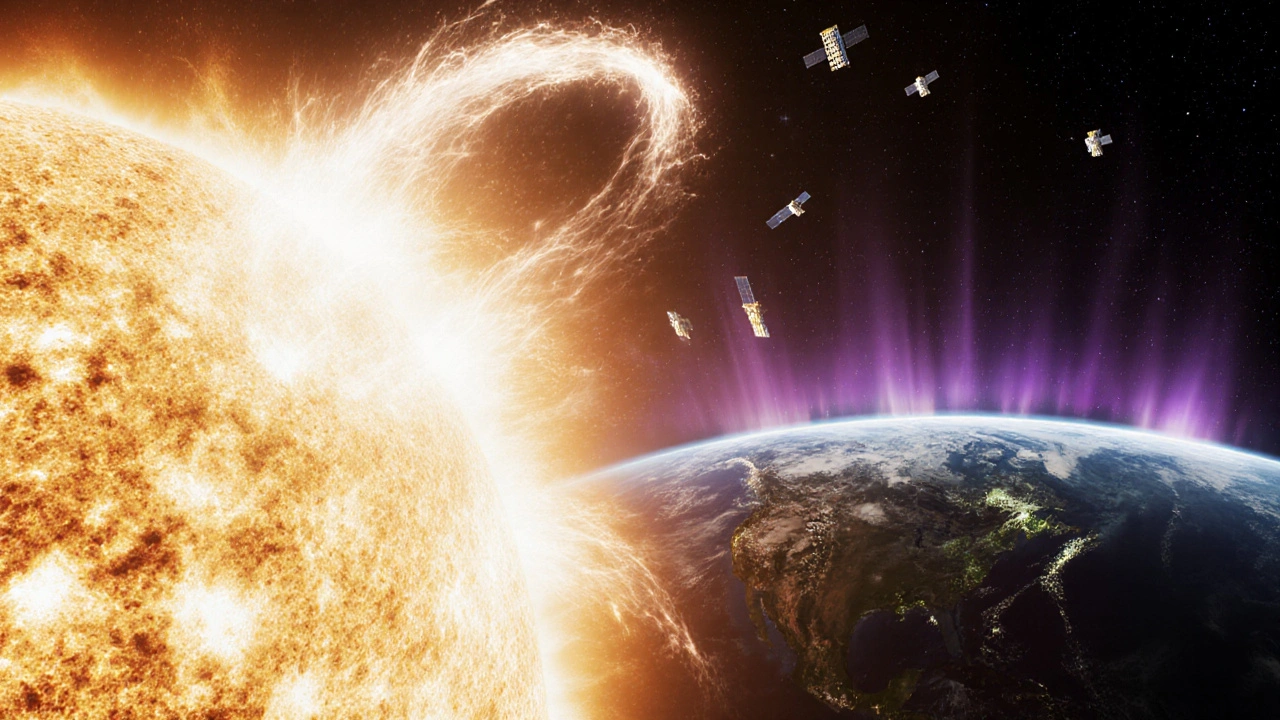
Learn how space systems are designed to survive solar storms, from radiation-hardened satellites to real-time forecasting systems. Understand the real risks to GPS, power grids, and communications-and how we're building resilience before the next major event.
Learn More