
When you think of satellites, you probably picture one lonely orb circling Earth. But a new kind of space mission is changing that: formation flying satellites, a group of multiple spacecraft flying in coordinated patterns to act as a single instrument. Also known as satellite swarms, these teams of small satellites move in sync—sometimes just meters apart—to collect data no single satellite could achieve alone. This isn’t science fiction. NASA, ESA, and private companies are already using them to map gravity fields, monitor climate change, and even simulate giant space telescopes.
How do they do it? Each satellite in the formation uses GPS, laser rangefinders, and radio signals to stay locked in position. They adjust their orbits constantly using tiny thrusters, responding to tiny changes in gravity or atmospheric drag. This level of precision is like flying five cars in a tight diamond at 17,000 miles per hour—without bumping into each other. The result? A distributed system that’s cheaper, more flexible, and harder to disable than one big satellite. For example, a swarm can cover more ground than a single satellite, or combine signals to create ultra-high-resolution images of Earth’s surface. It’s why companies like SpaceX and Planet Labs are betting big on this tech for their internet and Earth imaging networks.
Related technologies like LEO satellite networks, constellations of small satellites in low Earth orbit designed for global coverage often rely on formation flying to avoid collisions and optimize signal strength. And when you look at missions like NASA’s GRACE-FO, which tracks water movement by measuring tiny changes in distance between two satellites, you see how formation flying isn’t just useful—it’s essential for cutting-edge science. These systems don’t just replace big satellites; they make possible new kinds of measurements that were impossible before.
What you’ll find in the posts below are real-world examples of how formation flying satellites are being used today—not just in theory, but in orbit. From how they’re built to how they talk to each other, and why they’re becoming the new standard for space missions, you’ll see the full picture. Whether you’re curious about how Starlink’s satellites avoid crashes or how future Mars missions might use swarms to map terrain, the answers are here.
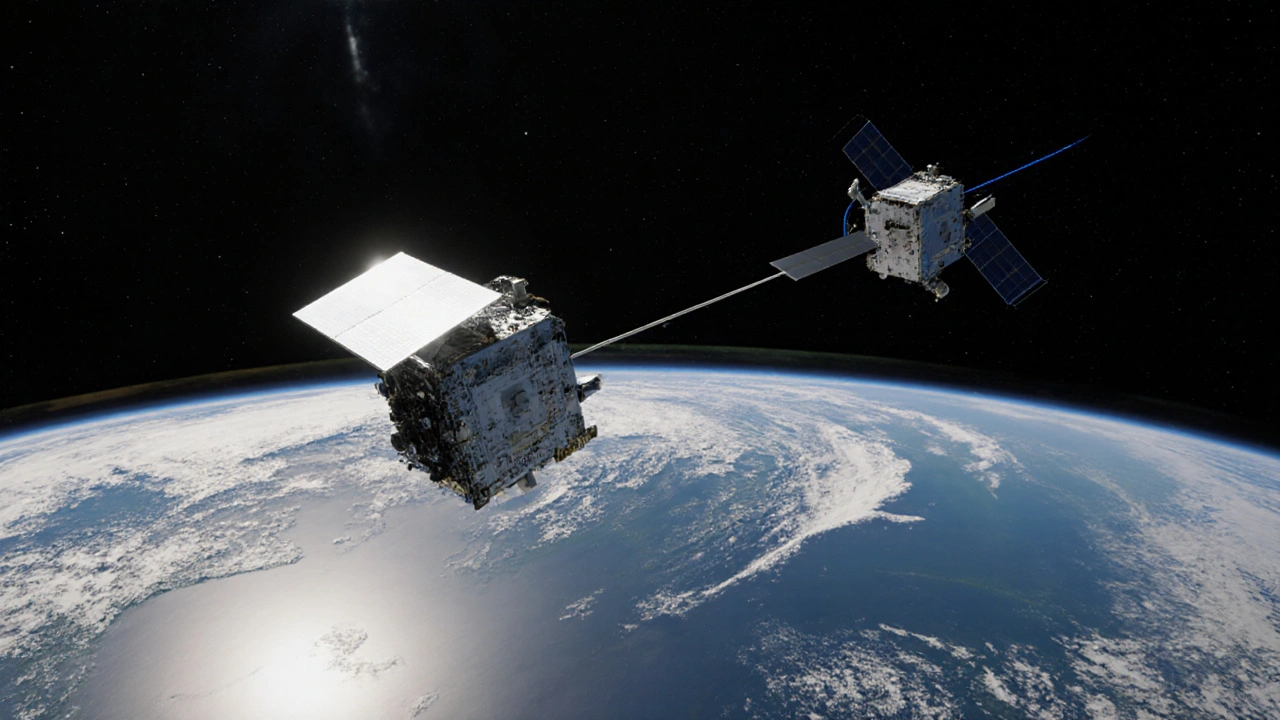
Formation flying satellites use precise relative navigation and control to act as a single instrument in space, enabling missions impossible for single spacecraft. Learn how they work, what goes wrong, and why they’re the future of space science.
Learn More