
When we talk about exoplanets, planets that orbit stars other than our Sun. Also known as extrasolar planets, they are no longer just theoretical—they’re being found by the thousands, and each one changes what we thought possible about planets and life. Just 30 years ago, we had no proof any existed beyond our own solar system. Now, we know there are more exoplanets in our galaxy than stars. That’s at least 100 billion worlds, some as small as Earth, others bigger than Jupiter, all drifting through the dark between stars.
The Kepler mission, a NASA space telescope designed to hunt for planets by watching for tiny dips in starlight was the game-changer. It didn’t take pictures—it counted shadows. When a planet passes in front of its star, it blocks a fraction of the light. That’s the transit method, the most successful way to detect exoplanets. It’s how we found rocky worlds in the habitable zone, the Goldilocks region around a star where liquid water could exist. These aren’t just distant dots. They’re candidates for alien oceans, atmospheres, maybe even signs of life. And we’re not just finding them—we’re starting to analyze their air. Telescopes like JWST are sniffing out methane, water vapor, carbon dioxide. That’s not science fiction. That’s today’s science.
What makes exoplanets so exciting isn’t just their number. It’s what they reveal about us. We used to think our solar system was typical. Turns out, it’s weird. Hot Jupiters orbiting their stars in days. Super-Earths twice Earth’s size but made of rock. Planets with two suns. Systems with planets packed tighter than our inner solar system. These aren’t anomalies—they’re the norm. And they force us to rethink how planets form, how life might arise, and whether Earth is truly special. The search isn’t just about finding another Earth. It’s about understanding how common—or rare—our home really is.
Below, you’ll find real stories from the front lines of this discovery: how we track these worlds, what tools we use, why some look promising for life, and how the next generation of telescopes will take us even further. These aren’t just articles. They’re snapshots of humanity’s first real look at the cosmic neighborhood beyond our own.
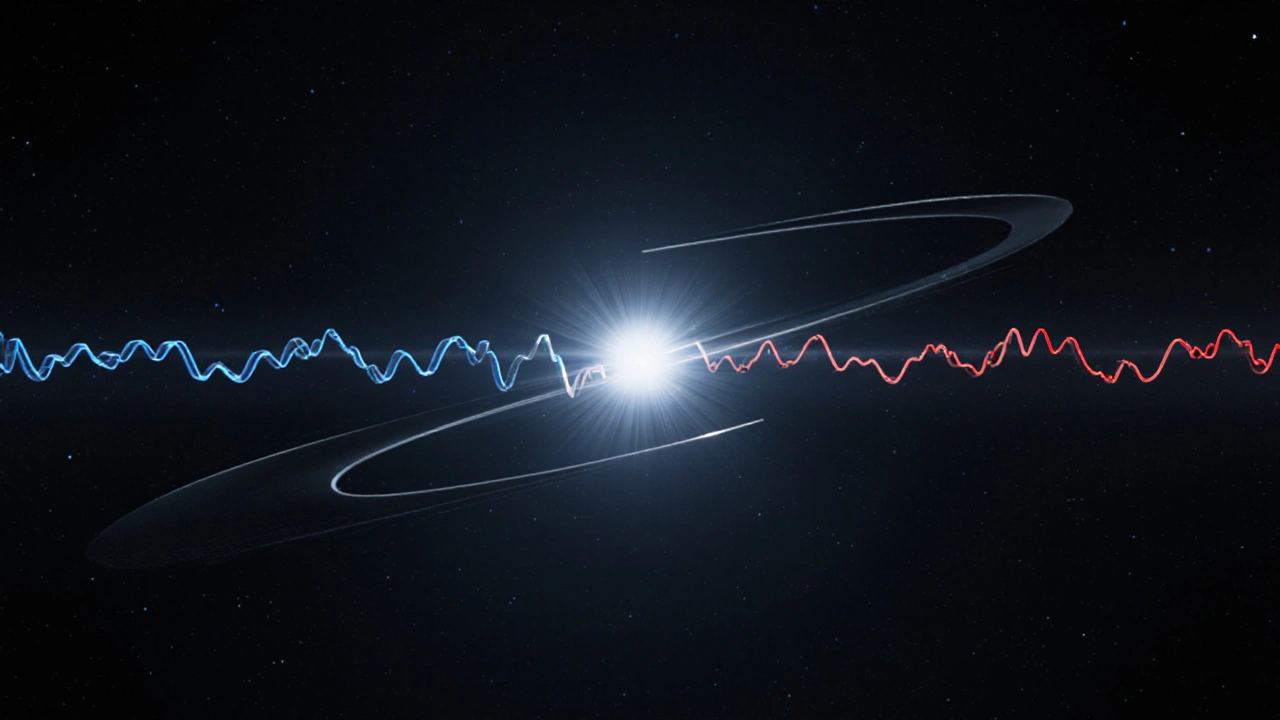
The radial velocity method detects exoplanets by measuring tiny wobbles in a star’s motion caused by orbiting planets. It’s how we found Proxima Centauri b and confirmed the TRAPPIST-1 system - and it’s still essential for measuring planetary mass.
Learn More