
When we talk about exoplanet detection, the process of identifying planets outside our solar system. Also known as extrasolar planet hunting, it’s no longer science fiction—it’s routine astronomy. Just 30 years ago, we had zero confirmed exoplanets. Today, we’ve found over 5,500. The breakthrough didn’t come from bigger telescopes alone. It came from smarter ways to see the invisible.
Most exoplanets are found using the transit method, watching for tiny dips in a star’s light as a planet passes in front of it. Think of it like a mosquito flying across a car headlight—you don’t see the bug, but you see the shadow. NASA’s Kepler telescope used this trick to find thousands of worlds, including rocky planets in the habitable zone. Another key method is radial velocity, measuring how a star wobbles due to a planet’s gravity. It’s like watching a dancer spin while holding a heavy ball—the star moves just enough to reveal the unseen partner.
Then there’s direct imaging, catching actual light from the planet itself. It’s like trying to photograph a firefly next to a searchlight. Only the biggest, youngest, and hottest planets show up this way—but when they do, we get real pictures, not just data spikes. These methods don’t work alone. They cross-check each other. A planet found by transit might be confirmed by radial velocity. A candidate spotted by direct imaging might be studied later with spectroscopy to check for water vapor or methane in its atmosphere.
What makes this all possible? Tools like the Kepler telescope, the James Webb Space Telescope, and ground-based observatories using advanced filters and adaptive optics. But the real engine is data. Computers now scan millions of starlight curves every day, spotting patterns no human would catch. We’re not just finding planets—we’re starting to classify them: hot Jupiters, super-Earths, ocean worlds, and rogue planets drifting alone in the dark.
Why does this matter? Because every new exoplanet adds a piece to the puzzle of whether we’re alone. Finding one with the right temperature, atmosphere, and chemistry could change everything. The next big leap? Detecting biosignatures—chemical signs of life—on distant worlds. That’s not decades away. It’s happening now, in real-time data from telescopes we’ve already launched.
Below, you’ll find real stories from the front lines of exoplanet discovery: how missions were designed, what went wrong, how engineers fixed them, and what’s coming next. From space telescope tech to the math behind wobbly stars, this collection cuts through the hype and shows you exactly how we’re finding—and understanding—other worlds.
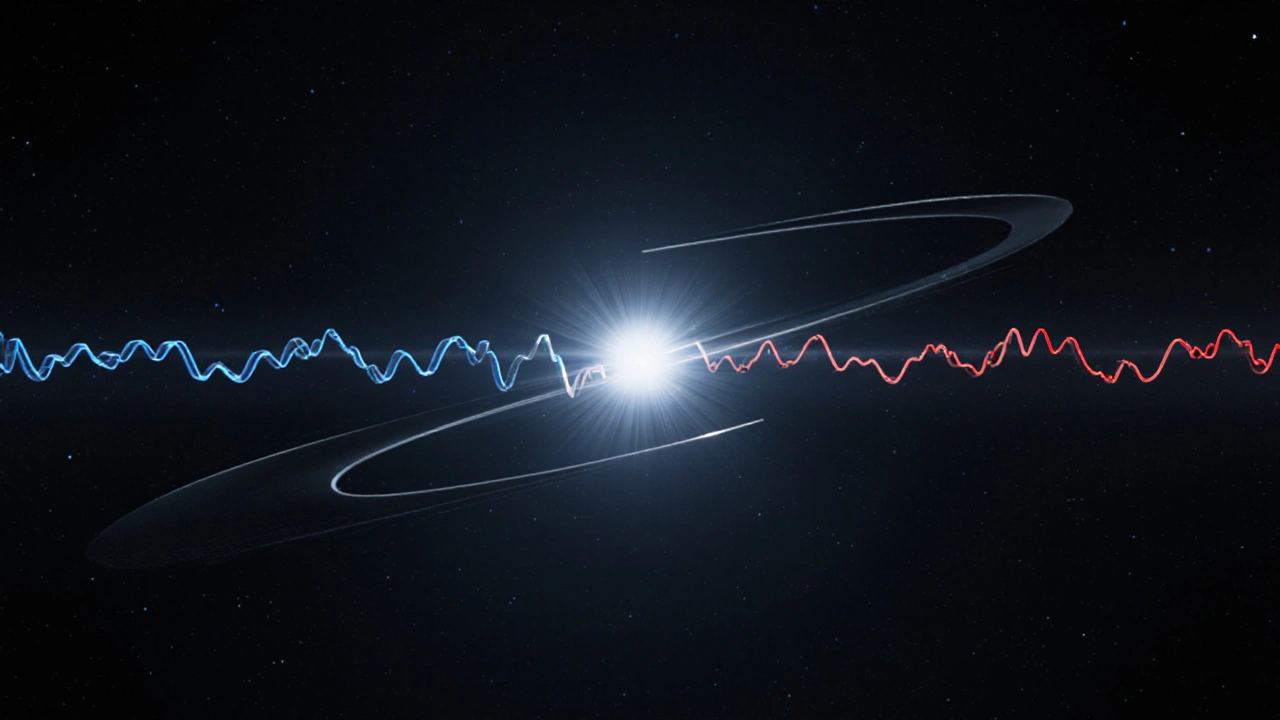
The radial velocity method detects exoplanets by measuring tiny wobbles in a star’s motion caused by orbiting planets. It’s how we found Proxima Centauri b and confirmed the TRAPPIST-1 system - and it’s still essential for measuring planetary mass.
Learn More