
When a star moves toward or away from us, its light shifts slightly in color—this is Doppler spectroscopy, a technique that detects tiny changes in a star’s light spectrum caused by the gravitational tug of orbiting planets. Also known as the radial velocity method, it’s how astronomers found the first planets outside our solar system—and it’s still one of the most reliable ways to spot them today. It doesn’t see the planet directly. Instead, it watches the star wobble. Every time a planet pulls on its star, the star moves just a little—like a child tugging on a spinning merry-go-round. That tiny motion changes the wavelength of the star’s light. When the star moves toward Earth, the light squeezes into bluer tones. When it moves away, the light stretches into redder tones. These shifts are too small for the eye to see, but a high-resolution spectrometer can measure them down to a fraction of a pixel.
This method works best for big planets close to their stars, because they tug harder and faster. Jupiter-sized worlds orbiting close in create the clearest signals. That’s why early discoveries were mostly hot Jupiters—not because they’re common, but because they’re easiest to catch. Over time, better instruments and longer observations let scientists find smaller planets, even ones the size of Earth. The technique doesn’t just find planets—it tells you their minimum mass, how long their year is, and how elliptical their orbit is. It’s not perfect. A star’s own activity—like sunspots or flares—can mimic a planet’s signal. That’s why Doppler spectroscopy often teams up with other methods, like transit photometry, to confirm discoveries. But it’s the only method that gives you mass directly. Transit tells you size. Doppler tells you weight. Together, they reveal density—and that’s how you know if a world is rocky, gassy, or something weirder.
Many of the missions and technologies you’ll find in this collection rely on this same principle. From formation flying satellites that need ultra-precise positioning to cryogenic propellant depots, orbital fuel stations that require exact orbital tracking to dock safely, precise motion detection is everything. Even space weather resilience, the effort to shield satellites from solar storms, depends on understanding how signals shift under pressure. The same physics that lets us find planets light-years away also helps us keep our satellites alive in orbit. You’ll see how this science shows up in everything from water recovery systems on the ISS—where sensors track tiny fluid shifts—to GNSS guidance in farming, where satellites detect ground movement down to the centimeter. Doppler spectroscopy isn’t just about finding new worlds. It’s about learning how to measure the invisible, and that skill runs through nearly every modern space and Earth-based technology.
Below, you’ll find real-world examples of how this science shapes space missions, instrumentation, and the tools we use to understand our place in the universe. Some posts dive into the hardware behind the measurements. Others show how the same principles apply far beyond astronomy. This isn’t theory—it’s applied physics, used every day to push the limits of what we can detect, build, and survive out there.
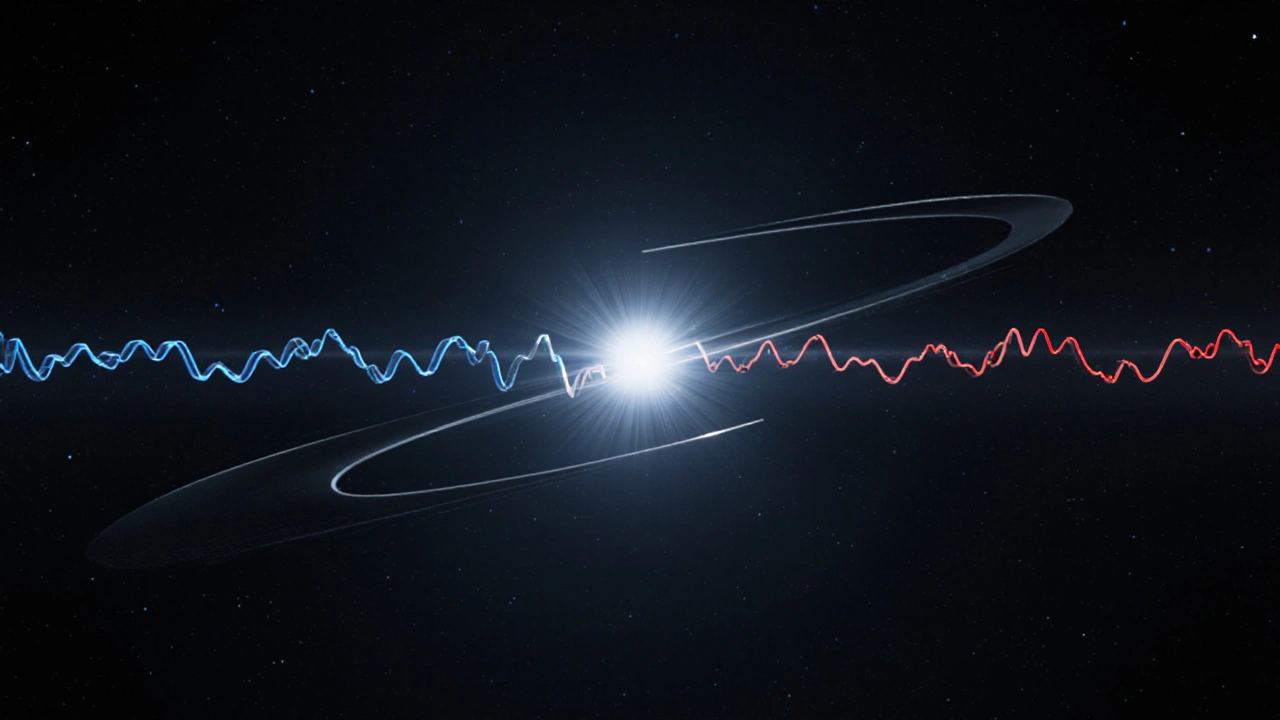
The radial velocity method detects exoplanets by measuring tiny wobbles in a star’s motion caused by orbiting planets. It’s how we found Proxima Centauri b and confirmed the TRAPPIST-1 system - and it’s still essential for measuring planetary mass.
Learn More