
When we talk about the ATHENA mission, a next-generation X-ray observatory led by the European Space Agency to map the hot and energetic universe. Also known as the Advanced Telescope for High Energy Astrophysics, it’s not just another space telescope—it’s a window into the invisible forces shaping galaxies, black holes, and the cosmic web. While optical telescopes show us stars and planets, ATHENA will see the superheated gas that fills the space between galaxies—gas so hot it glows in X-rays, not visible light.
This mission builds on decades of X-ray astronomy, from Chandra to XMM-Newton, but it’s a giant leap. ATHENA’s mirror will be 20 times more sensitive than any previous X-ray telescope, letting it spot fainter sources and gather data faster. It’ll track how black holes grow by swallowing matter, how galaxy clusters form through violent collisions, and how hot gas flows through the universe’s largest structures. These aren’t abstract ideas—they’re physical processes that shape everything we see. The European Space Agency, the intergovernmental organization coordinating space science missions across Europe is leading this effort, with support from NASA and other global partners. It’s part of a broader push to understand the hot universe, the portion of the cosmos dominated by million-degree plasma, invisible to optical telescopes but critical to cosmic evolution. Without tools like ATHENA, we’d miss 90% of the matter in the universe.
ATHENA isn’t launching until the late 2030s, but its design is already influencing how we build space instruments. The same technology being tested for its X-ray mirrors is being used in smaller missions to study solar flares and neutron stars. Meanwhile, missions like the ISS communication systems, networks that keep astronauts connected using ground stations and satellites, and cryogenic propellant depots, orbital fuel stations enabling deep space missions show how space tech evolves across domains—precision sensors, thermal control, and data transmission all matter, whether you’re listening to a radio call from orbit or capturing X-rays from a black hole 10 billion light-years away.
What you’ll find below isn’t just a list of articles—it’s a collection of real-world connections. From how satellites survive solar storms to how water is recycled for Mars missions, these stories show the same engineering discipline, the same curiosity, and the same drive to explore what’s hidden. ATHENA won’t just collect data. It’ll answer questions we haven’t even thought to ask yet.
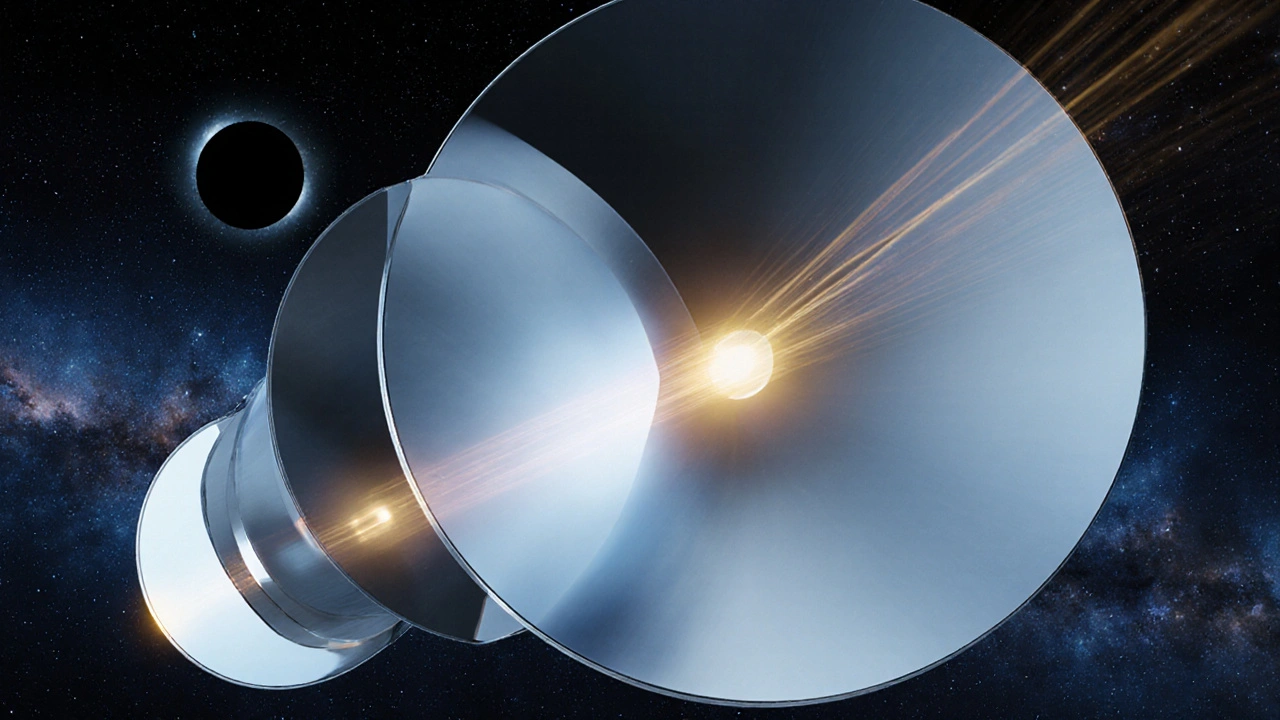
Grazing incidence optics enable X-ray space telescopes to focus high-energy radiation by reflecting it at shallow angles. This technology powers missions like Chandra and the upcoming ATHENA telescope, revealing black holes and galaxy clusters invisible to optical telescopes.
Learn More