
When you think about becoming an astronaut, you probably imagine zero-gravity flips, spacewalks, or landing on Mars. But before any of that, you need to astronaut language requirements, the official language rules astronauts must meet to fly on international missions. Also known as space mission communication standards, these rules aren’t optional—they’re life-or-death. NASA and Roscosmos don’t just pick languages because they sound cool. They pick them because every crew member on the International Space Station needs to understand instructions, alarms, and emergencies—fast.
English is the main working language on the ISS, but Russian, the second mandatory language for astronauts flying to the ISS is just as critical. Why? Because the Soyuz spacecraft, which has carried every astronaut to the station since the Space Shuttle retired, runs entirely in Russian. If the main control panel flashes a warning in Russian and you don’t understand it, you can’t react. Same goes for emergency procedures, life support checks, and even daily check-ins with mission control in Moscow. You don’t need to be fluent like a native speaker, but you do need to pass a B2 level test—enough to handle technical conversations, ask for help, and understand complex instructions under stress.
Crew communication in space, how astronauts share information during missions to avoid errors and build trust isn’t just about vocabulary. It’s about tone, clarity, and timing. In a noisy, high-pressure environment, a misheard word can mean a wrong valve, a failed experiment, or worse. That’s why astronauts train together for months, practicing commands in both languages, even if they’re from different countries. The European Space Agency, JAXA, and CSA all require their astronauts to learn both English and Russian. Some even take extra courses in basic Mandarin or Arabic, just in case future missions involve partners from those regions.
It’s not just about speaking—it’s about listening. A 2021 NASA study found that communication breakdowns during simulations were more often caused by language gaps than technical failures. One astronaut from Japan recalled a moment when a simple phrase like "pressure rising" was misunderstood as "pressure stable" because of accent differences. That’s why training now includes accent adaptation drills and real-time translation checks. The goal isn’t to erase accents—it’s to make sure every word lands clearly, no matter who’s saying it.
What you’ll find in the posts below aren’t just articles about language tests or training programs. You’ll see how astronauts actually use these skills—like how they handle emergencies when the comms glitch, why Russian is still the language of the Soyuz cockpit, and how even simple phrases like "copy that" or "stand by" become lifelines hundreds of miles above Earth. This isn’t about learning a new language for fun. It’s about staying alive, working as a team, and making sure the mission doesn’t fail because someone didn’t understand a single word.
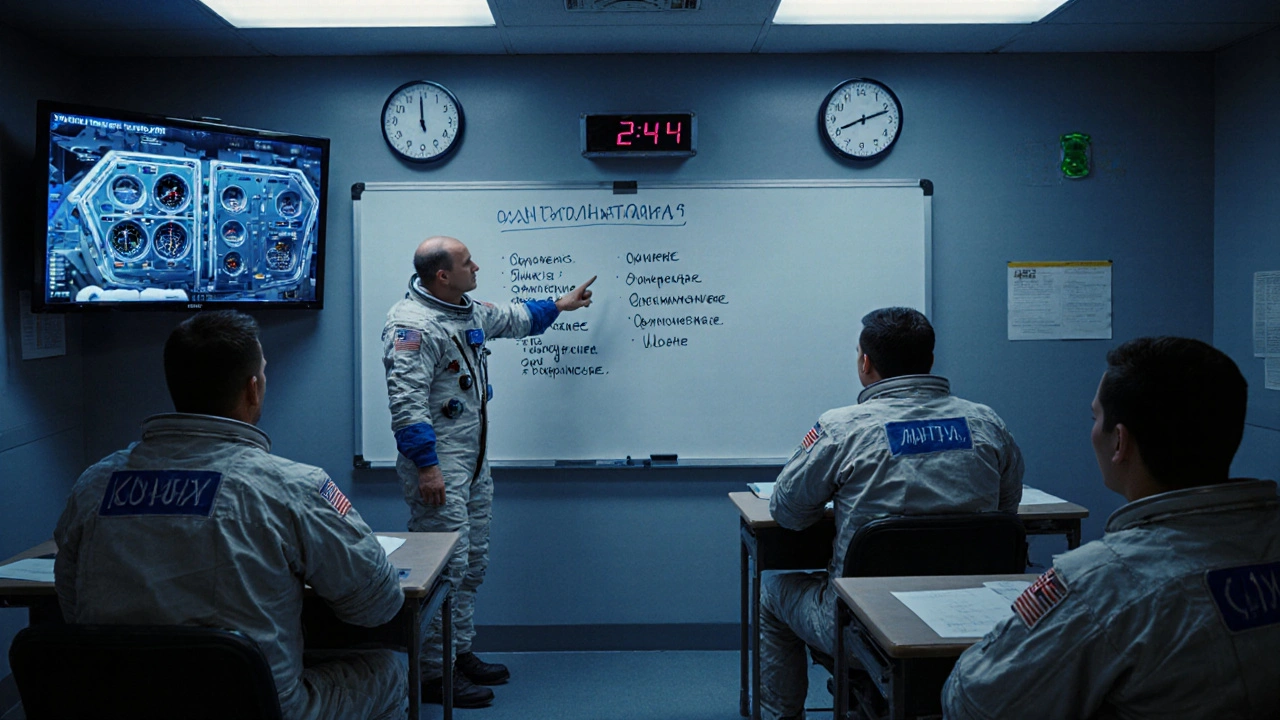
Russian language training is mandatory for all non-Russian astronauts heading to the ISS. Learn why survival, not just communication, depends on mastering technical Russian for emergencies, docking, and life support systems.
Learn More