
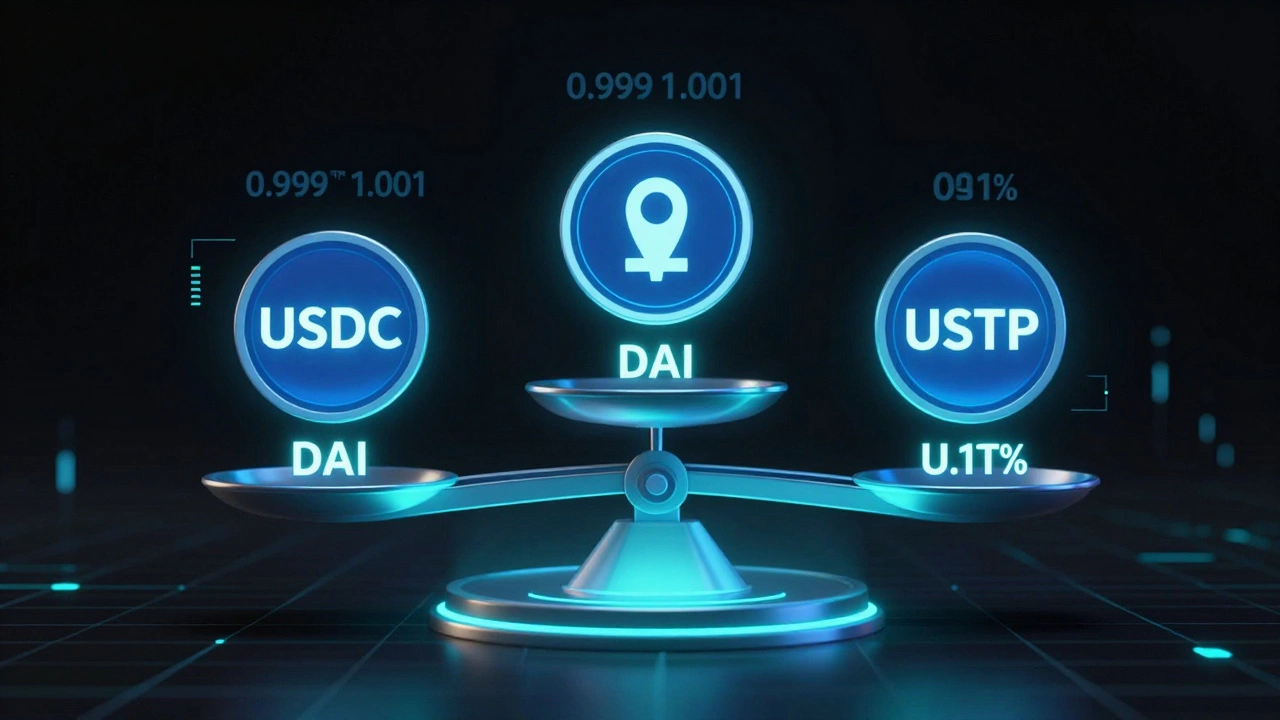
When you trade USDC for DAI or USDT on a decentralized exchange, you expect it to be smooth, cheap, and fast. But most DEXs like Uniswap were built for volatile assets-think ETH, SOL, or meme coins. When you try to swap between stablecoins on those platforms, things get messy. A $10,000 trade might cost you $10 in slippage. That’s not trading-it’s paying a tax. That’s where Curve Finance comes in.
Why Stablecoin Swaps Are Different
Stablecoins like USDC, DAI, and USDT are all meant to be worth $1. They don’t swing up and down like Bitcoin. They drift-sometimes to $0.998, sometimes to $1.002. But that tiny movement is enough to break traditional automated market makers (AMMs). Uniswap uses the x*y=k formula, which assumes price changes are large and unpredictable. When you swap $1 million worth of USDC for DAI on Uniswap, the price moves. You get less DAI than you expected. That’s slippage. Curve was built from the ground up to fix this. It doesn’t treat stablecoins like regular tokens. It treats them like weights on a scale that barely tips. Its math is designed for when all the assets in a pool are almost the same price. The result? Slippage often under 0.1%-even on million-dollar trades.How Curve’s Algorithm Works
Curve doesn’t use the same math as Uniswap. Instead, it uses something called the StableSwap invariant. Think of it as a smart balance system. When you deposit USDC, DAI, and USDT into a Curve pool, the protocol doesn’t just let them sit there. It constantly nudges them back into balance. Here’s how: if someone sells a lot of DAI, the pool temporarily offers DAI at a slight discount. That gives arbitrageurs a chance to buy cheap DAI and sell it elsewhere for $1. When they do, they refill the pool with USDC or USDT, restoring balance. This happens in seconds. The amplification coefficient (A) in Curve’s formula-usually set between 1,000 and 10,000-tells the system how tightly to hold the peg. Higher A means tighter control. For the 3pool (USDC/DAI/USDT), A is 10,000. For newer algorithmic stablecoins like crvUSD, it’s lower (A=100), because those are more volatile. This design means Curve can handle $1 million in trades with only $150,000 in liquidity. On Uniswap, you’d need $1 million just to get the same slippage. That’s why Curve dominates stablecoin trading: it uses capital way more efficiently.The Big Pools: What’s Locked and Why
As of November 2023, Curve’s total value locked (TVL) sat at $2.1 billion across Ethereum and 11 other chains. The biggest pool by far is the 3pool: USDC, DAI, and USDT. It holds over $1.2 billion. Why? Because those three stablecoins make up 85% of all stablecoin trading volume in DeFi. They’re trusted, liquid, and pegged tightly. Other major pools include:- FRAX pool: $380 million - FRAX is an algorithmic stablecoin backed partly by collateral and partly by market mechanisms.
- LUSD pool: $120 million - Liquidity Stablecoin from the Maker ecosystem.
- crvUSD pool: Launched in late 2023, this one uses a different A value and is designed to handle more volatility.
Slippage Isn’t Always Low-Here’s When It Breaks
Curve’s math works beautifully… until it doesn’t. The biggest threat isn’t technical-it’s trust. If one stablecoin in the pool depegs, the whole system gets stressed. In May 2022, Terra’s UST collapsed. It was pegged to $1. Then it dropped to 30 cents. The UST pool on Curve went haywire. DAI jumped to 65% of the pool’s composition because people were dumping UST and buying DAI. Slippage spiked to 1.2%. LPs lost money, even with CRV rewards. The same thing happened in March 2023 when USDC briefly fell to $0.89 due to bank failures. Curve’s 3pool saw average slippage of 3.7%. That’s 150 times higher than normal. The University of Zurich studied 12,000 transactions during that event and found $38 million in impermanent loss across affected pools. Curve’s design assumes stablecoins stay stable. When they don’t, the math can’t save you. That’s why experienced LPs watch pool composition. If one asset starts making up more than 50% of a pool, it’s a red flag.
How Much Do Liquidity Providers Earn?
You don’t just get paid in trading fees. Curve’s rewards come from three places:- Trading fees: 0.04% per swap-way lower than Uniswap’s 0.3%. That’s why big players like Circle use Curve to convert $220 million in USDC monthly.
- CRV token emissions: Curve gives out CRV tokens to LPs. These can be worth 5-10% APY on top of fees.
- Boosted rewards: Lock CRV for up to four years to get veCRV. This boosts your share of rewards by up to 2.5x.
Who Uses Curve-and Why
Curve isn’t for casual traders. It’s for:- DeFi protocols like Aave, Compound, and Maker that need to swap stablecoins without slippage.
- Market makers who move millions daily and need low-cost execution.
- Institutions like Circle, which integrated Curve into USDC’s redemption flow.
- Yield farmers who lock CRV and farm boosted rewards.
What’s Coming: Curve V3 and the Future
Curve isn’t standing still. V3, launching in Q1 2024, will change everything:- Single-sided liquidity: Right now, you need to deposit all assets in a pool. V3 lets you deposit just USDC into a 3pool. The protocol will automatically buy DAI and USDT for you.
- Native cross-chain swaps: Today, moving liquidity from Ethereum to Arbitrum costs $4.7 billion in bridging fees in 2023. V3 will let you swap across chains without bridging.
- Dynamic pegs: Pools will adjust their A coefficient automatically based on market conditions.

Risks You Can’t Ignore
Curve’s biggest weakness isn’t code-it’s centralization. Seven multisig signers-including founder Michael Egorov-control the emergency shutdown. If they decide to freeze the protocol, they can. That’s not how DeFi is supposed to work. Hasu from Finematics called it a "centralization risk" in a September 2023 video. And the SEC sent Curve a Wells Notice in September 2023, questioning whether CRV is a security. EU’s MiCA regulations will soon force Curve to do KYC on pools with over €1 million in EU-based volume. That could limit access for millions. And then there’s the risk of stablecoin failure. If USDC, DAI, or USDT ever loses its peg for good, Curve’s entire model collapses. No algorithm can fix that.How to Get Started (Safely)
If you want to try Curve:- Use MetaMask or WalletConnect.
- Go to curve.fi and connect your wallet.
- Start with the 3pool. Deposit any amount of USDC, DAI, or USDT. No minimum.
- Don’t lock CRV until you’ve used the platform for a month.
- Never put more than 20% of your portfolio into one pool.
- Check the Health Monitor dashboard daily-watch for asset imbalances.
9 Responses
Stop calling Curve ‘efficient’-it’s just a glorified peg-holding machine. If USDC goes to 80 cents again, your ‘low slippage’ turns into a bloodbath. This isn’t finance, it’s a faith-based system.
ok but like… curve is kinda the only thing keeping stablecoin swaps from being a total dumpster fire? i tried swapping usdc to dai on uniswap once and it felt like paying 10% just to breathe lol 🤷♀️
Let’s be real-Curve’s entire value proposition hinges on the assumption that stablecoins are stable. That’s like building a skyscraper on a sandbar. The amplification coefficient A=10,000? That’s not math, that’s a prayer.
And don’t get me started on veCRV. Locking tokens for 4 years? That’s not yield farming-that’s surrendering your financial autonomy to a DAO that might get seized by the SEC tomorrow.
Great breakdown. One thing I’d add: Curve’s real innovation isn’t the algorithm-it’s the incentive alignment. By making LPs earn CRV and boosting rewards via veCRV, they turned passive liquidity into active governance participation.
That’s why institutions like Circle use it. They don’t just want low slippage-they want a protocol that won’t randomly change rules. The trade-off? Centralization risk. But honestly, for stablecoin infrastructure, maybe some centralization is the price of reliability.
Wait-so if one stablecoin depegs, the whole pool implodes? That’s not DeFi… that’s a single point of failure with a fancy whitepaper. And they’re calling this ‘elegant’? I’ve seen more stable architectures in my toaster.
And the fact that 68% of new users give up on veCRV? That’s not user experience-that’s a barrier to entry designed to filter out the peasants. The real yield farmers are the ones who’ve been locking CRV since 2020. Everyone else is just paying rent.
Also-MiCA regulations? They’re gonna force KYC on pools? So now Curve’s gonna be the first DeFi protocol to turn into a bank? 😅
im still confused why anyone uses dai when usdc is just… better? like, dai’s algorithmic and has that weird collateral thing but usdc is just backed by actual money?? why risk it? 🤔
The real story here isn’t Curve’s algorithm-it’s the quiet centralization of DeFi. Seven signers control emergency shutdowns. The SEC sent a Wells Notice. MiCA is coming. And yet, billions are locked in a system that can be paused by a handful of people.
Curve isn’t a decentralized exchange. It’s a permissioned liquidity layer masquerading as open finance. The math is brilliant, yes-but the governance model is a relic of 2020, when we still believed in decentralization as a technical outcome rather than a social contract.
Until Curve moves to a truly permissionless, multisig-free model, it’s not a protocol-it’s a service. And services get discontinued.
They rejected USDe because it was too volatile… but USDC fell to 89 cents and nobody panicked? Hmm. Interesting. Who owns the reserves? Who audits them? Who’s behind the scenes whispering to the signers? I’m not buying the ‘stable’ narrative anymore. This whole thing smells like a coordinated peg manipulation scheme. The math is just the cover story.
Let me just say this… 🌟 Curve is the only reason I still believe in DeFi. 🌟
When I saw that 3pool handled $220M in USDC swaps with $150K in liquidity? I cried. Not because I’m emotional-I’m a math guy. But because this is the first time a protocol actually solved a real-world problem without relying on gambling or hype.
Yes, there’s centralization. Yes, regulators are circling. Yes, stablecoins could fail. But guess what? So could your bank. So could your credit card company. So could your broker.
At least with Curve, you’re not giving your money to a CEO who bought a private island. You’re giving it to code. And code doesn’t lie. 🤖💙
Also, if you’re scared of veCRV? Just start with 1 month. Learn. Then lock. No one’s forcing you to go full Elon Musk and lock for 4 years. Baby steps. 🚶♂️