
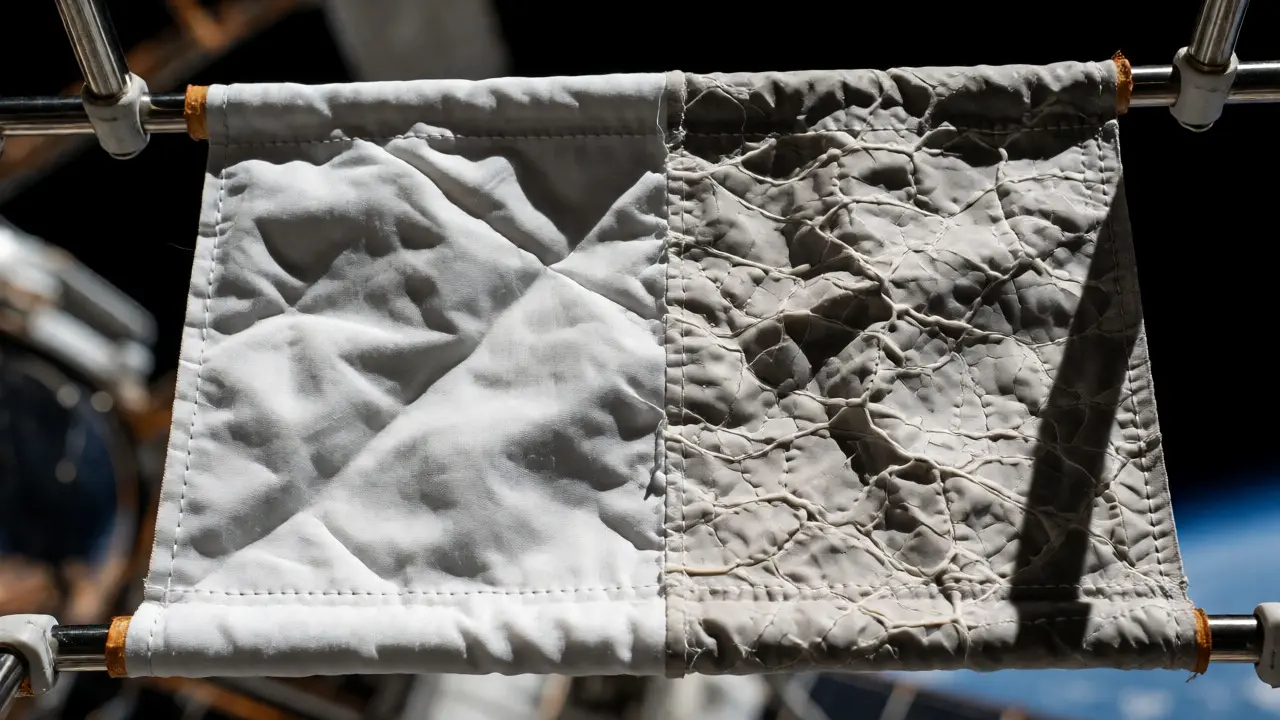
Imagine stepping onto the Moon in a suit that feels brand new when you leave the airlock, but turns brittle, dark, and fragile after just a few hours. That’s not science fiction-it’s the reality of space suit materials aging under extreme conditions. For decades, engineers assumed that if a fabric could survive launch and vacuum, it would hold up on the surface. But recent data from NASA’s Artemis program and earlier Apollo missions prove otherwise. The combination of ultraviolet (UV) radiation and mechanical stress doesn’t just wear down suits; it fundamentally changes their molecular structure, often without obvious visual cues until failure is imminent.
| Factor | Primary Effect | Material Impact |
|---|---|---|
| UV Radiation | Photo-oxidation, chain scission | Embrittlement, discoloration, strength loss |
| Mechanical Fatigue | Cyclic bending, pressure strain | Fiber separation, seam failure, reduced elasticity |
| Lunar Dust | Abrasion, electrostatic adhesion | Rapid thickness loss, fiber fraying |
The Invisible Killer: UV Radiation in Low Earth Orbit and Beyond
You might think space is cold, so things shouldn’t degrade quickly. But solar UV radiation is relentless. Unlike Earth, where the atmosphere filters out most harmful wavelengths, astronauts are exposed to full-spectrum sunlight. This energy breaks chemical bonds in polymer chains, a process called photo-oxidation. It sounds technical, but the result is simple: materials get harder, darker, and weaker.
NASA’s Materials International Space Station Experiment (MISSE) provided hard evidence. Researchers exposed pristine spacesuit fabrics to the harsh environment outside the International Space Station for 18 months. Every sample darkened. More alarmingly, some lost up to 38% of their ability to reflect sunlight. Why does this matter? A darker suit absorbs more heat. If your thermal control system isn’t designed for that extra load, you risk overheating during an EVA. Even worse, the material becomes brittle. One study found that Apollo-era fibers lost four times their ultimate tensile strength after similar exposure. They didn’t tear easily at first glance, but they snapped with far less force than when new.
Different fibers react differently. Kevlar, known for its bulletproof toughness, loses about 12% of its strength under UV exposure. Nomex, used for heat resistance, fades and weakens by nearly 10%. Then there’s Vectran, a high-performance fiber often considered superior for gloves. Under direct UV, unprotected Vectran yarn can completely erode. This shows why you can’t just pick the strongest fiber off the shelf. You need one that survives the light.
Mechanical Fatigue: When Movement Becomes Damage
If UV is the silent killer, mechanical fatigue is the noisy one. Space suits aren’t static shells; they’re complex machines that bend, twist, and stretch. Every time an astronaut raises an arm, kneels, or grips a tool, the fabric undergoes cyclic stress. Over time, this leads to fatigue. Think of it like bending a paperclip back and forth until it snaps. Now imagine doing that while wearing a pressurized balloon that makes every movement harder.
Pressurization adds another layer of complexity. Higher internal pressure increases stiffness. NASA tests comparing 4.3 psi and 6.3 psi operating pressures showed that higher pressure improves safety margins but significantly increases the physical work required from the astronaut. This extra effort translates directly into higher stress on seams, joints, and glove fingertips. Phase VI gloves, currently among the best available, have an operational life rated for only 25 eight-hour EVAs in controlled environments. That number drops drastically when you add real-world variables like dust and temperature swings.
Glove performance is particularly critical because hands do the most intricate work. Repetitive finger flexing causes localized heating and friction. Without proper lubrication or protective coatings, the inner layers rub against each other, generating micro-debris that can contaminate seals or clog joints. Engineers now use "glove-box" testing to simulate these high-tempo activities, measuring how many cycles a glove can withstand before losing dexterity or integrity.
The Lunar Dust Problem: Abrasion Meets Adhesion
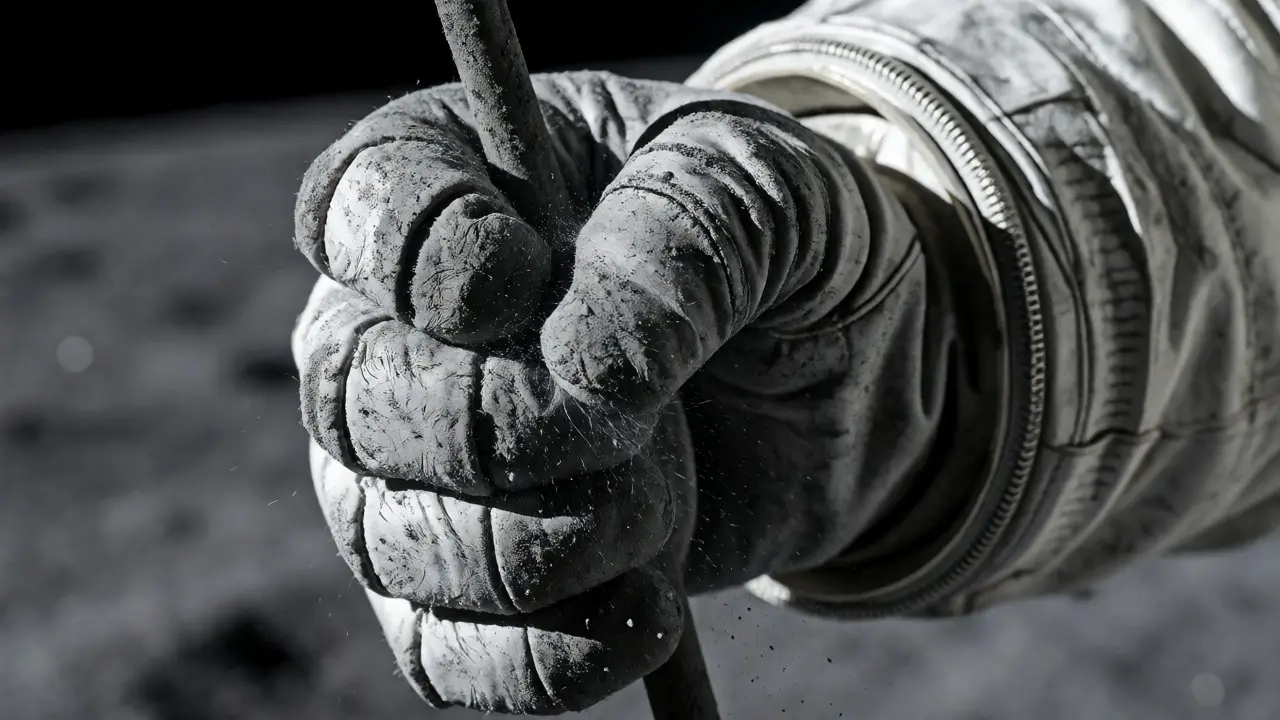
On the Moon, the enemy isn’t just radiation or movement-it’s dirt. Lunar regolith is nothing like Earth soil. It’s sharp, angular, and statically charged. Because there’s no weathering, those grains remain jagged forever. When they get into your suit’s folds, bearings, or zippers, they act like sandpaper. And because they’re electrically attracted to surfaces, they don’t just fall off; they cling.
Apollo astronaut Pete Conrad famously reported that his suit showed more wear after eight hours on the lunar surface than training suits did after 100 hours on Earth. He described wear through the outer layer all the way down to the insulation. Modern simulations confirm this. In accelerated abrasion tests using lunar simulant, Ortho-Fabric-the current standard for outer layers-lost 40% of its tensile strength and 58% of its elongation capacity after just eight hours of tumbling. Cotton, for comparison, lost only 12.6% under the same conditions. This disparity highlights how vulnerable synthetic space fabrics are to abrasive forces.
Microscopy reveals even more disturbing details. Particles as small as 10 micrometers wedge themselves between fibers, separating them and causing fraying. Once a fiber is cut, the structural integrity of the entire weave collapses. Coatings meant to protect the fabric sometimes make things worse. Some ceramic coatings increased abrasion rates because they cracked under flexing, creating new sharp edges that chewed up the underlying textile.
Layered Defense: How Multilayer Suits Manage Risk
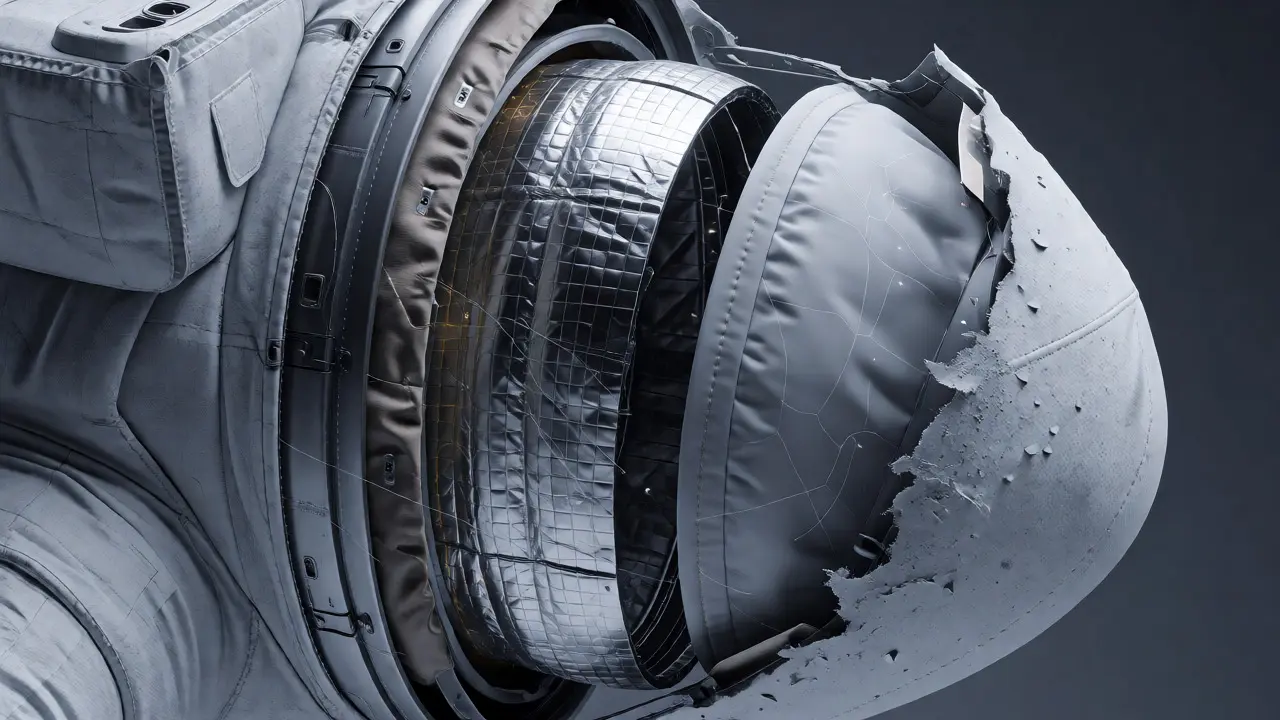
Given these threats, why haven’t we switched to a single super-material? Because no single fiber solves everything. A good space suit is a compromise, built as a multilayer composite. Each layer has a specific job, and redundancy is key.
- Outer Cover: Made from GORE-TEX, Nomex, and Kevlar. Its job is abrasion resistance and thermal reflection. It takes the beating so inner layers don’t have to.
- Thermal Micrometeoroid Garment: Multiple aluminized films separated by spacers. These reflect heat and stop tiny particles from puncturing the pressure bladder.
- Pressure Restraint: Woven fabric that keeps the suit from ballooning too much when inflated.
- Bladder: An airtight rubber-like layer that holds the oxygen.
This architecture allows damage to be contained. If the outer layer gets scratched or UV-damaged, the pressure bladder remains intact. However, this also means that inspection is tricky. You can see tears in the outer cover, but you can’t easily see if the bladder underneath has been weakened by atomic oxygen or microscopic dust penetration. This is why future suits may feature replaceable outer shells. Instead of retiring a whole suit because the cover is worn, astronauts could swap out the sacrificial layer, extending the life of the expensive core components.
Testing Limitations: Why Lab Results Don’t Always Match Reality
One of the biggest challenges in qualifying space suit materials is that we test them in isolation. We expose samples to UV in one chamber, then test their strength. We run abrasion tests in another machine. But in space, these factors happen simultaneously. UV makes fibers brittle, which makes them more susceptible to breaking when bent. Dust creates fresh surfaces that absorb more UV. Thermal cycling expands and contracts materials, opening cracks that let dust in.
NASA’s standardized glove evaluation explicitly excluded combined effects like UV plus atomic oxygen plus dust. This gap means our current lifespan predictions might be optimistic. A material that passes a UV-only test might fail catastrophically when subjected to the same UV dose while being mechanically stressed. Recent studies suggest that sequential testing underestimates damage. A fabric might look fine after UV exposure, but once you start flexing it, the embrittled fibers snap immediately. This interaction effect is hard to model but critical for long-duration missions like Artemis.
The Future: Smarter Materials and Instrumented Suits
So, what’s next? Engineers are moving away from relying solely on initial strength specs. They’re looking at residual performance-how well a material works after it’s been abused. This involves developing UV-stable coatings that don’t crack when flexed. It also means designing better dust mitigation systems, perhaps using electrodynamics to repel charged particles from critical joints.
Another trend is instrumented suits. Imagine sensors woven into the fabric that monitor strain, temperature, and radiation dose in real-time. Instead of guessing when a suit needs retirement, mission control could see exactly how much fatigue each joint has accumulated. This data would feed into predictive maintenance models, allowing for safer, longer EVAs. As we prepare for sustained presence on the Moon and eventually Mars, understanding these aging mechanisms isn’t just academic-it’s a survival requirement.
Why does UV radiation affect space suit materials differently than on Earth?
Earth's atmosphere blocks most harmful UV wavelengths. In space, especially in low Earth orbit or on the Moon, materials face unfiltered, high-intensity solar UV. This causes photo-oxidation, breaking polymer chains and leading to embrittlement and discoloration much faster than terrestrial weathering.
How does lunar dust damage space suits?
Lunar dust particles are sharp, angular, and electrostatically charged. They adhere to suit surfaces and work their way into folds, zippers, and bearings. Their abrasive nature cuts fibers and reduces material thickness, leading to rapid loss of tensile strength and potential breaches in pressure integrity.
Can space suit materials be repaired in space?
Minor repairs are possible using patch kits for the outer layers. However, significant mechanical fatigue or deep abrasion usually requires replacing the entire component or garment. Future designs aim for modular, replaceable outer shells to extend the life of the core pressure-retaining layers.
What is Ortho-Fabric?
Ortho-Fabric is the primary outer material used in NASA's Extravehicular Mobility Unit (EMU). It is a woven blend of GORE-TEX (PTFE), Nomex, and Kevlar. It provides abrasion resistance, thermal stability, and tear protection, though it is susceptible to UV degradation and lunar dust abrasion over time.
How long do modern space suit gloves last?
Current state-of-the-art gloves, such as the Phase VI, have a rated operational life of approximately 25 eight-hour EVAs in controlled environments. This lifespan decreases significantly when exposed to real-world hazards like lunar dust, extreme temperature cycling, and combined UV/mechanical stress.