
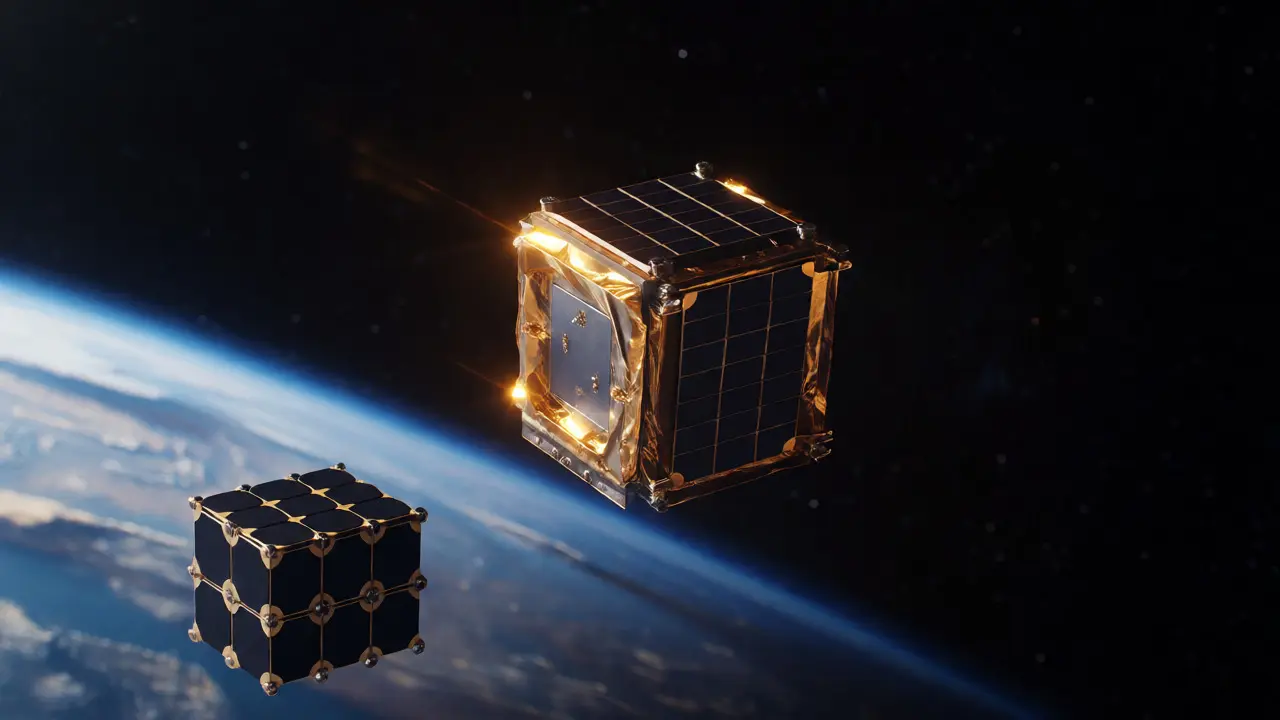
Think you need a billion-dollar budget to do serious astronomy? Think again. While the James Webb Space Telescope grabs headlines with its massive mirror and complex engineering, a quieter revolution is happening in low Earth orbit. CubeSat astronomy uses tiny, standardized spacecraft to answer specific scientific questions that big observatories often ignore or can't afford to chase. These aren't just toys for students; they are precision instruments capable of detecting exoplanet transits, mapping X-ray halos, and monitoring stellar flares. If you're an enthusiast, student, or researcher wondering how science gets done when the bank account is tight, this is your guide to the small-but-mighty world of orbital micro-observatories.
What Exactly Is a CubeSat?
A CubeSat is a miniaturized satellite based on a standard unit called a "U" (unit). One U measures exactly 10 × 10 × 10 centimeters-about the size of a loaf of bread. Most astronomy missions use 6U configurations, which stack six of these units together into a box roughly the size of a shoebox (10 × 20 × 30 cm). This standardization is key. It allows universities and smaller agencies to buy off-the-shelf components, reducing development time from decades to just a few years.
The strategy isn't to replace giants like Hubble or JWST. Instead, it's about specialization. A large telescope might survey the entire sky once every few months. A CubeSat can stare at one specific star system for weeks without interruption. This high-cadence observation is perfect for catching fleeting events, like a planet passing in front of its star or a sudden flare from a red dwarf. The trade-off? You get less light-gathering power and lower resolution, but you gain agility and affordability.
Breaking Down the Costs: Millions, Not Billions
Let's talk numbers, because this is where the magic happens. Traditional flagship missions cost billions. Even "small" conventional satellites often run tens of millions. In contrast, research-grade astrophysics CubeSats typically cost between US$5 million and US$10 million. Some have come in even lower.
| Mission Name | Type | Approximate Cost | Key Achievement |
|---|---|---|---|
| HaloSat | X-ray Surveyor | < $4 Million | Mapped Milky Way's hot gas halo |
| CUTE | UV Spectrograph | $3.3M - $5 Million | Detected atmospheric escape in exoplanets |
| ASTERIA | Photometry Demo | ~$10 Million (est.) | Demonstrated sub-arcsecond stability |
| SPARCS | UV Monitor | Under $10 Million | First dedicated M-dwarf UV monitor (2026) |
These figures include development, integration, and launch access via programs like NASA's CubeSat Launch Initiative (CSLI). For context, HaloSat, a mission studying the Milky Way's hot gaseous halo, cost less than $4 million through its first year of operations. That’s a rounding error compared to major observatories. This affordability opens doors for institutions that previously couldn't compete in the space race.
Real Science: From X-rays to Exoplanets
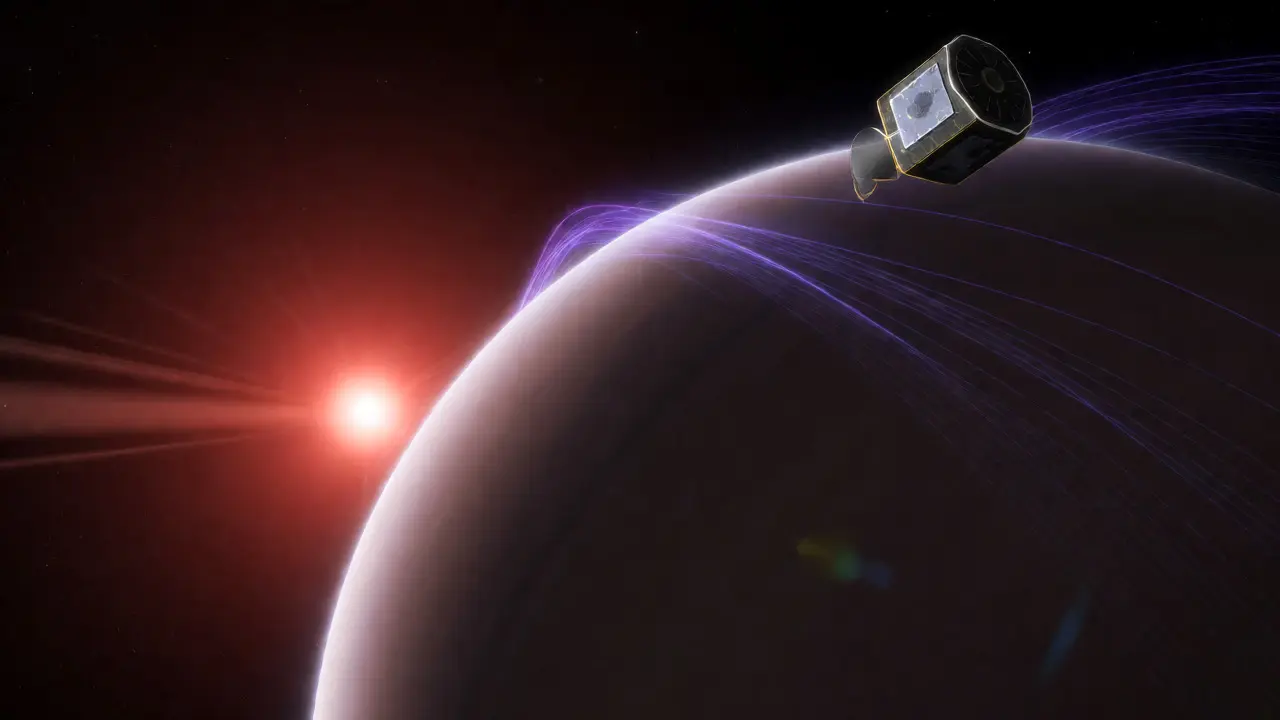
Skepticism is natural. Can a shoebox really do science? The evidence says yes. Look at CUTE (Colorado Ultraviolet Transit Experiment). Launched in 2021, this 6U spacecraft uses near-ultraviolet spectroscopy to study close-in giant exoplanets. By watching planets transit their stars, CUTE detects heavy elements escaping into space. For the planet WASP-189b, CUTE found magnesium ions flying away from the planet, proving that ultraviolet observations from space can reveal atmospheric dynamics invisible from the ground due to Earth's ozone layer blocking those wavelengths.
Then there's HaloSat. Operating from 2018 to 2021, it surveyed the sky in soft X-rays. It didn't take pretty pictures; it measured diffuse emission from the galaxy's hot gas halo. It produced a complete archive of 415 fields and contributed to seven refereed papers. It proved that a small detector, if placed correctly and operated long enough, can solve fundamental questions about galactic structure.
And let's not forget ASTERIA. This mission was a technology demonstrator, but it crossed a line. It achieved pointing stability better than 0.5 arcseconds over 20 minutes. Why does that matter? Because detecting an exoplanet transit requires spotting a tiny dip in brightness. ASTERIA managed to detect a marginal transit signal for the super-Earth 55 Cancri e. It wasn't a definitive discovery on its own, but it proved that miniaturized optics and thermal control could achieve the precision needed for photometry.
The New Frontier: SPARCS and Stellar Activity
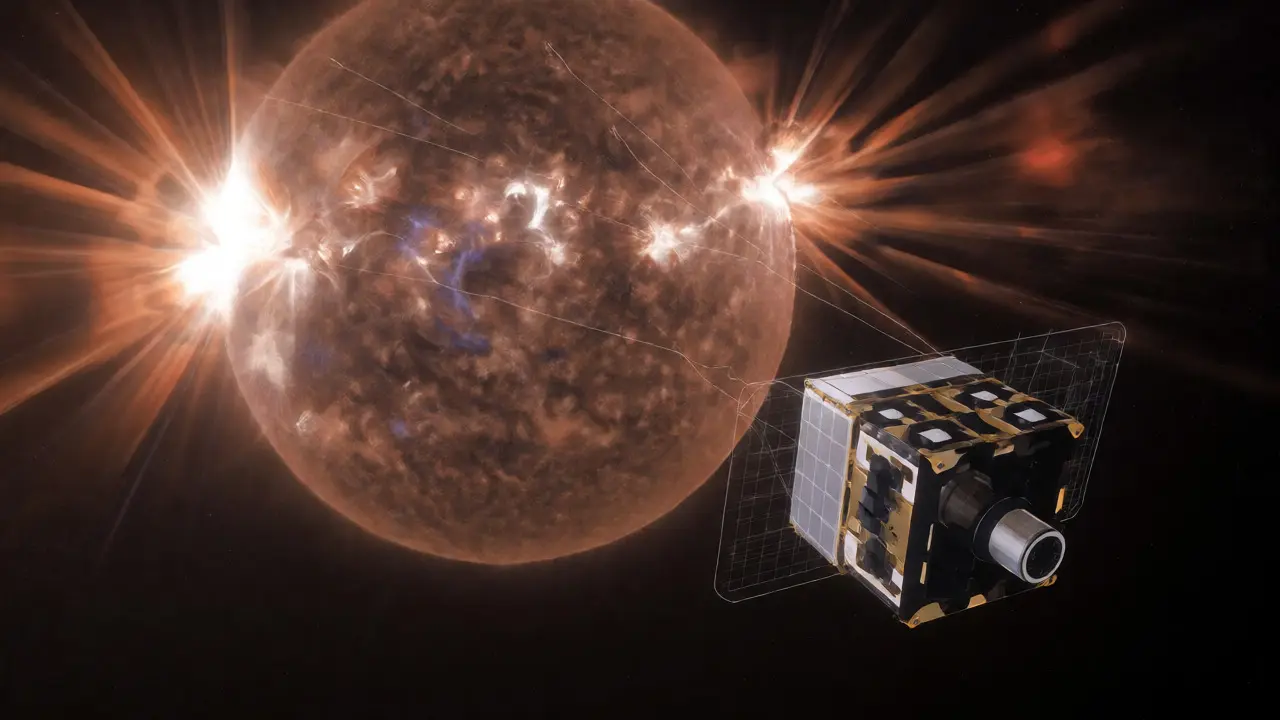
In January 2026, SPARCS (Star-Planet Activity Research CubeSat) launched. Its goal is distinct: monitor low-mass M- and K-type stars. These stars are common hosts for potentially habitable planets, but they are also prone to violent flares. Ground-based telescopes struggle here because many of these stars are faint in visible light, and crucial UV data is blocked by our atmosphere.
SPARCS carries two detectors to watch these stars in both far-ultraviolet and near-ultraviolet bands simultaneously. By tracking stellar activity over months, scientists can better understand the radiation environment surrounding exoplanets. Did a flare strip away a planet's atmosphere? SPARCS helps answer that. As of October 2026, it is actively collecting data, marking the beginning of a new era in continuous stellar monitoring.
Limitations: What CubeSats Can't Do
It's not all sunshine and low costs. Physics is unforgiving. A small aperture means fewer photons. You can't see faint galaxies or resolve fine details on distant nebulae. The National Academies warned back in 2016 that aperture and pointing limits cap what CubeSats can achieve. You won't find deep-field surveys or high-resolution imaging on these platforms.
Power and communication are also bottlenecks. A 6U satellite has limited battery capacity and a small antenna. Downloading large datasets takes time. Thermal control is another headache; keeping detectors cold and stable in the harsh vacuum of space requires clever engineering, as seen in ASTERIA's success. If your science question requires a huge mirror, wide spectral coverage, or massive data throughput, a CubeSat is likely the wrong tool.
How to Get Involved or Understand the Pipeline
If you're wondering how these projects happen, it's a multidisciplinary effort. Teams must define a precise science goal, design an instrument that fits within strict mass and volume constraints, and build a spacecraft that can point steadily enough. Programs like NASA's CSLI provide launch opportunities for educational and nonprofit groups. The process usually involves proposing a mission in November for potential launch slots released around August.
For enthusiasts, following these missions offers a front-row seat to agile science. You don't need a PhD to appreciate the elegance of solving a specific problem with minimal resources. These missions prove that innovation often comes from constraint. When you limit the budget, you force creativity. And sometimes, that creativity leads to discoveries that billion-dollar machines miss simply because they were looking elsewhere.
Why are CubeSats cheaper than traditional satellites?
CubeSats use standardized sizes (like 1U or 6U), allowing teams to buy commercial off-the-shelf parts instead of custom-building everything. They also often launch as secondary payloads on rockets carrying larger primary satellites, significantly reducing launch costs.
Can CubeSats discover new exoplanets?
Yes, but with caveats. Missions like ASTERIA have detected transit signals, but CubeSats generally lack the sensitivity to discover faint or distant planets routinely. They excel at characterizing known bright targets or conducting targeted surveys rather than broad blind searches.
What is the main advantage of space-based UV astronomy?
Earth's atmosphere absorbs most ultraviolet radiation. Ground-based telescopes cannot observe these wavelengths. Space-based CubeSats like CUTE and SPARCS can access UV data, which is critical for studying stellar flares and planetary atmospheres.
How long do CubeSat astronomy missions last?
Typical lifetimes range from one to three years. Factors like battery degradation, orbital decay, and component reliability dictate longevity. For example, HaloSat operated for about two years before re-entering the atmosphere.
Do universities actually build these satellites?
Yes. Many CubeSat astronomy missions, such as CUTE and SPARCS, are led by university teams (University of Colorado Boulder and Arizona State University, respectively). Students and faculty handle design, testing, and operations.