
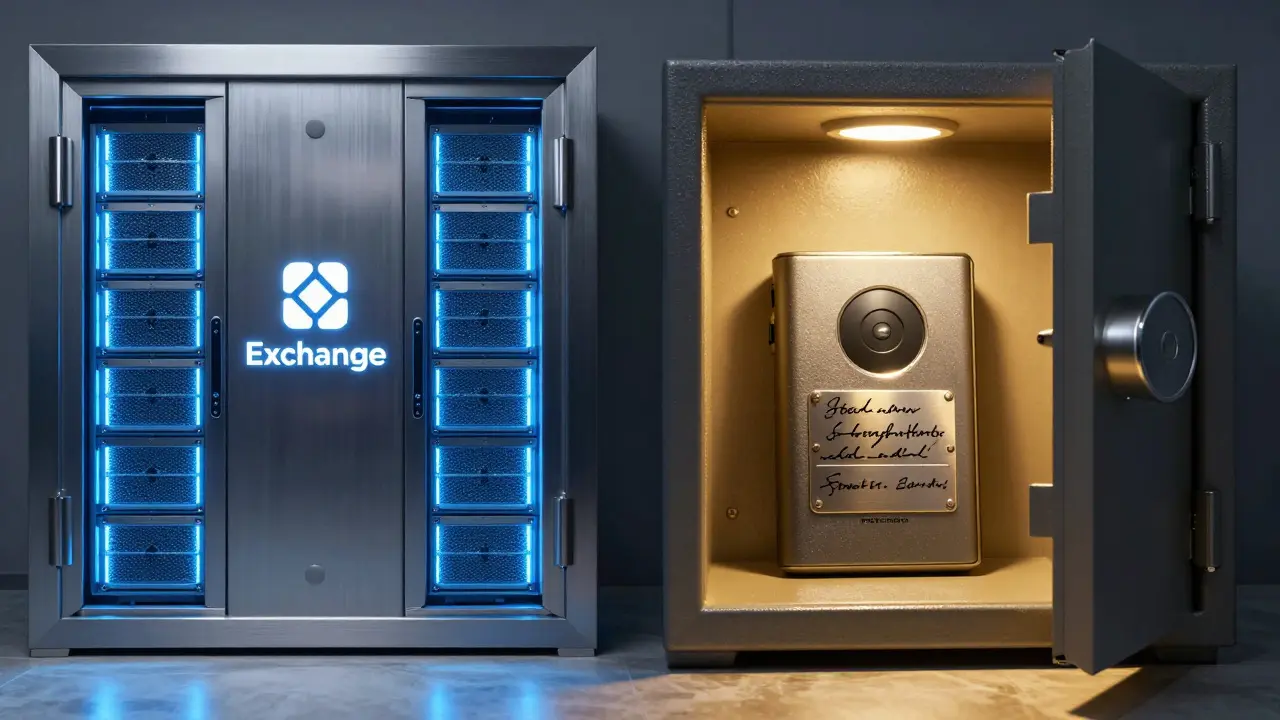
Remember the phrase "Not your keys, not your coins"? It’s more than just a catchy slogan in the cryptocurrency world; it is the fundamental rule of ownership. When you leave your digital assets on an exchange, you are essentially asking a company to hold your money for you. If that company fails, gets hacked, or decides to freeze your account, your access to those funds vanishes instantly. This reality became painfully clear to millions after the collapse of FTX in late 2022 and earlier disasters like Mt. Gox. Today, in 2026, the choice between keeping your crypto on an exchange or moving it to self-custody is no longer just about technical preference-it is about financial survival.
You face two distinct paths for storing your digital wealth. On one side, you have exchange storage, which offers convenience and ease but comes with significant counterparty risk. On the other, you have self-custody, which gives you total control and privacy but demands that you take full responsibility for your own security. The right choice depends entirely on what you plan to do with your crypto, how much you hold, and how comfortable you are with managing your own security protocols.
Understanding the Core Difference: Who Holds the Keys?
To make an informed decision, you first need to understand the mechanics behind these two models. The difference boils down to one thing: private keys. A private key is a complex string of characters that acts as the password to your cryptocurrency wallet. Whoever holds the private key controls the funds. There is no bank manager to call if you lose it, and there is no central ledger that can reverse a transaction.
In an custodial wallet (provided by exchanges like Coinbase or Binance), the platform generates and stores the private keys for you. You interact with the exchange using a username and password, but the actual crypto sits in their vaults. They manage the security, handle the backups, and process the transactions. It works exactly like a traditional bank account. You trust them to keep your money safe and available when you ask for it.
In contrast, a non-custodial wallet (self-custody) means you generate and store the private keys yourself. These keys live on your device-whether it’s a smartphone app, a desktop program, or a dedicated hardware device. No third party has access to your funds. You are the bank. You are the security team. You are the customer support. This model aligns with the original philosophy of Bitcoin and blockchain technology: decentralization and personal sovereignty.
| Feature | Exchange Storage (Custodial) | Self-Custody (Non-Custodial) |
|---|---|---|
| Private Key Control | Held by the exchange | Held by you |
| Recovery Options | Password reset via email/support | Seed phrase backup only (no recovery service) |
| Counterparty Risk | High (exchange bankruptcy/hack) | None (you are the custodian) |
| User Responsibility | Low (platform handles security) | High (you manage all security) |
| Privacy | Low (KYC/AML data collection) | High (no personal data required) |
| Best For | Active trading, beginners | Long-term holding, large amounts |
The Risks of Leaving Crypto on Exchanges
It is tempting to leave your crypto on an exchange because it is easy. You can buy, sell, and trade with a few clicks. However, this convenience comes with hidden dangers that many users ignore until it is too late. The primary risk is counterparty risk. This means you are exposed to the financial health and security practices of the institution holding your assets.
Exchanges are prime targets for hackers. Even the most secure platforms can suffer breaches. When Coincheck was hacked in 2018, over $530 million worth of NEM tokens were stolen. While some exchanges have insurance, coverage is often limited and claims can be denied based on fine print. More dangerously, exchanges can fail due to mismanagement or fraud. The collapse of FTX showed that even top-tier platforms can vanish overnight, leaving users with nothing but worthless IOUs.
Beyond hacks and bankruptcies, exchanges operate under regulatory scrutiny. They must comply with Know Your Customer (KYC) and Anti-Money Laundering (AML) laws. This means they collect your personal data, including government ID and proof of address. In extreme cases, governments can force exchanges to freeze accounts belonging to specific individuals or regions. If your funds are on an exchange, you have no recourse. The exchange controls the tap. With self-custody, no one can freeze your assets unless they physically steal your private keys.
The Power and Responsibility of Self-Custody
Choosing self-custody means taking back control. According to recent surveys, over 56% of cryptocurrency users now prefer managing their own holdings through self-custody wallets. This shift reflects a growing awareness of the risks associated with centralized platforms. When you use a non-custodial wallet, you eliminate counterparty risk entirely. Your assets exist on the blockchain, secured by cryptography, not by a company’s balance sheet.
However, this power comes with a heavy burden: responsibility. In the world of self-custody, there is no "forgot password" button. If you lose your seed phrase (also known as a recovery phrase), your crypto is gone forever. There is no customer support line to call. No IT department to restore your account. The network does not know who you are, and it does not care if you lost access. This permanence is both its greatest strength and its greatest danger.
Self-custody also offers superior privacy. Since you do not need to provide personal identification to use a non-custodial wallet, your financial activities remain anonymous. Transactions are visible on the public blockchain, but they are not linked to your name or identity unless you voluntarily connect them. This level of privacy is invaluable for individuals living in unstable economies or those who simply value financial autonomy.

Types of Self-Custody Wallets: Hot vs Cold
Not all self-custody solutions are created equal. Understanding the difference between hot and cold wallets is crucial for securing your assets effectively.
Hot wallets are software-based wallets connected to the internet. Examples include mobile apps like Trust Wallet or MetaMask, and desktop applications. They are convenient for frequent transactions, interacting with decentralized applications (dApps), and managing smaller amounts of crypto. However, because they are online, they are vulnerable to malware, phishing attacks, and device theft. If your phone or computer is compromised, your keys could be at risk.
Cold wallets, or hardware wallets, are physical devices designed to store private keys offline. Brands like Ledger and Trezor are industry standards. These devices never expose your private keys to the internet. When you sign a transaction, the device processes it internally and sends only the signed transaction to the network. This makes them immune to remote hacking attempts. For long-term holders (often called "HODLers") and anyone storing significant value, a hardware wallet is the gold standard of security.
Cost Considerations: Fees and Economics
Money matters. Let’s look at the economics of each approach. Exchanges charge various fees: trading fees, withdrawal fees, and sometimes deposit fees. Withdrawal fees can be particularly high, especially during periods of network congestion. If you move your crypto from an exchange to a self-custody wallet, you pay this fee once. After that, you only pay network fees (gas fees) when you transact.
Network fees vary by blockchain. Moving Bitcoin can cost tens of dollars during peak times, while moving assets on Solana or Polygon costs fractions of a cent. For active traders who make dozens of transactions a day, staying on an exchange might seem cheaper initially because they avoid withdrawal fees. However, for long-term holders, the cumulative cost of exchange fees and the risk of asset loss far outweigh the occasional network fee paid in self-custody.
Moreover, self-custody eliminates custodial fees. Some institutional custodians charge annual percentages of assets under management. Retail self-custody is free, aside from the initial cost of a hardware wallet (typically $50-$150).
A Hybrid Strategy for Most Users
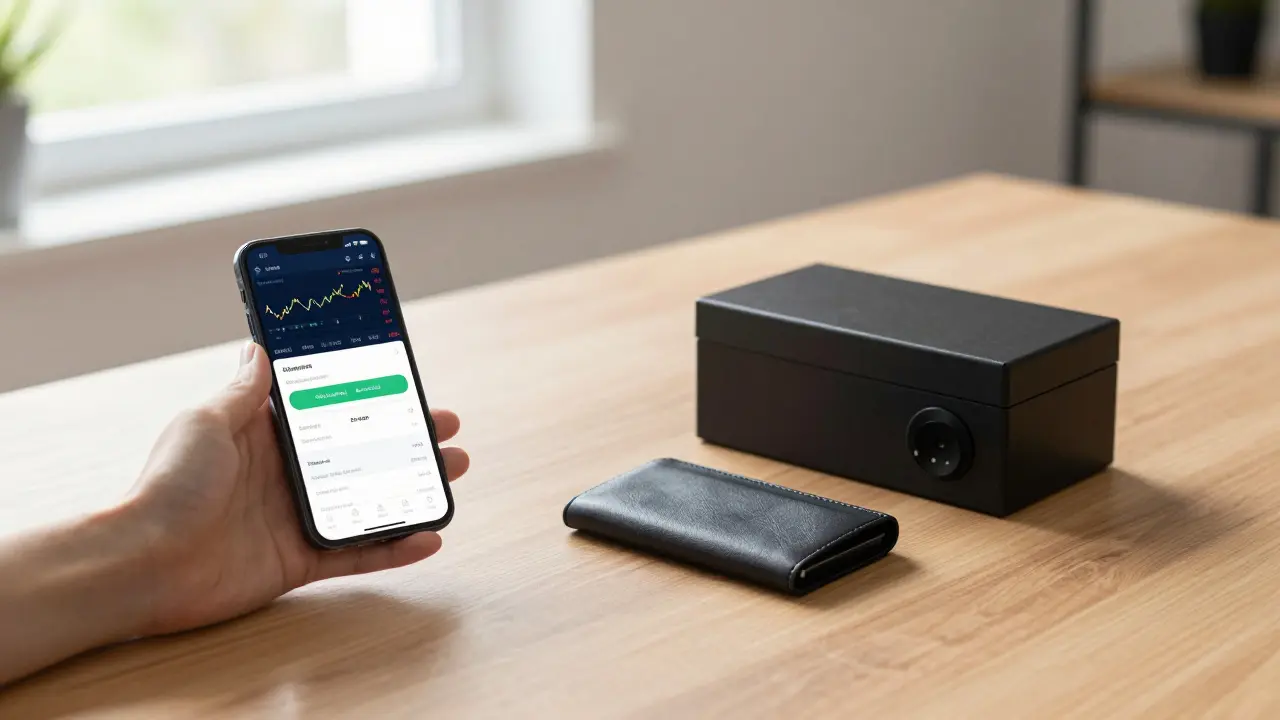
You do not have to choose one method exclusively. In fact, the most prudent strategy for most people in 2026 is a hybrid approach. Think of your exchange account like a checking account and your self-custody wallet like a safe deposit box.
Keep only the amount of crypto you intend to trade actively on the exchange. This minimizes your exposure to counterparty risk while allowing you to react quickly to market movements. Once you have made profits or accumulated holdings you plan to keep for months or years, withdraw them to a self-custody wallet. This ensures that the majority of your portfolio is protected from exchange failures, hacks, and regulatory freezes.
This strategy balances convenience with security. It allows you to participate in the dynamic crypto economy without gambling your entire net worth on the integrity of a third-party platform.
Essential Security Practices for Self-Custody
If you decide to move toward self-custody, you must adopt strict security habits. Here are the non-negotiable rules:
- Write down your seed phrase manually. Never store it digitally. Do not take a photo of it. Do not save it in a cloud note. Use pen and paper, or better yet, metal backup plates that resist fire and water damage.
- Store backups securely. Keep your seed phrase in a safe location, such as a home safe or a safety deposit box. Consider splitting backups across multiple secure locations to protect against house fires or theft.
- Buy hardware wallets directly from manufacturers. Never purchase used devices from third parties. A used wallet could have been tampered with to steal your keys.
- Verify every transaction. Always double-check recipient addresses on the hardware device screen before signing. Phishing sites can mimic legitimate interfaces, so always confirm details on the trusted device.
- Keep software updated. Regularly update your wallet apps and firmware to patch any potential security vulnerabilities.
Learning these skills takes time, but the payoff is absolute ownership of your assets. The learning curve is steep, but resources are abundant. Many modern wallets offer intuitive interfaces that guide you through the setup process step-by-step.
Conclusion: Taking Back Control
The debate between self-custody and exchange storage is not just technical; it is philosophical. It asks whether you want to rent access to your money or own it outright. While exchanges provide a user-friendly gateway into the crypto world, they should not be your final destination. As the industry matures, the expectation is shifting: serious investors are expected to manage their own keys.
Start small. Buy a hardware wallet. Move a modest amount of crypto to test the process. Learn how to back up your seed phrase. Once you feel confident, gradually shift your long-term holdings out of custodial hands. In the volatile world of cryptocurrency, true security comes from independence. By mastering self-custody, you ensure that your financial future remains in your control, regardless of what happens to the platforms around you.
Is it safer to keep crypto on an exchange or in a self-custody wallet?
For long-term holdings, self-custody is significantly safer because it eliminates counterparty risk. Exchanges are vulnerable to hacks, bankruptcy, and regulatory freezes. Self-custody puts you in full control, though it requires you to manage your own security properly.
What happens if I lose my seed phrase?
If you lose your seed phrase, your crypto is permanently inaccessible. There is no way to recover it. Unlike a bank account, there is no customer support to help you reset access. This is why creating multiple secure backups is critical.
Can I use a self-custody wallet for daily spending?
Yes, but it is less convenient than an exchange. Hot wallets (software wallets) are suitable for daily transactions, but you must be cautious of phishing and malware. For larger sums, hardware wallets are recommended but may be slower to use for quick payments.
Do I need KYC to use a self-custody wallet?
No. Self-custody wallets do not require Know Your Customer (KYC) verification. You can create a wallet anonymously. However, buying crypto with fiat currency usually involves an exchange that requires KYC, so you will need to transfer the funds after purchase.
Which hardware wallets are best for beginners in 2026?
Ledger and Trezor are the most widely trusted brands. Both offer user-friendly companion apps and strong security features. Look for models with touchscreen interfaces and open-source firmware for added transparency.