
You buy a token on a blockchain. You think you’re buying the next big thing in decentralized finance. But then a regulator steps in and says, "Actually, that’s a stock." Suddenly, your investment isn’t just code; it’s a legal instrument subject to federal laws. This is the moment when crypto becomes a security. It’s not about the technology itself. It’s about what that technology represents.
As of mid-2026, the line between a utility token and a security token, which is a blockchain-based digital certificate representing legally protected asset rights such as shares, bonds, or real estate interests, is clearer than ever. Regulators like the U.S. Securities and Exchange Commission (SEC) have made it plain: if a token promises profit, ownership, or dividends, it’s likely a security. This distinction changes everything for investors and issuers alike.
What Exactly Is a Security Token?
To understand why some tokens get regulated while others don’t, you first need to know what a security token actually is. Unlike Bitcoin, which acts as digital cash, or Ethereum, which powers apps, a security token is a digitized version of a traditional financial asset. Think of it as a share of stock, a bond, or a piece of real estate, but recorded on a blockchain instead of in a paper ledger.
Security tokens are digital representations of ownership or economic rights in regulated financial instruments like equity, debt, or commodities. They function as "digital wrappers" around real-world claims. If you hold a security token for a company, you might be entitled to voting rights or a slice of the profits. If it’s tied to real estate, you might receive rental income distributions. The key difference from other cryptocurrencies is that these rights are enforceable by law.
This brings us to the core question: when does a crypto asset cross the line? The answer lies in the nature of the rights attached to the token. If the token grants access to a service, it’s usually a utility token. If it grants a claim on future value or revenue, it’s a security token.
The Legal Test: How Regulators Decide
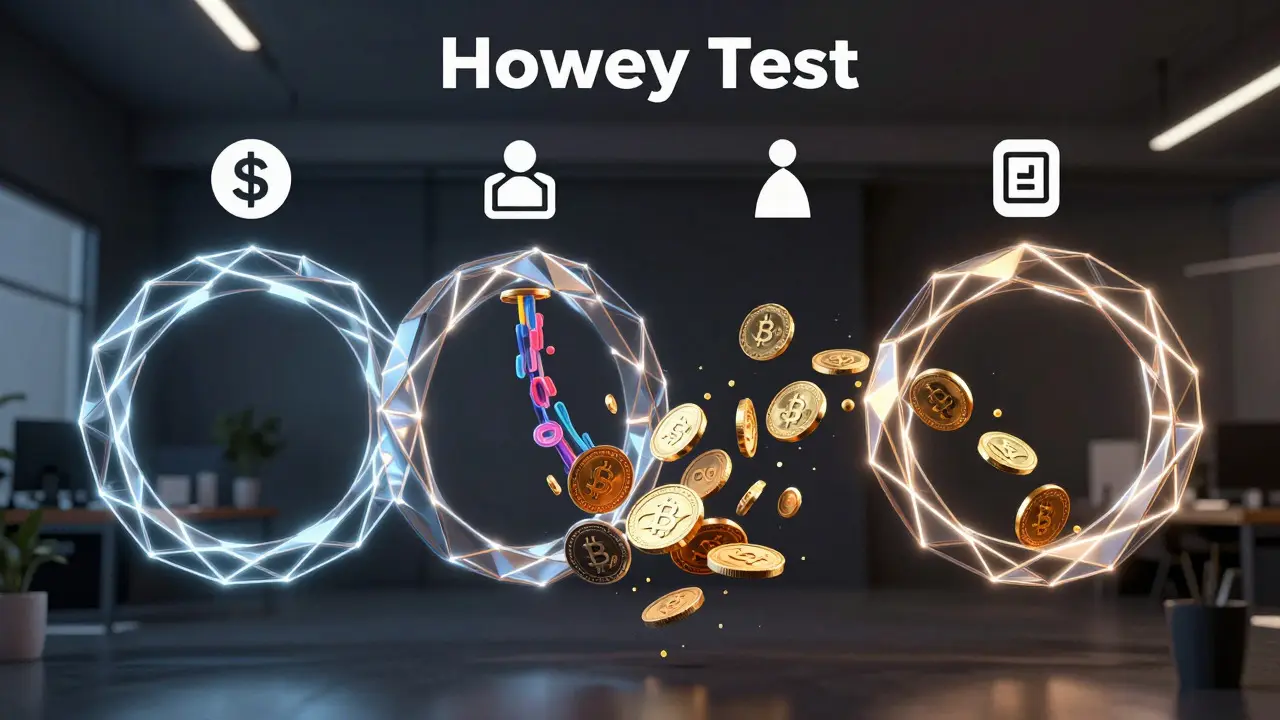
Regulators don’t guess whether something is a security. They use established legal tests. In the United States, the primary tool is the Howey Test, which is a legal framework used to determine if an arrangement constitutes an investment contract under federal securities laws. Created by a Supreme Court case in 1946, this test asks four questions:
- Is there an investment of money?
- Is there a common enterprise?
- Is there an expectation of profit?
- Does that profit come from the efforts of others?
If the answer to all four is yes, the asset is a security. Most initial coin offerings (ICOs) from the early 2010s failed this test because they promised returns based on the development team’s work. Today, with the rise of tokenization, which is the process of converting rights to an asset into a digital token on a blockchain, regulators apply this same logic to new projects. The SEC has clarified that formatting a security as a crypto asset doesn’t exempt it from registration.
This means that even if your token runs on a decentralized network, if it behaves like a stock, it must follow stock market rules. Issuers must register the offering, provide detailed disclosures, and often restrict sales to accredited investors-those with high net worth or income levels.
Why Companies Are Turning to Security Tokens
If regulation sounds burdensome, why would any company choose to issue security tokens? The answer is efficiency and access. Traditional capital markets are slow, expensive, and fragmented. Selling a bond or issuing private equity can take months and involve armies of lawyers and bankers. Security tokens can streamline this process significantly.
Here are the main advantages driving adoption in 2026:
- Faster Settlement: Traditional trades settle in two days (T+2). Blockchain transactions can settle in seconds or minutes, reducing counterparty risk.
- Fractional Ownership: High-value assets like commercial real estate or fine art can be split into thousands of small tokens. This allows smaller investors to participate in markets previously reserved for the wealthy.
- Programmable Compliance: Smart contracts can automatically enforce rules. For example, a token can be coded to prevent transfer to unaccredited investors or to automatically distribute dividends to holders.
- Liquidity: Private assets like venture capital stakes or private debt are notoriously illiquid. Security token platforms aim to create secondary markets where these assets can be traded more easily.
For issuers, this means lower costs and broader investor reach. For investors, it means access to diversified portfolios with lower minimum investments.
Security Tokens vs. Utility Tokens: A Clear Comparison
Confusion between these two types of tokens still causes headaches for many participants. To help clarify, here is a direct comparison of their characteristics.
| Feature | Security Token | Utility Token |
|---|---|---|
| Purpose | Investment, ownership, income | Access to services, platform usage |
| Legal Status | Subject to securities laws | Generally not regulated as securities |
| Value Driver | Underlying asset performance | Network demand and utility |
| Transferability | Often restricted (KYC/AML required) | Usually open and permissionless |
| Example | Tokenized Tesla shares | Ethereum (ETH) for gas fees |
Notice that utility tokens are like arcade tickets. You buy them to play games on a specific machine. Security tokens are like stocks. You buy them hoping the company grows and pays you back. The regulatory treatment follows this functional difference.
The Regulatory Landscape in 2026
The year 2026 marks a turning point for digital securities. After years of ambiguity, major jurisdictions are establishing clear frameworks. In the U.S., the SEC continues to enforce existing laws rather than creating new ones, treating crypto assets through the lens of traditional securities statutes. This approach provides stability but demands strict compliance.
Internationally, the trend is similar. The European Union’s Markets in Crypto-Assets (MiCA) regulation provides a unified rulebook for crypto assets, distinguishing clearly between e-money tokens, asset-referenced tokens, and those that qualify as securities. Countries like Singapore and Switzerland have long been friendly to fintech innovation, offering sandboxes where companies can test security token offerings under supervision.
One critical development is the rise of specialized infrastructure. Networks like Polymesh and Securitize are built specifically for security tokens. They embed identity verification and compliance checks directly into the protocol. This makes it harder to accidentally trade a security illegally, as the blockchain itself prevents unauthorized transfers.

Risks and Challenges for Investors
Despite the benefits, security tokens are not without risks. Because they represent real-world assets, they carry the same fundamental risks as traditional investments. If the underlying company fails, the token loses value. If the real estate market crashes, the tokenized property drops in price.
Additionally, there are technical and operational risks:
- Custody Issues: Who holds your tokens? If the custodian goes bankrupt or gets hacked, your assets could be at risk. Institutional-grade custody solutions are essential.
- Liquidity Risk: While secondary markets are growing, they are still nascent. You might find it difficult to sell a niche security token quickly without affecting its price.
- Regulatory Uncertainty: Laws are evolving. A token classified as a security today might face new reporting requirements tomorrow. Staying compliant requires ongoing effort.
Investors should treat security tokens with the same caution as private equity or hedge fund investments. Due diligence is non-negotiable. Read the prospectus. Understand the underlying asset. Know who the issuer is.
How to Get Started with Security Tokens
If you’re ready to explore this space, here is a practical roadmap:
- Verify Your Status: Determine if you are an accredited investor. Many security token offerings are restricted to this group due to regulatory exemptions.
- Choose a Reputable Platform: Use established security token exchanges or issuance platforms that perform thorough Know Your Customer (KYC) and Anti-Money Laundering (AML) checks.
- Analyze the Asset: Look beyond the blockchain hype. Evaluate the financial health of the issuing entity, the quality of the underlying collateral, and the legal structure of the offering.
- Secure Your Wallet: Ensure your digital wallet supports the specific token standards used by the project (often ERC-1400 or similar). Consider using hardware wallets for added security.
- Monitor Compliance: Keep track of tax obligations and reporting requirements. Security tokens generate taxable events like dividends and capital gains, just like traditional securities.
The bridge between traditional finance and blockchain is being built one token at a time. By understanding the legal definitions and practical implications, you can navigate this emerging market with confidence.
Are all cryptocurrencies considered securities?
No. Only tokens that meet the definition of an investment contract under laws like the Howey Test are considered securities. Assets like Bitcoin and Litecoin are generally viewed as commodities or currencies, while tokens promising profit from the efforts of others are likely securities.
Can I trade security tokens on regular crypto exchanges?
Typically, no. Most public exchanges like Binance or Coinbase avoid listing unregistered securities to avoid legal trouble. Security tokens are usually traded on specialized platforms that verify investor accreditation and enforce compliance rules.
What is the difference between a security token and a stablecoin?
A stablecoin is pegged to a fiat currency like the US Dollar to maintain a stable value. A security token represents ownership in an asset or company and fluctuates in value based on the performance of that underlying asset. Stablecoins are primarily for payments; security tokens are for investment.
Do I need to be an accredited investor to buy security tokens?
In many cases, yes. Under US Regulation D, most private security token offerings are limited to accredited investors. However, some offerings under Regulation A+ or Regulation S may allow retail participation, depending on the jurisdiction and specific exemption used.
How are security tokens taxed?
Taxation varies by country but generally mirrors traditional securities. In the US, receiving dividends from a security token is taxable income. Selling the token for a profit triggers capital gains tax. Consult a tax professional familiar with digital assets for accurate advice.