
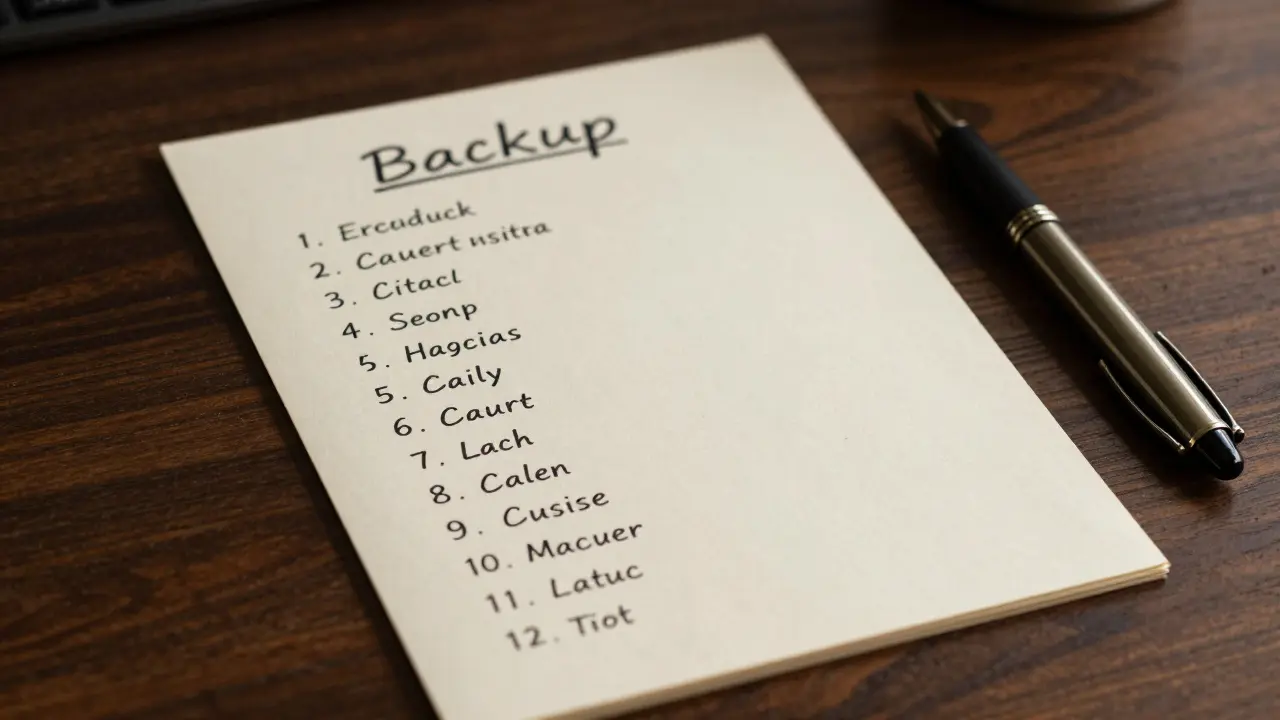
Imagine waking up to find your laptop fried or your phone stolen. If your digital assets are stored in a basic app, that's a panic-inducing scenario. But if you have a 12 to 24-word list scribbled on a piece of paper in a safe, you're essentially untouched. This is the power of the mnemonic phrases, the invisible backbone of the cryptocurrency security stack.
Most people think of a crypto wallet as a place that "holds" coins. In reality, your coins live on the blockchain; the wallet just holds the keys. If you lose those keys, your funds are gone forever. There is no "Forgot Password" button in decentralized finance. That is why understanding the relationship between seed phrases and physical hardware is the only way to ensure you actually own your money.
The Quick Rundown on Key Security
- Seed Phrases: Human-readable backups of your master private key.
- Hardware Wallets: Devices that keep your keys offline (cold storage).
- BIP-39: The industry standard that makes your words compatible across different wallet brands.
- Entropy: The randomness that ensures no two people generate the same phrase.
What Exactly is a Mnemonic Phrase?
A Mnemonic Phrase is a sequence of 12 to 24 randomly generated words that acts as a master key for your cryptocurrency wallet. Instead of forcing you to memorize a terrifying string of 64 alphanumeric characters (a raw private key), the system converts that data into simple words from a specific list.
This process is governed by BIP-39 (Bitcoin Improvement Proposal 39). Think of BIP-39 as the universal dictionary for crypto backups. Because most wallets follow this rule, you can take a phrase generated on one device and enter it into a completely different brand of wallet to recover your funds. It's the gold standard that prevents you from being locked into a single software provider.
When you set up a wallet, the software uses a secure entropy source-essentially a high-tech digital coin flip-to pick words from a list of 2,048 possibilities. A 12-word phrase provides 128 bits of entropy, while a 24-word phrase bumps that up to 256 bits. To put that in perspective, guessing a 24-word phrase is mathematically harder than winning the lottery every single day for a year.
How Hardware Wallets Change the Game
If you keep your keys on a phone or laptop, you're using a "hot wallet." Since these devices touch the internet, they are targets for malware and hackers. This is where Hardware Wallets come in. These are dedicated physical devices, like those made by Ledger or Trezor, that operate in a completely offline environment.
The magic happens inside a secure chip. The hardware wallet generates your mnemonic phrase offline and never lets it leave the device. When you want to send Bitcoin or Ethereum, you don't "upload" your key to the internet to sign the transaction. Instead, the device signs the transaction internally and only sends the finished "approval" back to your computer. Your private keys never touch the web, making it nearly impossible for a remote hacker to steal your funds.
| Feature | Hot Wallet (Software) | Hardware Wallet (Cold) |
|---|---|---|
| Key Storage | Online (Internet-connected) | Offline (Secure Chip) |
| Attack Vector | Phishing, Malware, OS hacks | Physical theft of device/phrase |
| Convenience | High (Instant access) | Medium (Requires physical device) |
| Security Level | Moderate to Low | Very High |
The Danger of the "Brain Wallet"
Some users try to be clever by creating their own mnemonic phrases using a favorite poem, a song lyric, or a sequence of words they think is random. This is called a "brain wallet," and it is a recipe for disaster. Humans are terrible at being random. We have patterns, and hackers have software that can guess those patterns in milliseconds.
A wallet-generated mnemonic is truly random. A brain wallet is predictable. There are bots that constantly scan the blockchain for funds stored in phrases based on famous books or common phrases. If you "invent" your own seed, you aren't adding security-you're creating a backdoor for thieves.
Pro Tactics for Storing Your Phrase
Since your mnemonic phrase is the single point of failure for your wealth, how you store it is more important than which wallet you buy. If you lose your device, the phrase saves you. If someone steals the phrase, the device is useless because they already have your money.
First, forget digital storage. No screenshots, no Notes apps, no emails, and definitely no "hidden" files on your desktop. If it's on a device that connects to Wi-Fi, it's not secure. Instead, use analog methods:
- Paper Backups: Write the phrase clearly on paper. Store it in a fireproof safe or a bank deposit box.
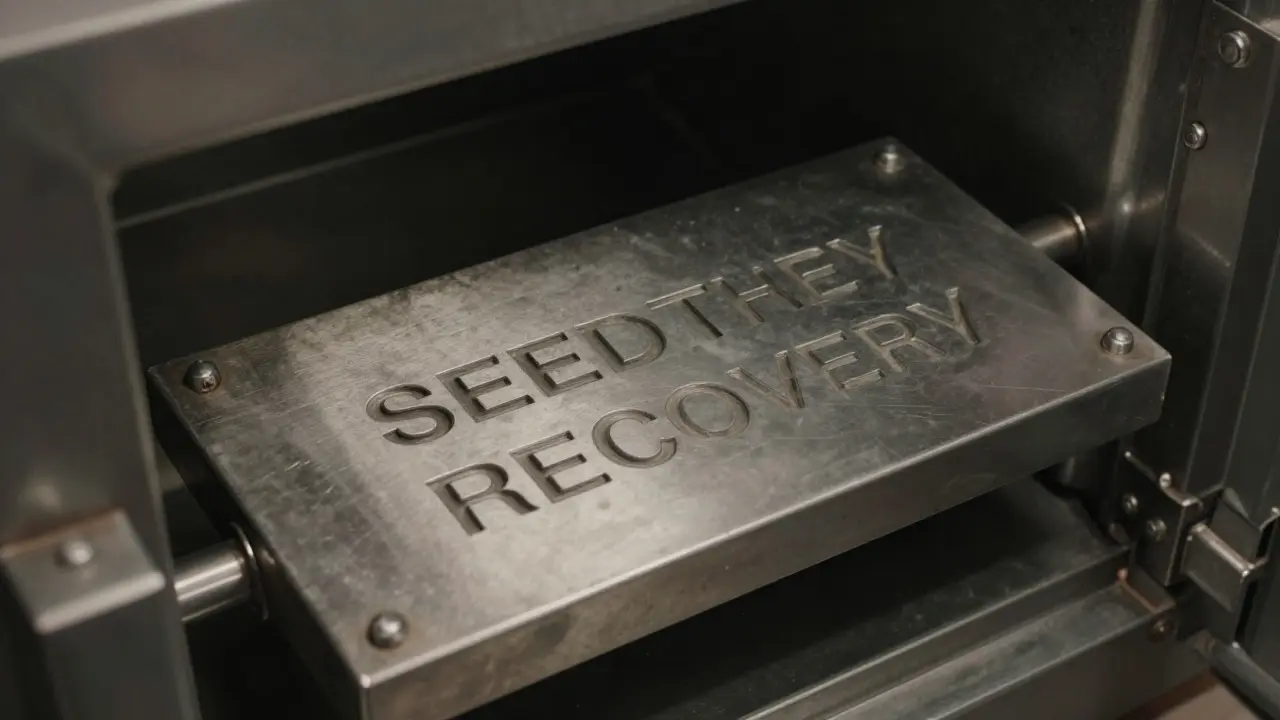
- Metal Plates: Paper burns and ink fades. Many pros use stainless steel or titanium plates where the words are engraved or punched in. These can survive a house fire or a flood.
- The 25th Word: Some wallets allow an optional "passphrase." This acts as a secondary password. Even if someone finds your 24 words, they still can't access the funds without this extra secret word. It's essentially a hidden vault within your wallet.
- Split Storage: Don't keep all your eggs in one basket. Split your phrase or use a multisig setup where multiple keys are required to move funds.
Walking Through a Wallet Recovery
What actually happens when you use your phrase to recover funds? Whether you're moving from a lost Ledger to a new Trezor or switching to a software wallet like BlueWallet, the process is the same thanks to the BIP-39 logic.
- Install a compatible wallet application on a new, secure device.
- Select "Import Wallet" or "Restore from Recovery Phrase."
- Enter your 12 or 24 words in the exact order they were originally generated.
- The wallet uses the mathematical derivation path to recreate your private keys and locate your addresses on the blockchain.
- Your balances reappear, and you have full control again.
It's important to remember that the phrase doesn't "contain" the money; it's a map that tells the wallet where to look on the public ledger to find the funds you control.
Can I change my mnemonic phrase once a wallet is set up?
No, you cannot "change" a phrase for an existing wallet. The phrase is the mathematical root of your addresses. To change it, you must generate a brand new wallet with a new phrase and manually send all your funds from the old addresses to the new ones.
What happens if I misspell one word during recovery?
The BIP-39 standard includes a checksum. If you enter a word incorrectly or in the wrong order, the wallet will usually tell you immediately that the phrase is invalid. However, if you accidentally enter a different valid word from the BIP-39 list, you might end up in a completely different, empty wallet. Always double-check your spelling.
Does the wallet company have a copy of my seed phrase?
For non-custodial hardware wallets (like Ledger or Trezor), the company never sees your phrase. It is generated on the device's secure element chip and stays there. If a company asks for your seed phrase during "customer support," they are scammers. Real hardware wallet companies will never ask for your recovery words.
Is a 24-word phrase significantly safer than a 12-word phrase?
Mathematically, yes, because it increases the entropy. However, for practically all users, 12 words are more than enough to prevent brute-force attacks. The biggest risk isn't a computer guessing your words; it's a human stealing your piece of paper. A 12-word phrase is slightly easier to record accurately, which reduces the risk of user error.
Can I use the same mnemonic phrase for different cryptocurrencies?
Yes. Most modern wallets are "multi-currency." A single BIP-39 seed can derive keys for Bitcoin, Ethereum, and many other coins. This is why it's called a master key; it handles multiple derivation paths to manage various assets under one backup phrase.
Next Steps for Your Security Stack
If you're still using an exchange (like Binance or Coinbase) to store your coins, you don't actually have a mnemonic phrase-the exchange has it. Your first step should be moving assets to a self-custody wallet. If you're already using a software wallet, consider upgrading to a hardware device for any amount of money you'd be devastated to lose.
Once you have your device, do a "recovery test." Before sending a large amount of crypto to your new wallet, send a small amount, wipe the device, and try to recover it using your written phrase. It's better to find out you wrote a word wrong when you only have $10 at stake than when you have your entire life savings on the line.
15 Responses
Good basics here.
Oh sure, just put your entire life savings on a piece of metal and hope the government doesn't just decide that metal detectors are the new way to "audit" your private keys, because we all know the "industry standard" is basically just a way for the architects of the system to keep us in a little digital box while they pretend it's decentralization!
The emphasis on the recovery test is absolutely vital; many newcomers overlook this step, only to realize their error far too late!
It is honestly laughable that people still believe a 12-word phrase is "more than enough" when the sheer scale of quantum computing advancement is practically knocking at the door, and yet we are told to be complacent with a security model that relies on the user not accidentally burning a piece of paper, which is a laughably fragile point of failure for something claiming to be the future of global finance.
The absolute horror of realizing you've lost your seed phrase is a nightmare I wouldn't wish on my worst enemy. It's a visceral, heart-stopping moment of total helplessness where you realize your wealth has simply evaporated into the digital void!
I always tell my buddies to just get a Trezor and forget about it, way easier than stressing over software wallets.
Imagine thinking that a standard 256-bit entropy source is just "random" when you're dealing with the deterministic nature of these derivation paths, but hey, I guess for the average retail trader, pretending that a shiny USB stick is some magical impenetrable fortress of solitude is just the kind of low-effort security theater that keeps the ecosystem humming along while the actual whales are using multi-sig setups with geographically distributed shards that would make your head spin if you actually understood the underlying cryptography.
makes sense i guess
I agree that the recovery test is the most important part of the whole setup.
While the advice is helpful, I must point out that the phrase "you're essentially untouched" is a bit hyperbolic, isn't it? One should be precise with language when discussing financial security, although I appreciate the friendly intent behind the guide.
For those of you who are just starting out, it is worth taking the extra time to research the specific differences between various hardware brands, as the user interface and the way they handle different coin types can vary significantly, which might lead to some confusion if you are not prepared for the learning curve associated with cold storage.
money is just a collective hallucination anyway, but might as well keep the keys safe
Too much reading but basically just buy a ledger.
It's really about finding a balance between total security and actually being able to use your funds without a panic attack every time you open your wallet.
Just use a cold wallet and keep the seed offline. Simple as.