
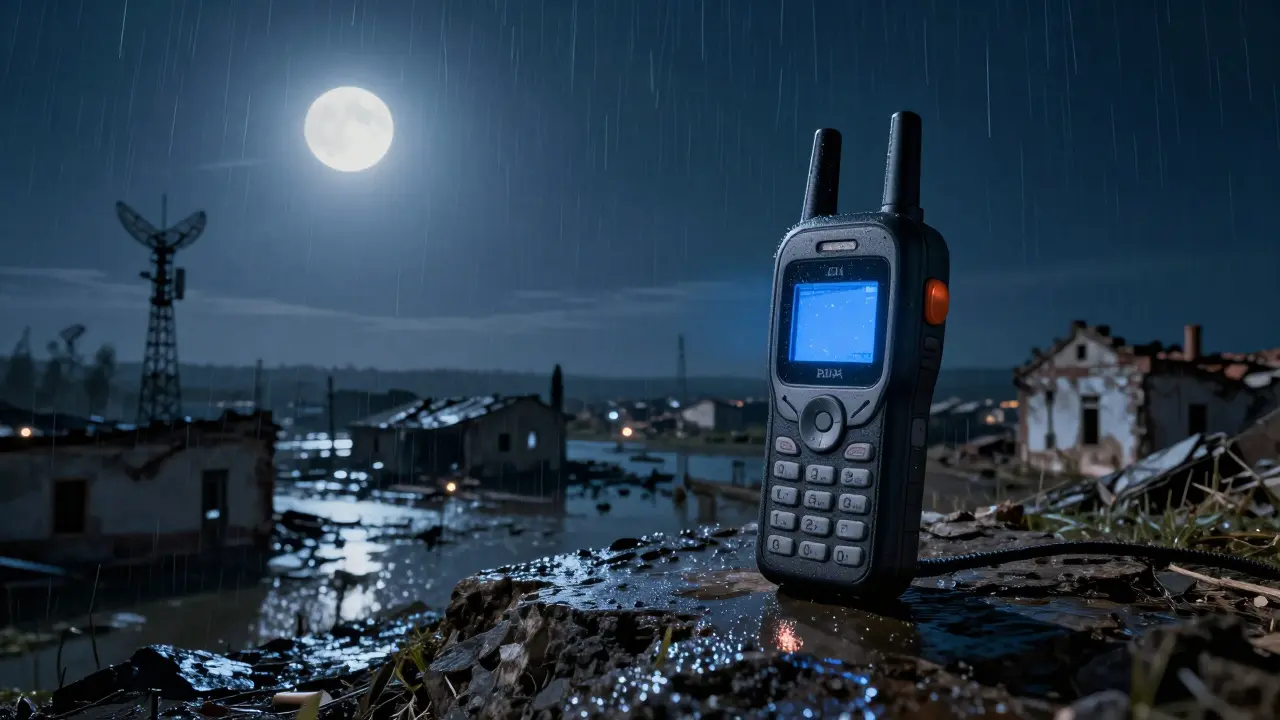
When the power goes out, cell towers collapse, and your smartphone shows "No Service," there’s one thing that still works: a satellite phone. Not because it’s fancy or expensive, but because it doesn’t need the ground. It talks directly to satellites orbiting 36,000 kilometers above Earth. That’s the key difference. While your phone relies on towers that can be flooded, burned, or crushed by debris, satellite phones keep working when everything else fails.
Why Satellite Phones Work When Cell Networks Don’t
After the 2011 earthquake and tsunami in Japan, hospitals scrambled to coordinate evacuations. More than 70% of the satellite phones in use kept working for all four days. Meanwhile, fewer than 40% of regular cell phones and landlines stayed online. Why? Because the towers were underwater, crushed by rubble, or without power. Satellites? They don’t care. They’re up there, untouched, broadcasting signals across the entire planet. This isn’t a one-off story. In the 2024 California wildfires, one user on Reddit described how their Iridium 9555 was the only device that connected for 72 hours. Emergency crews couldn’t reach them. Cell towers were gone. But that satellite phone? It rang. They coordinated evacuations. They saved lives. Satellite phones don’t need Wi-Fi, cellular towers, or even electricity grids. All they need is a clear view of the sky and a battery. Most modern models, like the IsatPhone 2, are built to survive. They’re waterproof (IP67 rating), dustproof, and shock-resistant. Weighing just 309 grams, they fit in a backpack. And they last: 8 hours of talk time, 160 hours on standby. That’s more than a week of standby if you’re stranded.How Satellite Networks Actually Work
There are two main types of satellite networks: geostationary and low Earth orbit (LEO). Geostationary satellites, like those used by Viasat, hover over one spot on Earth, 36,000 km up. They’re great for stable, wide-area coverage but have a slight delay-about half a second-because the signal has to travel that far up and back. LEO satellites, like those from Iridium and Starlink, fly much lower-around 1,200 km. That means faster connections and less lag. Iridium’s network has 66 satellites circling the planet, so no matter where you are, at least one is always overhead. And since they talk to each other in space (called inter-satellite links), your call doesn’t have to bounce down to Earth and back up again. That cuts delays and improves reliability. In 2024, Viasat and Addvalue launched their Inter-satellite Data Relay System (IDRS). Before this, sending a text or location update could take hours. Now? It takes minutes. During the 2025 Hurricane Maria response, medical teams used this system to coordinate supply drops 78% faster than with older satellite tech.Who Uses These Phones-and Why
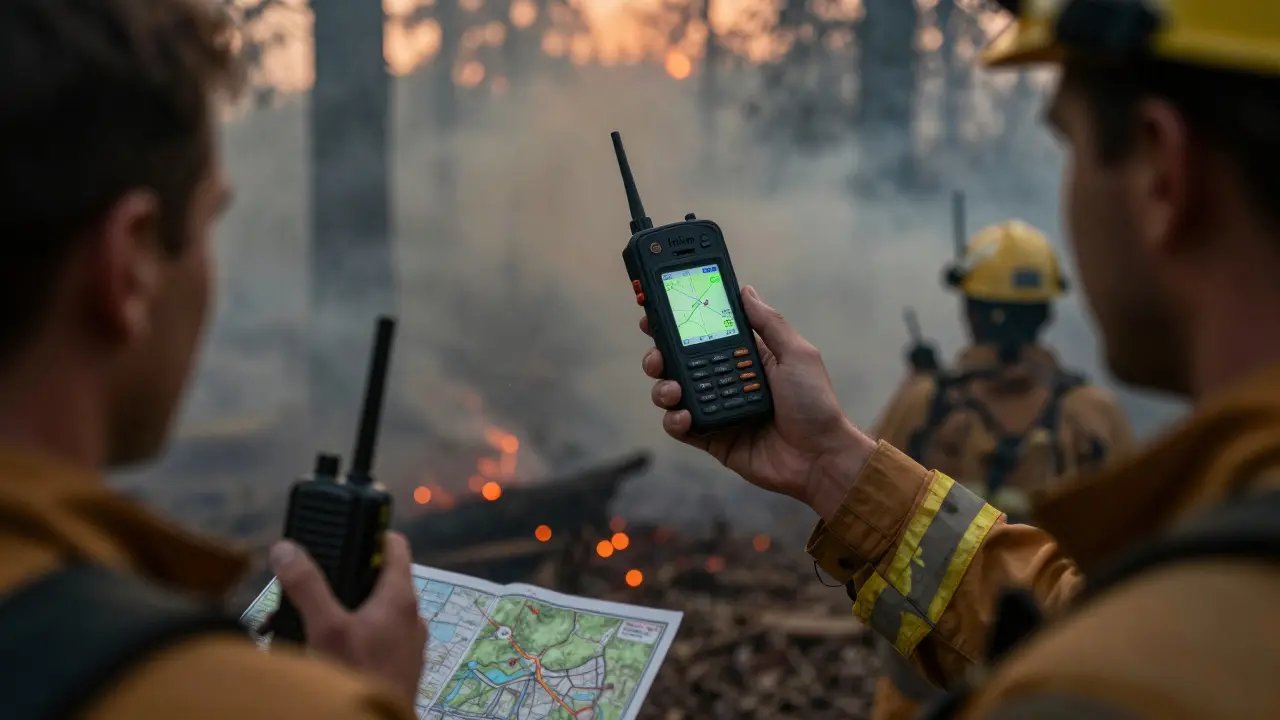
You might think satellite phones are only for military or deep-sea sailors. But that’s changing. As of Q4 2025, there were 1.2 million active satellite phones worldwide. And that number is growing at 8.3% a year. The biggest users? Emergency services. Fire departments, search-and-rescue teams, and disaster response agencies rely on them. In 2023, only 42% of these agencies had satellite phones. By 2027, ABI Research predicts that number will jump to 65%. Why? Because climate disasters are getting worse. The UN says major disasters have increased by 83% since 2000. When a wildfire sweeps through Maui or a hurricane hits the Caribbean, satellite phones become the only lifeline. Beyond emergencies, they’re used by:- Oil and gas workers on remote rigs
- Scientific teams in Antarctica or the Amazon
- Maritime crews far from shore
- Adventure travelers hiking the Himalayas or crossing the Australian outback
- Preppers who want a backup when society breaks down
What You Get-and What You Don’t
Satellite phones are tough, but they’re not perfect. Here’s the real picture. What they do well:- Work anywhere on Earth, including oceans, deserts, and polar regions
- Survive extreme weather, dust, and drops
- Enable push-to-talk (PTT) like a walkie-talkie-no dialing needed
- Include built-in GPS and SOS buttons (Iridium Extreme has this)
- Charge via USB-C-no special adapters
- Work indoors or under heavy tree cover-you need sky access
- Handle high-speed data-max speed is 432 kbps (a slow video call on a 5G phone is 1,000 times faster)
- Offer cheap calls-$1.50 per minute vs. $0.03 on your phone
- Fit in your pocket-they’re bulkier than smartphones
Costs, Models, and What’s New in 2026
As of Q1 2026, here’s what you’ll pay:- IsatPhone 2 (Viasat): $799, 8-hour battery, IP65 rating, clear voice, simple interface
- Iridium Extreme: $1,199, MIL-STD-810H certified, SOS button, GPS tracking, better ruggedness
- Starlink Phone (new in 2023): $999 for the terminal, voice and text included in $150/month plan
Training and Real-World Use
You can’t just grab a satellite phone and expect to use it perfectly on the first try. Most users need 15 to 20 minutes of training. That means learning:- How to point the antenna toward the sky
- How long to wait for a signal (sometimes 30 seconds to a minute)
- How to use SOS and GPS features
- How to conserve battery during long deployments
Is It Worth It for You?
If you live in a city with reliable cell service? Probably not. You don’t need a satellite phone to text your friend or check the weather. But if you:- Work in remote areas
- Travel off-grid
- Lead emergency response teams
- Live in a region prone to storms, fires, or earthquakes
- Want to be prepared when the grid goes down
What’s Next for Satellite Communication
The future is faster, cheaper, and more integrated. By 2030, analysts predict satellite voice and data costs will drop 35-40%. Speeds will jump 5 to 10 times. And your smartphone? It might not need a separate satellite device at all. But the core truth won’t change: when the world breaks down, satellites don’t. They’re silent, steady, and always watching. And when every second counts, that’s the only kind of connection that matters.Can I use a satellite phone indoors?
No. Satellite phones require a clear view of the sky. Walls, roofs, and dense tree cover block the signal. You need to be outside, with no obstructions between you and the sky. Some models have external antennas you can mount on a vehicle or tripod to improve reception.
How long do satellite phone batteries last?
Most models last 8 hours of talk time and up to 160 hours on standby. In emergency situations, battery life can be extended by turning off non-essential features, using solar chargers, or carrying spare batteries. Some newer terminals, like those from Digisat, offer up to 72 hours of operation with solar assistance.
Are satellite phones legal to use in all countries?
Yes, in most countries. Satellite phones are legal for personal and professional use in the U.S., Australia, Canada, the EU, and most of the world. Some countries, like North Korea and Russia, restrict or ban them. Military zones and certain government areas may also prohibit their use. Always check local regulations before traveling.
Can satellite phones send text messages and emails?
Yes. Most modern satellite phones support SMS text messaging and basic email via low-bandwidth data services. Iridium and Viasat offer data plans that allow you to send short emails or location updates. Speeds are slow-around 24-432 kbps-but enough for critical messages when you have no other option.
What’s the difference between Iridium and Viasat satellite phones?
Iridium uses a constellation of low Earth orbit satellites that provide global coverage with low latency and inter-satellite links. Viasat (formerly Inmarsat) uses geostationary satellites, which offer more stable signals but slightly higher delay. Iridium phones are more rugged and include GPS/SOS features. Viasat’s BGAN terminals offer faster data speeds and are preferred for mobile command centers. Iridium is better for personal use; Viasat is better for professional teams needing data.
Will my smartphone ever connect directly to satellites?
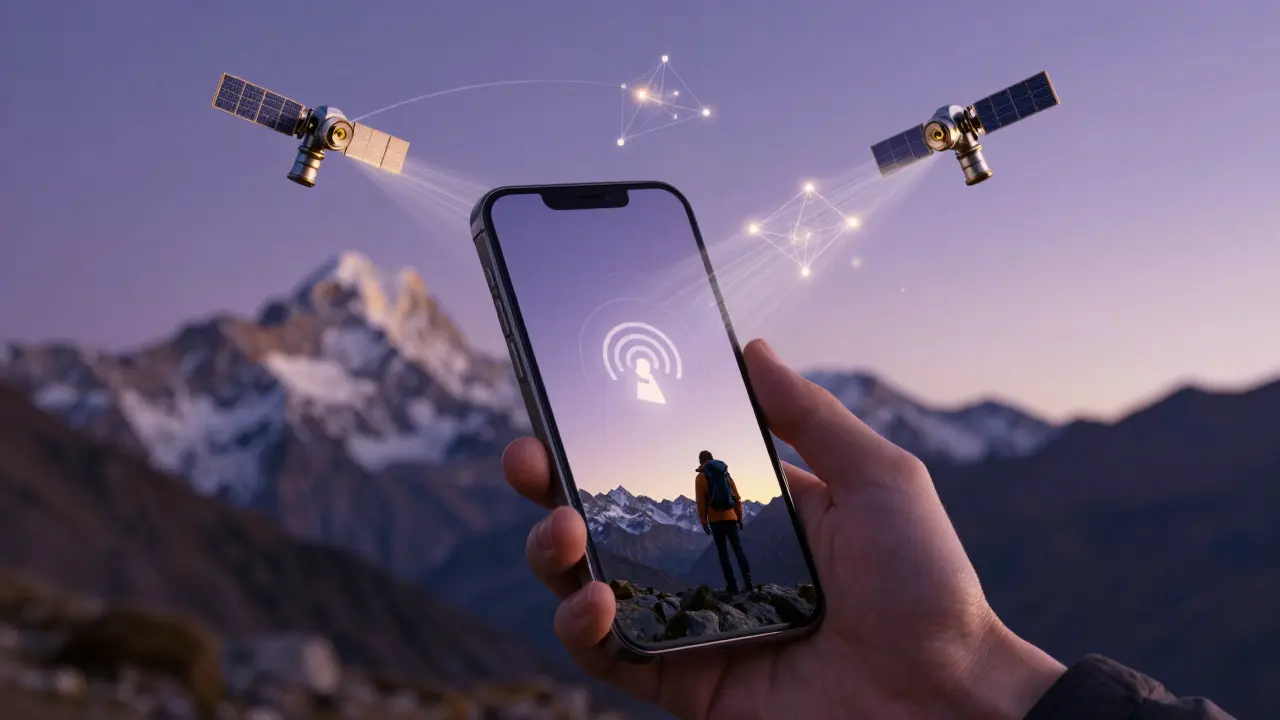
Yes, and it’s already starting. Starlink and Lynk Global are testing direct-to-cell satellite technology. By 2027, some smartphones will be able to send texts and make emergency calls via satellite without needing a separate device. This won’t replace your cellular plan but will act as a backup in remote or disaster zones.
How do I charge a satellite phone in the wild?
Most modern satellite phones use USB-C, so you can charge them with any standard power bank, solar charger, or car adapter. For extended trips, solar panels designed for outdoor use are ideal. Some emergency kits include hand-crank chargers as a last-resort option. Always carry at least one spare battery if you’re heading into areas with no access to power.
Do satellite phones work during hurricanes or earthquakes?
Yes. That’s their main purpose. During the 2011 Japan tsunami and the 2023 Maui wildfires, satellite phones were the only communication tools that worked when cell towers were destroyed or overloaded. Satellites operate in space, so ground-level damage doesn’t affect them. They’re the last line of communication when everything else fails.