
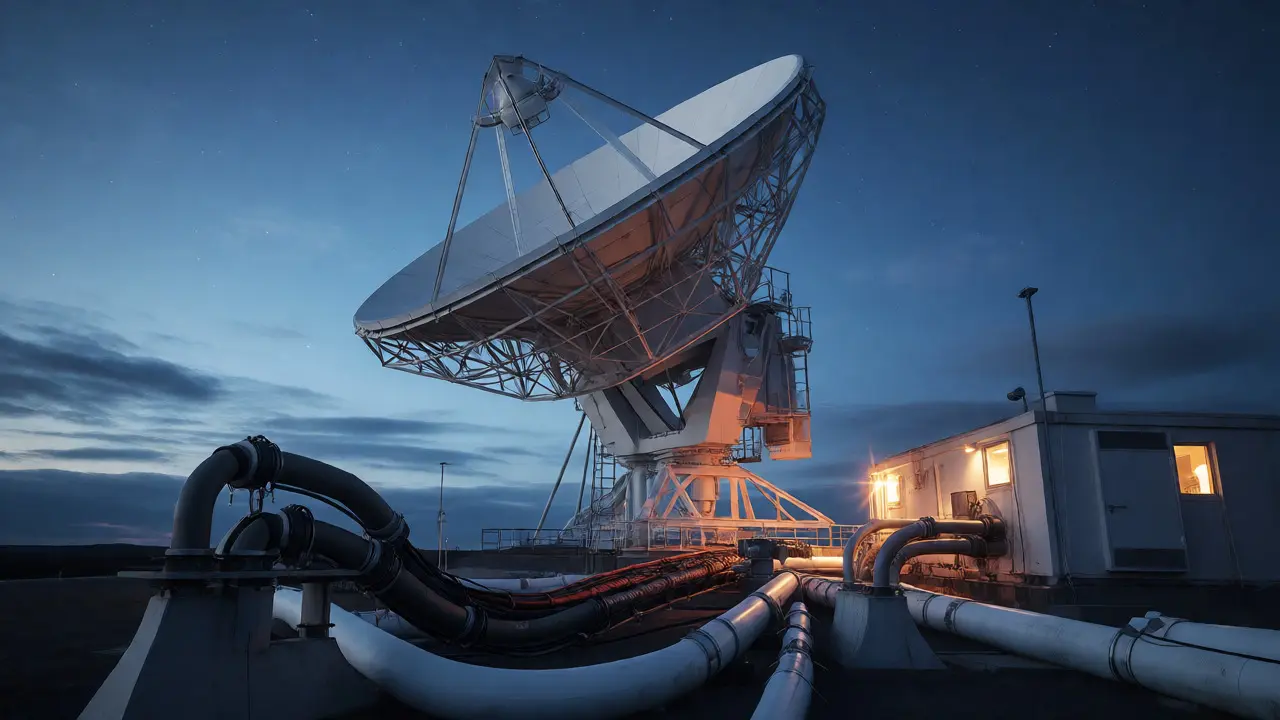
You can build the most sophisticated satellite in the world, but if you cannot talk to it, you have just launched a very expensive piece of space junk. The Satellite Ground Segment is the critical infrastructure that keeps spacecraft alive, healthy, and useful. It is not just a bunch of dishes pointing at the sky; it is a complex ecosystem of radio frequency links, software stacks, and human operators that manages everything from battery health to orbit adjustments.
Most people think of satellites as the hero of space missions. But the real work happens on Earth. This article breaks down how Telemetry, Tracking, and Command (TT&C) networks function, what mission control centers actually do, and why international standards like CCSDS are the glue holding modern spaceflight together.
The Core Architecture: More Than Just Antennas
A typical ground segment isn't monolithic. It is split into distinct functional areas that must talk to each other seamlessly. According to NASA’s recent guidance for small satellites, the architecture generally consists of four main pillars:
- Ground Station Terminals: These are the physical interfaces with space. They use RF or optical transceivers to send commands up and receive data down.
- Mission Operations Center (MOC): The brain of the operation. Here, engineers generate commands, monitor spacecraft health, and manage scheduling.
- Data Storage and Network Layer: A high-speed backbone that connects remote ground stations to the MOC in real time. Without this, telemetry would sit idle in a server farm thousands of miles away.
- Science Operations Centers (SOC): Optional but common for scientific missions, these facilities handle payload-specific data analysis separate from basic spacecraft housekeeping.
The flow of information is strictly controlled. Commands originate at the MOC, travel through secure networks to a ground station, get modulated onto a carrier wave, and beam up to the satellite. Telemetry follows the reverse path. If any link in this chain fails, the mission risks going silent.
TT&C Networks: The Lifeline of Spacecraft
TT&C stands for Telemetry, Tracking, and Command. It is the fundamental service provided by the ground segment. Think of it as the nervous system of the satellite relationship. You need three things to keep a spacecraft operational:
- Telemetry: Data coming down from the satellite about its status-temperature, voltage, gyroscope readings, and error logs.
- Tracking: Determining exactly where the satellite is in orbit using Doppler shift measurements and ranging signals.
- Command: Instructions sent up to change the satellite's mode, point its antennas, or fire thrusters.
Industry leaders like Indra Space highlight that these functions often use different frequency bands to optimize performance. Typically, S-band is reserved for TT&C because it offers robust connectivity even during rain fades or partial obstructions. X-band or Ka-band handles high-rate payload data, such as high-resolution imagery. This separation ensures that critical command links aren't clogged by massive downloads of scientific data.
| Frequency Band | Primary Use Case | Data Rate Capability | Reliability Characteristics |
|---|---|---|---|
| S-Band | TT&C (Telemetry, Tracking, Command) | Low to Medium (kbps) | High resilience to atmospheric interference |
| X-Band | Payload Data Downlink | High (Mbps to Gbps) | Susceptible to rain fade; requires clear line-of-sight |
| Ka-Band | High-Throughput Communications | Very High (Gbps) | Highly susceptible to weather; narrow beams |
Mission Control Centers: Where Decisions Happen
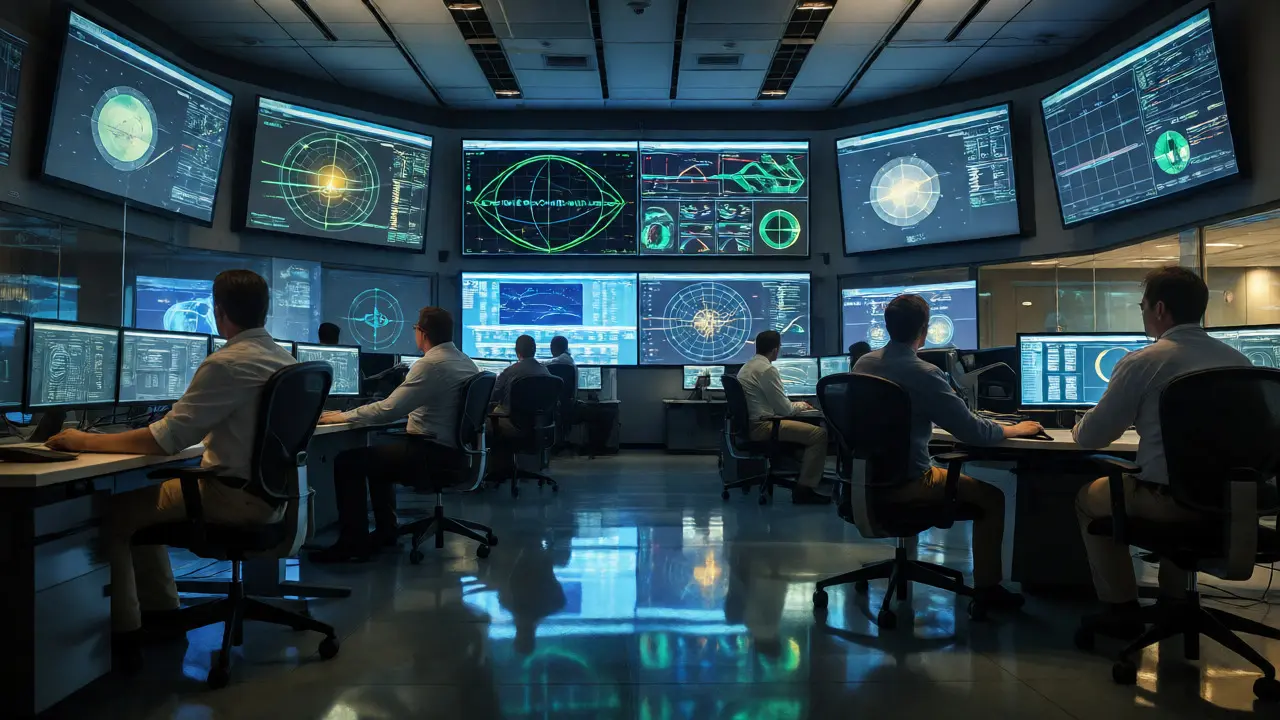
If TT&C is the nervous system, the Mission Control Center is the brain. It is not just a room full of screens. Modern MOCs are integrated environments that combine several critical functions. The US Department of Defense categorizes these into four primary components:
- Mission Management: High-level planning, anomaly resolution, and decision-making authority.
- Mission Data Processing: Handling the influx of science and payload data, distributing it to users.
- Space/Ground Asset Command and Control: Direct interaction with the spacecraft via TT&C links.
- Additional Functions: Training simulators, configuration management, and cybersecurity monitoring.
In practice, this means an operator at ESA’s European Space Operations Centre (ESOC) might be looking at a dashboard showing a slight drop in solar panel efficiency. The software flags this as an anomaly. The operator checks historical trends, consults thermal models, and decides to adjust the satellite's attitude to cool the panels. That decision becomes a command packet, which is verified, encrypted, and scheduled for transmission at the next pass over a ground station in Australia or Spain.
The Role of CCSDS Standards
How do a ground station in Japan communicate with a satellite built in Europe? Through the Consultative Committee for Space Data Systems (CCSDS). This international body sets the protocols that make interoperability possible. Without CCSDS, every agency would speak a different digital language.
Two key standards dominate TT&C traffic:
- Packet Telemetry (CCSDS 102.0-B-5): Defines how telemetry data is broken into packets. Each packet has a header identifying the source and type, allowing ground systems to parse mixed streams of data efficiently.
- Telecommand (CCSDS 201.0-B-3 and COP-1): Defines how commands are packaged and acknowledged. The Command Operation Procedures (COP-1) ensure that if a command gets corrupted in transit, the ground station knows to retransmit it.
These standards were restructured around 2002 to treat telemetry and telecommand as formal communication protocols, similar to TCP/IP on the internet. This shift allowed for modular software development. Today, most mission control software implements these CCSDS recommendations directly, ensuring that a new satellite can plug into existing ground infrastructure without custom coding for every single message.
Security and Resilience in the Ground Segment
As space assets become more valuable, they also become targets. The National Institute of Standards and Technology (NIST) updated its baseline profile for satellite ground segments in August 2026, emphasizing that TT&C networks are critical command-and-control assets. They are no longer just utility connections; they are cyber-physical systems that require hardening.
NIST recommends monitoring both bus and payload TT&C traffic separately. Why? Because a compromise in the payload data stream (like a hacked image file) shouldn't necessarily stop you from commanding the spacecraft to turn off its transmitter. Security layers include:
- Network Sensors: Monitoring the links between ground stations and the MOC for unusual traffic patterns.
- Access Control: Strict authentication for anyone sending commands. Not everyone in the building can tell the satellite to dump its fuel.
- Anomaly Detection: Automated systems that flag unexpected telemetry values, which could indicate a sensor failure or a spoofing attack.
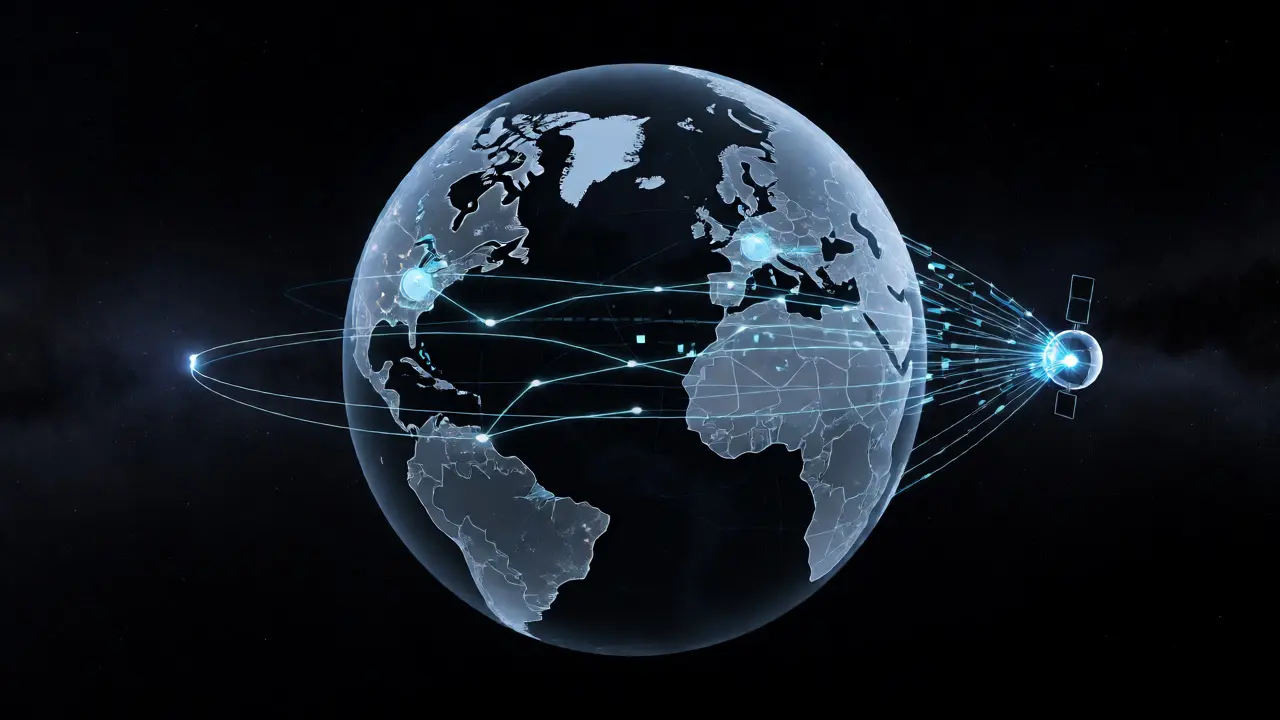
Resilience goes beyond cybersecurity. Ground segments must survive natural disasters and equipment failures. Many agencies use networked ground stations so that if one site goes offline due to a storm, another can take over the contact window. This redundancy is essential for maintaining continuous coverage, especially for low-Earth orbit satellites that move quickly across the sky.
Practical Implementation Challenges
Setting up a ground segment is rarely a plug-and-play affair. Even for small satellites, the integration effort is significant. You need specialized RF engineers to design the link budgets, software developers to implement CCSDS protocols, and operations staff trained in orbital mechanics.
Common pitfalls include underestimating the complexity of ground station scheduling. With hundreds of satellites in orbit, competition for antenna time is fierce. Mission planners must balance the need for frequent telemetry checks against the desire for long-duration payload data dumps. Automated scheduling tools help, but human oversight remains crucial for handling anomalies that don't fit pre-programmed rules.
Another challenge is latency and connectivity. While fiber optics connect most ground stations to central hubs, remote sites may rely on satellite backhaul or microwave links, introducing delays. For real-time commanding, this latency matters. If you are controlling a rover on Mars, you accept minutes of delay. For LEO satellites, you want milliseconds. Designing the network topology to minimize this lag is a core part of ground segment engineering.
Frequently Asked Questions
What is the difference between TT&C and payload data?
TT&C (Telemetry, Tracking, and Command) handles the 'housekeeping' data necessary to keep the satellite alive and oriented. This includes health status, battery levels, and navigation fixes. Payload data is the actual product the satellite was built to collect, such as weather images, communication signals, or scientific measurements. TT&C usually uses lower-frequency, more robust bands like S-band, while payload data often uses higher-frequency bands like X-band or Ka-band for higher throughput.
Why are CCSDS standards important for satellite operations?
CCSDS standards ensure interoperability between different space agencies and commercial operators. By standardizing packet formats for telemetry and telecommand, CCSDS allows a ground station in one country to communicate effectively with a satellite built in another. This reduces development costs, simplifies software integration, and enables the creation of shared ground station networks.
Can a single ground station cover the entire globe?
No, a single ground station cannot provide continuous coverage for most satellites, especially those in Low Earth Orbit (LEO). Due to the curvature of the Earth and the speed of the satellite, visibility windows are short (often 10-15 minutes per pass). To maintain near-continuous contact, operators use a network of ground stations distributed globally or employ relay satellites like the TDRS system.
What happens if the ground segment loses connection with a satellite?
If the connection is lost, the satellite typically enters a safe mode, relying on onboard autonomy to maintain basic health functions like power generation and thermal control. The ground team will attempt to reacquire the signal during subsequent passes. If the loss persists, they analyze stored telemetry from previous contacts to diagnose potential issues before attempting recovery commands.
How does cybersecurity impact satellite ground segments?
Cybersecurity is critical because the ground segment controls the spacecraft. A breach could allow attackers to inject malicious commands, potentially disabling the satellite or causing it to drift out of orbit. Modern ground segments implement encryption for command links, strict access controls for operators, and continuous monitoring of network traffic to detect anomalies indicative of cyber threats.
Next Steps for Ground Segment Planning
If you are designing a mission, start by defining your availability requirements. Do you need continuous coverage, or is daily contact sufficient? This decision drives your ground station network size and cost. Next, select your frequency bands carefully, balancing regulatory constraints with technical performance. Finally, prioritize security early. Retrofitting encryption into an existing ground segment is far harder than building it into the initial architecture.