

When you deposit your ETH or USDC into a DeFi lending platform, you might think your assets are safely locked in your own vault. But what if those same assets are being used by someone else-without your knowledge-to secure another loan? That’s rehypothecation, and it’s quietly running in the background of most major DeFi protocols today. It sounds technical, but the consequences are simple: your money could vanish during a market dip, even if you never borrowed a cent.
What Exactly Is Rehypothecation in DeFi?
Rehypothecation isn’t new. In traditional finance, banks take your stocks or bonds as collateral for a loan, then use those same assets to borrow money themselves. It’s legal, regulated, and capped-usually at 140% of your liability in the U.S. But in DeFi, there’s no such limit. When you deposit crypto into a lending protocol like Jupiter Lend or Aave, your assets don’t just sit there. They get reused, over and over, across multiple smart contracts. One dollar of collateral can back three, five, even ten loans. That’s leverage. Hidden leverage.Think of it like this: you lend your friend $1,000. They turn around and lend $800 of it to someone else. That someone else lends $600 to a third person. Now, your original $1,000 is supporting $2,400 in debt. If the third person defaults, your friend can’t pay you back. In DeFi, this chain of debt is automated by code. No human checks it. No regulator watches it. And you, the depositor, are often never told.
How DeFi Protocols Hide the Risk
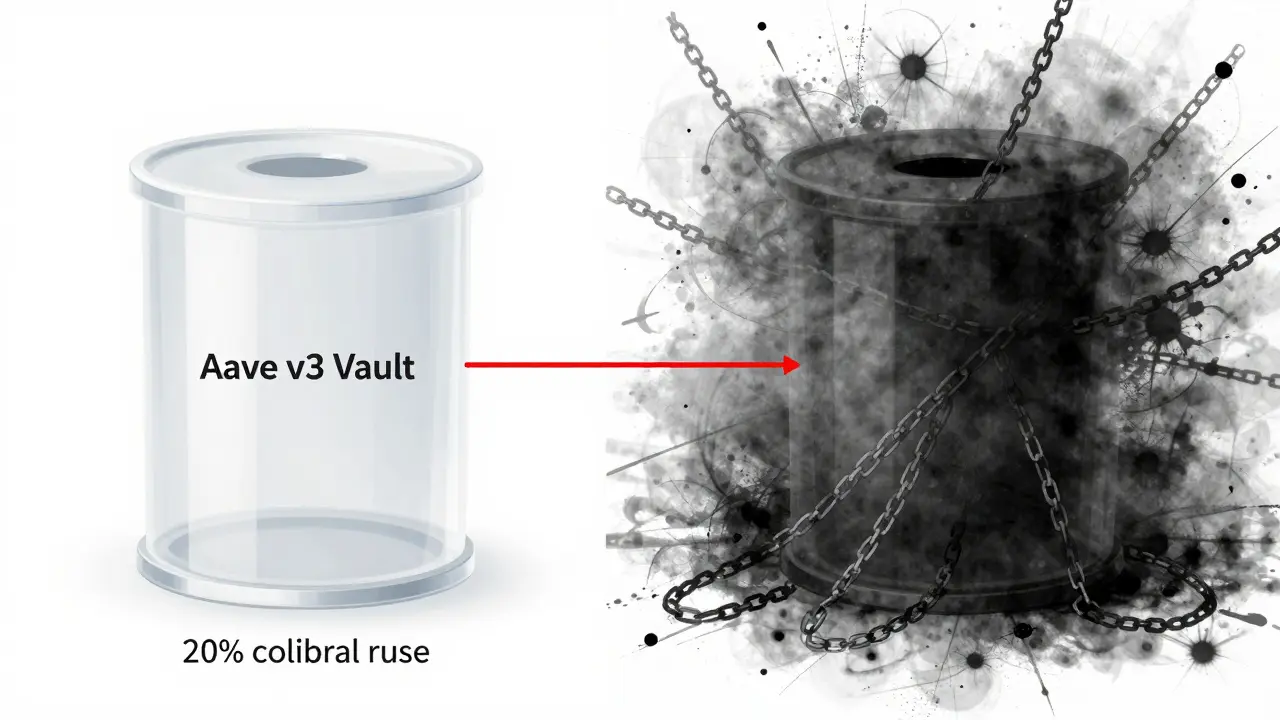
Most DeFi platforms market themselves as “transparent” and “decentralized.” They promise “isolated vaults” that keep your assets separate. But here’s the trick: isolation doesn’t mean independence. A vault might look like your own private room, but if it shares the same underlying collateral pool as other vaults, a crash in one can drag down all of them.The Jupiter Lend incident in August 2024 exposed this perfectly. Over 14,000 users had their funds frozen when a single vault got liquidated. Why? Because their “isolated” vaults were all backed by the same ETH reserve. When ETH dropped 15%, the system triggered cascading liquidations. The protocol had never disclosed that collateral from Vault A was being used to back Vault B, C, and D. Users thought they were safe. They weren’t.
According to DeFi Safety’s 2024 audit, only 18% of major protocols clearly disclose rehypothecation practices. The rest rely on vague terms like “cross-vault liquidity” or “shared collateral pools” buried in fine print. Even worse, 92% of protocols have no legal terms that explain what happens to your assets if the system fails. You don’t own them anymore-you’re just a participant in a financial chain you can’t see.
Why This Is Worse Than Traditional Finance
In traditional banking, if a broker rehypothecates your assets, there are rules. Regulators monitor it. Insurance exists. You can file a claim. In DeFi? There’s no FDIC. No SEC oversight. No legal recourse. When Jupiter Lend froze $42 million, users had to wait days for a patch. Some got their money back. Others didn’t.Regulators are catching up. The U.S. SEC fined Jupiter Lend in February 2025 for misleading disclosures. ESMA in Europe is pushing for similar rules. But until these rules are enforced on-chain, you’re on your own. The Financial Stability Board warned in 2017 that rehypothecation can create “operational impediments” that prevent clients from accessing their assets during a crisis. That’s not a theory. It’s what happened in 2024.
And unlike banks, DeFi protocols don’t have capital buffers. They don’t hold reserves. They rely on over-collateralization. But if 10 vaults are all using the same 100 ETH as collateral, and ETH drops 30%, all 10 vaults are undercollateralized at once. No one gets to pick and choose who gets liquidated first. The code does it all at once.

Real Numbers: The Hidden Cost of Efficiency
DeFi’s biggest selling point is “capital efficiency.” By reusing collateral, protocols claim they can offer higher yields. And yes, they do. But at what cost?- Protocols with aggressive rehypothecation saw a 68% average collateral shortfall during the March 2023 crash.
- During the May 2021 market plunge, protocols with high rehypothecation intensity had a 78% higher chance of insolvency.
- Total Value Locked (TVL) in protocols using rehypothecation hit $58.7 billion by November 2024-43% of the entire DeFi lending market.
That’s not innovation. That’s a house of cards. The math looks great when prices are rising. But when they fall, the entire system starts collapsing like dominoes. And you’re not just risking your deposit-you’re risking the whole chain.
How to Protect Yourself
You can’t stop rehypothecation. But you can avoid the worst of it. Here’s how:- Check the fine print. Look for terms like “collateral reuse,” “shared liquidity,” or “cross-vault exposure.” If it’s not stated clearly, assume the worst.
- Use tools. DeFiLlama’s risk dashboard, Chainalysis’s Rehypothecation Risk Scanner, and Blocksec’s tracker show real-time collateral reuse ratios. Check them before depositing.
- Choose transparent protocols. Aave v3 and MakerDAO now show exact collateral reuse limits. Aave’s isolated pools display exactly how much of your asset is being reused. That’s the gold standard.
- Don’t over-leverage. Keep your loan-to-value ratio below 65% during volatile markets. The lower your debt, the less likely you are to get caught in a cascade.
- Diversify. Don’t put all your crypto into one protocol. Spread it across platforms with different risk profiles. If one fails, you won’t lose everything.
Experienced users say it takes 8-12 hours to learn how to spot hidden rehypothecation. Beginners? More than 20. But if you’re serious about DeFi, this isn’t optional. It’s survival.
What’s Changing in 2025 and Beyond
The tide is turning. After the Jupiter Lend fallout, major protocols had to respond. Aave added clear reuse ratios in October 2024. Compound introduced circuit breakers in November. MakerDAO launched single-collateral vaults in December. The DeFi Safety Council rolled out a mandatory disclosure framework in September 2024. And Ethereum’s EIP-7272, expected in Q2 2025, will let wallets trace collateral chains on-chain-making hidden reuse impossible to hide.But change is slow. 58% of analysts believe risky rehypothecation will still exist in 2026, especially in newer, less-regulated protocols. Institutional investors have already left the opaque ones. Galaxy Digital found that 92% of institutional DeFi capital went to protocols with transparent disclosures in Q3 2024. If big money is walking away, you should too.
Final Warning
DeFi promises freedom. But freedom without transparency is just risk. Rehypothecation isn’t evil-it’s a tool. Used carefully, it can make DeFi more efficient. Used blindly, it can wipe out your savings. The protocols aren’t lying. They’re just not telling you the whole truth. And in crypto, that’s enough to lose everything.If you’re depositing assets into a DeFi protocol, ask yourself: Do I know who else is using my money? If you can’t answer that, you’re not investing. You’re gambling.
Is rehypothecation the same as lending my crypto to someone else?
Not exactly. When you lend your crypto, you’re directly giving it to a borrower. Rehypothecation means the platform takes your collateral, uses it as security for its own loans, and then those loans might be used to fund other users. You didn’t lend directly-you’re part of a chain. The borrower doesn’t even know your assets are backing their loan.
Can I opt out of rehypothecation in DeFi?
No-not directly. Unlike traditional brokers where you can sign a form to prohibit rehypothecation, DeFi protocols don’t offer opt-out choices. Your assets are governed by the smart contract’s code. If the contract allows reuse, your deposit automatically becomes part of the system. Your only protection is choosing protocols that don’t reuse collateral-or that disclose it clearly.
Are all DeFi lending platforms using rehypothecation?
No, but most do. A Chainalysis Q3 2024 audit found that 83% of major lending protocols implement some form of rehypothecation. Protocols like Aave v3, MakerDAO, and Lido Finance have either limited reuse or fully disclosed it. But the majority-especially newer or yield-focused platforms-hide it behind terms like “isolated vaults” or “optimized liquidity.” Always verify.
What happens to my assets if a protocol gets hacked or fails?
If a protocol fails due to rehypothecation-triggered cascading liquidations, your assets may be locked indefinitely. Unlike banks, DeFi protocols don’t have insurance or recovery mechanisms. In the Jupiter Lend incident, $42 million was frozen for days. Some users recovered everything. Others lost part of their funds permanently. There’s no guarantee. Your assets are only as safe as the smart contract’s design-and most were never built for collapse scenarios.
Is rehypothecation illegal in DeFi?
Not yet. But regulators are moving fast. The SEC fined Jupiter Lend in February 2025 for deceptive disclosures about collateral reuse. ESMA is drafting rules for EU-based DeFi platforms. While rehypothecation itself isn’t banned, hiding it or misleading users about it is becoming illegal. Protocols that don’t disclose risk clearly now face fines, lawsuits, and delisting from major wallets and exchanges.
How can I tell if a DeFi protocol is hiding rehypothecation?
Look for red flags: vague terms like “isolated vaults” without clear collateral limits, no mention of reuse in documentation, or marketing that emphasizes “high yields” without risk warnings. Check blockchain explorers like Etherscan to trace how collateral flows between vaults. If your deposited asset appears in multiple loan contracts, rehypothecation is happening. Tools like Chainalysis’s Rehypothecation Risk Scanner can automate this check.
14 Responses
So let me get this straight-you deposit ETH, think you’re safe, and suddenly some algorithm is using your money to back five other people’s loans like it’s a blockchain game of Jenga? And we call this ‘innovation’? Sweet mother of decentralized chaos, I need a drink.
They don’t even label it. No ‘WARNING: YOUR ASSETS ARE BEING REUSED’ banner. Just a pretty UI with ‘Earn 12% APY!’ and a footnote in Comic Sans that says ‘collateral may be subject to cascading liquidations.’ I’m not investing. I’m volunteering for a crypto pyramid scheme.
I’ve seen DeFi devs tweet ‘transparency’ like it’s a virtue. Meanwhile, their whitepaper has more euphemisms than a politician’s apology. ‘Shared liquidity’? That’s corporate speak for ‘your money is now someone else’s margin call.’
And don’t even get me started on the ‘isolated vaults’ lie. It’s like saying your apartment is private because the walls are painted different colors. The plumbing? Shared. The foundation? Shared. The collapse? Also shared. I’m out.
Why do I feel like I’m the only one who remembers the 2022 crash? Because no one talks about it. They just move on to the next ‘revolutionary’ protocol with a new logo and zero disclosure. I’m not mad. I’m just disappointed in humanity.
Also, if you’re still using Jupiter Lend after August 2024, I’m not judging. I’m just… confused. Like, did you not read the part where $42M vanished? Or did you just assume ‘DeFi’ means ‘Don’t Expect Funds Back’?
This is all a scam. The government and the big banks are behind this. They want you to think crypto is free, but it’s just a trap. They let you deposit, then they use your ETH to fund loans for people who don’t even exist. It’s all fake. The whole thing is a Ponzi. I know this because I read a post on a forum in 2021 that said the same thing. They’re coming for your crypto. They’re coming for you.
Thank you for writing this. Honestly, this is one of the clearest breakdowns I’ve seen on rehypothecation. I’ve been in DeFi for years and never fully understood how the collateral chains worked-until now.
I used to think ‘isolated vaults’ meant my money was safe. Turns out, it just meant my money was in a room with a sign that said ‘Do Not Enter,’ while the door was wide open and everyone else was walking through. I’m not mad, I’m just… educated now.
I checked my Aave positions after reading this. Turns out, my USDC vault has a reuse ratio of 1.8x. Not terrible, but definitely not zero. I’m moving half to MakerDAO’s single-collateral vaults tomorrow. No more guessing.
If you’re new to DeFi, please don’t skip the fine print. I know it’s boring. But if you don’t, you’re not being smart-you’re being lucky. And luck runs out.
Also, props to the author for mentioning DeFiLlama’s risk dashboard. That tool saved my portfolio in 2023. Bookmark it. Use it. Live by it.
Wow. I didn’t realize how deep this went. I’ve been using Aave for a year and thought I was being careful. But now I’m wondering-did I even read the terms? Or did I just click ‘Accept’ because it said ‘no risk’? I’m so embarrassed.
I’m going to spend the weekend going through every protocol I’ve ever deposited into. I don’t want to lose my savings because I was too lazy to check a dropdown menu. Also, I just learned the word ‘rehypothecation’ and I’m kind of proud. It’s like ‘hypothecation’ but with extra layers of chaos.
Thanks for making me feel dumb in the best way possible. I needed this.
This is such an important topic, and you explained it so clearly. I’ve been warning my friends about this for months, but no one listens until they lose money.
I’ve been using MakerDAO for over two years now, and I love how transparent they are. They show exactly how much of your collateral is being reused, and they cap it at 1.5x. That’s not perfect, but it’s way better than the wild west of other protocols.
My advice? Stick with the big names that have been audited by multiple teams. Don’t chase 20% APY on some new DeFi project with a Discord server full of bots. If it sounds too good to be true, it’s probably hiding a 5x rehypothecation chain.
Also, diversify. Don’t put all your eggs in one basket-even if that basket says ‘isolated.’ I’ve spread mine across three protocols with full disclosure. It’s boring. But it’s safe.
You’re not paranoid for being cautious. You’re smart.
Just wanted to say this is one of the most well-written deep dives I’ve read on DeFi risks. No fluff. No hype. Just facts. And the numbers? Oof. 68% collateral shortfall? That’s not a bug-it’s a feature of the system.
I used to think DeFi was about ownership. Now I realize it’s about trust in code. And code doesn’t care if you lose everything. It just executes.
I switched to Aave v3 after the Jupiter Lend thing. The collateral reuse dashboard alone is worth it. Seeing that my ETH is only being reused 1.2x? That’s peace of mind. I’ll take slightly lower yields over existential risk any day.
Also, if you’re still using protocols that don’t show reuse ratios, you’re not a DeFi degenerate-you’re a sitting duck. Go check Chainalysis. Right now. I’ll wait.
This is so true. I’m from South Africa, and I started with DeFi because I thought it was my way out of the banking mess here. But now I realize-DeFi just copied the same problems, just with more code and less accountability.
I used to think the blockchain was magic. Turns out, it’s just a ledger that lets people do the same old financial tricks, but faster and without lawyers.
I’ve started using only protocols that show real-time reuse ratios. It’s a pain, but better than waking up to a $0 balance. I also avoid anything that says ‘optimized liquidity’-that’s code for ‘we’re rehypothecating your stuff.’
Thanks for making this so clear. I’m sharing this with my whole crypto group. They’re going to be mad… but alive.
Let me guess-you’re one of those people who thinks DeFi is ‘trustless’? Newsflash: it’s not. It’s just trust in a bot that doesn’t have a conscience.
Rehypothecation isn’t evil-it’s capitalism with a blockchain tattoo. You think you’re earning yield? Nah. You’re the collateral. The protocol’s the middleman. And the real winners? The devs who cashed out before the crash.
I’m not saying don’t use DeFi. I’m saying: don’t be naive. If you can’t trace where your ETH goes after you deposit it, you’re not a user-you’re a data point.
Also, the fact that 92% of protocols hide this? That’s not an accident. That’s a business model. And guess what? You’re the product.
Go check your wallet. Now. I’ll be here when you come back screaming.
Man, I didn’t even know this was a thing. I thought my USDC was just sitting there like a savings account. Turns out, it’s probably funding some guy’s leveraged BTC position in another country.
I’m not tech-savvy, but I’m smart enough to know when something feels off. I’ve been using Aave for a while, and I just checked the dashboard. My reuse ratio is 1.1x. Not great, but not terrifying.
I’m moving half of it to MakerDAO. I don’t care if I lose 1% yield-I care if I lose 100% of my savings. Also, I just downloaded DeFiLlama. It’s weirdly satisfying to see all the numbers.
Thanks for the wake-up call. I owe you a coffee if we ever meet in person. Or at least a meme.
Okay, so let’s geek out for a sec. Rehypothecation in DeFi is essentially a recursive collateral stack-where each layer of debt is backed by the same underlying asset, and the system assumes infinite liquidity because ‘the market will always go up.’
It’s a classic systemic risk scenario, but with zero regulatory buffer. Unlike traditional finance, where capital buffers and margin calls are human-mediated, DeFi automates the cascade. One liquidation triggers ten more. No discretion. No mercy.
And the real kicker? The protocols don’t even track the *effective* leverage. They track TVL. But TVL is just the sum of all deposits. It doesn’t account for reuse. So a $10B TVL protocol could be backed by $2B in actual collateral. That’s not leverage-it’s delusion.
That’s why EIP-7272 is so critical. If we can trace collateral chains on-chain, we can finally audit the real risk. Until then, we’re all playing Russian roulette with smart contracts.
Also, ‘isolated vaults’ is the most ironic term in DeFi history. It’s like calling a prison cell ‘private room.’
Wow. This is the most accurate thing I’ve read all week. And I’m a grammar Nazi, so I know accuracy.
First: ‘rehypothecation’ is spelled with an ‘e,’ not an ‘a.’ You got it right. Good job.
Second: ‘isolated vaults’ is a lie. It’s like saying your car is ‘private’ because the windows are tinted. The engine? Still shared. The fuel? Still used by others.
Third: you missed one key point. Even if a protocol says ‘no reuse,’ if it’s built on top of a protocol that does reuse (like using Aave as liquidity source), you’re still exposed. It’s collateral all the way down.
Fourth: ‘capital efficiency’ is just corporate speak for ‘we’re borrowing your money to lend it to someone else.’
Fifth: if you’re using any protocol that doesn’t show reuse ratios, you’re not an investor-you’re a debt slave with a wallet.
Sixth: I just checked my wallet. I’m moving everything to MakerDAO. Now. Before I accidentally fund a crypto pyramid.
You’re acting like this is news. Everyone who’s been in DeFi for more than six months knows this. The entire ecosystem is built on this. It’s not a bug. It’s the feature.
I lost 80% of my portfolio in 2022 because I didn’t know. Now I know. And I still use it. Why? Because the yields are insane. And I’m not rich. I need the money.
So yeah, your money might vanish. But if you’re smart, you’ll only deposit what you can afford to lose. And if you lose it? You’ll learn. And so will the next guy.
This isn’t a warning. It’s a filter. The weak get wiped out. The strong adapt. That’s crypto.
I’ve been thinking about this for weeks now, ever since I read about the Jupiter Lend collapse. It’s not just about rehypothecation-it’s about how we’ve normalized risk in DeFi. We’ve turned financial safety into a feature we ignore because we’re too busy chasing yields.
I used to think that if something was on the blockchain, it was immutable, transparent, and safe. But now I see that blockchain just makes the deception faster. The code doesn’t lie. But the people who write the code? They’re very good at hiding the truth.
I’ve started reading every single line of every whitepaper now. I’ve been doing this for three months. I’ve lost track of how many protocols I’ve abandoned because they didn’t disclose reuse ratios. It’s exhausting. But I’d rather be exhausted than broke.
There’s a part of me that feels guilty for being so cautious. Like maybe I’m missing out. But then I remember: I’m not here to get rich. I’m here to keep what I have. And that’s worth more than any APY.
Thank you for writing this. It’s the first time I’ve seen someone say it so clearly. I’m sharing it with my family. They think I’m crazy for not putting everything into Solana. But now, maybe they’ll understand.
Oh honey, this is not just about DeFi. This is about capitalism with a crypto mask. You think you’re owning your assets? Nah. You’re just the collateral in a global game of financial musical chairs.
I’ve been in crypto since 2017. I’ve seen this exact pattern repeat: hype, yield, collapse, then a new protocol with a prettier logo and the same damn risk.
And you know what’s wild? The people who lose money? They come back. They always come back. Because they think ‘this time it’s different.’
But it’s not. It’s the same old leverage. Same old hidden chains. Same old ‘trust the code’ nonsense. The code doesn’t care. The code doesn’t cry. The code doesn’t pay you back.
I’ve been using MakerDAO since 2021. Why? Because they’re honest. They show the numbers. They don’t hide behind ‘isolated vaults’ like it’s a magic spell. I wish more did.
If you’re still using protocols that don’t disclose reuse, you’re not a pioneer. You’re a pawn. And pawns get sacrificed. Every. Single. Time.
So go check your wallet. Right now. And if you see ‘shared liquidity’? Run. Run like your ETH depends on it. Because it does.