
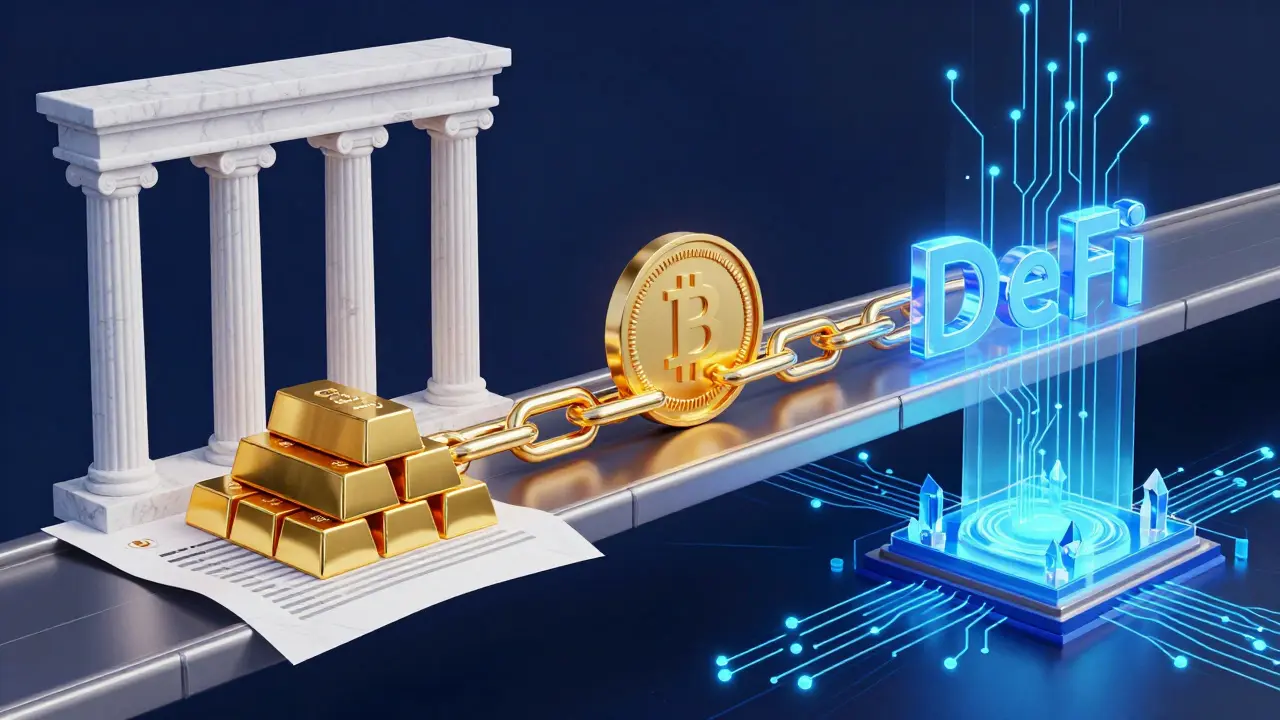
Real-World Asset Tokenization is the process of converting physical and financial assets into blockchain-based digital tokens that represent ownership or stakes in those assets. By bridging the gap between centralized finance (CeFi) and decentralized finance (DeFi), this technology creates a hybrid ecosystem where a piece of art or a commercial building can be traded as easily as a stock share. It transforms ownership from a series of paper contracts and manual registries into a transparent, programmable digital ledger.
How Tokenization Actually Works
Turning a physical building or a gold bar into a token isn't as simple as clicking a button. It requires a rigorous three-tier framework to ensure the digital token actually represents something real and legal. First comes the verification phase. Experts audit the asset, verify its value, and document its legal standing. You can't tokenize a building you don't actually own, so this step is non-negotiable.
Once the asset is verified, the technical layer kicks in. A
Smart Contract is
a self-executing contract with the terms of the agreement directly written into lines of code.
This contract defines exactly what the token represents-whether it's a percentage of rental income from a property or a claim on a specific amount of gold. These contracts live on the blockchain, making ownership history practically impossible to forge.
Finally, there is the regulatory wrap. Because these tokens represent real value, they fall under financial laws. Depending on where the asset is located, legal structures are put in place to ensure the tokens comply with local securities laws. This ensures that if a dispute arises, there is a legal recourse in the physical world, not just a digital record on a chain.
Looking further ahead, the scale of this transition is hard to wrap your head around. Some forecasts suggest that total asset tokenization could hit 30 trillion dollars by 2030. Even the more conservative estimates from McKinsey & Company suggest a non-crypto tokenized market of 2 trillion dollars by 2030. This growth is being fueled by a shift in how Wall Street views blockchain-not as a way to trade volatile tokens, but as a superior infrastructure for managing traditional assets.
Then there is the world of
Private Credit, which is
a loan made by a non-bank lender to a company.
Traditionally, this market was closed to everyone except the elite. Now, private credit is projected to pass 200 billion dollars in the tokenized space, giving average investors a way to earn predictable returns from corporate debt. We're also seeing a rise in tokenized ESG (Environmental, Social, and Governance) assets and carbon credits, making it easier for companies to trade and verify their environmental impact.
Beyond liquidity, there's the democratization of access. Fractional ownership means you don't need millions to diversify your portfolio. You can own 0.01% of a Picasso painting or a slice of a commercial warehouse. This removes the barriers that have kept the most profitable asset classes reserved for high-net-worth individuals. When you combine this with the transparency of a blockchain, the risk of fraud is significantly reduced because every transfer of ownership is recorded in an immutable ledger.
We are seeing a transition from the "Wild West" era of crypto, where value was based on hype, to a mature financial infrastructure. This new era uses
Artificial Intelligence to help with asset valuations and new privacy tools to ensure that while the blockchain is transparent, sensitive corporate data remains protected. The goal is a world where the distinction between a "digital asset" and a "traditional asset" completely disappears.
Yes, but it depends on the jurisdiction. Legitimate tokenization projects create a legal entity (like an LLC) that owns the property. The tokens then represent shares in that entity rather than the physical dirt itself. This allows the project to follow existing property and securities laws while providing the benefits of blockchain trading. Public blockchains like Ethereum or Polygon are decentralized across thousands of nodes globally, meaning there is no single point of failure. More importantly, the legal documentation established during the verification phase ensures that your ownership is recognized by law, regardless of the technical status of the network. Currently, most high-value RWA tokens are available through specialized institutional platforms or regulated security token exchanges. As the tech matures, we'll likely see these integrated into standard brokerage apps, allowing you to buy a fraction of a bond as easily as you buy a share of Apple. The underlying asset risk remains the same (e.g., if a building loses value, the token does too). However, tokenization adds a layer of "smart contract risk"-the possibility of a bug in the code. This is why institutional-grade audits and regulatory compliance are critical to a project's safety. Tokenized Treasuries and gold-backed tokens are generally the easiest entry points. They have high liquidity, clear valuations, and are less complex than real estate or private credit, making them a great way to get a feel for how RWA works.
For those in more complex scenarios, such as managing a portfolio of physical properties, exploring "fractionalization tools" can help you understand how to split equity without losing control of the asset. Keep an eye on government regulations in your specific region, as the laws around digital securities are evolving rapidly in 2026, and what is legal today may have new reporting requirements tomorrow.
The Explosive Growth of RWA
If you think this is just a theoretical concept, look at the numbers. We've moved past the "experiment" phase. In early 2025, tokenized government bonds were already seeing massive momentum, jumping from a market cap of 4.7 billion dollars to 5.6 billion dollars in just a few months. Even more striking is the projection for U.S. bonds, which are expected to skyrocket from roughly 775 million dollars in 2024 to a staggering 28 billion dollars by the end of 2025.
Source
Projected Market Value
Key Drivers
Security Token Market
$30 Trillion
Broad asset conversion
McKinsey & Company
$2 Trillion (non-crypto)
Mutual funds, bonds, loans
RWA Report
$500B - $3 Trillion
Private credit, Real Estate, ESG
What is Actually Being Tokenized?
While government bonds are the current star, the scope of RWA is much broader. The most popular categories include stocks, real estate, and gold, but we are seeing a move toward more complex assets. Imagine a toll road or a solar farm. These are massive infrastructure projects that usually require billions in funding from a handful of giant firms. Through tokenization, these projects can be broken into smaller digital pieces, allowing retail investors to fund a bridge in another country and earn a piece of the toll revenue.Why This Matters for the Average Investor
Why go through the trouble of putting a house on a blockchain? The answer is liquidity. Traditionally, real estate is a "frozen" asset. If you own a 10-million-dollar apartment building and need 50,000 dollars for an emergency, you can't exactly sell the kitchen. You'd have to sell the whole building or take a loan. With tokenization, you can sell a small fraction of your ownership tokens on a secondary market almost instantly. This brings liquidity to assets that were previously stuck.
The Institutional Shift
Wall Street is no longer just watching from the sidelines. Major banks and investment funds are actively building their own platforms. For these giants, tokenization isn't about "disrupting" finance-it's about making it faster and cheaper. In the current system, settling a trade for a bond or a stock can take days (T+2 or T+1). On a blockchain, settlement can happen almost instantly. This reduces the amount of capital that needs to be held in reserve and slashes the administrative costs associated with paperwork and intermediaries.Is tokenized real estate actually legal?
What happens if the blockchain crashes?
How do I actually buy these tokens?
Does tokenization increase the risk of an investment?
What are the best assets to tokenize for beginners?
Next Steps for Investors
If you're looking to get involved, start by researching the difference between a "utility token" and a "security token." Most RWAs are security tokens, meaning they are regulated like stocks. Look for platforms that provide transparent audits of their physical reserves-if they claim to have gold, they should have a third-party firm verifying that gold actually exists in a vault.