

Ever wonder how satellites stay perfectly aligned with the Sun day after day, even as Earth spins beneath them? It’s not magic. It’s physics-specifically, the way Earth’s bulge at the equator pulls on satellites in a predictable, controllable way. This force, called the J2 perturbation, is the secret behind sun-synchronous orbits, the workhorses of Earth observation, weather monitoring, and climate science. Without understanding RAAN drift and how J2 shapes it, satellites would drift out of position, and our daily satellite images would be useless.
What Is RAAN, and Why Does It Matter?
RAAN stands for Right Ascension of the Ascending Node. Sounds complicated? It’s not once you break it down. Imagine a satellite orbiting Earth. As it travels, it crosses the equator twice: once going north, once going south. The point where it crosses from south to north is the ascending node. RAAN is the angle between that point and a fixed reference in space-specifically, the direction of the vernal equinox (the spot where the Sun crosses the equator in March). This angle tells you how tilted the orbit is around Earth’s equator.
If Earth were a perfect sphere, RAAN would stay locked in place forever. But Earth isn’t a sphere. It’s squished-like a slightly flattened ball. The equator bulges out, and that bulge creates an uneven gravitational pull. This is the J2 perturbation. And because of it, RAAN doesn’t stay still. It drifts.
The J2 Perturbation: Earth’s Secret Weapon
Earth’s oblateness is measured by a number called J2. It’s not just a tiny correction-it’s the biggest gravitational glitch in low-Earth orbit. In fact, J2 is over 1,000 times stronger than all other irregularities in Earth’s gravity combined. That’s why it dominates how satellites move over time. While other forces like atmospheric drag or solar pressure come and go, J2 is steady, predictable, and always there.
Here’s the key: J2 doesn’t change the satellite’s height, shape, or tilt. It only rotates the whole orbit around Earth. Think of it like twisting a hula hoop slowly around your waist. The hoop stays the same size and shape, but its position shifts over time. That’s exactly what happens to RAAN under J2. The formula for this drift is simple in concept:
dΩ/dt = -3J2Re² / (2p²n) · cos(i)
Where:
- dΩ/dt = rate of RAAN change (degrees per day)
- J2 = Earth’s oblateness coefficient
- Re = Earth’s radius
- p = semi-latus rectum (related to orbit shape)
- n = mean motion (how fast the satellite orbits)
- i = orbital inclination (tilt from equator)
The negative sign tells you the direction: for most orbits, RAAN moves westward. That’s critical. Because if you know the math, you can make it drift exactly how you want.
Sun-Synchronous Orbits: The Perfect Alignment
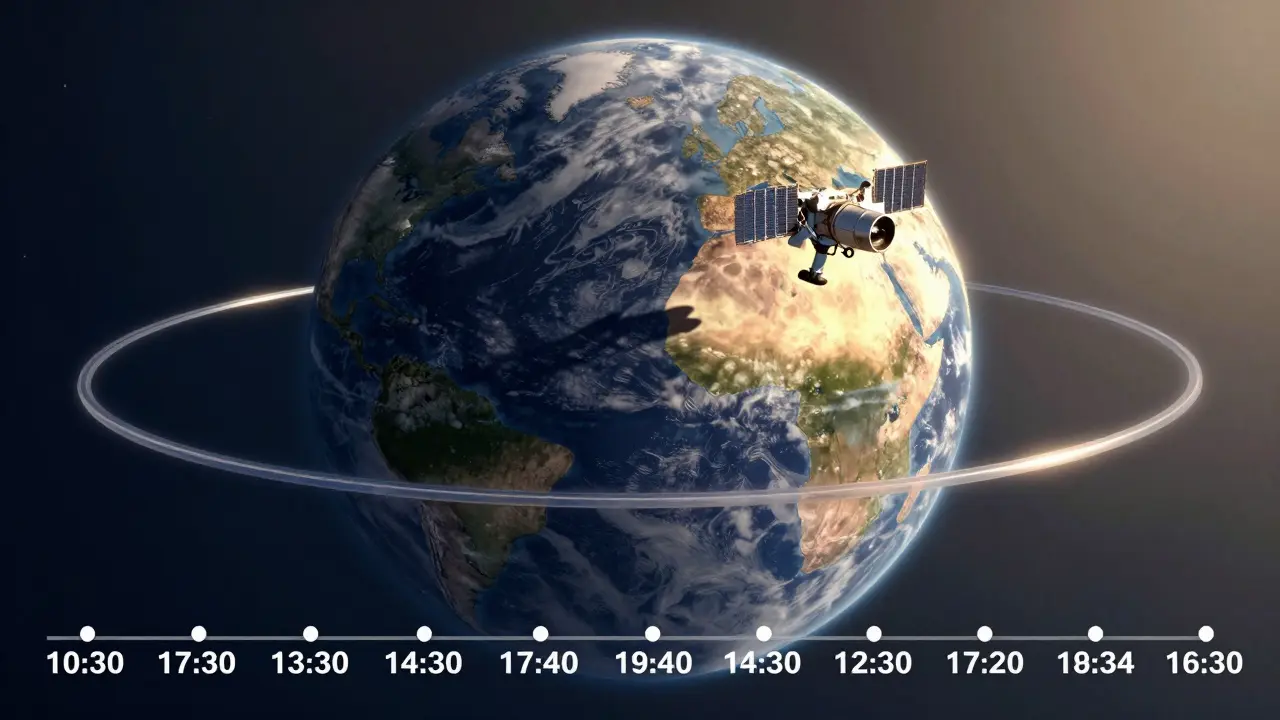
Here’s where it gets brilliant. A sun-synchronous orbit isn’t a special type of orbit-it’s just an orbit with RAAN drifting at exactly 360 degrees per year. That means the orbital plane rotates once every 12 months, keeping pace with the Sun’s position in the sky. The result? A satellite passes over the same city, forest, or ocean at the same local time every day. If it flies over New York at 10:30 AM local time today, it’ll do the same tomorrow, next week, next year.
This is why satellites like Landsat, Sentinel, and NOAA’s weather birds all fly in sun-synchronous orbits. Consistent lighting means you can compare images taken months apart without shadows or glare messing up the data. Farmers use it to track crop health. Scientists use it to measure ice melt. Firefighters use it to monitor wildfire spread. All because of a single, controlled drift.
How do you make it happen? You pick the right inclination. For a circular orbit around 700 km altitude, you need an inclination of about 98.6 degrees. That’s retrograde-slightly more than 90, meaning the satellite flies from south to north over the equator, but overall moves westward relative to Earth. That’s the sweet spot where J2’s pull matches Earth’s yearly revolution around the Sun.
Why Not Just Use Thrusters?
You might think: why not just fire a rocket to adjust the orbit? Simple: fuel is heavy, expensive, and limited. A satellite with a 100 kg fuel tank might only last 5 years. But if you design the orbit right from the start, you don’t need to burn fuel at all. The Earth does the work for you.
That’s why mission planners don’t fight J2-they use it. They calculate the exact combination of altitude and inclination so that RAAN drift is exactly 0.9856 degrees per day (360°/365.25 days). No thrusters. No maintenance. Just physics doing its job.
Constellations and Formation Flying: Letting Gravity Do the Work
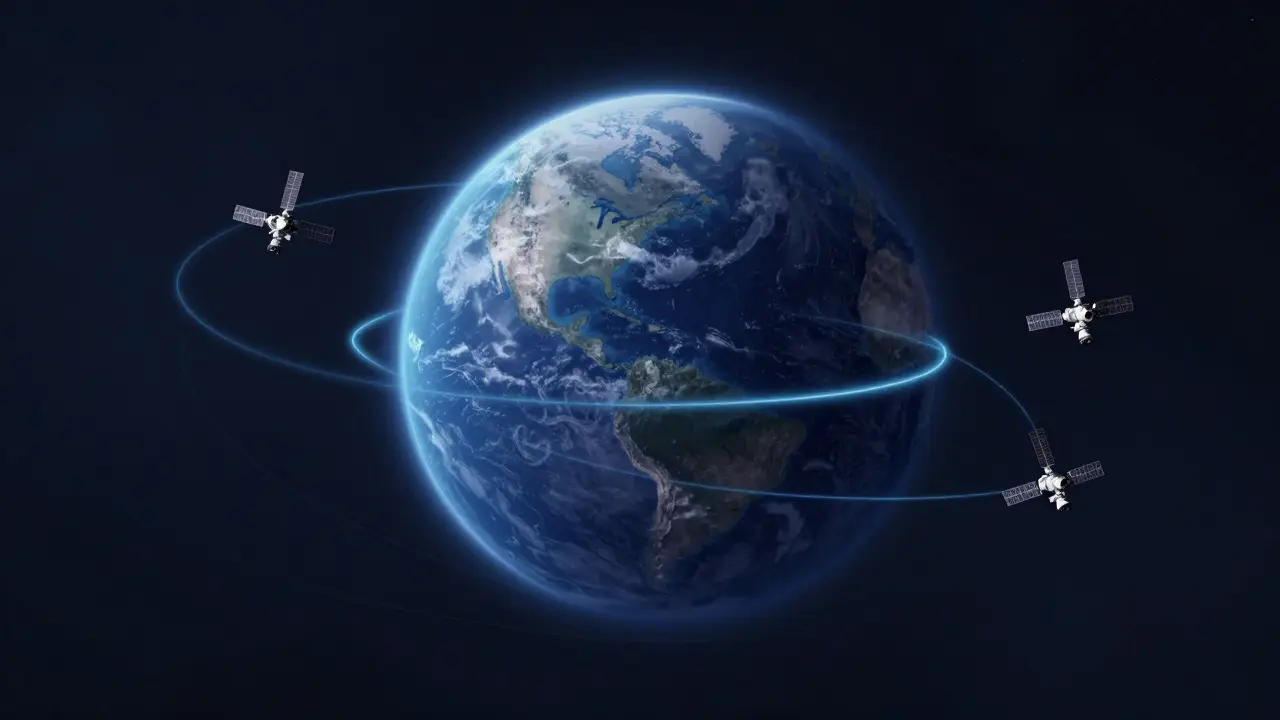
It gets even smarter. Satellite constellations-like Starlink or Planet Labs’ fleet-don’t launch all their satellites into the same plane. Instead, they launch them into slightly different altitudes. Because RAAN drift depends on altitude (higher orbits drift slower), each satellite slowly moves into its own plane over weeks or months. No thrusters needed. Just time and J2.
Researchers at Carleton University showed that if you model J2 properly, you can predict how two satellites will drift apart with astonishing accuracy. Old models assumed circular orbits and got things wrong. New models use real orbital shapes, including eccentricity, and can predict positions within meters-even after months. That’s how you keep satellites from colliding or drifting too far apart.
One study even showed that by choosing the right starting altitude, a satellite could naturally shift its RAAN by 30 degrees over 100 days-just by letting J2 act. That’s like steering without a steering wheel.
When the Math Breaks Down
Of course, it’s not perfect. Simple models can be off by kilometers after just a few orbits. Why? Because real orbits aren’t perfectly circular. They have small bumps and wobbles. If you ignore those, your predictions go haywire. The breakthrough came when engineers stopped treating orbital elements as fixed and started using osculating elements-real-time snapshots of the orbit’s actual shape and position. This tiny shift turned guesswork into precision.
Today, every serious satellite mission uses J2-perturbed models. NASA, ESA, and private companies all rely on them. The difference between a mission that lasts 10 years and one that fails in 2 is often just how well they modeled this one perturbation.
The Bigger Picture
RAAN drift isn’t a glitch to fix. It’s a tool. And J2 perturbation isn’t a problem-it’s an opportunity. By understanding how Earth’s shape tugs on satellites, we turn a natural irregularity into a precise, reliable system. From tracking climate change to monitoring crop yields to spotting wildfires before they spread, sun-synchronous satellites are quietly shaping our understanding of the planet.
And it all comes down to one simple truth: Earth isn’t round. And that’s exactly why we can see it so clearly.
What causes RAAN drift in satellites?
RAAN drift is caused by Earth’s oblateness-the fact that Earth bulges at the equator. This uneven shape creates a gravitational tug called the J2 perturbation, which slowly rotates the orbital plane over time. Unlike other forces, J2’s effect is predictable and depends only on the satellite’s altitude, inclination, and shape of its orbit.
How do sun-synchronous orbits stay in sync with the Sun?
They’re designed so that the J2-induced RAAN drift exactly matches Earth’s yearly motion around the Sun. This means the orbital plane rotates 360 degrees per year, keeping the satellite’s path aligned with the Sun’s position. As a result, the satellite always passes over the same location at the same local solar time-like 10:30 AM every day-ensuring consistent lighting for imaging.
Why is J2 the most important perturbation in low-Earth orbit?
J2 is over 1,000 times stronger than other gravitational irregularities (like J3 or J4). While atmospheric drag fades at higher altitudes and solar pressure varies with sunlight, J2 is constant and dominant. It’s the primary reason satellite orbits change shape over time, making it essential for accurate mission planning.
Can you change RAAN without using fuel?
Yes. By launching satellites into slightly different altitudes, you exploit the fact that RAAN drift rate changes with altitude. Higher orbits drift slower. Over weeks or months, this natural difference causes satellites to spread into different orbital planes-no thrusters needed. This method is used in satellite constellations to build coverage without active control.
Why do some satellite models fail to predict RAAN drift accurately?
Many older models assume circular, unchanging orbits. But real orbits have small eccentricities and wobbles. If you treat orbital elements as fixed, errors build up quickly-sometimes by kilometers within days. Modern models use osculating elements, which update the orbit’s true shape in real time, reducing errors dramatically and enabling precise formation flying and collision avoidance.
What’s Next?
The next generation of satellites won’t just use J2-they’ll optimize for it. New missions are being designed to drift into position using J2, not thrusters. Some are even using it to adjust their inclination slowly, letting gravity reshape their orbit over months. This isn’t science fiction. It’s routine engineering now.
And if you’re watching satellite images of melting glaciers, shifting coastlines, or growing cities-you’re seeing the quiet, invisible hand of J2 at work. Earth’s shape, once seen as a flaw, has become the most reliable tool we have to watch our planet change.
11 Responses
They don't want you to know this but the sun-synchronous orbit is just a cover. The real reason satellites stay in place is because the government planted hidden ion thrusters in every one of them. J2? That's a distraction. They're using this 'Earth bulge' nonsense to hide the fact that we're being watched 24/7 by AI drones that don't need fuel. Wake up.
I keep thinking about how beautiful it is that Earth's imperfection-this very real, physical bulge-is what lets us see our planet clearly. We spent centuries trying to make things perfect, and now we're using a flaw to understand change. That’s poetic. The planet isn't broken. It's helping us. I feel a deep gratitude for that.
Crazy how something as simple as a squished ball can do all this. I always thought space tech was all about fancy rockets and lasers. Turns out it's just gravity doing its quiet job. Kinda comforting, really. Like nature’s got our back. No need to overcomplicate it.
This entire article is a waste of time. J2? RAAN? You sound like a NASA pamphlet. Any real engineer just uses GPS and thrusters. Why overthink it? We have the tech. Let’s stop pretending physics is magic. Also, Ireland doesn’t need this crap. We got better things to do.
So basically we’re just letting gravity do the steering? Like a kid on a swing? Lmao. Why are we making this sound so complicated? It’s just physics doing its thing. No need for equations. Just let the Earth spin and the satellites drift. Genius. Or lazy. Depends if you’re a nerd or not.
Minor correction: the formula uses 'p' as the semi-latus rectum, not 'p' as in pressure. Also, 'Re' is Earth's equatorial radius, not mean radius. Small details matter. Don't want someone building a satellite based on misread symbols.
This is why American space agencies are so arrogant. They treat gravity like a tool instead of a force of nature. We don't 'use' J2-we respect it. In Europe, we’d call this an act of hubris. You’re not mastering the cosmos. You’re just lucky it’s predictable. And you still haven’t fixed the debris problem.
It is of paramount importance to note that the J2 perturbation, while significant, is not the sole determinant of orbital evolution. One must also account for lunisolar gravitational harmonics, atmospheric drag at perigee, and solar radiation pressure, particularly in the 500–800 km altitude regime. The conflation of dominant perturbation with exclusive driver is a common pedagogical oversimplification that may mislead novice orbital mechanicians.
I just cried reading this. I didn't even know I needed to know this. But now I get it. Earth isn't perfect. And that's why we can see wildfires, ice melting, crops dying. It's like the planet is whispering its secrets through gravity. I feel so connected to satellites now. Like they're my friends. Watching. Caring. Always at 10:30 AM. Thank you.
omg this is so cool!! i work with satellite data and never realized how much of it is just gravity doing the work 🤯 like we’re not even trying to control it, we’re just… letting it happen?? that’s wild. also ty for explaining RAAN like i’m 5 i finally get it now!!
The concept of utilizing natural gravitational perturbations for orbital maintenance is both efficient and scientifically sound. However, one must consider the long-term implications of relying on such passive systems, particularly in the context of increasing space traffic and potential collision risks. A prudent approach includes redundancy and active monitoring.