

Setting up voting rules in a DAO isn’t just about counting tokens-it’s about balancing power, preventing abuse, and making sure real people can actually shape the future of the protocol. Too many DAOs fail not because their code is broken, but because their voting rules are broken. You can have millions of tokens in circulation, but if 95% of them sit idle while 5% decide everything, you don’t have democracy. You have a dictatorship with a blockchain logo.
What Quorum Really Means
Quorum is the minimum percentage of voting tokens that must participate for a proposal to be valid. It’s not about how many people vote-it’s about how much of the total voting power shows up. Think of it like a town hall: if only three people show up out of 1,000 eligible voters, can they really make a decision for everyone? In DAOs, the answer is often yes-and that’s the problem.Early DAOs made a simple mistake: they set quorum as a percentage of total token supply. That included tokens locked in treasury, tokens held by founders, and tokens that had never been moved since launch. Uniswap learned this the hard way. When it launched, its 4% quorum was calculated against 40 million UNI tokens. But only about 10 million were ever actively used for voting. That meant the real quorum was closer to 16% in practice-far higher than intended. The result? Proposals kept failing not because people disagreed, but because they didn’t bother to vote.
Today, the sweet spot is 4% to 10%. Compound started at 10% and watched proposals die for months. They lowered it to 4%. Aave uses 2% for small changes and 6.5% for big ones. Why? Because not all decisions are equal. A treasury spend of $50,000 doesn’t need the same scrutiny as a change to the core smart contract.
Thresholds: How Much Approval Is Enough?
Once a proposal clears quorum, it still needs to pass. That’s where thresholds come in. This is the percentage of votes cast that must be in favor. It’s not based on total supply-it’s based on votes actually received.Simple majority (50%+1) works for minor changes: tweaking a fee, adding a new token to the treasury, or updating a documentation link. But when you’re changing how the protocol earns money or who can withdraw funds, you need more than a coin flip.
Most serious DAOs use tiered thresholds:
- 50%+ - Routine treasury spends under $100,000
- 66%+ - Major treasury spends over $1 million, tokenomics changes
- 75%+ - Core protocol upgrades, governance system changes
Bancor goes even further. For small co-investments (up to 100,000 BNT), it requires 80% approval. For larger ones, it drops to 66.7%. Why? Because adding $50,000 to a liquidity pool is less risky than adding $1 million. The system scales caution with scale.
But here’s the trap: high thresholds sound safe, but they can kill progress. If 75% is required for every change, even critical security fixes can get stuck. DAOs like Aragon and MakerDAO have seen proposals sit for months because they couldn’t reach 75%. The community agreed it was needed-but 25% of voters either didn’t care, didn’t understand, or were actively blocking it. That’s not consensus. That’s gridlock.

Turnout Is the Real Problem
You can set the perfect quorum and threshold. But if no one votes, they’re meaningless. The biggest threat to DAOs isn’t hackers-it’s apathy.Take Aave. A proposal to change a liquidity parameter passed with 92% approval. Sounds great, right? Except only 3% of the total token supply voted. That’s 92% of 3%. In real terms, a handful of wallets made a decision that affected millions. That’s not governance. That’s a vote by accident.
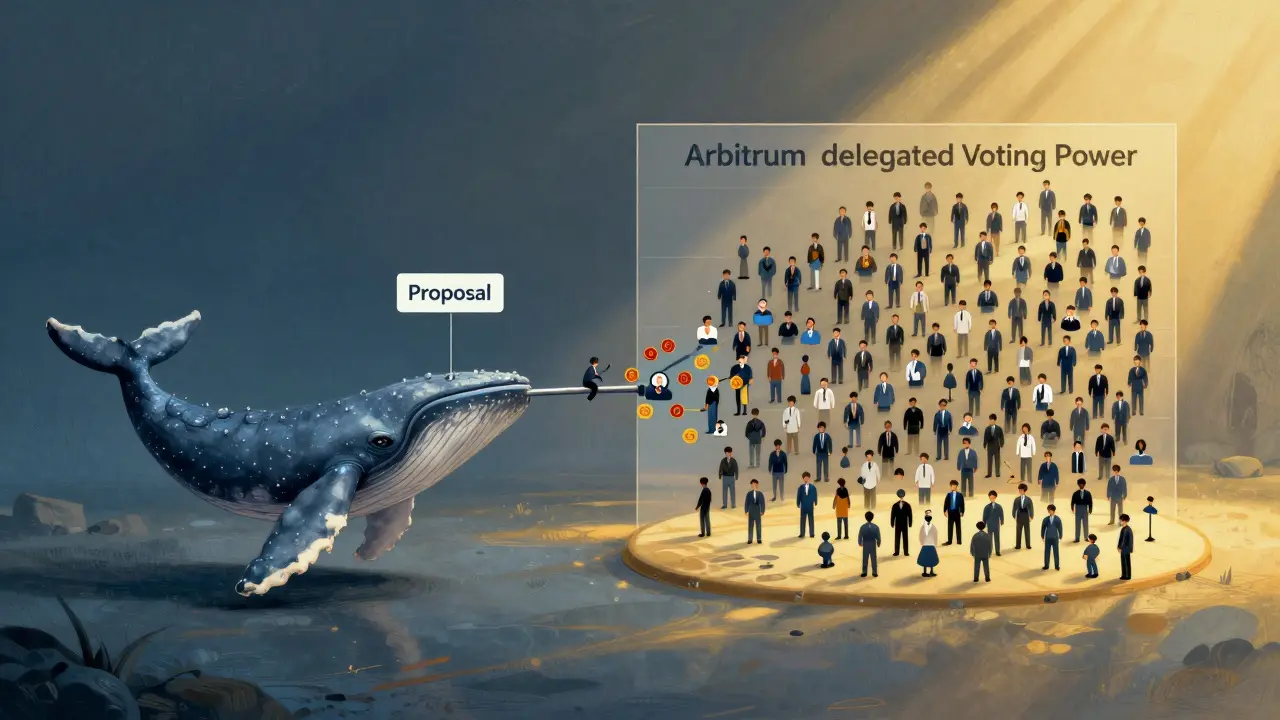
That’s why Arbitrum changed its model. Instead of using total ARB supply, it now uses delegated voting power (DVP). That means only tokens that have been delegated to active voters count toward quorum. If 100,000 ARB are delegated, the quorum is calculated against 100,000-not the 1.2 billion in circulation.
This fixes two big issues:
- It stops inactive wallets from artificially inflating the quorum requirement.
- It makes it easier for engaged voters to pass proposals because the bar is based on real participation, not theoretical supply.
Arbitrum’s system also includes floor and ceiling limits. The quorum can’t drop below 0.4% or rise above 0.5% of delegated power. That prevents extreme swings. If participation spikes, the bar rises. If it drops, the bar doesn’t collapse into chaos.
What Happens When You Get It Wrong
Yam Finance didn’t survive its first week. Why? Its quorum was set at 5% of total supply-including 20% of tokens locked in the treasury that couldn’t vote. The math was impossible. No proposal could ever reach quorum. The DAO was dead before it started.Other DAOs face different disasters:
- Too low quorum (below 4%) - A single whale with 5% of tokens can pass any proposal. No one else needs to vote. That’s why Uniswap raised its threshold after a whale pushed through a harmful proposal.
- Too high quorum (over 20%) - Governance becomes paralyzed. Proposals die not because they’re bad, but because no one has time to vote. Status quo wins. Innovation dies.
- No tiered thresholds - A $100,000 spend and a $10 million treasury raid both need 50% approval. That’s reckless.
And then there’s the delegate problem. Tally’s research found that DAOs need at least 5-10 delegates with enough voting power to submit proposals. If only 3 people can even create a vote, you’re not a DAO-you’re a committee with 10,000 followers.
How to Set Your Own Rules
If you’re building or joining a DAO, here’s how to avoid the pitfalls:- Start with 5% quorum - It’s high enough to prevent abuse, low enough to allow participation.
- Use tiered thresholds - 50% for small things, 66% for medium, 75% for critical changes.
- Use delegated voting power - Only count tokens that are actively delegated. Ignore locked or inactive supply.
- Set floor and ceiling limits - No quorum below 3%, no quorum above 10%. This keeps things stable.
- Monitor for 3 months - Track actual turnout. If only 2% of voters show up for every vote, lower the quorum. If 15% show up, raise it.
- Don’t copy Uniswap blindly - Their 4% works because they have 40 million active voters. Your DAO might have 500. Adjust accordingly.
DAO governance isn’t a one-time setup. It’s a living system. You wouldn’t build a car and never change the oil. Don’t build a DAO and never adjust its voting rules.
What’s Next?
The future of DAO voting isn’t just about percentages. It’s about how people vote. Quadratic voting, conviction voting, and holographic consensus are being tested. These systems give more weight to passionate, long-term participants-not just big wallets.But until then, the basics still matter. Get quorum right. Get thresholds right. Get turnout right. The rest will follow.
What’s the difference between quorum and threshold in a DAO?
Quorum is the minimum percentage of voting tokens that must participate for a proposal to be valid. Threshold is the minimum percentage of votes cast that must be in favor for the proposal to pass. Quorum stops proposals from passing with no participation. Threshold ensures that even if people vote, they must overwhelmingly agree.
Why do some DAO proposals fail even when most voters support them?
Because they didn’t meet quorum. If only 3% of tokens vote, and the quorum is set at 5%, the proposal fails-even if 95% of those 3% voted yes. The system doesn’t care how many voted yes; it cares how many voted at all.
Can a single wallet control a DAO’s votes?
Yes-if quorum is too low and thresholds are weak. A wallet holding 5% of tokens can pass any proposal with 50% threshold if no one else votes. That’s why top DAOs use quorums above 4% and thresholds above 66% for major changes. Some also limit how much one wallet can delegate to prevent centralization.
What’s delegated voting power (DVP), and why is it better?
DVP calculates quorum based only on tokens that have been delegated to active voters, not the total token supply. This prevents inactive or locked tokens from inflating the voting bar. It makes governance more responsive and harder to block by abstention. Arbitrum’s switch to DVP reduced the number of delegates needed to pass proposals and lowered the risk of coordinated boycotts.
How often should DAO voting rules be changed?
Every 6 to 12 months. If turnout drops below 2%, lower the quorum. If whales are passing everything, raise thresholds. DAOs like Compound and Uniswap have adjusted their rules multiple times based on real data-not guesswork. The best governance systems evolve as the community grows.
14 Responses
Let’s be real-most DAOs are just thinly veiled venture funds with a blockchain sticker. Quorum isn’t about democracy; it’s about preventing whales from pulling a fast one. But here’s the kicker: if your quorum is set against total supply, you’re basically designing a system where 95% of participants are expected to be passive spectators. That’s not governance. That’s a performance art piece called 'The Illusion of Decentralization.'
Compound’s shift from 10% to 4% wasn’t a technical tweak-it was a recognition that participation is a feature, not a bug. You can’t expect people to show up if the bar is set at ‘run a marathon in a snowstorm.’
they’re all rigged. the whole thing. the 4% thing? that’s just a cover. the real voters are all in a discord server somewhere with the devs. you think uniswap’s ‘community’ votes? nah. it’s 3 wallets with 120k keys. they just make it look like democracy so you keep using their app.
Delegated voting power? That’s just a backdoor for oligarchs. You think Arbitrum’s system is better? It’s worse. Now instead of one whale controlling everything, you have five whales controlling everything through proxies. They call it ‘delegation’ but it’s just feudalism with gas fees. And don’t get me started on the floor and ceiling limits-that’s algorithmic tyranny. Who the hell designed this? A bureaucrat with a crypto wallet?
Remember when Ethereum tried to do governance? It collapsed because people realized: if you can’t vote with your feet, you’re not free. You’re just a shareholder in a corporation that pretends to be decentralized.
The elegance of DAO governance lies not in the mathematical precision of thresholds or quorums, but in the emergent social contract that arises from consistent, transparent participation. When we anchor quorum to total token supply, we inadvertently institutionalize apathy as a structural feature of the system. This is not an oversight-it is a design flaw rooted in a fundamental misreading of human behavioral economics.
Delegated Voting Power, as implemented by Arbitrum, represents a paradigmatic shift: it transforms governance from a static, supply-based metric into a dynamic, participation-driven feedback loop. By recalibrating the denominator to reflect only those tokens actively engaged in the governance process, we reintroduce agency-agency that is neither theoretical nor aspirational, but empirically observable and quantifiable.
Moreover, the introduction of floor and ceiling limits introduces a stabilizing mechanism reminiscent of negative feedback in control systems. This prevents both the tyranny of low participation and the paralysis of excessive consensus requirements. It is, quite frankly, one of the most sophisticated institutional innovations in decentralized governance since the advent of quadratic funding.
What is often mistaken for ‘complexity’ is, in fact, resilience. And resilience, in systems theory, is not a luxury-it is a prerequisite for longevity.
Quorum should be based on active voters, not total supply. Simple.
so like… if i dont vote, i’m just… contributing to the system? like, my inactive tokens are basically doing a silent protest? lol. also, 75% for core upgrades? that’s not consensus, that’s a hostage situation. if one guy says no, the whole thing dies? that’s not governance, that’s a bad group project.
Oh wow, another whitepaper on how to make blockchain voting less broken. Newsflash: people don’t care. You think a 4% quorum fixes anything? Nah. It just makes it easier for the same 50 people to keep running things. And don’t even get me started on ‘delegated voting power’-that’s just a fancy word for ‘let the influencers decide for you.’
DAOs are just corporate boards with extra steps. The real power is still in the dev wallets. You can tweak numbers all day, but until you break the dev-team monopoly, you’re just rearranging deck chairs on the Titanic.
heard about aave passing a proposal with 3% turnout. 92% of that 3% voted yes. so… 2.76% of all tokens decided a change that affects everyone. that’s not democracy. that’s a whisper in an empty room.
There is a deeper philosophical tension here that transcends technical parameters. Governance in DAOs is not merely a mathematical exercise-it is an existential negotiation between individual autonomy and collective survival. When we set quorum against total supply, we are, in effect, demanding that every token holder, regardless of engagement, bear the moral weight of every decision.
This is a form of epistemic violence. It assumes that all participants are equally capable, equally informed, and equally invested. But human beings are not fungible assets. Some are builders. Some are observers. Some are simply trying to survive.
Delegated Voting Power does not solve this-it acknowledges it. By allowing engagement to define legitimacy, we honor the reality that governance must emerge from lived participation, not from the ghostly presence of dormant wallets. This is not a hack. It is a philosophy made code.
4% quorum? That’s laughable. You think that stops whales? I’ve seen wallets with 12% of total supply pass proposals with zero opposition. And the ‘tiered thresholds’? Pure theater. If you’re not requiring 80% for anything that moves more than $500k, you’re not protecting the treasury-you’re just delaying the inevitable.
Also, why are we still using token-weighted voting? It’s 2025. We have quadratic voting. Conviction voting. Even simple one-person-one-vote would be better than letting a single whale buy a majority.
agree with paul. quorum should be active voters. also, 5% is fine to start. no need to overcomplicate. just let people vote if they care. if they don’t, that’s fine. don’t make it a chore.
irish people don’t even vote in real elections. why would we think they’ll vote on a blockchain? this whole thing is a rich guy’s game. they’ll tweak numbers till they get the outcome they want. then call it ‘community driven.’
the 4% thing works for uniswap because they have millions of users. if your dao has 200 people, 4% is like 8 people. so if 5 of them are in a group chat, they own the whole thing. stop copying uniswap. build for your community. not their fantasy.
you’re missing the point. the real issue isn’t the numbers. it’s the lack of onboarding. if people don’t know how to vote, or why it matters, no quorum or threshold will help. fix education first. then tweak the math.