
Imagine you’re flying a spacecraft to the edge of our solar system. You can’t see Earth anymore-it’s just another star in the sky. Your radio link to mission control is weak, delayed by hours, or maybe broken entirely. So, how do you know where you are? For decades, we relied on huge ground antennas and precise timing signals from home. But there’s a better way that doesn’t need us to look back at Earth at all. It looks up.
X-ray Pulsar Navigation, often called XNAV, uses rapidly spinning neutron stars as natural GPS satellites. These stars, known as millisecond pulsars, flash X-rays with such extreme regularity that they rival atomic clocks. By measuring when these flashes arrive at your spacecraft, you can calculate your position anywhere in the galaxy without talking to anyone on Earth. This isn’t science fiction; it’s been tested on the International Space Station, and it’s the future of deep-space autonomy.
Why We Need Natural GPS Satellites
Current deep-space navigation relies heavily on the Deep Space Network (DSN). That’s a giant array of massive dish antennas on Earth that track probes using radio waves. It works great, but it has limits. The DSN is expensive, busy, and requires constant communication between the probe and Earth. If a probe goes behind Jupiter or Mars, the signal gets blocked. If the antenna breaks, you’re blind.
Then there’s GPS. You might think, "Can’t I just use GPS?" No. GPS satellites orbit Earth. Their signals fade out quickly beyond low Earth orbit. At the Moon, GPS is barely usable. At Mars, it’s useless. XNAV solves this because pulsars are everywhere. They don’t care if you’re near Earth or halfway to Pluto. They provide an absolute reference frame that doesn’t degrade with distance.
This method is passive. Your spacecraft doesn’t send anything out; it just listens. This saves power and reduces complexity. More importantly, it gives you independence. You aren’t waiting for a command from Houston to correct your course. You fix it yourself, in real-time, based on data from the cosmos itself.
How Neutron Stars Become Cosmic Clocks
To understand XNAV, you have to look at what a pulsar actually is. When a massive star dies, its core collapses into a city-sized ball of neutrons-about 20 kilometers across but more massive than our Sun. This object spins incredibly fast, sometimes hundreds of times per second. As it spins, it shoots beams of radiation like a lighthouse. If one of those beams sweeps past Earth, we see a pulse.
Most pulsars are noisy. They glitch, slow down, or speed up unpredictably. But millisecond pulsars are different. They’ve been spun up by feeding off material from a companion star, smoothing out their rotation. Some are so stable that they lose less than one second every million years. That stability is key. If the clock ticks irregularly, your position calculation fails.
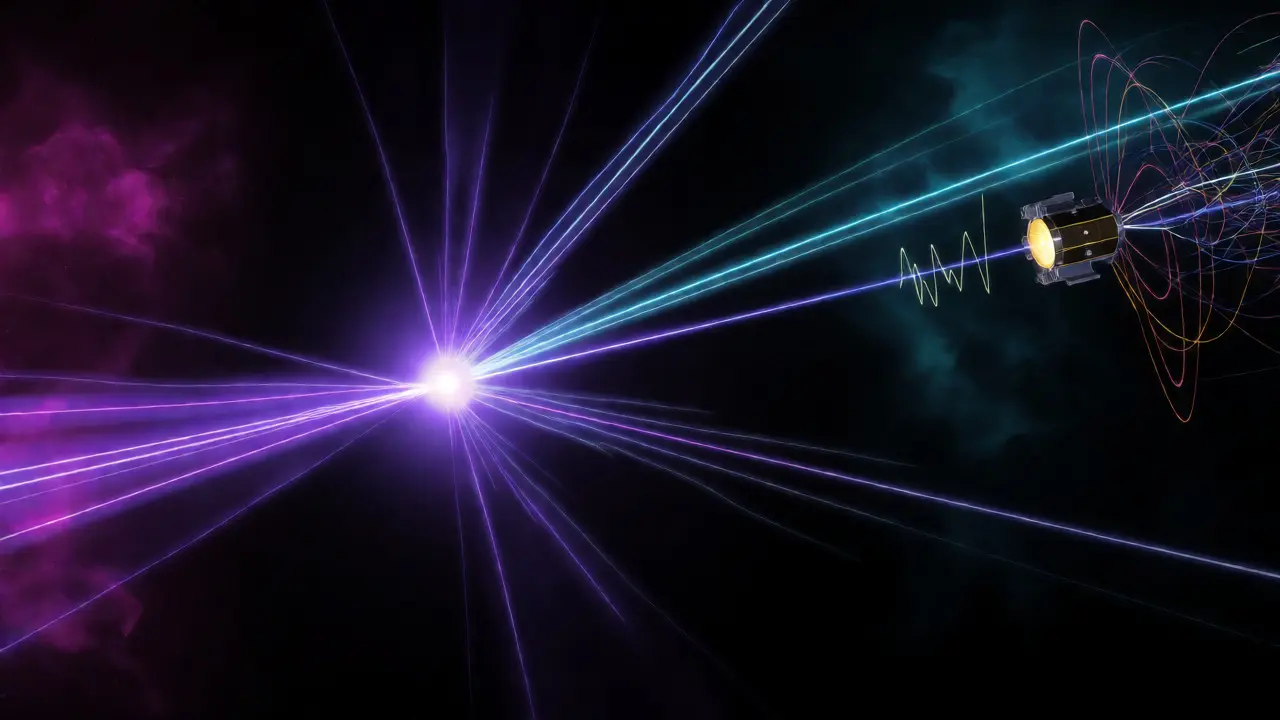
The spacecraft carries a detector sensitive to X-rays. It counts individual photons arriving from specific directions. Because the pulses are periodic, the computer can "fold" the arrival times against a known period, creating a profile that shows exactly where the peak of the pulse occurred. Comparing this observed time to the predicted time tells you how far away you are along that line of sight.
The Math Behind the Magic
Navigation here is really about timing. Light travels at about 300,000 kilometers per second. That means a tiny error in time translates to a big error in distance. One microsecond of timing error equals roughly 300 meters of position error. Ten microseconds? Three kilometers. A millisecond? Three hundred kilometers.
So, why not just use radio waves? Radio pulses from pulsars travel through interstellar gas, which slows them down slightly depending on frequency-a phenomenon called dispersion. Correcting for this requires knowing exactly how much gas is between you and the star, which changes over time. X-rays don’t suffer from this dispersion. They travel straight and true. This makes X-ray timing cleaner and easier to process onboard.
To get a full 3D position (latitude, longitude, altitude), you need data from multiple sources. Just like GPS needs four satellites, XNAV typically needs three or four well-spaced pulsars. With one pulsar, you only know your distance along that one line. Add a second, and you narrow it down to a circle. Add a third or fourth, and you pinpoint your location in space.
Real-World Tests: From ISS to China
You might wonder if this actually works outside of simulations. It does. In 2017, NASA’s SEXTANT experiment aboard the International Space Station proved it. Using the NICER instrument, the station tracked four pulsars and calculated its own orbit autonomously. It achieved accuracy better than 10 kilometers without any help from ground-based tracking systems. For a spacecraft moving at 8 kilometers per second, that’s impressive precision derived purely from starlight.
China also jumped into the game with XPNAV-1, launched in late 2016. This satellite focused on observing the Crab Nebula pulsar. While the Crab is bright and easy to detect, it’s not the most stable clock. Still, the mission successfully recorded millions of X-ray events and demonstrated that space-based detectors could capture the necessary data. Later processing showed position accuracies around 38 kilometers, proving the hardware works even if the source selection matters greatly.
| Method | Dependency | Range Limit | Autonomy Level | Key Limitation |
|---|---|---|---|---|
| Deep Space Network (DSN) | Earth Ground Stations | Unlimited (with line of sight) | Low (Requires Earth interaction) | Signal delay, bandwidth limits, cost |
| Optical Navigation | Visible Planets/Moons | Near target bodies | Medium | Needs illuminated targets, poor in dark space |
| X-ray Pulsar Nav (XNAV) | Neutron Stars | Galactic | High (Fully onboard) | Weak signals, requires large detectors |
| Inertial Navigation | Internal Gyros/Accelerometers | Short term only | High | Drift accumulates over time |

The Hardware Challenge: Catching Faint Whispers
If XNAV is so great, why isn’t every probe using it? The problem is signal strength. X-rays from distant pulsars are scarce. Most detectors used today, like those on NICER, are large and heavy. To get good accuracy quickly, you need a big collecting area. A small sensor means you have to wait longer to gather enough photons to trust the timing.
Engineers are working on smaller, lighter sensors. Concepts suggest instruments weighing under 4 kilograms and drawing less than 4 watts could work for deep-space missions, though with reduced performance. The trade-off is clear: bigger detector means faster fixes and higher accuracy. Smaller detector means longer observation times and potentially larger errors.
There’s also the issue of choosing the right stars. The Crab Pulsar is bright but unstable. Millisecond pulsars are stable but faint. Missions must carefully select a set of pulsars that balances brightness with long-term timing stability. This requires maintaining an onboard catalog of pulsar parameters, which must be updated periodically as models improve.
Where XNAV Fits in the Future of Exploration
XNAV won’t replace the DSN tomorrow. It’s not meant to. Instead, it acts as a backup and an enabler for new types of missions. Imagine a swarm of small satellites exploring the asteroid belt. They can’t all call home constantly due to bandwidth limits. Each one can navigate itself using pulsars, forming a network that stays coordinated without central control.
For crewed missions to Mars, XNAV provides a critical safety net. If communications fail during a solar storm, astronauts still know where they are relative to Earth and Mars. It also helps with formation flying, where multiple spacecraft need to maintain precise distances from each other in deep space.
As of October 2026, no major deep-space probe uses XNAV as its primary system. But it’s no longer theoretical. It’s a validated technology moving toward operational adoption. The focus now is on improving detector efficiency, reducing mass, and refining the software algorithms that turn raw photon counts into smooth, reliable navigation solutions.
Is X-ray Pulsar Navigation accurate enough for landing on Mars?
Currently, XNAV provides kilometer-level accuracy, which is great for cruise phases but not precise enough for final landing maneuvers. Landing requires meter-level precision, usually provided by optical navigation and radar altimeters near the planet. XNAV is best used for getting close to the target, after which traditional methods take over for the final descent.
Do pulsars ever stop emitting X-rays?
Yes, eventually. Pulsars slow down over millions of years and may stop emitting detectable high-energy radiation. However, the timescales involved are vastly longer than human spaceflight missions. For the next few centuries, the selected millisecond pulsars will remain stable enough for navigation purposes.
Can XNAV work if my spacecraft is rotating?
Yes, but it complicates things. The spacecraft needs to know its attitude (orientation) precisely to point the detector at the right part of the sky. Modern spin-stabilized spacecraft can modulate the signal and decode it, but three-axis stabilized platforms with fixed detectors are generally easier to operate for XNAV tasks.
Why not use visible light instead of X-rays?
Visible light from pulsars is extremely dim compared to their X-ray emissions. X-rays allow for sharper timing resolution and are less affected by interstellar dust scattering than radio waves. While optical telescopes are common, they struggle to pick up the faint, rapid pulses needed for high-precision timing without very large apertures.
Is XNAV affected by black holes or gravity wells?
Gravity affects the path of light and the rate of time, so yes, general relativity plays a role. Navigation software accounts for these effects using relativistic models. The Solar System Barycenter model includes corrections for gravitational potential differences, ensuring that timing residuals reflect position rather than just gravity-induced delays.