
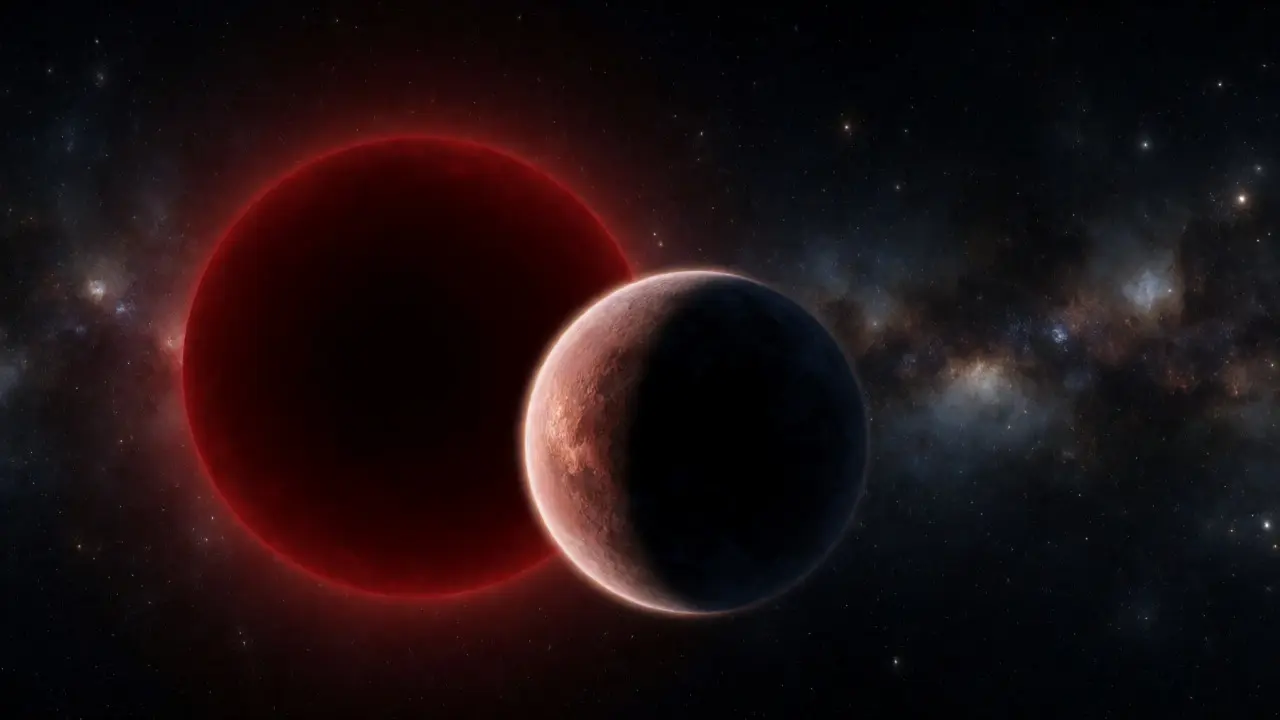
Imagine looking up at the night sky and knowing that just next door, in cosmic terms, sits a rocky world potentially capable of supporting life. That world is Proxima Centauri b, an exoplanet orbiting Proxima Centauri, the closest star to our Sun. Discovered in 2016, it remains the nearest known planet outside our solar system, sitting roughly 4.2 light-years away. While science fiction often paints nearby stars as easy destinations, the reality of Proxima b is far more complex and fascinating than a simple "second Earth." It challenges our understanding of planetary formation, stellar activity, and what it truly means for a planet to be habitable.
The Discovery of Our Nearest Neighbor
Finding planets around other stars is incredibly difficult because they are tiny, dim, and lost in the glare of their host stars. For decades, astronomers relied on detecting the subtle wobble of a star caused by the gravitational pull of an orbiting planet. This method, known as radial velocity or Doppler spectroscopy, requires extreme precision. In 2016, a team led by Guillem Anglada-Escudé from Queen Mary University of London announced the discovery of Proxima b using this technique. They utilized data from the HARPS spectrograph at the European Southern Observatory’s La Silla facility in Chile, combined with observations from the Very Large Telescope.
The campaign, famously named "Pale Red Dot," involved nearly nightly observations over several months. The goal was to detect the minute shift in Proxima Centauri’s light spectrum caused by the tug of a planet. The signal they found indicated a planet with a minimum mass about 1.3 times that of Earth, orbiting its star every 11.2 days. This wasn't just another distant dot; it was right on our doorstep. The proximity makes it the most studied exoplanet in history, serving as a benchmark for how we detect and characterize worlds around small, cool stars.
Orbiting a Volatile Red Dwarf
To understand Proxima b, you must first understand its parent star. Proxima Centauri is an M-type red dwarf star, significantly smaller and cooler than our Sun. With only about 12% of the Sun’s mass, it emits much less energy. Consequently, the "habitable zone"-the region where liquid water can exist on a planet's surface-is much closer to the star than it is for the Sun. Proxima b orbits at just 0.05 astronomical units (AU), which is roughly one-twentieth of the distance between Earth and the Sun.
This close orbit creates unique conditions. Because the planet is so near its star, it is likely tidally locked. This means one side always faces the star, experiencing perpetual daylight, while the other side is in eternal darkness. On such a planet, weather patterns would be extreme. Winds might blow constantly from the hot day-side to the cold night-side. However, models suggest that if the planet has a thick atmosphere or oceans, heat could be redistributed effectively, preventing the atmosphere from freezing out on the dark side. This dynamic climate system is a major area of theoretical research, as we have never observed a tidally locked terrestrial planet directly.

The Flare Problem: A Hostile Environment?
While Proxima b sits in the habitable zone, living there would not be like living on Earth. Red dwarfs are notoriously active. Proxima Centauri frequently unleashes powerful flares-explosions of radiation and charged particles. In 2018, researchers detected a massive flare that increased the star’s brightness at millimeter wavelengths by hundreds of times. During such events, high-energy X-rays and ultraviolet radiation bombard the planet. Studies indicate that the radiation environment on Proxima b could be tens to hundreds of times more intense than what Earth receives today.
This raises a critical question: Can a planet retain an atmosphere under such constant assault? Without a strong magnetic field to deflect these stellar winds, the atmosphere could be stripped away over billions of years. If Proxima b lost its air, it would be a barren rock, similar to Mars but even harsher. Conversely, if it formed with a massive ocean or developed a dense secondary atmosphere, it might shield its surface from sterilizing radiation. We currently do not know which scenario is true. The lack of direct atmospheric data means we are relying on computer simulations, some optimistic and others quite pessimistic.
| Parameter | Earth | Proxima Centauri b |
|---|---|---|
| Host Star Type | G-Type Yellow Dwarf | M-Type Red Dwarf |
| Distance from Star | 1 AU | ~0.05 AU |
| Orbital Period | 365 days | 11.2 days |
| Minimum Mass | 1 Earth Mass | ~1.3 Earth Masses |
| Stellar Activity | Moderate | High (Frequent Flares) |
| Tidal Locking | No | Likely Yes |
Why We Haven't Seen Its Atmosphere Yet
You might wonder why we haven't just pointed a telescope at Proxima b and taken a picture. The problem is contrast. The planet is extremely faint compared to its bright host star, and they appear very close together in the sky. Furthermore, Proxima b does not transit its star from our perspective. Transits occur when a planet passes directly in front of its star, blocking a tiny fraction of light. This event allows astronomers to analyze the starlight filtering through the planet's atmosphere, revealing chemical signatures like oxygen or methane. Since Proxima b doesn't cross our line of sight, this powerful tool is unavailable.
Instead, scientists rely on indirect methods. They measure the planet's mass via radial velocity, which gives a lower limit on its size. Using mass-radius relationships, they estimate whether it is rocky, gaseous, or icy. Recent upgrades to instruments like ESPRESSO have improved the precision of these measurements, confirming the planet's existence and refining its orbital parameters. But until we build telescopes large enough to separate the planet's light from the star's glare-such as the upcoming Extremely Large Telescopes-we will remain blind to its actual surface conditions and atmospheric composition.
The Interstellar Travel Reality Check
Proxima b's fame often leads to the misconception that we could visit it soon. At 4.2 light-years away, it is the closest destination beyond our solar system. However, light itself takes four years to make the trip. With current chemical rocket technology, a probe would take tens of thousands of years to arrive. Even ambitious concepts like laser-propelled sails, proposed by initiatives like Breakthrough Starshot, aim to send gram-scale cameras at 20% the speed of light. Even then, the journey would take about 20 years, followed by another 4 years for the data to return home.
For now, Proxima b is a target for remote sensing. Its proximity allows us to study it better than any other exoplanet, providing insights into how common rocky worlds are around the most abundant type of star in the galaxy. Red dwarfs make up about 70% of all stars in the Milky Way. If planets like Proxima b are common, then the universe is teeming with potential habitats, even if many are hostile. Understanding this specific planet helps us interpret the broader census of galactic planets.
Is Life Possible on Proxima b?
The debate over life on Proxima b is heated among experts. Optimists point to the planet's location in the habitable zone and its Earth-like mass. They argue that subsurface oceans could protect life from surface radiation, much like extremophiles survive deep in Earth's crust. Pessimists highlight the cumulative effect of billions of years of high-energy flares, suggesting the surface is sterile and the atmosphere gone.
What is clear is that Proxima b defies simple categorization. It is not a twin of Earth, nor is it necessarily a dead rock. It represents a new class of planetary environments that we are only beginning to comprehend. As we await next-generation observatories, each new piece of data reshapes our expectations. Whether it hosts microbial life or is a desolate wasteland, Proxima b forces us to rethink the boundaries of habitability in the cosmos.
How far is Proxima Centauri b from Earth?
Proxima Centauri b is approximately 4.2 light-years away from Earth. This makes it the closest known exoplanet to our solar system, located within the Alpha Centauri triple star system.
Can humans live on Proxima Centauri b?
It is uncertain. While it lies in the habitable zone, the frequent and intense stellar flares from its red dwarf host star may strip away the atmosphere and expose the surface to lethal radiation. Additionally, tidal locking could create extreme temperature differences between the day and night sides.
How long would it take to travel to Proxima Centauri b?
With current chemical propulsion technology, a trip would take tens of thousands of years. Advanced concepts like laser-sailed probes could theoretically reduce this to around 20 years, but such technology is still in development.
Has Proxima Centauri b been photographed?
No, Proxima Centauri b has not been directly imaged. It is too faint and too close to its bright host star for current telescopes to resolve separately. Most knowledge comes from indirect detection methods like radial velocity measurements.
What kind of star does Proxima Centauri b orbit?
It orbits Proxima Centauri, which is an M-type red dwarf star. These stars are smaller, cooler, and more magnetically active than our Sun, posing significant challenges for planetary habitability due to frequent solar flares.
13 Responses
oh wow another article about a planet we can't actually visit without dying of old age first but hey at least it's close right? i mean if you squint hard enough and ignore the fact that your star tries to kill you every few days it sounds kinda cozy. i love how we keep hyping up these exoplanets like they're just waiting for us to move in with our furniture. maybe next time they'll tell us it has wifi too.
the tidal locking part is often misunderstood by people who haven't read beyond the headlines. models suggest that atmospheric circulation could prevent the night side from freezing completely which is crucial for habitability. also worth noting that red dwarfs are the most common stars so understanding proxima b helps us understand the majority of planetary systems in the galaxy
it's not habitable. stop pretending it is. radiation strips atmospheres. end of story.
wait but what if the magnetic field is super strong?? 🤔 i feel like we always assume the worst case scenario but nature is weird and wonderful ✨ maybe there are microbes hiding under the ice on the dark side!! 🥺💕 science is just guessing sometimes isn't it?? 🌌🔭
Actually, the assumption of a strong magnetic field is speculative at best. While Earth's magnetosphere protects us, Proxima Centauri b orbits within the heliosphere of its host star, which is much more compact than ours. The stellar wind pressure is significantly higher. Furthermore, recent studies using ESPRESSO data have refined the mass estimates, suggesting it might be slightly denser than initially thought, which could imply a larger core and potentially a stronger dynamo effect, but this is far from confirmed. We simply do not have direct observational evidence of an atmosphere yet, let alone its composition or protective capabilities. To state definitively that life is impossible ignores the resilience of extremophiles on Earth, but to claim it is likely habitable ignores the harsh reality of M-dwarf activity. It is a balance of probabilities, not a binary yes/no.
i think it's cool that we even know it exists honestly. doesn't matter if we can live there tomorrow. just knowing there's something else out there makes the universe feel less lonely. plus the science behind finding it was pretty neat.
yeah exactly. the journey is the destination kind of thing. we learn so much just by looking. no need to rush moving house lol
everyone acts like 4 light years is nothing. it's basically infinity for humans. we can barely get to mars without a lot of drama. sending a probe takes decades. getting back takes longer. it's useless for colonization. it's only useful for astronomy nerds. which i respect but don't sell me on 'new earth' nonsense.
You are missing the bigger picture here! This discovery validates the radial velocity method and proves we can find Earth-mass planets around small stars. That is HUGE for statistical analysis of galaxy-wide habitability! We aren't trying to colonize it tomorrow; we are building the dataset that tells us where to look next! Every bit of data brings us closer to understanding our place in the cosmos! Let's focus on the progress rather than the immediate limitations!
It is imperative to maintain a sense of proportion regarding these astronomical findings. While the scientific community rightly celebrates the detection of Proxima Centauri b, the public discourse often suffers from a severe lack of contextual understanding. The term "habitable zone" is frequently misinterpreted as synonymous with "habitable," which is a fundamental error in logic. One must consider the immense technological hurdles involved in interstellar travel, not to mention the biological implications of prolonged exposure to high-energy radiation. Until we possess the means to directly image the planet's atmosphere, any assertion regarding its suitability for human life remains purely theoretical and speculative at best.
I appreciate the clarity provided in this discussion. It is indeed vital to distinguish between potential habitability and confirmed livability. However, I would encourage everyone to remain open to the possibility that our current models may be incomplete. History has shown that assumptions about celestial bodies often change dramatically with new data. Let us support the ongoing research with patience and curiosity rather than definitive skepticism or unwarranted optimism.
we should've found it first. americans invented the telescope basically. anyway good job europeans stealing our thunder again. still better than china finding stuff we missed.
hey at least we're all looking at the same sky right now. that's pretty special. keeps things grounded while we dream big