
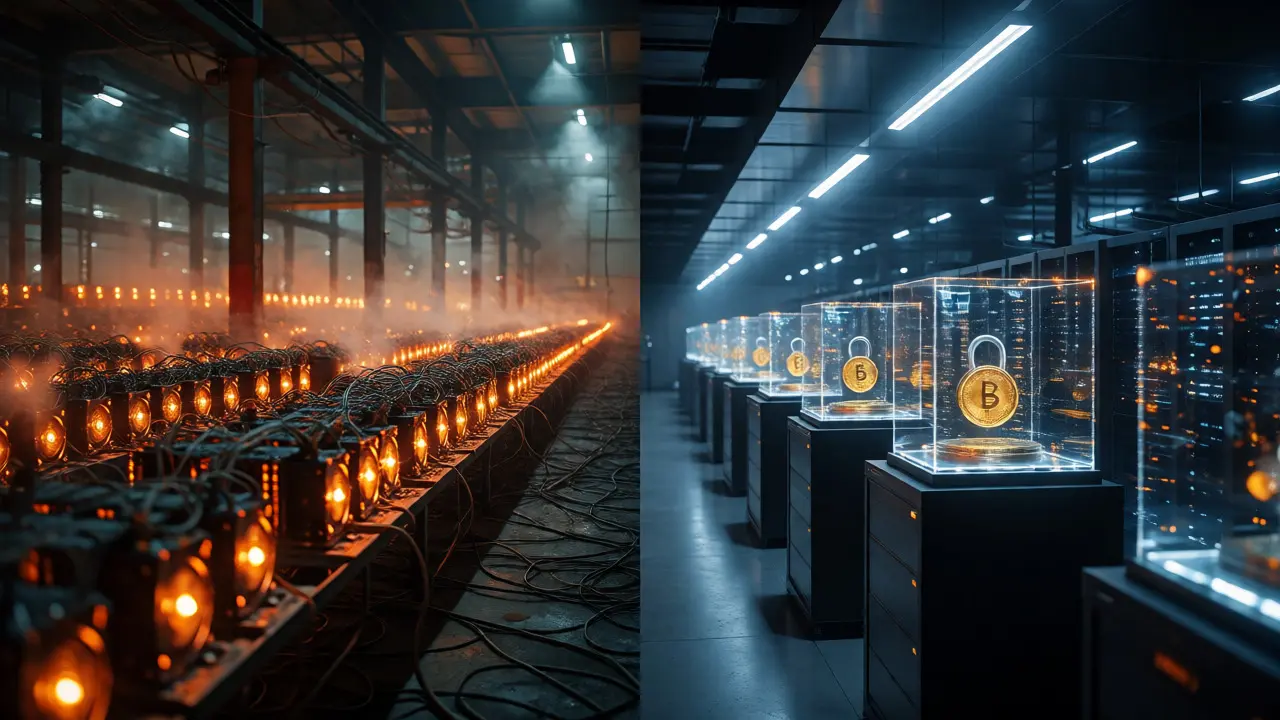
Imagine you’re trying to decide which version of history is real. In the physical world, we have records, witnesses, and laws. In cryptocurrency, we have two main ways to agree on truth: Proof-of-Work (PoW) and Proof-of-Stake (PoS). One burns electricity to lock in facts; the other locks up money to do the same job. Neither is perfect, but understanding how they differ helps you grasp why Bitcoin feels like digital gold while Ethereum acts more like a global computer.
You might wonder why this matters if you just want to buy or sell coins. The answer lies in security and cost. If the system securing your assets is fragile, expensive, or centralized, your experience changes drastically. As of late 2026, these two mechanisms dominate the landscape. Bitcoin still uses PoW, launched back in 2009 by Satoshi Nakamoto. Ethereum switched from PoW to PoS in September 2022 with "The Merge," cutting its energy use by nearly 99.95%. Let’s break down what actually happens under the hood, who pays for it, and where the risks lie.
The Core Mechanism: Burning Energy vs. Locking Capital
Proof-of-Work is essentially a race. Miners compete to solve a complex mathematical puzzle using specialized hardware called ASICs (Application-Specific Integrated Circuits). The first one to find the solution gets to add the next block of transactions to the chain and earns a reward. This process requires massive amounts of electricity because the difficulty adjusts so that blocks are found roughly every ten minutes. It’s an external cost: you burn fuel (electricity) to prove you did work.
In contrast, Proof-of-Stake replaces hardware with collateral. Validators deposit a specific amount of cryptocurrency-32 ETH on Ethereum-into a smart contract. They don’t race; instead, the protocol randomly selects them to propose or validate blocks. If they act honestly, they earn rewards. If they try to cheat or go offline, they lose part of their stake. Here, the cost is internal: you tie up capital that could otherwise be spent or invested.
This fundamental difference shapes everything else. PoW relies on physical resources that exist outside the network. PoS relies on economic incentives inside the network. When you look at a new node joining the network, verifying a PoW chain means checking the cumulative work done. Verifying a PoS chain means trusting the current set of validators and the rules governing their behavior.
Security Models: Physical Force vs. Economic Penalty
Security in PoW is objective and brute-force. To rewrite Bitcoin’s history, an attacker needs to control more than 50% of the network’s total computing power (hashrate). This is known as a 51% attack. Because mining requires expensive machines and cheap electricity, attacking Bitcoin is incredibly costly. You can’t just rent a few servers; you need industrial-scale infrastructure. However, this also means that if miners stop being profitable-say, due to a price crash or high energy costs-they might turn off their machines, temporarily lowering security until difficulty adjusts.
PoS security works differently. An attacker needs to acquire a majority of the staked tokens. On Ethereum, this means buying or controlling over half of all staked ETH. But here’s the twist: unlike mining equipment, which can be reused or sold, slashing penalties destroy the attacker’s stake. If you sign two conflicting blocks, you get slashed. This makes attacks economically irrational unless the potential gain outweighs the loss of billions in collateral. Yet, PoS introduces new risks. What if a large exchange holds most of the stake? Or if a bug in validator software causes thousands of validators to fail simultaneously?
A 2025 study in the *Review of Financial Studies* suggested that under certain conditions, PoS chains can be more secure than equivalent PoW chains, especially at scale. But this depends heavily on parameters like token distribution and slashing effectiveness. In practice, PoW offers a simpler threat model: spend money on energy. PoS offers a complex one: manage keys, avoid bugs, and hope governance doesn’t fracture.

The Energy Debate: Consumption vs. Opportunity Cost
Energy consumption is the most visible difference. According to the Cambridge Digital Mining Industry Report (April 2025), Bitcoin mining consumes about 138 TWh annually-roughly 0.5% of global electricity. That’s comparable to medium-sized countries. Critics argue this is wasteful. Proponents point out that 52.4% of this energy comes from sustainable sources like renewables and nuclear, often using stranded energy that would otherwise go unused.
Ethereum’s shift to PoS reduced its energy use by approximately 99.95%. Validators run standard servers, not power-hungry ASICs. This makes PoS far more attractive for environmentally conscious investors and regulators. But “near-zero” isn’t zero. Data centers, networking gear, and user devices still consume power. The key distinction is intent: PoW deliberately scales energy use to match security budgets. PoS decouples security from energy, tying it instead to token value and participation rates.
| Feature | Proof-of-Work (e.g., Bitcoin) | Proof-of-Stake (e.g., Ethereum) |
|---|---|---|
| Primary Resource | Electricity & Hardware | Crypto Capital (Stake) |
| Entry Barrier | High (ASICs, cheap power) | Medium-High (32 ETH + uptime) |
| Finality | Probabilistic (10+ mins) | Deterministic (~12-15 mins) |
| Attack Cost | Rent/Buy Hashpower | Acquire Stake + Risk Slashing |
| Environmental Impact | High Direct Consumption | Low Direct Consumption |
Decentralization: Who Really Controls the Chain?
Decentralization is often misunderstood. It’s not just about having many nodes; it’s about resistance to censorship and capture. In PoW, centralization risks come from mining pools and hardware manufacturers. By 2025, four major mining pools controlled about 75% of Bitcoin’s hashrate. While miners can switch pools, geographic concentration remains an issue. Most mining happens in regions with cheap electricity, such as parts of North America and Central Asia. If those regions face regulatory crackdowns or grid failures, the network suffers.
PoS faces different centralization pressures. Wealth concentration plays a bigger role. Those with more tokens can run more validators. Additionally, liquid-staking protocols like Lido allow users to stake without running hardware, but this concentrates influence among a few operators. A 2025 analysis showed declining concentration in some metrics, but reliance on a few client implementations (software clients) remains a risk. If a bug affects the dominant client, a large portion of the network could stall.
There’s also the question of access. Running a full Bitcoin node is cheap-you just download the chain. But mining is expensive. Running an Ethereum validator requires 32 ETH (a significant sum depending on market price) plus technical skill. Pooled staking lowers the barrier but adds custodial risk. You’re trusting a third party to keep your keys safe and your node online. This shifts trust from code to intermediaries, potentially undermining the ethos of decentralization.

Performance and User Experience
If you’re sending a payment, speed matters. Bitcoin’s PoW design prioritizes security over speed. Blocks arrive every 10 minutes. For small purchases, merchants often accept zero-conf transactions, but for larger sums, waiting six confirmations (an hour) is standard. This slowness is a feature, not a bug-it ensures stability.
Ethereum’s PoS design allows for faster block times (12 seconds per slot) and explicit finality. Once a block is finalized, it cannot be reversed without slashing a huge portion of the network. This makes PoS better suited for applications requiring quick settlement, like decentralized finance (DeFi) trades or gaming. However, throughput still depends on layer-2 solutions (rollups). PoS alone doesn’t make Ethereum infinitely scalable; it just removes the energy bottleneck.
From a user perspective, PoW feels like sending cash through a slow, secure vault. PoS feels like using a credit card-faster, but tied to a system of guarantees and penalties. Your choice between them often depends on whether you prioritize absolute neutrality and proven resilience (PoW) or efficiency and modern functionality (PoS).
Regulatory and Future Outlook
Regulators view these models differently. In May 2025, the U.S. SEC clarified that certain staking activities aren’t securities offerings, easing pressure on PoS providers. This legal clarity favors PoS adoption. Meanwhile, PoW faces scrutiny over environmental impact and tax treatment of mining revenue.
Looking ahead, PoW will likely remain the gold standard for store-of-value assets. Its long-term viability depends on transaction fees replacing block subsidies as rewards shrink. PoS will continue dominating smart-contract platforms due to its scalability and lower operating costs. The debate won’t end soon. Each model exposes different vulnerabilities: PoW to energy markets and hardware supply chains; PoS to wealth inequality and social coordination failures.
Ultimately, there is no “best” consensus mechanism. There is only the right tool for the job. If you want a digital commodity resistant to political interference, PoW’s physical anchoring is hard to beat. If you want a programmable financial system with low overhead, PoS’s economic alignment is compelling. Understanding these trade-offs helps you navigate the evolving crypto landscape without getting swept up in hype.
Is Proof-of-Stake less secure than Proof-of-Work?
Not necessarily. PoW security is based on physical resource expenditure, making attacks expensive but straightforward to attempt. PoS security is cryptoeconomic, relying on slashing penalties to deter dishonesty. Academic models suggest PoS can be equally or more secure at scale, provided the stake is sufficiently distributed and slashing mechanisms are robust. The risk profiles differ: PoW faces hardware/electricity constraints, while PoS faces wealth concentration and software bugs.
Why did Ethereum switch to Proof-of-Stake?
Ethereum switched primarily to reduce energy consumption by ~99.95%, improve scalability potential, and enable faster finality. The Move to PoS also aligns security with economic incentives rather than external energy markets, allowing for more efficient resource utilization and supporting future upgrades like sharding and rollup-centric scaling.
Can I mine Bitcoin at home?
Technically yes, but profitably? Rarely. Modern Bitcoin mining requires specialized ASIC hardware costing thousands of dollars and access to very cheap electricity (often below $0.05/kWh). Home setups usually incur losses after accounting for electricity costs and hardware depreciation unless subsidized by renewable excess or heat reuse strategies.
What is a 51% attack?
A 51% attack occurs when a single entity controls more than half of the network's mining power (PoW) or staked capital (PoS). This allows them to double-spend coins, censor transactions, or reorganize recent blocks. In PoW, it requires renting/buying hashpower; in PoS, it requires acquiring majority stake, risking slashing if caught cheating.
Does Proof-of-Stake cause wealth inequality?
Critics argue yes, because those with more tokens can earn more rewards, compounding their advantage. However, proponents note that anyone can pool funds or use delegated staking services to participate. The degree of inequality depends on token distribution and the accessibility of staking infrastructure.
13 Responses
This is such a balanced take 🧠✨ I’ve always felt like people get too hung up on the "energy" argument without seeing the bigger picture of security trade-offs. It’s fascinating how PoW anchors itself in physical reality while PoS floats in economic abstraction. Both have their place, and honestly? The coexistence is what makes the ecosystem resilient. We need both digital gold and global computers to thrive! 🌍💚
Wake up sheeple!! 😱 They tell you PoS is "secure" but who controls the validators?? Big Tech. BlackRock. The same guys printing the fiat money that backs the stake. It’s circular logic designed to keep the elites in power while we burn coal for Bitcoin so they can buy our houses with cheap ETH rewards. The slashing penalties are just theater to make us feel safe while they consolidate control. Don’t be fooled by the greenwashing!! 🐑🔥
The article conveniently glosses over the regulatory arbitrage inherent in PoS. While the SEC gave staking a pass, that doesn't mean it's legally bulletproof forever. Furthermore, the claim that PoS is "more secure at scale" relies heavily on the assumption that token distribution remains decentralized, which history suggests is unlikely given liquidity incentives favor whales. You're comparing theoretical models against practical realities where governance capture is a real threat.
Bitcoin is king 👑 Period. Energy use is a feature not a bug because it proves work was done. PoS is just rich people getting richer by locking up coins. If America leads in mining, we lead in crypto. Simple as that. USA 🇺🇸💪
I find it absolutely hilarious that people still defend Proof-of-Work like it’s some holy grail when it’s literally destroying the planet for speculative assets. 🙄 Do you know how much water is used for cooling those ASIC farms? It’s obscene. And don’t get me started on the "digital gold" narrative-it’s just a shiny rock for tech bros who don’t understand economics. Ethereum moving to PoS was the only rational choice, and anyone sticking with PoW is just emotionally attached to outdated hardware. 📉💅
Lazy analysis. You didn't even touch on the validator concentration risk post-Merge properly. Lido holding >30% isn't decentralization, it's oligarchy. Fix your sources next time.
@jyotshna Senapati I appreciate the passion! 🌈 But let’s remember that Bitcoin mining often utilizes stranded energy that would otherwise go to waste, turning a negative externality into a positive one. It’s not just about burning coal; it’s about balancing the grid. Both systems serve different user needs, and dismissing one entirely misses the nuance of why both exist. Let’s celebrate diversity in consensus mechanisms! 🤝✨
interesting point about the opportunity cost
i wonder though if the psychological aspect of "locking capital" creates a different kind of stability than "burning energy"
when you burn something its gone but when you lock something its still yours just stuck
does that change how validators behave under stress compared to miners?
miners might turn off machines if prices drop but validators might panic sell their stake
thats a whole different risk vector i think
would love to hear thoughts on that behavioral economics angle
One must consider the geopolitical implications of this transition with utmost seriousness. The shift towards Proof-of-Stake effectively transfers sovereignty from physical infrastructure owners to financial asset holders. This is not merely a technical upgrade but a fundamental restructuring of power dynamics within the global monetary system. Those who dismiss the risks of client diversity failures do so at their own peril, as a single software bug could cascade into systemic failure across multiple jurisdictions simultaneously.
Bro you’re missing the biggest conspiracy: The Merge wasn't about energy savings it was about making it easier for institutions to dump on retail! 🤡 Now they run the nodes and we just hold the bags. Also why is nobody talking about the fact that most validators are running on AWS or GCP? Centralized servers = centralized points of failure. Wake up!! The code is law until the server crashes lol. 💀📉
I think it’s important to validate both perspectives here. For beginners, understanding that PoW requires physical resources while PoS requires financial commitment helps clarify the entry barriers. It’s not just about speed or energy; it’s about what you value more-proven historical resilience or modern efficiency. Both paths offer great learning opportunities for investors looking to diversify their knowledge base. Keep exploring both sides! 🌟📚
Your analogy of "digital gold" versus "global computer" is vividly apt, yet it subtly obscures the symbiotic relationship these networks share. While PoW provides an immutable anchor of truth through thermodynamic expenditure, PoS offers a fluid, responsive layer for complex computation. Rather than viewing them as adversaries, we should perceive them as complementary pillars of a maturing financial architecture-one stoic and enduring, the other agile and expansive. This duality ensures that whether one seeks preservation or innovation, there exists a robust mechanism tailored to those distinct aspirations.
We are all just actors in a grand performance of trust. PoW burns the candle to see in the dark; PoS locks the door and hopes no one picks the lock. In the end, does it matter which fire we tend, as long as the light holds? Or are we just dancing around the ashes of old paradigms, pretending the new ones won't burn us too? Existential dread is the only true consensus mechanism. 🎭🕯️