
Imagine trying to drive a car across the entire United States using only a single tank of gas. Now imagine that same car has an engine that sips fuel at a trickle but runs for months without stopping. That is essentially what Electric Propulsion (EP) does in space. Unlike chemical rockets that burn massive amounts of propellant for short bursts of speed, electric thrusters use electricity to accelerate ions or plasma to incredibly high speeds. But here is the catch: where does that electricity come from? You can’t exactly plug into a wall outlet in deep space.
The answer lies in two main architectures: harvesting sunlight with solar arrays or splitting atoms with a reactor. This isn't just theoretical physics; it’s the backbone of modern space exploration. From NASA’s Psyche mission heading to a metal asteroid to future crewed Mars flights, how we generate power dictates how fast we go, how much payload we carry, and how far we can reach. Let’s break down the engineering reality behind powering these silent, efficient engines.
How Solar-Electric Propulsion Works
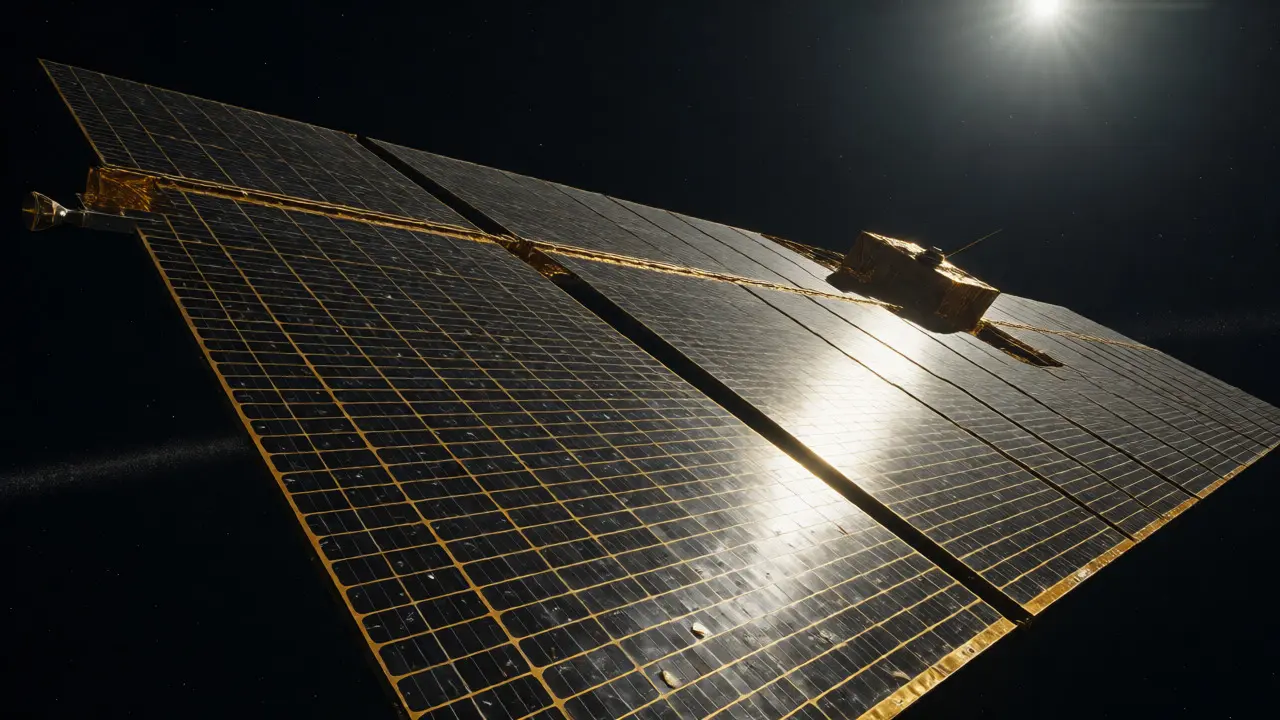
Solar-Electric Propulsion (SEP) is currently the workhorse of the industry. It works by converting sunlight into electricity via photovoltaic cells, which then powers a thruster. The chain is straightforward: sunlight hits the array, generates DC power, passes through a Power Processing Unit (PPU) to regulate voltage, and finally accelerates propellant like xenon out the back of the spacecraft.
The biggest advantage? Sunlight is free and abundant near Earth. The downside? Physics. As you move away from the Sun, available power drops off according to the inverse-square law. At Earth’s distance, a large array might produce 10-20 kW. By the time you reach Jupiter, that same array produces less than 1 kW. Furthermore, when your spacecraft enters a shadow (like behind the Moon), you lose all generation capability unless you have heavy batteries on board.
NASA’s Psyche spacecraft, launched in late 2023, is a perfect case study. Its massive 75-square-meter solar wings generate about 21 kW near Earth. But as it cruises toward the asteroid belt, that output plummets to roughly 2.3-3.4 kW. Engineers had to design the mission knowing the thrusters would run at full throttle initially, then gradually throttle down as sunlight faded. This limitation means SEP missions are often long-duration affairs, trading time for fuel efficiency.
The Nuclear-Electric Alternative
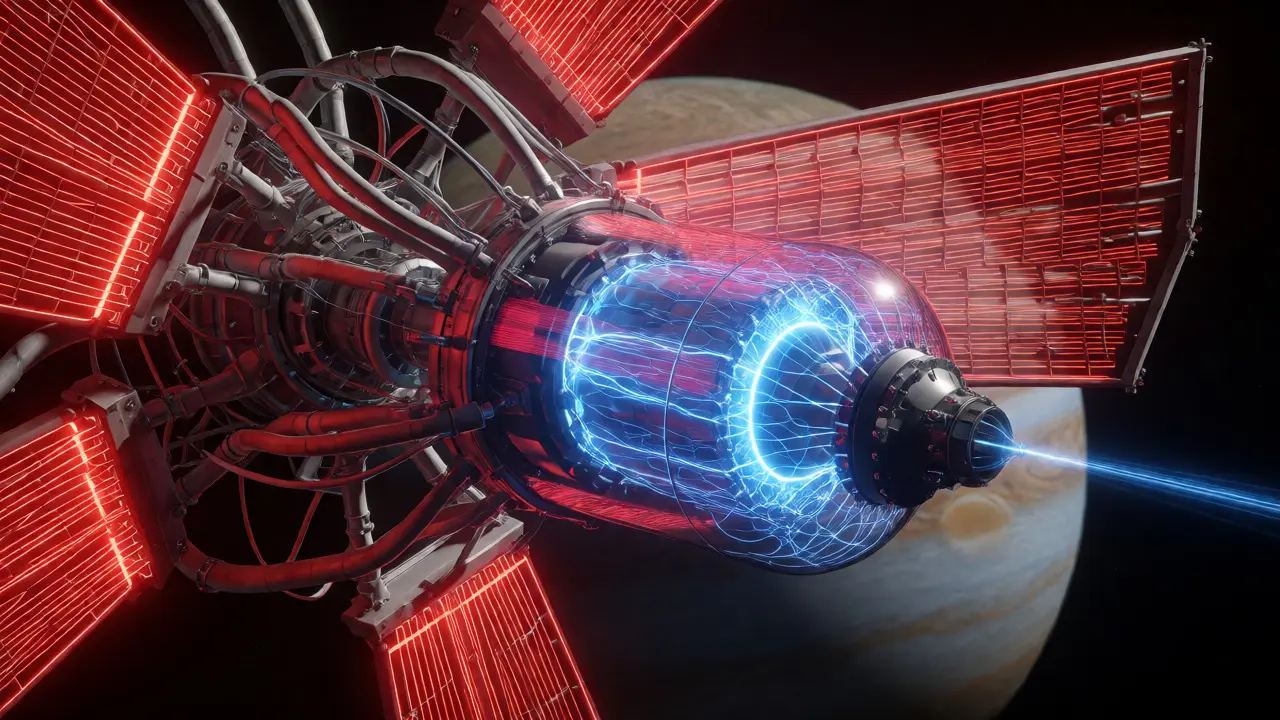
If sunlight is too weak or inconsistent, engineers look to Nuclear-Electric Propulsion (NEP). Instead of panels, NEP uses a fission reactor to generate heat. This heat drives a generator-often via Stirling engines or Brayton cycles-to create electricity. The key benefit is independence from the Sun. Whether you are near Mercury or past Pluto, the reactor pumps out steady power.
This consistency unlocks higher thrust levels and faster transit times for outer solar system missions. A 10-kWe (kilowatt-electric) NEP system provides a power-rich environment that radioisotope thermoelectric generators (RTGs) simply cannot match. For ambitious projects like crewed Mars logistics, studies suggest reactors could exceed 1 MWe (megawatt-electric). However, this comes with significant hurdles: reactor mass, complex heat rejection radiators, shielding requirements, and the political and safety challenges of launching nuclear material.
Thruster Types and Power Efficiency
You can’t discuss power generation without talking about the engine consuming it. The type of thruster determines how efficiently electrical energy becomes motion. Two primary technologies dominate the field: Gridded-Ion Thrusters and Hall Effect Thrusters.
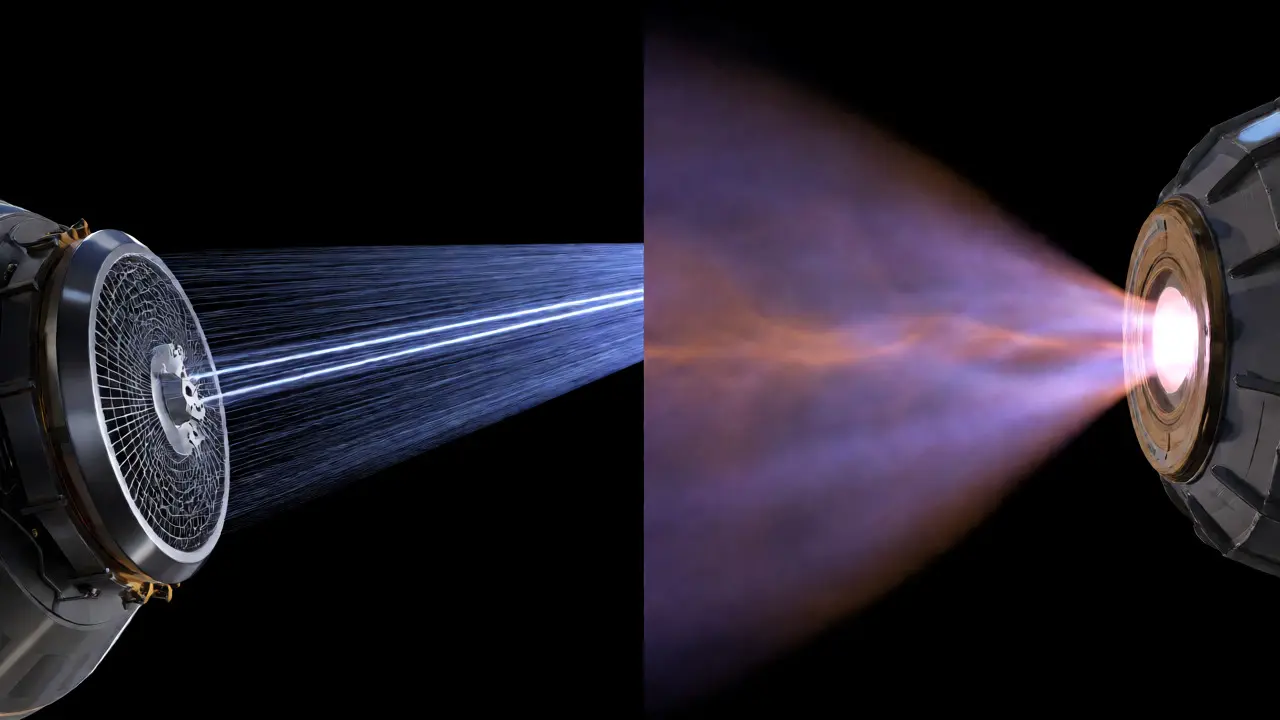
Gridded-Ion Thrusters, such as NASA’s NEXT system, are precision instruments. They use electrostatic grids to accelerate ions. They offer very high specific impulse (efficiency), exceeding 4,100 seconds, meaning they get more delta-v per kilogram of propellant. However, they are complex, expensive, and generally operate at lower thrust-to-power ratios.
Hall Effect Thrusters are simpler and more robust. They use magnetic fields to trap electrons and ionize propellant. While their specific impulse is lower (typically 1,500-3,500 seconds), they deliver higher thrust for the same amount of power. Recent advancements, like the 100-kW-class nested Hall thrusters tested by NASA, show promise for scaling up power levels significantly.
| System Type | Specific Impulse (s) | Efficiency | Typical Power Range | Status |
|---|---|---|---|---|
| NEXT Ion Thruster | > 4,100 | > 70% | 0.5 - 6.9 kW | Tech Ready (TRL 7) |
| NSTAR Ion Thruster | > 3,100 | > 61% | 0.5 - 2.3 kW | Flight Proven |
| PPE-AEPS Hall Thruster | ~ 2,800 | ~ 60-65% | Up to 12.5 kW | In Development (TRL 6) |
| 100-kW Nested Hall | 1,550 - 3,560 | ~ 58% | Up to 96 kW | Ground Tested |
Choosing Between Solar and Nuclear
So, which architecture wins? It depends entirely on the mission profile. For inner solar system operations-geostationary orbit raising, lunar Gateway support, or asteroid rendezvous within Mars’ orbit-SEP is usually the clear choice. The technology is mature, hundreds of spacecraft already fly with it, and there are no launch safety risks associated with nuclear material.
NEP becomes compelling when you need continuous high power regardless of location. Missions to the outer planets, interstellar probes, or high-delta-v cargo transfers to Mars benefit from the constant energy supply. However, the complexity of managing waste heat (radiators are huge and fragile) and the regulatory burden of nuclear launches keep NEP from being the default option today. Currently, we see a layered approach: low-to-medium power SEP for commercial satellites and robotic science, with NEP reserved for flagship deep-space and crewed logistics missions.
Future Outlook and Challenges
The bottleneck in electric propulsion is rarely the propellant; it’s the power. Improving power generation directly increases mission speed and payload capacity. Near-term engineering priorities focus on higher-specific-power solar arrays that resist radiation degradation and lighter, more efficient radiators for nuclear systems.
We are also seeing shifts in market dynamics. Commercial demand for satellite servicing and orbital debris removal is driving investment in medium-power SEP systems. Meanwhile, government agencies are pushing the boundaries of NEP, aiming for 50-kW demonstrations as a stepping stone toward megawatt-class systems. The cancellation of DARPA’s DRACO program in 2025 highlighted the cost-benefit struggles of nuclear thermal propulsion, but it did not halt nuclear-electric research. In fact, interest in compact fission reactors for surface power and electric propulsion remains strong.
Ultimately, the future of space travel looks electric. As we push further from the Sun, our ability to generate and manage electricity in vacuum will define how quickly we explore the cosmos. Whether through silicon wafers catching photons or uranium splitting atoms, power generation is the invisible hand guiding every electric thruster firing.
Why is electric propulsion slower than chemical rockets?
Electric propulsion generates much lower thrust than chemical rockets. While chemical rockets provide massive acceleration for short periods, electric thrusters provide gentle, continuous acceleration over weeks or months. This allows them to achieve higher final velocities with far less propellant, but the initial acceleration is too low for launching from Earth's surface.
Can solar panels work effectively in deep space?
Yes, but their effectiveness decreases rapidly with distance from the Sun due to the inverse-square law. Near Jupiter, solar intensity is only about 4% of what it is at Earth. This requires enormous solar arrays, making solar-electric propulsion impractical for very distant missions unless the power demands are extremely low.
What is specific impulse and why does it matter?
Specific impulse measures how efficiently a rocket uses propellant. Higher specific impulse means the engine gets more thrust per unit of propellant consumed. Electric thrusters have very high specific impulse (often 1,500-4,000+ seconds) compared to chemical rockets (300-450 seconds), allowing spacecraft to carry much less fuel for long journeys.
Is nuclear-electric propulsion safe to launch?
Launching nuclear reactors requires strict safety protocols. In the U.S., launches undergo a formal risk-informed safety analysis and authorization process. The reactor is typically designed to remain subcritical during launch accidents, minimizing the risk of radioactive release. Despite these safeguards, public and political acceptance remains a significant hurdle.
What propellants are used in electric propulsion?
Xenon is the most common propellant because it is inert, easy to store, and has favorable ionization properties. However, krypton and argon are gaining popularity as cheaper alternatives, though they offer slightly lower performance. Lithium and iodine are also being explored for specialized high-performance applications.