
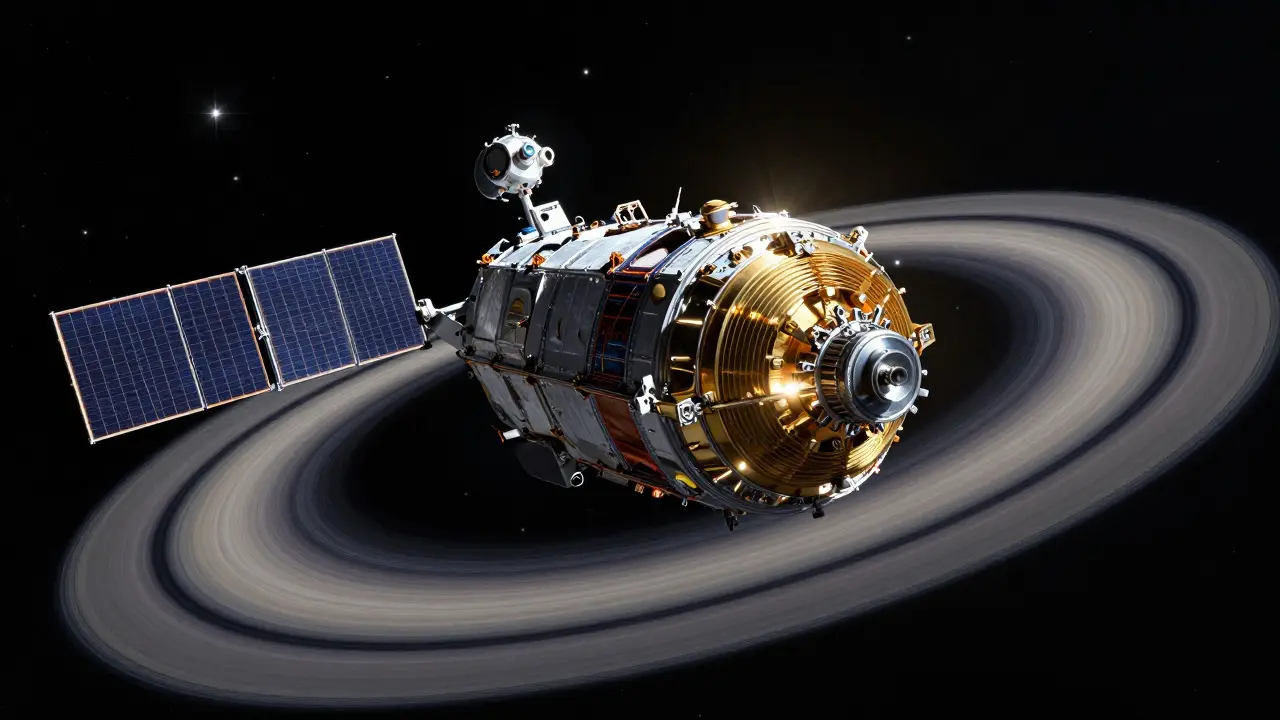
When a spacecraft flies past Mars or drifts into the outer solar system, it doesn’t have access to wall outlets, solar panels on rooftops, or even a reliable sunrise. Yet, every sensor, computer, radio, and thruster needs steady power - day and night, through dust storms and eclipse shadows. The secret isn’t magic. It’s the power distribution and management system - the invisible nervous system that keeps the whole mission alive.
Where Does the Power Come From?
Most spacecraft don’t carry fuel tanks for electricity. Instead, they rely on two main sources: sunlight and nuclear decay. Solar panels are the go-to for missions close to the Sun. The International Space Station, for example, uses massive solar arrays that generate over 150 volts. That’s way more than any onboard device can handle. So what happens next? The voltage gets stepped down, carefully and precisely. For missions heading beyond Jupiter - where sunlight is too weak - engineers turn to radioisotope power systems (RPS). These aren’t reactors. They’re more like long-lasting nuclear batteries. The Cassini mission to Saturn ran for 20 years on an RTG (radioisotope thermoelectric generator), converting heat from plutonium-238 decay into steady electricity. No moving parts. No need for sunlight. Just constant power, even in the darkest corners of space. Smaller satellites, like CubeSats, often use lithium-ion batteries paired with compact solar cells. These batteries are stacked in series and parallel to hit the exact voltage and capacity needed. One cell might deliver 3.7 volts. Ten in series? 37 volts. Add more in parallel? More runtime. It’s like building a custom power pack, but for a machine that can’t be plugged in.The Heart of the System: The Power Distribution Unit (PDU)
All that power - whether from solar panels, RTGs, or batteries - flows through one central hub: the Power Distribution Unit, or PDU. Think of it as the main electrical panel in your house, but way smarter and built to survive radiation, vacuum, and temperature swings from -150°C to +120°C. A PDU doesn’t just pass electricity along. It controls it. Inside, you’ll find:- Voltage regulators - keep the bus voltage steady at 28 volts (the standard inherited from aircraft)
- DC-DC converters - step down high solar voltage to 5V for computers or 12V for motors
- Shunt regulators - dump excess power as heat when the sun’s too strong
- Solid-state switches - turn devices on and off remotely, without mechanical parts that could fail
- Current shunts - measure how much power each instrument is using
Managing the Flow: Voltage, Current, and Ripple
Power isn’t just about turning things on. It’s about keeping things stable. Every onboard device has a voltage window it can handle - too high, and it fries. Too low, and it shuts down. Solar panels generate fluctuating voltage. Batteries discharge in a predictable curve. The PDU must smooth out these changes. That’s where regulation comes in. A shunt regulator, for example, acts like a pressure relief valve. If the solar panels produce too much power, the regulator shunts the extra to a heat sink, which radiates it into space. That’s why some spacecraft tilt their solar panels away from the Sun - not to save energy, but to reduce heat buildup. Then there’s ripple - tiny voltage fluctuations caused by switching circuits. If left unchecked, ripple can mess with sensitive sensors or communication systems. Engineers use filters and capacitors to smooth the power before it reaches critical hardware.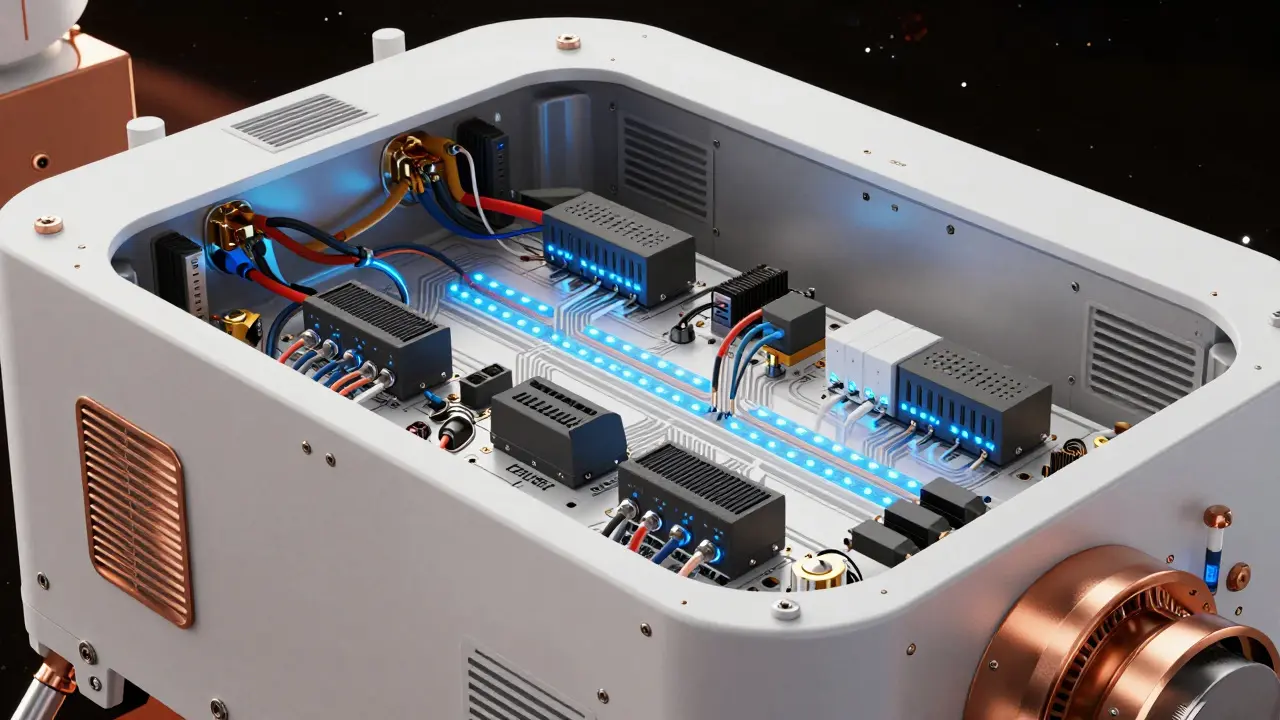
Energy Storage: Why Batteries Are Non-Negotiable
No spacecraft runs on solar power alone. Even in low-Earth orbit, the satellite goes into eclipse every 90 minutes. During those 30-40 minutes of darkness, the batteries take over. Lithium-ion batteries dominate modern missions. They’re lightweight, have high energy density, and can handle thousands of charge-discharge cycles. But they’re not foolproof. Overcharging? Thermal runaway. Deep discharge? Permanent damage. That’s why every spacecraft has a Battery Management System (BMS) built into the PMAD (Power Management and Distribution) subsystem. The BMS does three things:- Monitors each cell’s voltage and temperature
- Controls charging current to avoid overheating
- Disconnects failing cells before they take down the whole system
Redundancy and Safety: What Happens When Things Go Wrong?
In space, a blown fuse isn’t just inconvenient - it’s mission-ending. That’s why redundancy isn’t optional. Critical systems like attitude control, communications, and thermal management have dual or triple power paths. Imagine a spacecraft’s main bus loses power. The PDU doesn’t panic. It automatically switches to a backup distribution line. If that fails, it reroutes power from a non-critical subsystem - maybe the science camera - to keep the radio alive. This is called load shedding. It’s like turning off your lights to keep your fridge running during a blackout. Protection circuits are everywhere. Overcurrent? A fuse opens. Overvoltage? A crowbar circuit shorts the line to ground. Thermal runaway? The BMS cuts power. These systems don’t need human input. They react in milliseconds.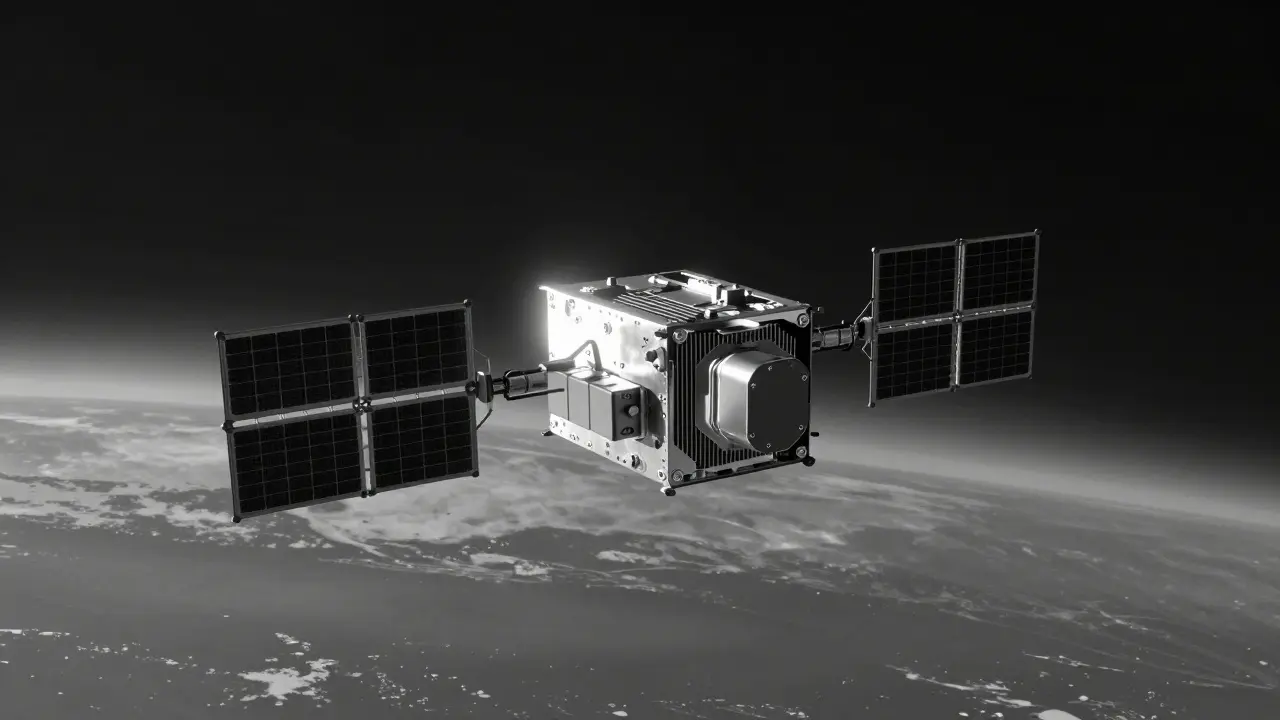
Small Satellites, Big Challenges
CubeSats change the game. A 3U CubeSat is roughly the size of a loaf of bread. It can’t carry giant solar arrays or heavy batteries. Every gram counts. Designers use integrated power boards that combine generation, storage, and distribution into a single PCB. Voltage converters are miniaturized. Switches are solid-state. Even the battery is custom-shaped to fit the gaps in the satellite’s structure. One common trick? Using the satellite’s metal casing as a heat sink. That way, heat from the PDU doesn’t build up - it spreads out. Thermal management isn’t an afterthought. It’s baked into the design.The Bigger Picture: Power as a Mission Enabler
Power isn’t just about keeping lights on. It enables everything. A Mars rover needs power to drill into rock. A satellite needs power to send images back to Earth. A probe needs power to fire thrusters and land safely. The best power systems aren’t the most powerful. They’re the most reliable. They adapt. They protect. They sacrifice non-essential loads to save the core mission. And they do it all without a single human touch. Engineers don’t just pick components. They build ecosystems. Solar panels, batteries, converters, switches - they all talk to each other. A drop in solar input triggers a battery discharge. A spike in current triggers a switch-off. Every action has a reaction, and the PDU is the conductor.What’s Next?
Future missions will need more power. NASA’s Artemis program plans to power lunar bases with 40+ kilowatts. That’s like running a small neighborhood. New tech is coming - advanced solar cells that work in low light, solid-state batteries with higher energy density, and AI-driven power managers that predict load needs before they happen. But the core idea stays the same: power must be managed, not just delivered. Because in space, if the power goes out, the mission goes dark.How do spacecraft get power in the dark?
Spacecraft use rechargeable batteries - usually lithium-ion - that are charged by solar panels when sunlight is available. During eclipses or nighttime, the system automatically switches to battery power. For missions far from the Sun, radioisotope power systems (RTGs) provide continuous power without sunlight.
Why is 28 volts the standard for spacecraft power?
The 28-volt standard comes from military aircraft design in the 1950s and 60s. It was a good balance between efficiency, safety, and wire thickness. Lower voltages need thicker wires to carry the same power, adding weight. Higher voltages risk arcing in vacuum. 28 volts became the legacy standard, and most spacecraft still use it today for compatibility and simplicity.
Can spacecraft power systems be repaired in space?
No, most spacecraft power systems are not repairable. Components are sealed, hardened, and built to last decades without maintenance. Redundancy is the key - if one part fails, another takes over. Future missions may include modular PDUs that can be swapped by robots, but no human repair has ever been done on a power system beyond low-Earth orbit.
What’s the difference between a PDU and a BMS?
The Power Distribution Unit (PDU) controls how power flows to all spacecraft components - switching, converting, and protecting. The Battery Management System (BMS) focuses only on the battery: monitoring cell health, controlling charge/discharge rates, and preventing overheating or overvoltage. The BMS is part of the larger PMAD system, which includes the PDU.
Why do some spacecraft tilt their solar panels away from the Sun?
It sounds counterintuitive, but tilting panels away from the Sun helps manage heat. When solar panels produce more power than needed, excess energy is dumped as heat by shunt regulators. Too much heat can damage electronics. By reducing the panel’s angle, engineers lower the input voltage, which reduces the amount of heat generated - a clever way to control thermal stress without adding more cooling hardware.
9 Responses
28 volts? Yeah that’s just NASA’s way of saying ‘we didn’t want to rethink this in 1965’.
It’s like using a flip phone because ‘it still works’.
No one’s gonna fix it. No one’s gonna upgrade it. Just keep taping it together with shunt regulators and hope.
Space tech is just duct tape with a PhD.
They use plutonium like it’s AA batteries. And somehow, we’re okay with that?
RTGs: the only thing more stable than a Mars rover’s Wi-Fi signal.
Imagine if your car ran on radioactive decay instead of gas. You’d be terrified. But space? Yeah, that’s fine.
It’s not magic. It’s just… we stopped asking questions.
And honestly? That’s the real power system.
you think they really need all that redundancy
or is this just a billion dollar way to make engineers feel safe
what if the real power source is just… belief
and the whole system is a placebo
they’re not even sure the PDU works
they just pray to it
and the batteries? they’re just charged by cosmic vibes
no one checks the voltage
they just hope
power is everything
no power no science
no power no talk
no power no life
they make it work
that’s all that matters
The way they balance heat, voltage, and failure modes is like watching a symphony of engineering.
Every shunt, every switch, every cell in the BMS - it’s not just logic, it’s poetry.
They’re not just building circuits.
They’re building survival.
And the fact that a 3U CubeSat can do what a 1980s satellite did - with less mass than a bag of sugar - is the quietest revolution of our time.
No fanfare. No press releases.
Just silent, stubborn, brilliant engineering.
That’s what keeps us reaching.
So let me get this straight - we send a probe to Jupiter…
…and its power system is basically a toaster wired to a nuclear glowstick?
And we call this ‘advanced’?
It’s like building a spaceship out of IKEA parts and calling it a Tesla.
But hey - it works.
So… I guess we’re all just impressed?
While I appreciate the technical ingenuity described herein, one must acknowledge the profound ethical and geopolitical implications of deploying radioisotope thermoelectric generators beyond Earth’s atmosphere.
Plutonium-238 is not merely a power source - it is a material of profound proliferation risk.
And yet, we continue to deploy it without international regulatory consensus.
Perhaps we should consider solar-electric propulsion augmented by orbital power beaming - a solution far more sustainable and transparent.
For the sake of future generations, we must not allow expediency to eclipse responsibility.
you know what’s wild
we’ve got a machine orbiting Jupiter powered by a lump of radioactive metal
and we’re all just vibing like it’s normal
like it’s not the most terrifying thing humanity has ever built
imagine if one of these things exploded
not in space
on the launchpad
and the whole thing just… poofed
like a nuclear candle
and we all just shrugged and said ‘well… at least the science worked’
we’re not brave
we’re just really good at ignoring the obvious
As a citizen of South Africa, I find it profoundly inspiring that humanity, despite its myriad challenges on Earth, continues to invest in such precision and foresight beyond our atmosphere.
Wherever you are - whether in a Cape Town township or a Houston lab - the same ingenuity that powers a CubeSat can illuminate the path to sustainable energy here.
Space technology is not a luxury.
It is a mirror.
And in its reflection, we see not just what we can do - but what we must become.
Let us not forget that the same discipline that manages voltage in deep space can also manage equity on Earth.