
Imagine trying to have a conversation with someone standing on the other side of a noisy stadium. You could shout into a megaphone, focusing all your energy in one direction, or you could use a complex system of microphones and speakers that automatically adjusts to track their voice while canceling out the crowd noise. In SATCOM antenna design is the engineering discipline focused on creating hardware for satellite communications links, we are essentially choosing between those two approaches. For decades, the megaphone-specifically the parabolic dish-has been the standard. But today, the industry is shifting toward the smart, adaptive system known as the phased array.
This transition isn't just about new technology; it's about survival in a changing orbital landscape. As low-Earth orbit (LEO) constellations like Starlink and OneWeb deploy thousands of fast-moving satellites, traditional static antennas struggle to keep up. Understanding the difference between these two technologies helps you decide what fits your needs, whether you are running a fixed gateway station or equipping a moving ship.
The Parabolic Dish: The Reliable Workhorse
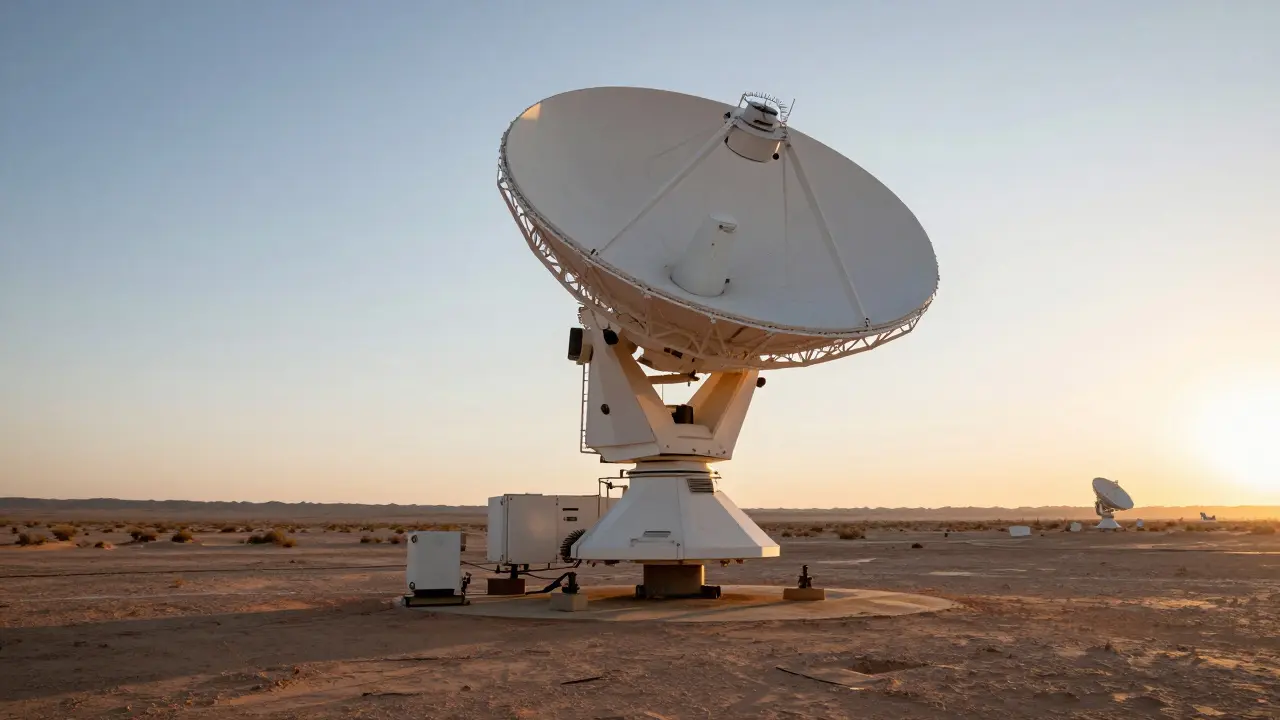
The parabolic reflector antenna has been the backbone of satellite communications since the early 1960s. When Telstar launched, it relied on this simple yet effective geometry. A parabolic surface focuses incoming radio waves onto a single feed point at its focal length, or conversely, collimates energy from the feed into a narrow, high-gain beam. This physical principle is incredibly efficient.
For fixed installations, such as ground stations communicating with geostationary (GEO) satellites, the parabolic dish remains king. Why? Because it offers exceptional gain per dollar. A large gateway antenna, often ranging from 3 to 13 meters in diameter, can achieve gains of 50-60 dBi in C/Ku/Ka bands. Even smaller VSAT dishes (0.6-0.8 meters) provide roughly 30 dBi of gain. The hardware is straightforward: a passive metal or mesh reflector, a feed horn, and a mechanical gimbal to point it.
However, this simplicity comes with physical limitations. Because the beam is physically directed by the shape of the dish, you need mechanical movement to track non-geostationary satellites. This introduces inertia, pointing latency, and wear and tear. If you are on a rolling ship or a pitching aircraft, keeping a heavy dish pointed accurately at a satellite moving across the sky requires bulky, expensive dual-axis gimbals. Furthermore, a single-feed dish creates only one primary beam. To talk to multiple satellites simultaneously, you need multiple feeds or multiple dishes, which increases cost and complexity.
Phased Arrays: The Electronic Revolution
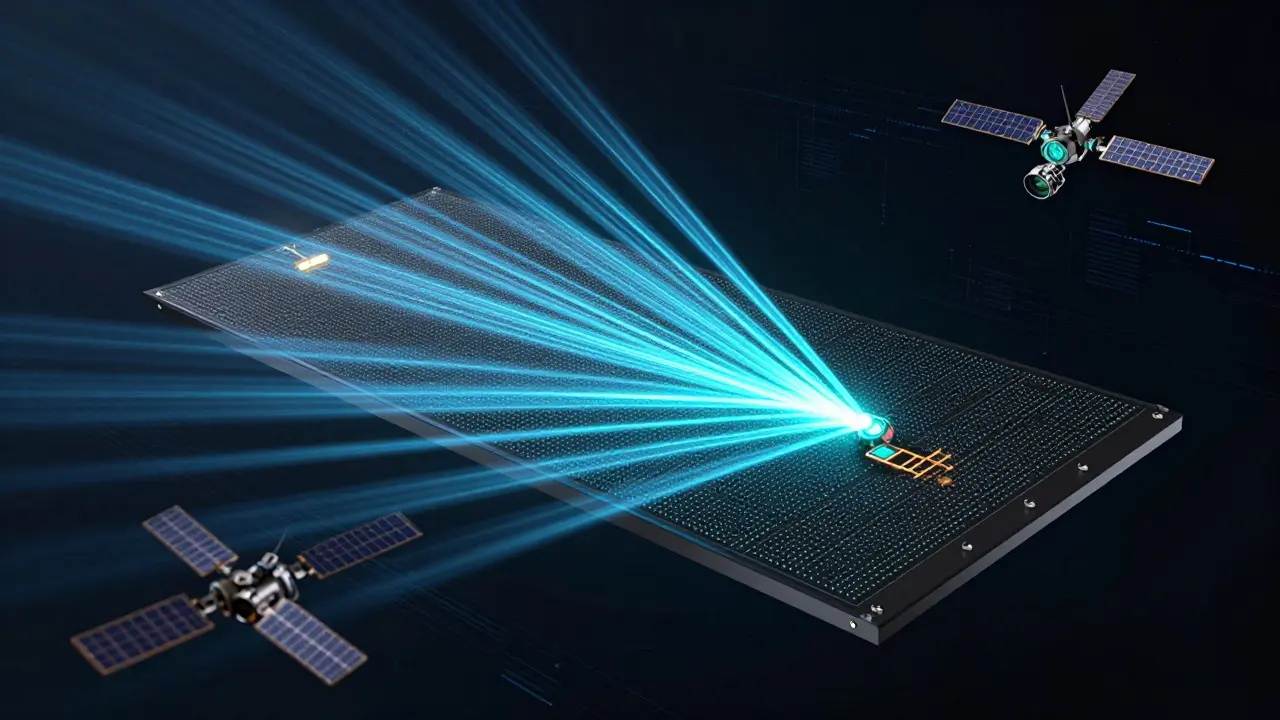
In contrast, a phased array antenna is an assembly of many discrete radiating elements that electronically steer the RF beam without mechanical motion. Instead of one big mirror, you have hundreds or thousands of small patch antennas or dipoles arranged in a grid. Each element is connected to a transmit/receive (T/R) chain containing power amplifiers, low-noise amplifiers, and phase shifters.
By precisely controlling the phase (and sometimes amplitude) of the signal at each element, the system creates constructive interference in one direction and destructive interference in others. This allows the beam to "steer" electronically in microseconds. Texas Instruments notes that this capability enables accurate tracking of moving targets without any physical movement. For LEO satellites, which zip across the sky at several degrees per second, this speed is not just convenient-it is essential.
The real magic of phased arrays, particularly Active Electronically Scanned Arrays (AESAs), lies in their flexibility. A single flat panel can generate multiple simultaneous beams. This means one antenna can maintain connections with different satellites, serve multiple users, or place nulls in the direction of interferers to boost signal clarity. Qorvo highlights that this dynamic beam shaping is critical for high-throughput satellites (HTS) and NGSO constellations, where spectrum reuse and adaptive coverage are key to performance.
Comparing Performance and Trade-offs
When deciding between a dish and an array, you are balancing gain, agility, size, weight, and power (SWaP). Here is how they stack up in practical scenarios:
| Feature | Parabolic Dish | Phased Array (AESA) |
|---|---|---|
| Beam Steering | Mechanical (slow, inertial limits) | Electronic (microsecond response) |
| Multi-Beam Capability | Limited (requires multiple feeds) | Native (multiple simultaneous beams) |
| Form Factor | Bulky, protruding, high drag | Flat, low-profile, conformal |
| RF Efficiency | High (passive aperture) | Moderate (active component losses) |
| Cost Structure | Low upfront, higher maintenance | High upfront, falling silicon costs |
| Best Use Case | Fixed GEO gateways, backhaul | Mobile terminals, LEO/MEO tracking |
Parabolic dishes win on raw efficiency and cost for fixed applications. Since most of the aperture is passive metal, there are fewer active components to fail or consume power. However, phased arrays dominate in mobile environments. Keysight Technologies points out that electronically steered arrays reduce SWaP significantly by eliminating gimbals and bulky reflectors. On an aircraft, a flat panel mounted flush against the fuselage reduces drag and radar cross-section compared to a rotating dish.
Design Challenges and Engineering Realities
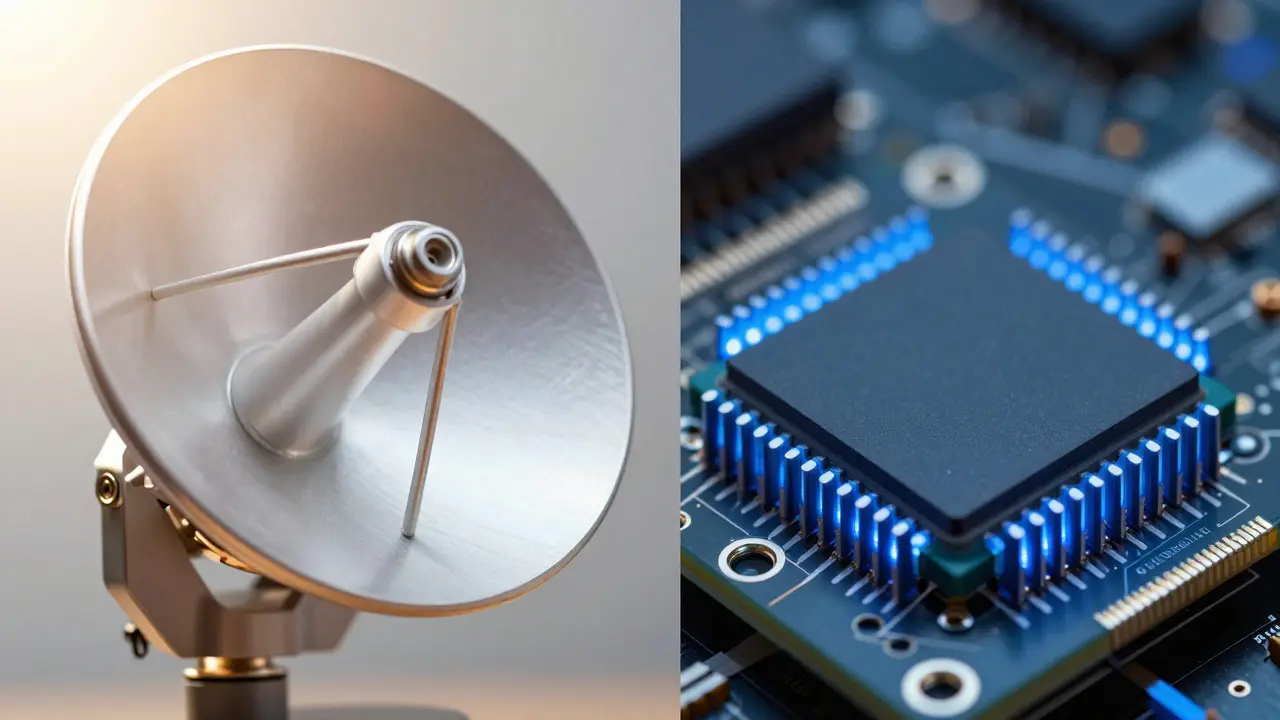
Designing a parabolic antenna is largely a matter of geometry and mechanics. You calculate the diameter based on the required gain formula $G \approx \eta (\pi D / \lambda)^2$, ensure the surface accuracy meets the RMS error requirements (often 0.3-0.5 mm for Ka-band), and select a robust mount. It is a mature field with well-understood physics.
Phased array design, however, is a multidisciplinary nightmare. You are dealing with mutual coupling between closely spaced elements, which distorts radiation patterns. You need precise calibration to correct for element-to-element gain and phase variations. Thermal management becomes critical because every element has its own amplifier generating heat. Keysight emphasizes that building a viable phased array requires advanced electromagnetic simulation and extensive over-the-air testing. It is not just an RF problem; it is a digital control, thermal, and mechanical engineering challenge rolled into one.
Yet, the trend is undeniable. The advent of low-cost silicon beamformers and RFICs has made these arrays economically viable beyond military budgets. What was once exclusive to fighter jets is now appearing in consumer LEO terminals. The YouTube presentation on "Building the Future SATCOM Phased-Arrays" argues that affordable silicon has become the backbone of next-generation SATCOM, enabling high data rates and interference tolerance that dishes simply cannot match in mobile scenarios.
The Hybrid Future and Emerging Innovations
While the industry swings toward phased arrays, innovation doesn't stop at flat panels. Some companies, like FreeFall Aerospace, are exploring hybrid approaches. They utilize spherical reflectors instead of parabolic ones, claiming simplified mechanical alignment and wider fields of view. While still reflector-based, these designs attempt to bridge the gap between the efficiency of dishes and the flexibility needed for modern links.
Meanwhile, academic research, such as the UC eScholarship thesis on novel phased arrays, pushes the boundaries further. Researchers are integrating T/R modules directly behind radiating elements to minimize losses and support wider bandwidths. This monolithic integration aims to solve the power and size issues that currently limit widespread adoption in smaller devices.
So, which should you choose? If you are setting up a permanent ground station for a GEO satellite, the parabolic dish is likely your best bet for cost-effective, high-gain performance. But if you need connectivity on the move-whether on a ship, plane, or car-or if you are connecting to a LEO constellation, the phased array is no longer a luxury; it is a necessity. The future of SATCOM is flat, fast, and electronic.
Why are phased arrays better for LEO satellites?
LEO satellites move rapidly across the sky, requiring antennas to track them at high angular velocities. Mechanical dishes have inertia and slow slew rates, making them difficult to stabilize on fast-moving targets. Phased arrays steer beams electronically in microseconds, allowing seamless tracking without physical movement.
Can a parabolic dish support multiple satellites at once?
Generally, no. A standard single-feed parabolic dish creates one main beam. To communicate with multiple satellites simultaneously, you would need multiple feeds or multiple separate dishes, which increases cost, weight, and installation complexity. Phased arrays can generate multiple simultaneous beams from a single aperture.
What is the main disadvantage of phased arrays?
The primary disadvantages are higher initial cost, greater power consumption due to active components (amplifiers per element), and complex calibration requirements. Additionally, their RF efficiency can be lower than passive parabolic dishes due to ohmic losses in the numerous active circuits.
Are parabolic dishes becoming obsolete?
Not entirely. For fixed GEO gateway stations and high-power broadcast uplinks, parabolic dishes remain highly efficient and cost-effective. They offer superior gain per dollar for stationary applications where mechanical steering is not a bottleneck. The shift is primarily in mobile and LEO sectors.
How does silicon technology impact SATCOM antennas?
Advances in low-cost silicon beamformers and RFICs have drastically reduced the price of phased array components. This mass-market semiconductor progress has moved phased arrays from expensive military-only hardware to commercially viable solutions for consumer and enterprise satellite terminals.