

Imagine dropping a spacecraft into Jupiter’s atmosphere at 47 kilometers per second. That is faster than any bullet fired on Earth. The friction alone generates enough heat to melt steel in seconds. This isn’t science fiction; it happened in 1995 with the Galileo probe. But getting data back from that inferno was just as hard as surviving it. If you’re interested in how we explore the gas giants, you need to understand the brutal trade-offs between keeping the electronics cool and keeping the radio link alive.
Outer planet atmospheric entry probes are one-time descent vehicles designed to dive into the thick atmospheres of Jupiter, Saturn, Uranus, and Neptune. Unlike orbiters, these probes don’t stay up there. They plunge down, measure what they can, and get crushed or burned up. The design challenge is extreme: managing peak heat fluxes up to 3 kW/cm² while maintaining a telemetry link through ionized plasma and dense gas.
The Heat Barrier: Why Entry Velocity Kills
When a probe hits an outer planet’s atmosphere, its kinetic energy turns into heat instantly. At Jupiter, entry velocities exceed 40 km/s. At Uranus and Neptune, they hover around 20-25 km/s. This creates a shock wave that heats the air to thousands of degrees. The probe’s front end, called the forebody, faces this directly.
Early studies in the 1970s realized that standard materials wouldn’t cut it. NASA’s initial concepts used graphite ablator shields. These materials burn away slowly, carrying heat with them. It’s like sweating, but much more violent. The goal is to keep the internal electronics below their survival temperature. For the Galileo probe, the transmitter failed after 61 minutes because the ambient temperature inside the capsule rose too high, despite the shield doing its job externally.
Modern designs use advanced ablators like HEEET (Heat-shield for Extreme Entry Environment Technology). HEEET is a woven carbon material that is lighter and more efficient than older graphite blocks. It allows engineers to reduce the mass fraction of the heat shield to about 5-20% of the total probe mass. This matters because every gram saved on the shield is a gram available for science instruments or fuel.
Communications: The Silent Descent
Surviving the heat is only half the battle. You have to talk to home. And here’s the catch: once the probe enters the atmosphere, it’s moving fast, spinning, and surrounded by glowing plasma. This plasma can block radio waves, causing a "blackout" similar to what astronauts experienced during re-entry on Apollo missions. But for outer planets, the blackout risk is compounded by distance.
A signal from Jupiter takes over 40 minutes to reach Earth. From Neptune, it takes four hours. There is no real-time control. The probe must be autonomous. Most designs rely on a relay orbiter rather than direct-to-Earth links. The orbiter passes overhead, picking up the probe’s UHF or S-band signals. As the probe descends deeper, the atmosphere gets denser. Dense atmosphere absorbs radio waves. If the probe goes too deep, too fast, the signal fades before all the data is sent.
This creates a tight optimization problem. Engineers choose a flight-path angle-often around -30 degrees-to balance three things:
- Thermal Load: A steeper angle means faster heating but shorter time in the hot zone.
- G-Load: Steeper angles cause higher deceleration forces, potentially crushing delicate instruments.
- Communication Window: A shallower angle extends the descent time, allowing more data transmission before the atmosphere becomes too opaque.
Material Science: The Shield Evolution
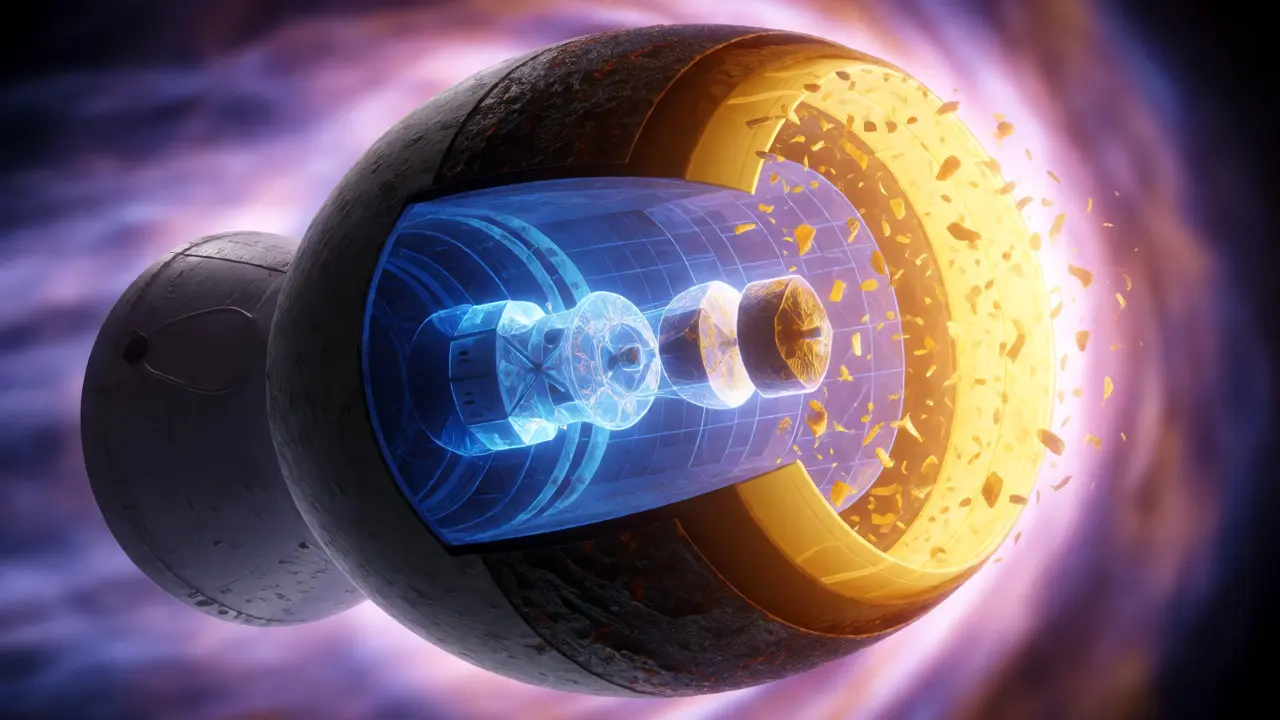
The history of these probes is really a history of material science. In the 1970s, the best option was ESA-3560, a phenolic impregnated ablator. It worked, but it was heavy. Today, we have better options. PICA (Phenolic-Impregnated Carbon Ablator) is famous from SpaceX’s Dragon capsules, but it’s also being adapted for deep space. However, for the highest heat loads of Jupiter, HEEET is the current gold standard.
Why does this matter? Because TPS (Thermal Protection System) mass dictates mission cost. A heavier shield requires a bigger rocket. A bigger rocket costs more money. By using low-density woven fabrics, engineers can build smaller, cheaper probes. The SNAP concept, proposed recently, aims for a 30 kg probe using HEEET. Compare that to Galileo’s 339 kg entry system, and you see the progress.
| Feature | Galileo (Jupiter) | ESA Ice Giant Concept | NASA SNAP Concept |
|---|---|---|---|
| Target Planet | Jupiter | Uranus/Neptune | Uranus/Neptune |
| Entry Velocity | ~47 km/s | ~21-25 km/s | ~21-25 km/s |
| Probe Mass | 339 kg | ~313 kg | ~30 kg |
| TPS Material | Graphite Ablator | HEEET / SLA-561V | Low-Density HEEET |
| Data Duration | 61 mins | 90-120 mins | TBD (Optimized) |
Thermal Control Beyond the Shield
People often think the heat shield solves everything. It doesn’t. The shield protects against the external fireball, but the probe still has to manage its own internal heat. During the years-long cruise to Jupiter, there’s almost no sunlight. Temperatures drop near absolute zero. Electronics freeze. To combat this, probes use Radioisotope Heater Units (RHUs). These small pellets of plutonium-238 generate steady warmth without needing solar panels.
Once entry starts, the game changes. The multilayer insulation blankets that kept the probe warm during cruise burn off quickly. Now, the probe relies on the thermal inertia of its structure. It’s a passive system. There are no active cooling fans or liquid loops to save you if the design margin is too tight. If the heat penetrates the aeroshell faster than predicted, the batteries die, or the sensors drift out of calibration. This is why ground testing is critical. Arc-jet facilities simulate the plasma environment, blasting test coupons with superheated gas to verify that the model matches reality.

The Plasma Blackout Risk
One of the biggest unknowns is the duration of the communication blackout. When the air ionizes, it reflects radio waves. Lower frequencies like UHF penetrate better than higher ones, but they carry less data. Engineers have to decide: do we send high-resolution images that might get lost in the noise, or low-res text that definitely comes through?
For the Galileo probe, the transmitter survived longer than expected, but barely. Future missions to ice giants face a different profile. The atmospheres of Uranus and Neptune are colder and denser in certain layers. This might actually help communications by reducing some types of turbulence, but it increases attenuation. Modeling this is tricky because we haven’t sent a probe there yet. We’re guessing based on remote sensing. That uncertainty drives conservative design choices, which often means leaving science capability on the table to ensure reliability.
Future Directions: Smaller and Smarter
The trend is toward smaller probes. Large flagship missions are expensive and rare. Small satellites and cubesat-like technologies are entering the deep space arena. The idea is to send multiple small probes instead of one big one. If one fails, you still get data from the others. This swarm approach reduces risk.
New materials like single-layer 3D-woven TPS are simplifying manufacturing. Traditional shields were stacked laminates, glued together layer by layer. Woven fabrics can be manufactured as a single piece, reducing weight and potential failure points. Combined with miniaturized sensors like NanoChem, we could soon see swarms of tiny probes diving into Neptune’s clouds, sending back detailed chemical profiles before disappearing forever.
Why can't we just use a parachute immediately upon entry?
Parachutes need stable airflow to work. At hypersonic speeds (over Mach 25), the air flow is turbulent and chaotic. Deploying a parachute too early would rip it apart. Probes must slow down significantly via aerodynamic drag first, usually until subsonic speeds, before deploying parachutes to stabilize the descent and lower terminal velocity.
How long does a signal take to reach Earth from Jupiter?
Light travels at roughly 300,000 km/s. Since Jupiter varies in distance from Earth, the one-way light time ranges from about 33 minutes at closest approach to over 53 minutes when it is on the opposite side of the Sun. This delay makes real-time control impossible; the probe operates autonomously during entry.
What is a ballistic coefficient and why does it matter?
The ballistic coefficient measures how well a vehicle resists deceleration due to drag. It is calculated as mass divided by drag area times drag coefficient. A high ballistic coefficient means the probe dives deeper before slowing down. Designers tune this value to hit specific pressure levels (like 10 bar or 100 bar) where they want to collect key scientific data.
Can we recover outer planet probes?
No. Current technology does not allow for landing and takeoff from gas giants. They lack a solid surface. Probes are expendable. They descend until they are crushed by pressure or destroyed by heat. Some concepts propose floating balloons, but even those would eventually fail or drift beyond tracking range.
What happens if the heat shield fails?
If the Thermal Protection System (TPS) fails, hot plasma penetrates the aeroshell. Internal temperatures rise rapidly. Batteries lose capacity, electronics malfunction, and structural components weaken. Typically, the mission ends within minutes of shield breach, resulting in loss of all remaining science data.
11 Responses
plasma blackout is the real killer here not the heat
we are flying blind for minutes at a time and hoping the math holds up
Spot on about the plasma issue. The ionization layer acts like a mirror for radio waves, especially at higher frequencies. That's why UHF is often preferred despite lower bandwidth-it penetrates the sheath better. We have to accept that we lose high-res data during peak heating to keep the link alive. It’s a brutal trade-off but necessary for survival.
OH MY GOD can you imagine being inside that capsule? 47 km/s! That is literally faster than anything we fire from a gun! My heart is pounding just reading this. The idea of melting steel in seconds is terrifying yet absolutely beautiful in its violence. I feel sick thinking about the G-forces crushing those delicate instruments while the world outside turns into a hellscape of fire. We are sending little metal coffins into the abyss and praying they whisper back before they die. It’s tragic and magnificent all at once!
The romanticization of 'brutal trade-offs' obscures the sheer incompetence inherent in our current engineering paradigms. We speak of HEEET as if it were a panacea, yet we ignore the epistemological crisis of modeling atmospheres we have barely touched. To reduce the probe to a mere vessel for data extraction is to miss the existential weight of its demise. These probes do not explore; they commit suicide in the name of empiricism. The silence after the signal fades is not a technical failure, but a philosophical statement on the limits of human reach.
this is so fascinating 🤯 i always wonder about the philosophy of these missions... like does the probe 'know' it's dying? 😅 also typo sorry autocorrect hates me sometimes lol but seriously the idea of autonomous decision making in such extreme conditions makes me think about consciousness vs programming 🧠✨ what do u guys think?
Listen, stop overthinking the philosophy and look at the numbers! You want results? Look at SNAP. 30 kg versus Galileo's 339 kg. That is an order of magnitude improvement in efficiency. Don't let perfect be the enemy of good. We need to push these smaller, cheaper concepts NOW because every day we wait is another day Uranus stays unexplored. Get off your high horse and look at the mass fraction savings. That is where the future is!
Everyone is hyping up the new materials like they're magic beans. HEEET is great, sure, but have you seen the testing margins? We are still guessing at Neptune's atmospheric density based on remote sensing. If the model is off by even 10%, that shield fails and we lose everything. People act like this is solved science when it's basically throwing darts in the dark. I bet half these concepts won't survive first contact with actual data. Stop pretending we know more than we do.
I appreciate the passion everyone brings to this discussion. While there are valid concerns regarding the uncertainty of atmospheric models, it is crucial to remain supportive of the iterative nature of space exploration. Each mission, regardless of outcome, provides invaluable data that refines our understanding. Let us encourage the engineers who are tackling these immense challenges with resilience and innovation.
the thermal inertia point is underrated
active cooling adds mass and complexity which defeats the purpose of small probes
passive systems are elegant if the margins are right
but yeah one bad prediction and its game over
it’s wild how much we rely on relay orbiters too. direct-to-earth is just not happening with that distance delay. makes me feel kinda lonely for the probe though, knowing it has no friends nearby except maybe that orbiter passing by occasionally. 🌌💔
interesting read. i mostly lurk but the part about flight-path angles balancing g-load and comms window really clicked for me. seems like a puzzle with no perfect answer just best guesses.