

Smart contracts on Ethereum are powerful. They can lock up millions in funds, automate loan repayments, or even trade assets without human intervention. But here’s the catch: they live in a closed system. They can’t see what’s happening outside the blockchain. No stock prices. No weather data. No sports scores. Without access to real-world information, most smart contracts would be useless. This is the Oracle Problem-and Chainlink is the solution that’s reshaping how Ethereum interacts with reality.
What Exactly Is an Oracle?
Think of an oracle as a messenger. It takes data from the outside world-like the price of Bitcoin or the temperature in Sydney-and delivers it to a smart contract on Ethereum. Simple, right? Not quite. The problem isn’t getting data. It’s getting trustworthy, tamper-proof data.Early oracle solutions relied on single companies like API providers or data vendors. One server. One source. One point of failure. If that server goes down, gets hacked, or lies, the whole smart contract fails. Imagine a DeFi lending platform that shuts down because it got a fake price for ETH. That’s not hypothetical. It’s happened. Chainlink was built to fix this.
How Chainlink Solves the Oracle Problem
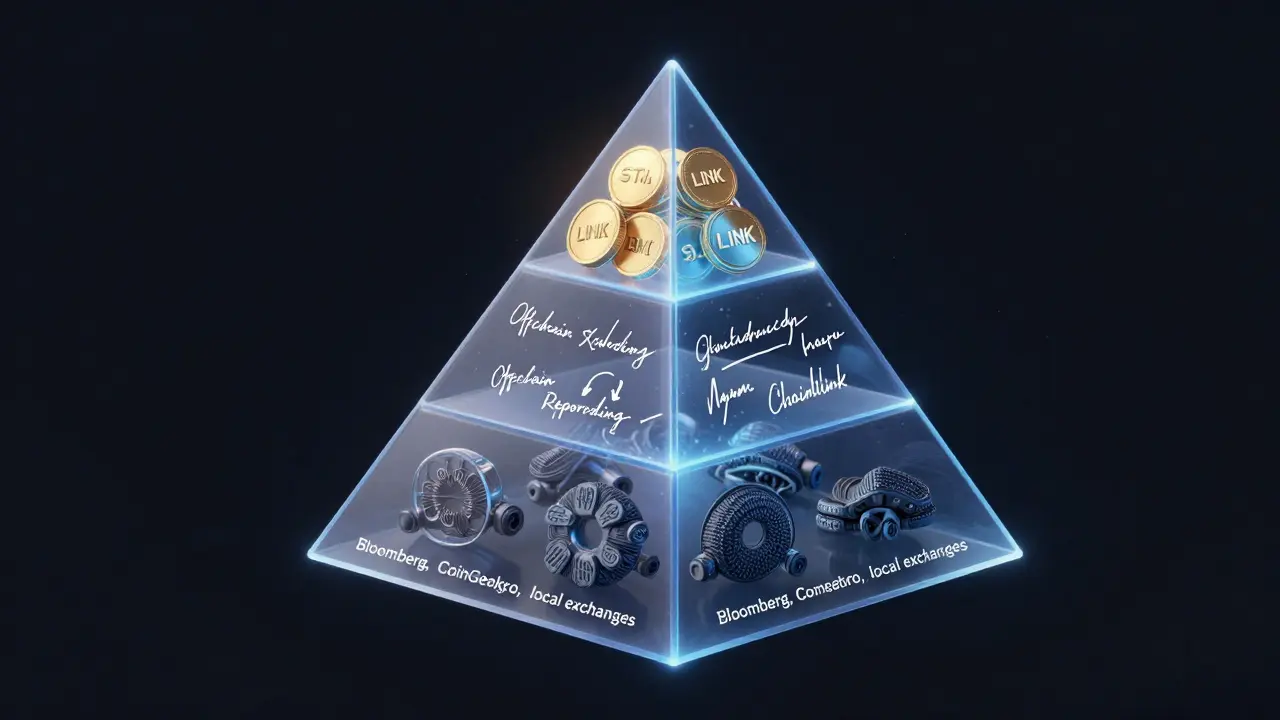
Chainlink doesn’t rely on one source. It uses dozens, sometimes hundreds, of independent node operators spread across the globe. Each node pulls data from multiple sources-like Bloomberg, CoinGecko, or even local exchanges. Then, they compete to deliver the data. Node operators stake LINK tokens as collateral. If they deliver accurate data, they earn more LINK. If they’re wrong or slow, they lose part of their stake. It’s a market-driven system where honesty pays.This isn’t just about multiple sources. It’s about how the data is processed. Chainlink uses Offchain Reporting (OCR2), a system where nodes communicate off-chain to agree on a single, accurate value before posting it to Ethereum. No single node controls the final number. The result? A data feed that’s faster, cheaper, and more secure than anything built on centralized models.
Push vs. Pull: How Data Gets to Your Smart Contract
Chainlink handles data delivery in two ways: push and pull.Push-based feeds (like Chainlink Data Feeds) send updates automatically. For example, the ETH/USD price feed updates every minute-or whenever the price moves more than 1%. This is what DeFi protocols like Aave and Compound use. They don’t need to ask for data. It’s already there, ready to use. If the feed stops updating, other nodes automatically take over. No single point of failure.
Pull-based oracles work differently. Here, the smart contract asks for data when it needs it. The oracle responds with a signed update. This saves gas fees because the data isn’t constantly being broadcast. It’s ideal for applications that don’t need real-time updates-like a game that checks weather data once a day.
The Three-Layer Security Model
Chainlink’s strength isn’t just in its architecture-it’s in how it layers security.Layer 1: Decentralized Oracle Network (DON) - Hundreds of independent nodes, each pulling data from multiple sources. No single entity controls the feed.
Layer 2: Offchain Reporting (OCR2) - Nodes agree on data off-chain using cryptographic signatures. This cuts down on on-chain costs and speeds up delivery. If one node fails to transmit, another picks up the job.
Layer 3: Staking and Reputation - Node operators lock up LINK tokens. Bad behavior means losing money. Good behavior means earning rewards. The Reputation Contract tracks each node’s history. If a node consistently delivers wrong data, it gets dropped from future jobs.
This three-layer approach means even if one node is compromised, the network still works. It’s like having 100 weather stations reporting temperature. If one says it’s 40°C in Adelaide in February, the others will flag it. The system doesn’t trust any single source-it trusts the pattern.

Chainlink CCIP: Beyond Price Feeds
Chainlink isn’t just about feeding prices into smart contracts anymore. With Cross-Chain Interoperability Protocol (CCIP), it’s becoming the backbone for moving assets between blockchains.Before CCIP, moving ETH from Ethereum to Polygon meant using a bridge. Bridges are risky. Many have been hacked because they rely on a small group of validators. CCIP changes that. Instead of trusting a few nodes, CCIP uses a decentralized oracle network to verify each transfer. An independent Risk Management Network watches for suspicious activity. It can pause transfers if too much value moves too fast.
For example, if someone tries to move $500 million from Ethereum to Arbitrum in five minutes, CCIP can detect the spike and freeze the route. Once the situation normalizes, it resumes. All of this is visible on-chain. No hidden logic. No black boxes.
Chainlink vs. LayerZero: A Clear Difference
You might hear about LayerZero as another cross-chain solution. It’s popular. But the two are fundamentally different.LayerZero lets developers choose their own security model. You can pick which verifier network to trust. That’s flexible-but it puts the burden of security on the app developer. Chainlink CCIP, by contrast, enforces a standardized, decentralized verification system. It doesn’t ask you to choose. It just works with built-in safety controls.
Think of it this way: LayerZero is like renting a car and choosing your own brakes. Chainlink CCIP is like driving a Tesla with automatic emergency braking, lane assist, and crash detection-all built in.
Real-World Impact: Who Uses Chainlink?
Chainlink isn’t theoretical. It’s running the backend of some of the biggest DeFi platforms.- Aave uses Chainlink price feeds to determine collateral values for loans.
- Lido relies on it to track staked ETH prices for liquidity rewards.
- BlackRock and JP Morgan are testing tokenized assets on Ethereum using Chainlink for real-time data.
- NFT marketplaces use it to verify rarity traits and auction outcomes.
- Insurance protocols pull weather data to auto-payout claims after floods or storms.
These aren’t small projects. They’re moving billions in value. And they all depend on Chainlink to keep the data accurate, timely, and tamper-proof.
Why Chainlink 2.0 Matters
The original Chainlink network was groundbreaking. Chainlink 2.0 is the upgrade that makes it scalable for mass adoption.It introduces hybrid smart contracts-contracts that can trigger real-world actions (like paying a bank or updating a database) based on on-chain events. It improves transaction sequencing so no one can front-run your trade. It adds better incentive structures so node operators are rewarded fairly, even during low-volume periods.
Most importantly, it reduces the need for trust. Every step-from data collection to on-chain verification-is cryptographically provable. You don’t have to believe Chainlink. You can verify it yourself.
What Happens If Chainlink Fails?
It’s worth asking: what if the whole system breaks?Chainlink has no central team that can shut it down. No CEO. No server room. No corporate headquarters. It’s a network of independent operators, each running software on their own hardware. Even if half the nodes go offline, the rest keep feeding data. The staking mechanism ensures that malicious actors lose money before they can cause real damage.
And if a major data source (like CoinGecko) goes down? Chainlink pulls from 10 others. It doesn’t depend on any one provider. That’s the beauty of decentralization.
Can smart contracts work without oracles?
No. Smart contracts on Ethereum are self-contained and can’t access real-world data on their own. Without an oracle, they can only use data that already exists on the blockchain-like past transactions or internal variables. That limits them to simple, isolated functions. To interact with stock prices, weather, or sports scores, they need an oracle.
Is Chainlink the only oracle on Ethereum?
No. Other oracles exist, like API3, Chainlink’s main competitor, and Pyth Network. But Chainlink is the most widely adopted. It powers over 80% of major DeFi protocols and has the largest network of node operators. Others are growing, but none match Chainlink’s scale, security layers, or institutional adoption.
How does Chainlink make money?
Chainlink doesn’t charge users directly. Instead, smart contract developers pay for data using LINK tokens. The LINK is distributed to node operators who deliver accurate data. Chainlink Labs, the team behind the protocol, doesn’t control the tokens or the network. The system runs on incentives, not fees.
What’s the difference between Chainlink and a blockchain bridge?
A bridge moves assets between blockchains using a trusted group of validators. If those validators are hacked, funds can be stolen. Chainlink CCIP doesn’t move assets directly. It verifies and authorizes transfers using a decentralized oracle network and a separate Risk Management Network. It’s not a bridge-it’s a secure messaging layer that lets other systems move assets safely.
Can I run a Chainlink node?
Yes. Anyone can become a Chainlink node operator. You need technical skills to run the software, a reliable internet connection, and enough LINK tokens to stake as collateral. Node operators earn LINK rewards for delivering accurate data. It’s not a get-rich-quick scheme-it’s a responsibility that requires uptime, security, and reliability.
Final Thought: Why This Matters
Ethereum’s future isn’t just about faster transactions or lower fees. It’s about connecting to the real world. Chainlink is the bridge that makes that possible. Whether you’re lending crypto, trading NFTs, or tokenizing real estate, you’re relying on data feeds that Chainlink makes trustworthy.It’s not magic. It’s engineering. A network of independent operators. Cryptographic proof. Economic incentives. And a relentless focus on security. That’s what turns a smart contract from a toy into a tool that institutions can trust.
9 Responses
Chainlink's approach to decentralized oracles is one of the most elegantly engineered solutions in DeFi. The three-layer security model isn't just marketing fluff-it's a masterclass in fault tolerance. By combining decentralized data ingestion, off-chain consensus, and economic staking incentives, Chainlink turns what could be a single point of failure into a self-correcting system. This is how infrastructure should be built: not with trust, but with verification.
The fact that institutions like BlackRock and JP Morgan are already using it speaks volumes. They don't gamble on hype. They bet on systems that can survive adversarial conditions. Chainlink doesn't just work-it works under pressure.
I appreciate how Chainlink separates the concerns of data sourcing, aggregation, and delivery. Too many projects try to do everything in one layer and end up brittle. The use of OCR2 to reduce on-chain costs while maintaining accuracy is particularly clever. It’s rare to see a protocol that optimizes for both efficiency and security without sacrificing one for the other.
Also, the distinction between push and pull models is something every developer should understand before building on-chain. Most don’t realize how much gas they’re wasting by forcing constant updates.
One thing that’s often overlooked: Chainlink’s reputation system doesn’t just punish bad actors-it rewards consistency. Nodes that perform reliably over time gain priority access to high-value data requests. That’s not just economic incentive-it’s professional accountability. Imagine if every public service operated this way.
And yes, the fact that it’s non-custodial, permissionless, and cryptographically verifiable makes it fundamentally different from centralized APIs. No more ‘trust us, we’re a big company’-just math and economics.
It’s wild how much of DeFi’s stability depends on this invisible layer. Most users think of Ethereum as the blockchain, but really, Chainlink is the nervous system connecting it to reality. Without it, Aave and Lido wouldn’t function. It’s the silent backbone.
You people act like Chainlink is the only solution, but API3 is doing something similar with direct oracle feeds and no middleman. And Pyth is faster, cheaper, and already live on Solana. Chainlink’s dominance is just inertia, not superiority. Stop acting like it’s flawless.
Also, the ‘no central team’ line is a joke. Chainlink Labs still controls the oracle templates, the feed deployment, and the governance token distribution. It’s decentralized in theory, centralized in practice. Don’t pretend otherwise.
lol i never realized how much i rely on chainlink until i read this. like i use aave all the time and never thought about how it knows what eth is worth. crazy that something so important is just… out there. like a digital weatherman for money.
So Chainlink doesn’t just make oracles better-it makes them *reliable*. That’s huge. I’ve seen so many DeFi projects crash because their price feed broke, and it’s always because they used some sketchy single-source API. Chainlink’s multi-node, multi-source approach is the only way to go. Seriously, if you’re building something that needs real-world data, don’t even think about anything else.
Also, the fact that it’s used by institutional players? That’s the real seal of approval. Not because they’re rich, but because they’ve got teams of auditors who check everything. If they trust it, you should too.
OCR2 is the real innovation here-not the decentralization. The whole ‘multiple nodes’ thing is table stakes. What’s revolutionary is the off-chain aggregation with cryptographic signatures. It cuts gas costs by 80% compared to on-chain medianization. That’s not an improvement-that’s a paradigm shift. And the fact that it’s composable with CCIP? That’s the future: modular, verifiable, cross-chain data pipelines. We’re not just feeding prices anymore. We’re building a decentralized data internet.
Let’s be honest-this whole system is the closest thing we’ve ever had to a divine oracle. 🙏 Blockchain + cryptography + economic incentives = truth that can’t be corrupted. 🤖✨
Think about it: for the first time in human history, we have a system where truth isn’t dictated by governments, corporations, or media. It’s determined by math, by stake, by consensus. That’s not just tech. That’s civilization-level progress.
Chainlink isn’t a tool. It’s a covenant. A promise that reality can be encoded, verified, and trusted without a single human in the loop. And if you’re not excited about that, you’re not paying attention.
Let’s not forget: every time a smart contract pays out an insurance claim because a hurricane hit, or locks a loan because ETH dipped below 2,800-that’s Chainlink making the world fairer. 🌍⚡
This isn’t crypto. This is the future of trust. And it’s already here.