
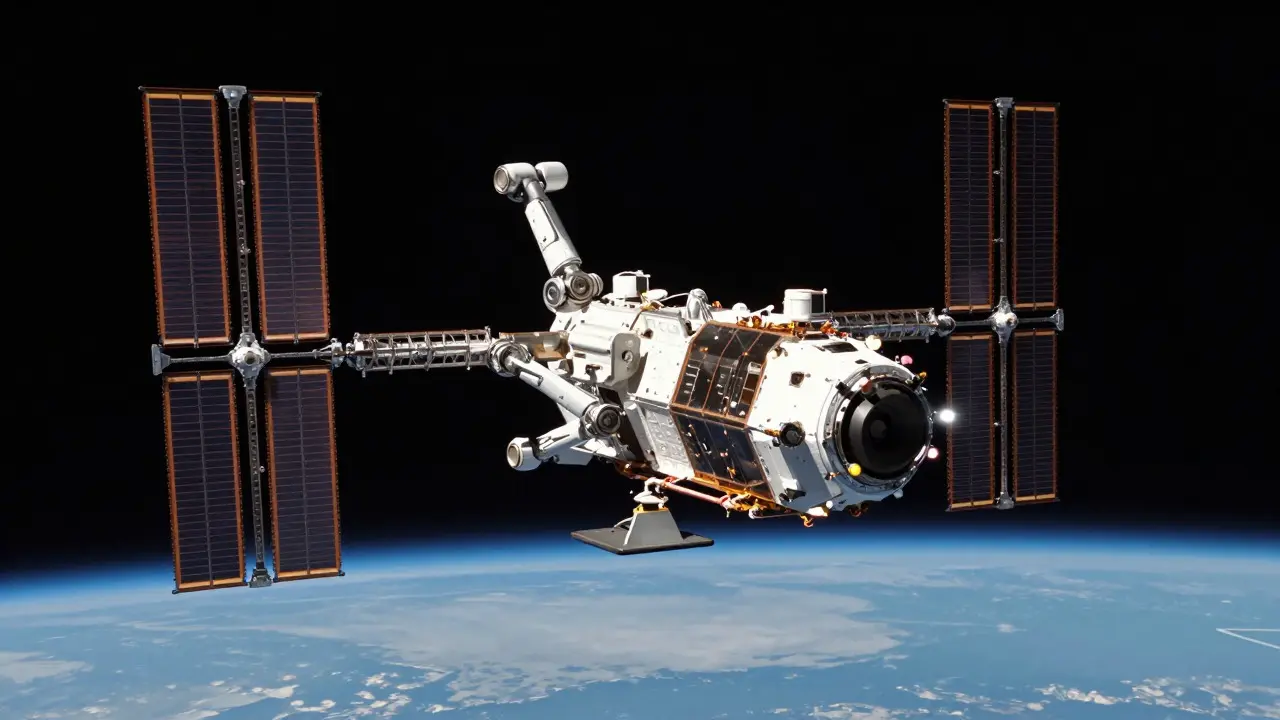
Imagine sending a mechanic into space to fix your satellite. Sounds like science fiction, right? Well, it’s happening now. Companies are building spacecraft that can dock with other satellites to refuel them, repair broken parts, or even de-orbit dead ones to clear up space junk. This is called on-orbit servicing, or OOS. But here’s the catch: while engineers have figured out how to fly these missions, lawyers and policymakers are still scratching their heads over who owns what, who pays if things go wrong, and whether one country has the right to touch another country’s satellite.
We’re standing at a crossroads. The technology for rendezvous and proximity operations (RPO) is ready, but the legal framework is stuck in the past. If we don’t sort this out, the future of commercial spaceflight could be grounded by lawsuits, security fears, and regulatory gridlock. Let’s break down the messy reality of space law today.
The Old Rules Don’t Fit the New Game
To understand why OOS is such a headache for lawyers, you first need to look at where our current rules come from. Most international space law rests on five United Nations treaties adopted between 1967 and 1979. The big one is the Outer Space Treaty of 1967. These documents were written when space was mostly about flags, footprints, and radio signals. No one back then imagined private companies flying service vehicles to tinker with each other’s hardware in low Earth orbit.
The problem? These treaties don’t mention on-orbit servicing explicitly. They talk about general principles like state responsibility and avoiding harmful interference. Article VI of the Outer Space Treaty says states are responsible for national activities in space, including those done by private companies. Article VII and the 1972 Liability Convention say states are liable for damage caused by their space objects. Article IX requires countries to avoid causing harmful interference to others.
That sounds fine until you realize "harmful interference" isn’t clearly defined for close-proximity maneuvers. Does hovering near a satellite count as interference? What if a servicing vehicle accidentally bumps into a third-party satellite? The old treaties give us broad strokes but no detailed brushwork for the complex dance of RPO missions.
Who Owns That Satellite?
Ownership and consent are the biggest sticking points. Under the 1975 Registration Convention, every space object is registered by a single state. That state retains jurisdiction and control over the object. So, if a U.S.-registered servicing spacecraft wants to approach a French-registered communications satellite, does the U.S. company need permission from France? From the French operator? Both?
Yumiko Takatori, a leading voice in recent space law analysis, highlights this dilemma. She asks fundamental questions: Whose permission must be obtained to approach a satellite? Who bears responsibility if an accident occurs? Currently, there is no standard protocol. Most experts agree that bilateral contracts between the servicing provider and the satellite owner are essential. These contracts need to reflect obligations under the Outer Space Treaty and clarify that the target owner consents to the approach.
Without clear consent mechanisms, every RPO mission risks being seen as an unauthorized intrusion-or worse, a hostile act. In a crowded orbital environment, ambiguity is dangerous. Operators need certainty that they won’t be sued or sanctioned for simply doing their job.
| Challenge Area | Core Question | Current Status |
|---|---|---|
| Consent & Ownership | Who must approve the approach? | No global standard; relies on bilateral contracts and state-level agreements. |
| Liability Allocation | Who pays if debris is created? | Unclear fault determination; gaps in insurance coverage for multi-party interactions. |
| Dual-Use Security | Is it a repair tool or a weapon? | High suspicion; requires transparency measures and export controls. |
| Regulatory Authority | Which agency licenses the mission? | Fragmented oversight; overlapping jurisdictions in major space nations. |
The Liability Nightmare
Let’s say a servicing mission goes wrong. Maybe the robotic arm jams, or the thrusters fire unexpectedly, creating a cloud of debris that hits another satellite. Who is liable? The servicing company? The satellite owner who hired them? The launching state of the servicer? The launching state of the victim?
This is where the law gets fuzzy. The 1972 Liability Convention establishes absolute liability for damage caused on Earth or to aircraft in flight, and fault-based liability for damage in space. But defining "fault" in a close-proximity operation involving two moving objects is incredibly difficult. Did the servicer make a navigation error? Did the target satellite drift unexpectedly? Was the Space Situational Awareness (SSA) data inaccurate?
ESPI Report 76, published in 2022, identifies liability uncertainty as a major barrier to investment. Insurers are hesitant to cover OOS missions because the risk models are unproven. Without clear rules on fault allocation, operators face an additional layer of financial risk. Newman and colleagues argue that robust domestic authorization regimes and comprehensive insurance frameworks are necessary precursors to commercial deployment. Until then, many potential clients will stick to traditional launch-and-forget models rather than risk a costly lawsuit.
Filling the Gaps: Standards and Self-Regulation
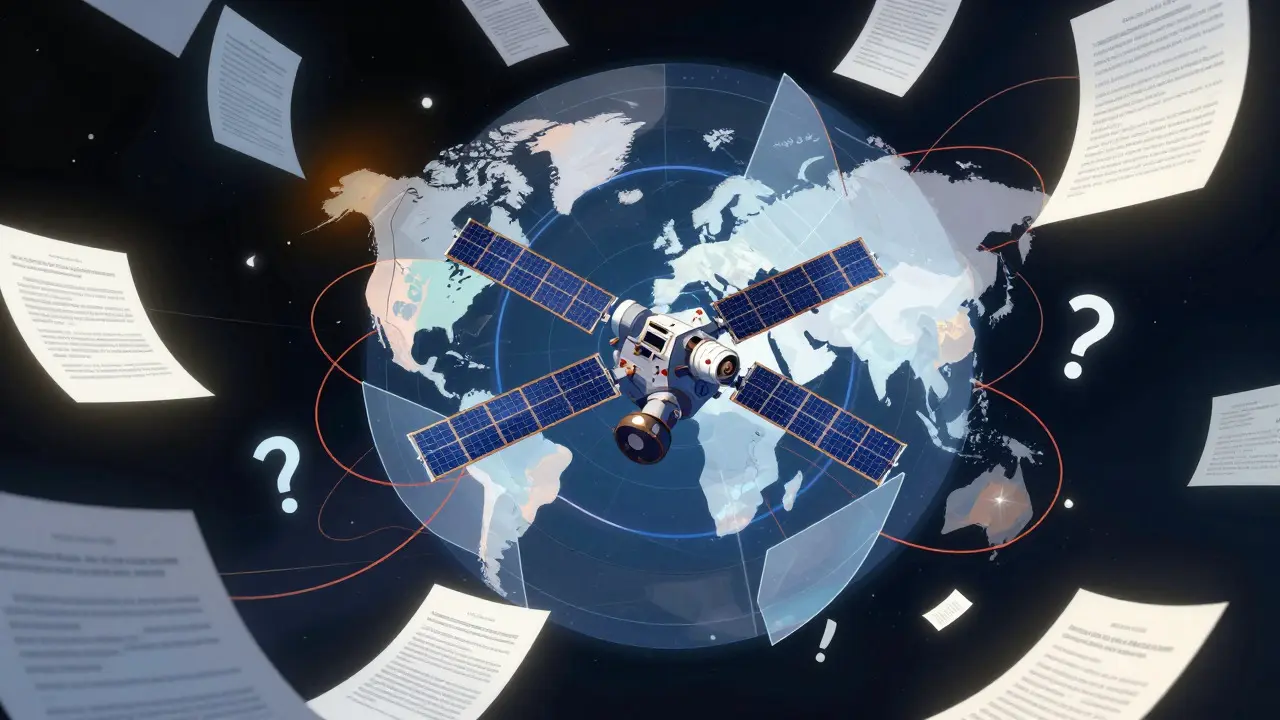
Since new global treaties take decades to negotiate, the industry is turning to standards and soft law to fill the vacuum. Two key players here are ISO 24330:2022 and CONFERS.
ISO 24330:2022, published on July 1, 2022, is a landmark document. It’s titled "Space systems - Rendezvous and proximity operations (RPO) and on-orbit servicing (OOS) - Programmatic principles." While it’s a voluntary technical standard, not a law, it sets best practices for mission planning, risk assessment, safety margins, and data exchange. Think of it as a checklist for safe behavior. Companies that follow ISO 24330 can demonstrate due diligence if something goes wrong, which helps with liability and licensing.
Then there’s CONFERS (Consortium for Execution of Rendezvous and Servicing Operations). This group includes major aerospace players like Boeing, Airbus, and Northrop Grumman. Their guiding principles emphasize that operations must be consensual, conducted via commercial agreements, and compliant with all national regulations and the Outer Space Treaty. CONFERS essentially operationalizes treaty obligations into practical norms for business. It tells regulators: "If you let us play by these rules, you can trust us to be safe and transparent."
The Dual-Use Dilemma
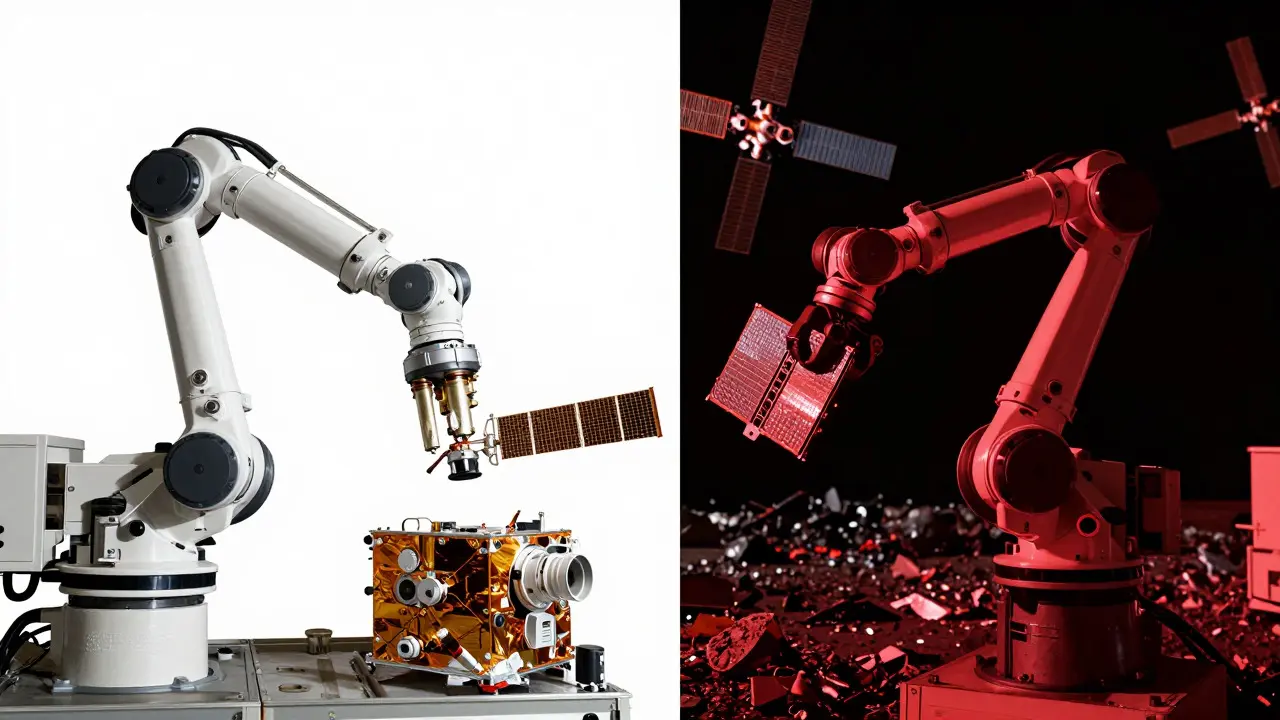
Here’s the elephant in the room: the same technology used to gently dock with a satellite for repairs can also be used to disable or capture it. A robotic arm that fixes a solar panel could just as easily rip it off. Thrusters that adjust orbit could push a satellite out of position.
Newman’s 2019 analysis warns that OOS technologies present a major challenge for international law because they could be weaponized. This dual-use nature creates deep security concerns. States may be reluctant to allow foreign servicing vehicles near their strategic assets, fearing espionage or sabotage. As a result, transparency becomes crucial. Operators need to prove their intentions are benign. Confidence-building measures, such as sharing SSA data and publishing mission plans, help alleviate these fears.
Export controls add another layer of complexity. High-tech components used in RPO missions often fall under strict export regulations. Navigating these rules requires careful coordination between industry and government agencies. If a servicing company violates export laws, the consequences can be severe, ranging from fines to loss of license.
National Regulatory Patchworks
While international law provides the baseline, national laws dictate the details. And here, the picture is fragmented. In the United States, for example, on-orbit activities are subject to a patchwork of regulations under multiple agencies. The Federal Communications Commission (FCC), the Federal Aviation Administration (FAA), and the Department of Commerce all have overlapping authorities. This confusion frustrates industry players who want clear guidelines.
A 2025 policy paper noted that U.S. laws do not explicitly address commercial on-orbit servicing, and Congress has not specifically authorized agencies to create OOS-specific regulations. The recommendation? Enable regulatory authority to provide clarity for licensing, safety, and liability. Similar calls for tailored national regimes are coming from Europe and Australia. Bond University researchers stress the need for clear standards for technical safety, SSA data use, and mission transparency.
In short, if you want to launch an OOS mission, you need to navigate a maze of local laws, export controls, and security reviews. Getting it wrong means delays, costs, or cancellation. Getting it right requires multidisciplinary teams combining legal expertise, engineering skills, and policy knowledge.
What Comes Next?
The path forward isn’t about scrapping the old treaties. It’s about adapting them. Experts like Christopher Newman advocate a pragmatic approach: interpret existing treaties to cover servicing, develop detailed national authorization regimes, and rely on technical standards like ISO 24330 and industry codes like CONFERS. We don’t need a new global treaty immediately; we need better implementation of what we have.
For the industry, this means investing in legal infrastructure. Contracts need to be tighter. Insurance products need to evolve. Transparency needs to increase. For policymakers, it means updating national laws to recognize OOS as a distinct activity with unique risks. Clearer rules will attract investment, spur innovation, and keep our orbits sustainable.
On-orbit servicing is essential for the future of space. It extends satellite lifetimes, reduces launch costs, and cleans up debris. But its success depends on solving the legal and policy puzzles today. If we get it right, we’ll see a thriving ecosystem of service providers keeping space clean and functional. If we get it wrong, we’ll face collisions, conflicts, and stagnation. The choice is ours.
What is the main legal challenge of on-orbit servicing?
The main legal challenges involve defining consent for approaching another satellite, allocating liability in case of accidents or debris creation, and managing dual-use security concerns where servicing technology could be perceived as a threat.
Does the Outer Space Treaty cover on-orbit servicing?
The Outer Space Treaty does not explicitly mention on-orbit servicing, but it governs these activities through general obligations on state responsibility, liability for damage, registration of space objects, and the duty to avoid harmful interference.
What is ISO 24330:2022?
ISO 24330:2022 is an international technical standard that establishes guiding principles and best practices for rendezvous and proximity operations (RPO) and on-orbit servicing (OOS), covering mission planning, risk assessment, and safety protocols.
Who is liable if a servicing mission causes damage?
Under current law, the launching state of the space object causing damage is internationally liable. However, determining fault in close-proximity operations is complex, and liability is often addressed through bilateral contracts between the servicing provider and the satellite owner.
Why is consent important in on-orbit servicing?
Consent is crucial because satellites remain the property of their registering states. Approaching or touching another state's satellite without permission could be viewed as unauthorized interference or a hostile act, violating principles of due regard and peaceful use of outer space.
What role does CONFERS play in space law?
CONFERS provides industry-led guiding principles for safe and responsible RPO and OOS operations. It promotes consensual operations, compliance with national regulations, and adherence to the Outer Space Treaty, helping to bridge the gap between technical practice and legal requirements.
13 Responses
the iso 24330 standard is actually a big deal here because it gives insurers something concrete to look at when pricing these risky missions right now we have this weird gap where the tech moves fast but the liability models are stuck in the sixties so having a checklist for safe behavior helps prove due diligence if things go south basically companies can say they followed the best practices even if the treaty language is vague about what constitutes harmful interference during close proximity ops
i love that someone finally wrote about this because the idea of fixing satellites instead of just launching new ones is so much better for the environment and our wallets too it feels like we are on the verge of a real shift in how we think about space sustainability
it is wild to think that we have the engineering to do this but the legal framework is still figuring out who owns what in orbit it makes you wonder how long it will take before we see a major incident that forces everyone to agree on rules rather than just talking about them softly
you are missing the point about state responsibility under article vi of the outer space treaty which clearly states that states bear international responsibility for national activities in outer space whether carried out by governmental or non-governmental entities so the private company is just an agent of the state and the state is liable period stop crying about contracts when the international law is already settled on this basic principle of attribution
none of this matters because the whole concept of on-orbit servicing is just a front for military surveillance and weaponization anyway why would any rational country allow a foreign robotic arm to get within inches of their strategic assets unless they were paranoid about espionage so the industry is lying to us about the commercial viability while governments quietly build kill sats
this is such an exciting time for space exploration and i really hope that the industry can work together to create those bilateral contracts quickly so we can start seeing more repair missions soon it gives me so much hope for the future of sustainable space travel
OMG this is literally the biggest issue in space right now and nobody talks about it enough because they are all focused on rockets and landing stuff on mars but if we cannot fix our own junk up there then everything is going to crash into each other and it will be a total disaster for everyone involved
the dual-use dilemma is absolutely fascinating because it turns every service vehicle into a potential spy or saboteur in the eyes of paranoid defense ministries imagine trying to explain to a general that your gentle docking maneuver is not a hostile takeover attempt it requires a level of trust that simply does not exist in current geopolitics
we need to push harder for clear national regulations because without them the innovation will stall completely and we will lose the chance to clean up low earth orbit let us demand that our representatives update the laws to reflect the reality of commercial spaceflight today
the masses fail to grasp the existential weight of orbital debris as a metaphor for human negligence in the cosmic void we treat the heavens as a dumping ground for our ego-driven technology while ignoring the silent scream of dead satellites drifting in eternal darkness it is a tragedy of epic proportions that only the enlightened few truly comprehend
I am literally shaking right now thinking about the possibility of a satellite collision caused by a malfunctioning robotic arm it would be the most catastrophic event in history and we are just sitting here debating paperwork while the clock ticks down to doom
you people are all so naive to think that insurance will ever cover these risks properly because the insurers know that the fault determination is impossible so they will just deny every claim and leave the operators holding the bag it is a rigged game from the start and you are all walking right into it
obviously the confers consortium is just a cover for the military industrial complex to legitimize their weaponized satellites under the guise of commercial servicing they want you to believe it is about repairs but it is really about establishing dominance in orbit and controlling who gets to stay up there and who gets removed