
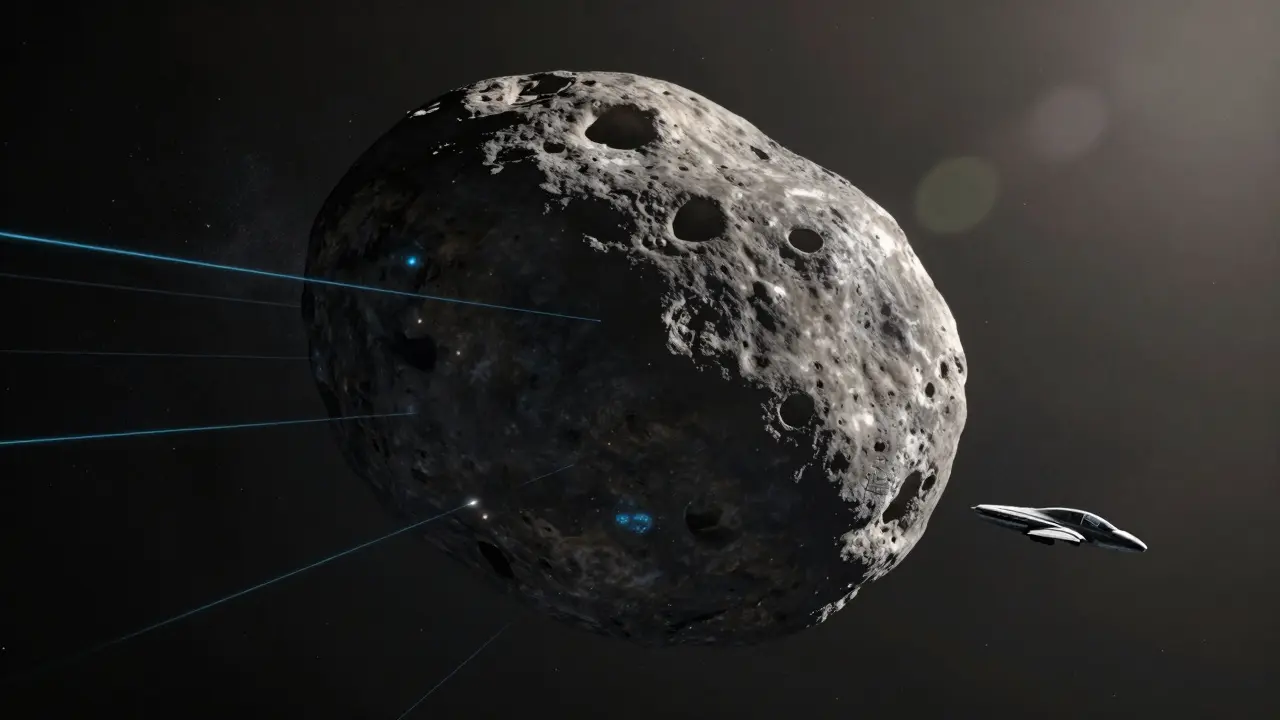
Imagine trying to park a car in a garage that is constantly shaking, changing shape, and pulling you toward the walls with uneven strength. That is essentially what engineers face when sending a spacecraft near an asteroid, a small celestial body with a weak and irregular gravitational pull. Unlike orbiting Earth or Mars, where gravity is predictable and spherical, navigating around small bodies like asteroids or comets requires a completely different set of rules. For anyone interested in the future of space exploration, particularly asteroid mining, understanding these dynamics is not just academic-it is the difference between a successful mission and a total loss.
The challenge begins with the sheer weakness of gravity. An asteroid’s gravitational parameter (GM) is tiny, often ranging from 10⁻¹⁰ to 10⁻³ km³/s². To put that in perspective, Earth’s GM is roughly 398,600 km³/s². This means the surface gravity on many asteroids is so low that it feels almost nonexistent. You might weigh less than a paperclip on some of these rocks. But weak gravity does not mean easy navigation. In fact, it makes things much harder because other forces, like solar radiation pressure or even the outgassing of a comet, can easily overpower the asteroid’s pull, knocking a spacecraft off course.
Why Small Body Gravity Is So Tricky
On Earth, we use spherical harmonic models to map gravity. These work well because our planet is mostly round. Asteroids, however, are lumpy. They look more like potatoes, dumbbells, or rubble piles held together by faint gravity. This irregular shape creates an inhomogeneous gravity field. The pull is stronger on one side than the other, and it changes direction unpredictably as you move closer.
This inhomogeneity leads to a phenomenon called gravity gradient torque. As a spacecraft approaches, the difference in gravitational pull across its own structure can cause it to rotate uncontrollably. If you do not account for this, your spacecraft could tumble into the surface before you even realize what happened. Traditional orbital mechanics, which assume a central point mass, fail here. Instead, engineers must rely on advanced modeling techniques to predict how the spacecraft will behave in this chaotic environment.
Modeling the Unmodelable: Polyhedron Gravity Models
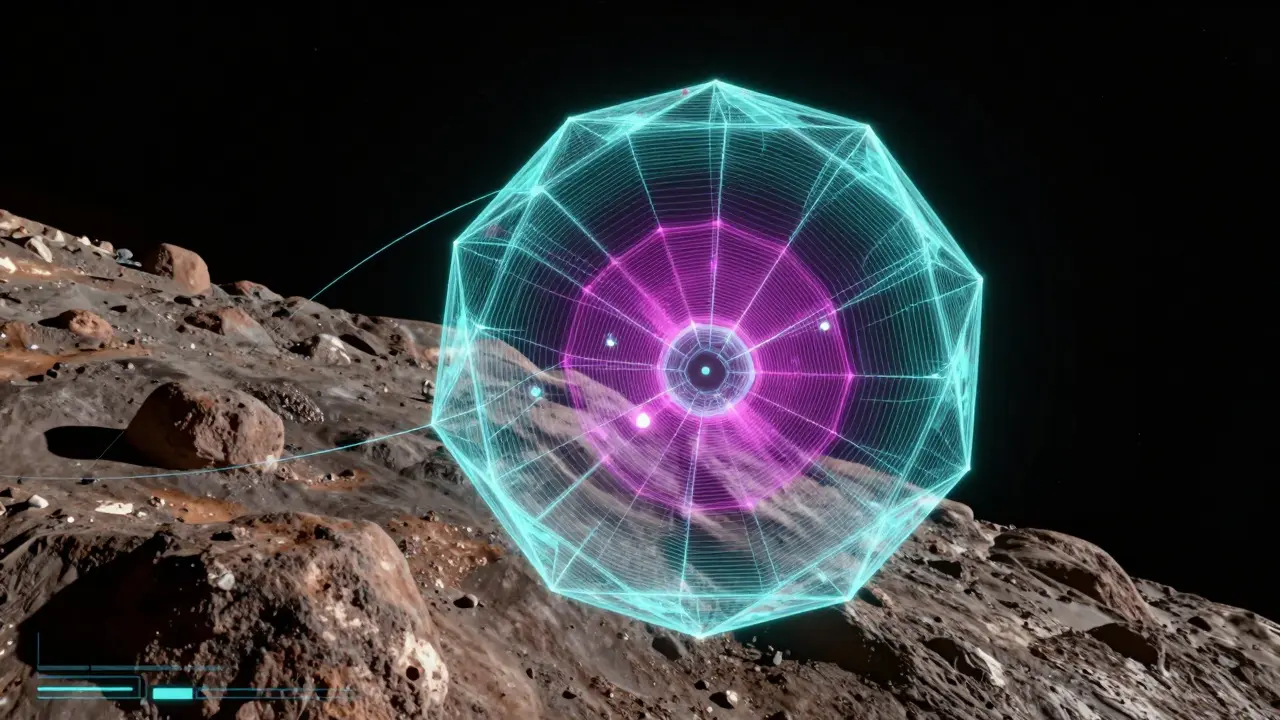
Since standard maps do not work, scientists have developed the polyhedron gravity model. Imagine breaking down the asteroid into thousands of tiny triangular facets. By calculating the gravitational contribution of each facet, engineers can create a highly accurate 3D map of the gravity field right down to tens of meters above the surface. This method allows for precise trajectory planning, but it requires significant computational power and detailed shape data.
Getting that shape data is part of the problem. Missions often start with limited knowledge of the target. This is why onboard estimation is critical. Modern spacecraft use algorithms like the unscented Kalman filter (UKF) to estimate their position and update the gravity model in real-time. The UKF handles the nonlinearities of the asteroid’s gravity better than older filters, allowing the spacecraft to adjust its path dynamically as it learns more about the body it is approaching.
| Feature | Earth Orbit (LEO) | Small Body Orbit (Asteroid) |
|---|---|---|
| Gravity Strength | Strong (~9.8 m/s² at surface) | Extremely Weak (10⁻⁵-10⁻³ m/s²) |
| Orbital Velocity | ~7.8 km/s | Centimeters per second |
| Gravity Model | Spherical Harmonics (Highly Accurate) | Polyhedron Model (Shape-Dependent) |
| Primary Perturbations | Atmospheric Drag, J₂ Effect | Solar Radiation Pressure, Outgassing, Shape Irregularities |
| Stability | Naturally Stable Long-Term Orbits | Often Unstable; Requires Active Control |
Types of Orbits Around Asteroids
You cannot just pick any altitude and expect to stay there. Around small bodies, orbits are categorized by their risk and utility. Understanding these types is essential for mission design, especially for commercial entities looking to extract resources.
- Distant Survey Orbits: Located tens of body radii away, these orbits are stable enough for initial mapping. Here, the asteroid looks like a point mass, and classical physics applies. It is the safest place to start.
- Intermediate Mapping Orbits: Closer in, where shape effects begin to dominate. These orbits require frequent corrections due to secular drift caused by the asteroid’s rotation and irregular gravity.
- Low Proximal Orbits: Just tens of meters above the surface. These are incredibly risky. A slight error in the gravity model can lead to impact within hours. However, they offer the best resolution for identifying mineral deposits.
- Terminator Orbits and Hovering: Some missions, like JAXA’s Hayabusa, used hovering trajectories. This is not a free orbit; it requires continuous thrust to maintain position over a specific spot, much like a helicopter hovering in a strong wind.
For asteroid mining operations, the goal is often to reach those low proximal orbits or land directly. But getting there safely requires mastering the transition from distant stability to proximal chaos.
Navigation Techniques: From Ground to Autonomy
In the past, ground stations tracked every move. Today, communication delays make that impossible for real-time control. A signal from Earth takes minutes to reach an asteroid, meaning you cannot react to an imminent collision in time. This has driven the shift toward autonomous navigation.
Spacecraft now rely heavily on optical navigation (OpNav). Cameras take pictures of the asteroid’s limb and landmarks, comparing them against star backgrounds to determine position. Newer research focuses on shape-free navigation, where the spacecraft does not need a pre-loaded model of the asteroid. Instead, it uses observed features to estimate relative position and velocity. This is crucial for CubeSats or secondary payloads that might approach newly discovered bodies with no prior data.
Another emerging technique involves landed transponders. If a lander touches down first, it can act as a beacon. The orbiter measures the distance and speed relative to this known point, drastically improving orbit determination accuracy. This cooperative approach can reduce errors from kilometers to mere meters, enabling precision landing and resource extraction.
The Future: Swarms and Machine Learning
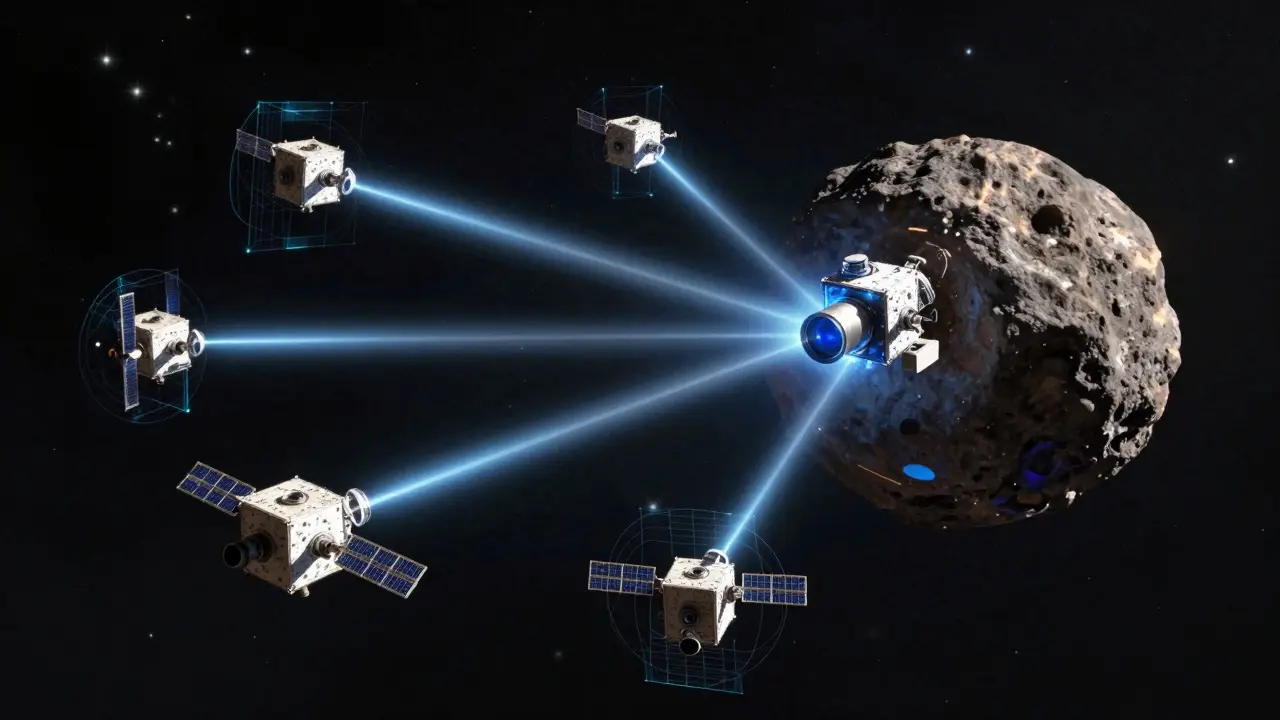
The next generation of missions will likely involve swarms of small satellites working together. Cooperative navigation allows multiple spacecraft to share data, creating a distributed sensor network. This redundancy ensures that if one satellite fails, the others can continue the mission. It also allows for tomography-mapping the internal density of the asteroid by analyzing how the swarm’s formation perturbs under gravity gradients.
Machine learning is also entering the mix. Algorithms trained on millions of simulated scenarios can recognize hazard patterns faster than traditional code. For short-lifetime, low-cost CubeSats, accepting higher risk for high-resolution data is a viable strategy. These "disposable" probes can perform daring close passes, gathering data that would be too risky for expensive flagship missions.
As we look toward 2026 and beyond, the ability to navigate these complex gravity fields is no longer just a scientific curiosity. It is the foundational technology for the commercial exploitation of space resources. Whether you are building a probe to study Near-Earth Objects or designing a miner to harvest water ice, mastering the art of small body navigation is non-negotiable.
What is the biggest challenge in navigating around an asteroid?
The primary challenge is the weak and highly irregular gravity field. Unlike planets, asteroids have lumpy shapes that create unpredictable gravitational pulls. This makes traditional orbital mechanics ineffective, requiring constant active control and real-time updates to the gravity model to avoid collisions.
How do spacecraft map the gravity of an unknown asteroid?
Engineers use polyhedron gravity models combined with onboard sensors. Cameras perform optical navigation to track the shape, while inertial sensors measure acceleration. Advanced filters like the unscented Kalman filter process this data to estimate the gravity field in real-time as the spacecraft approaches.
Are there stable orbits around all asteroids?
Not necessarily. Many low-altitude orbits around irregular, rotating asteroids are inherently unstable. While distant orbits are generally stable, close-proximity orbits often require continuous thrust (hovering) or frequent correction maneuvers to prevent the spacecraft from crashing or escaping.
What role does autonomy play in small body navigation?
Autonomy is essential due to communication delays. Since signals from Earth take minutes to arrive, spacecraft must make split-second decisions to avoid hazards. Autonomous systems use onboard computers to process camera images and sensor data, adjusting the trajectory without human input.
How does asteroid navigation differ from Earth orbit navigation?
Earth’s gravity is strong and spherical, allowing for stable, long-term orbits with minimal correction. Asteroid gravity is weak and irregular, making orbits unstable and susceptible to external forces like solar radiation. Navigation around asteroids requires precise, frequent adjustments and advanced modeling techniques not needed for Earth orbits.