
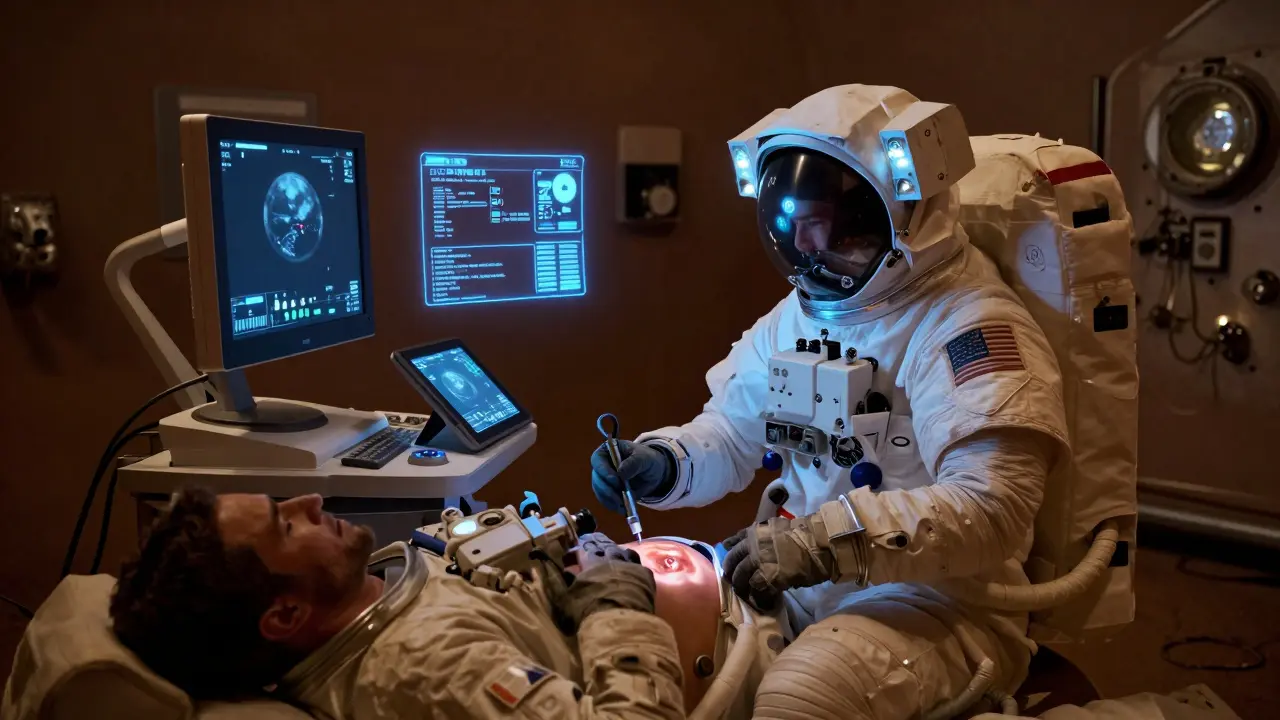
When astronauts land on Mars, they won’t have a hospital down the road. They won’t even have a phone call to a doctor. With communication delays of up to 22 minutes each way, and no possibility of evacuation, medical emergencies become life-or-death puzzles that must be solved entirely by the crew. This isn’t science fiction-it’s the reality NASA is preparing for right now. The medical support for Mars missions isn’t just an upgrade to what we have on the International Space Station. It’s a complete overhaul of how humans stay healthy when they’re truly alone in the solar system.
Why Earth’s Medical System Won’t Work on Mars
On the International Space Station, astronauts have a safety net. If someone gets sick, ground control steps in. Flight surgeons watch live vital signs. Specialists in Houston, Berlin, or Tokyo jump on the line within seconds. Medications are shipped every few months. Emergency evacuation? Possible in under a day. That’s not just convenient-it’s the foundation of current space medicine. But Mars changes everything. The distance means real-time help is impossible. A heart attack, a ruptured appendix, or even a bad kidney stone can’t wait 40 minutes for a doctor’s opinion. And once you’re on Mars, you’re stuck. No resupply missions. No replacement parts. No way to fly home. That’s why NASA’s medical system for Mars missions has to be built around one core idea: crew autonomy. No more waiting for instructions from Earth. The astronaut with medical training-often called the Crew Health Officer-becomes the primary doctor. They don’t just follow orders. They make decisions. They diagnose. They treat. And if they get hurt? Someone with zero medical background might have to step in. That’s not a hypothetical. It’s a scenario tested in simulations.The Four Pillars of Mars Medical Care
NASA’s approach to medical support for Mars missions breaks down into four essential areas: prevention, diagnosis, treatment, and long-term management. Each one requires new tools, new training, and new thinking.- Prevention is the first line of defense. On Mars, you can’t afford to get sick. That means food isn’t just about calories-it’s about nutrients that fight bone loss and muscle atrophy. Exercise isn’t optional-it’s a daily medical regimen. Sleep, light cycles, and mental health monitoring are built into the mission design. Even the layout of the spacecraft is designed to reduce stress and keep people calm.
- Diagnosis has to be fast, accurate, and done with minimal equipment. Forget CT scanners. Instead, portable ultrasound devices are being refined to spot kidney stones, internal bleeding, or lung fluid. These tools are being tested in Mars simulation environments like the Utah desert, where teams practice diagnosing emergencies under simulated communication delays.
- Treatment must be possible without surgeons. One breakthrough is Sonomotion’s focused ultrasound tech, which can literally nudge kidney stones out of the body without cutting. Heart attacks? Researchers at Stanford are testing AI-guided protocols to stabilize patients using only onboard drugs and devices. Even anesthesia is being rethought-how do you safely put someone under when gravity is different and medical supplies are limited?
- Long-term management deals with chronic issues that build up over two years. Radiation exposure, bone density loss, vision changes, and psychological strain aren’t emergencies-they’re slow-motion threats. The medical system must track these changes daily and adjust care plans automatically.
The AI Doctor in the Capsule
You can’t train every astronaut to be a cardiologist, a neurologist, and a trauma surgeon. So NASA is building a digital assistant-part AI, part clinical decision system-that acts like a medical expert in the room. NASA and Google are testing a tool designed specifically for Extended-Duration Isolated and/or Confined Operations (EIMO). This isn’t a chatbot. It’s a system that:- Continuously monitors vital signs from wearable sensors
- Flags early signs of illness before symptoms appear
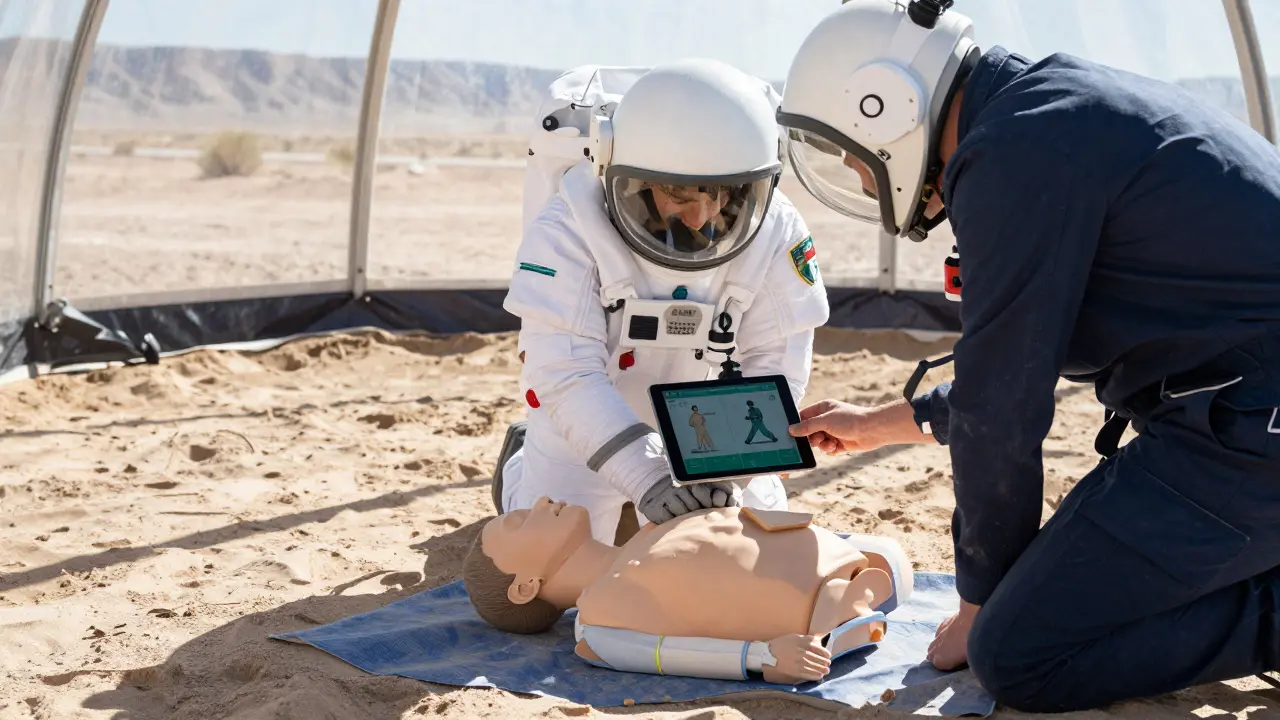
- Guides crew members step-by-step through procedures like inserting an IV or performing CPR
- Suggests treatment options based on available drugs and equipment
- Logs everything for later analysis by ground teams
Testing in the Desert, Preparing for Mars
You can’t test Mars medicine in a lab. You need isolation, limited resources, and real pressure. That’s why research teams are running simulations in the Utah desert. The Mars Desert Research Station (MDRS) outside Hanksville is one of the most important labs for space medicine. Teams live there for weeks at a time, cut off from the internet, with only a few medical supplies. They practice treating injuries under communication delays. One study found that delivering anesthesia in low gravity with no backup was nearly impossible without extensive training. Another revealed that crew members without medical backgrounds could successfully manage a simulated appendectomy using only a tablet-based guide. Dr. Matthieu Komorowski from Imperial College London helped design these simulations. His work shows that the biggest challenge isn’t the technology-it’s the human factor. Who makes the call when two crew members disagree on treatment? What happens if the crew doctor gets sick? How do you keep someone calm when they’re bleeding and 140 million miles from home? These aren’t theoretical questions. They’re being answered in real simulations-with real consequences.Data Is the New Medicine
On Mars, every heartbeat, every temperature reading, every drop of urine matters. The medical system doesn’t just treat-it collects. All health data is stored in a unified system that links clinical care with scientific research. Why? Because every time an astronaut’s blood pressure spikes or their sleep pattern shifts, it’s not just a medical note-it’s a clue to how the human body adapts to deep space. This data doesn’t just help the crew. It helps future missions. NASA’s Exploration Medical Capability (ExMC) team uses this information to refine protocols, update AI models, and design better equipment. The system must also work with other spacecraft systems-like water recycling-to ensure medical needs don’t compete with life support.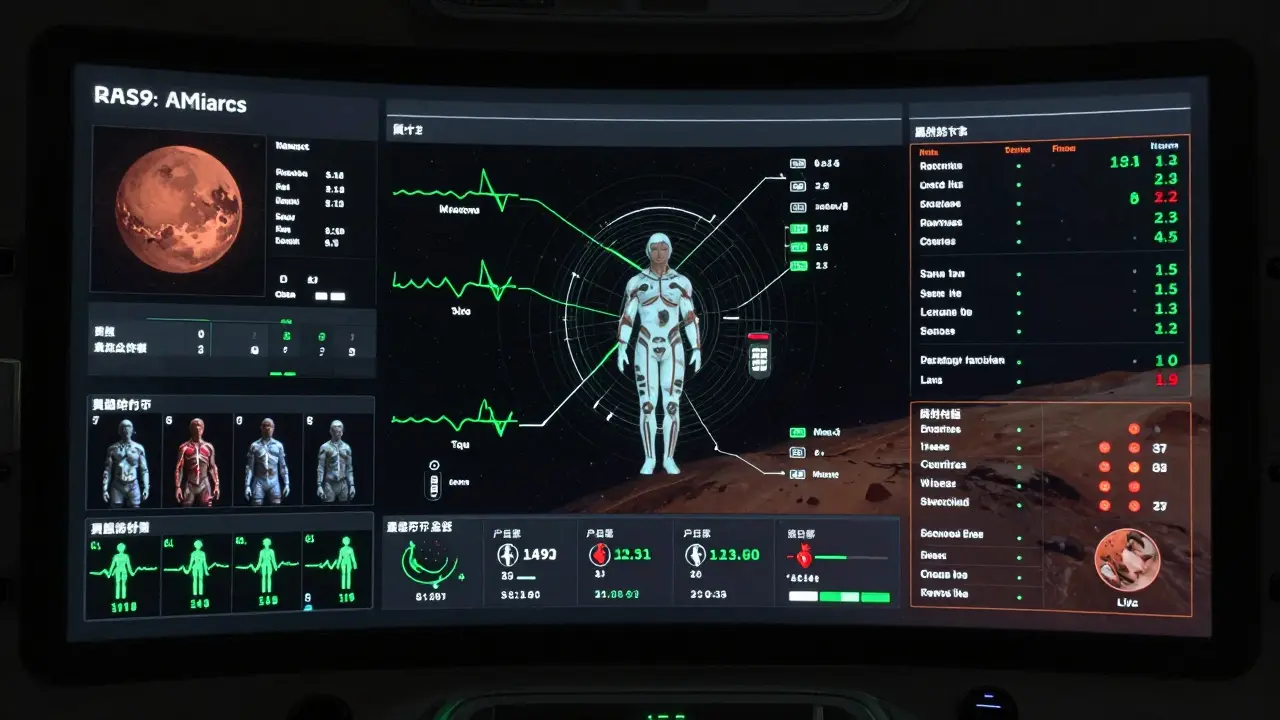
What Happens When the Doctor Gets Sick?
The scariest scenario isn’t a heart attack. It’s when the crew’s only trained medic is incapacitated. In that case, someone with no medical experience has to save a life. That’s why training now includes non-medical crew members. They learn how to use the AI system. They practice inserting IVs on simulators. They memorize emergency drug dosages. They rehearse CPR under simulated Mars gravity. It’s not about turning them into doctors. It’s about turning them into capable responders. In simulations, teams without formal medical training have successfully managed bleeding, seizures, and respiratory failure-using only a tablet, a few tools, and a step-by-step AI guide. The results are promising. But they also show how fragile the system is. One broken sensor. One misunderstood instruction. One delay in communication. Any of those could be fatal.The Bottom Line: Autonomy Is the Only Option
Mars won’t wait for perfect technology. It won’t wait for Earth to send help. The medical system for Mars missions has to be self-sufficient, intelligent, and resilient. It has to prevent illness before it starts. Diagnose without specialists. Treat without surgeons. And keep people alive even when their doctor is unconscious. This isn’t about sending a first-aid kit to Mars. It’s about sending a mobile hospital, a trained crew, and an AI doctor-all working together. And if we get it right, it won’t just save lives on Mars. It will change how medicine works on Earth, too-especially in remote areas, disaster zones, and isolated communities.When the first humans step onto Martian soil, they won’t just be explorers. They’ll be pioneers of a new kind of medicine-one that doesn’t rely on hospitals, but on human ingenuity, technology, and the quiet confidence that, even at the edge of the solar system, we can still care for each other.
Can astronauts on Mars get help from Earth in real time?
No. Communication delays between Earth and Mars range from 4 to 24 minutes one way, depending on planetary positions. This makes real-time video calls, live consultations, or remote guidance impossible. Medical decisions must be made autonomously by the crew, supported by AI tools and pre-loaded protocols.
What medical tools will be available on a Mars mission?
The medical kit will include portable ultrasound devices, wearable vital sign monitors, automated defibrillators, limited drug supplies, IV kits, and AI-powered diagnostic tablets. Specialized tools like focused ultrasound for kidney stones and AI-guided CPR systems are being tested. No large equipment like CT scanners or surgical suites will be carried.
How is AI being used in Mars medical support?
AI acts as a clinical decision support system that monitors health data, flags early warning signs, guides non-medical crew members through procedures, and suggests treatments based on available resources. It doesn’t replace human judgment-it enhances it, especially when communication with Earth is delayed or impossible.
Can a non-medical crew member perform emergency surgery on Mars?
No, complex surgery like appendectomy or open-heart procedures is not feasible with current technology and limited resources. However, non-medical crew members can be trained to manage critical emergencies like stopping bleeding, performing CPR, administering drugs, or using AI-guided tools to stabilize patients until further help is possible.
Why are desert simulations used to test Mars medicine?
Desert simulations like the Mars Desert Research Station (MDRS) in Utah replicate Mars mission conditions: isolation, limited supplies, communication delays, and harsh environments. These tests reveal how real humans react under stress, how equipment fails, and where protocols break down-information that can’t be gained in labs or on Earth orbit.
11 Responses
It’s wild to think that the future of medicine might not be in hospitals at all, but in a cramped capsule 140 million miles from Earth. The idea of an AI guiding someone through CPR while their teammate’s heart is failing… it’s terrifying and beautiful at the same time. We’re not just sending people to Mars-we’re building a new kind of human resilience.
And honestly? I think this tech will revolutionize rural healthcare back home. Imagine a small-town clinic with this kind of AI support. No more 3-hour drives to the ER when you’re in cardiac arrest. This is medicine evolving, not just for space, but for all of us.
The autonomy required for Mars medical care is staggering and yet profoundly necessary. The notion that a non-medical crew member must be capable of managing life-threatening emergencies without real-time guidance speaks to a radical rethinking of human capability under extreme constraints. The integration of AI as an enabler rather than a replacement is both pragmatic and ethically sound. One wonders whether such systems will eventually become standard in emergency response protocols on Earth, particularly in disaster zones or isolated regions where infrastructure is lacking. The implications are far-reaching and merit deep contemplation.
India has been doing telemedicine in remote villages for years. This Mars system? Just scaling it up. Same principles. Same tech. Just more stars in the background.
So we’re spending billions to teach astronauts how to do CPR with a tablet? Meanwhile my local ER has a 6-hour wait and the nurse can’t find my chart. Someone wake me up when NASA fixes healthcare on Earth first. This is just Elon’s ego with a stethoscope.
AI doesn’t replace the crew medic-it makes them unstoppable. And the fact that non-medical crew can stabilize a patient using step-by-step guides? That’s the real win. This isn’t sci-fi. It’s the future of emergency care. Anyone who says it’s too much to ask just hasn’t seen what humans can do under pressure.
Let’s be real-this is just NASA’s way of saying they’re not gonna send a doctor. They’re gonna send a guy with a tablet and hope for the best. We’re not ready for Mars. We’re not even ready for Alaska. Why are we pretending we are? This whole thing feels like a publicity stunt with a bunch of engineers who never had to fix a flat tire.
Bro the AI doctor is gonna be the MVP of the Mars crew. Think about it-monitors running 24/7, flagging a blood clot before the astronaut even feels dizzy, then walking them through an IV insertion like a VR game. This isn’t just medicine. It’s a whole new operational paradigm. And honestly? The real breakthrough isn’t the tech-it’s the fact that we’re finally designing systems around human limits instead of pretending humans are machines.
Very thoughtful. I appreciate how the focus is on training non-medical crew. In rural India, we often rely on community members to handle emergencies. The principles are similar. Technology helps, but trust and practice matter more.
This is so beautiful… I’m tearing up a little. 😭 The idea that we’re building a system where even when the doctor is unconscious, someone else can still save a life… it’s like humanity’s quiet promise to itself: we won’t leave anyone behind. Even on Mars. Even when it’s hard. Even when we’re scared. We’ll figure it out. Together. ❤️
How quaint. You speak of ‘AI doctors’ and ‘portable ultrasounds’ as if these are breakthroughs. I’ve seen this in 1970s Soviet space films-only they had actual surgeons with neural implants. This? This is NASA’s version of duct tape and prayer. The real innovation would be genetic augmentation, not step-by-step tablet guides. You’re not preparing for Mars-you’re preparing for a low-budget indie film.
Okay but what if the AI glitches? What if it tells someone to give the wrong drug? What if it’s hacked? What if the tablet dies? What if the person is too scared to follow the steps? What if the person is crying and hyperventilating and the AI just says ‘press here’? WHAT IF? WHAT IF? WHAT IF? This system is a ticking time bomb and no one wants to talk about it. Someone’s gonna die. And it’s gonna be tragic. And it’s gonna be on YouTube.