
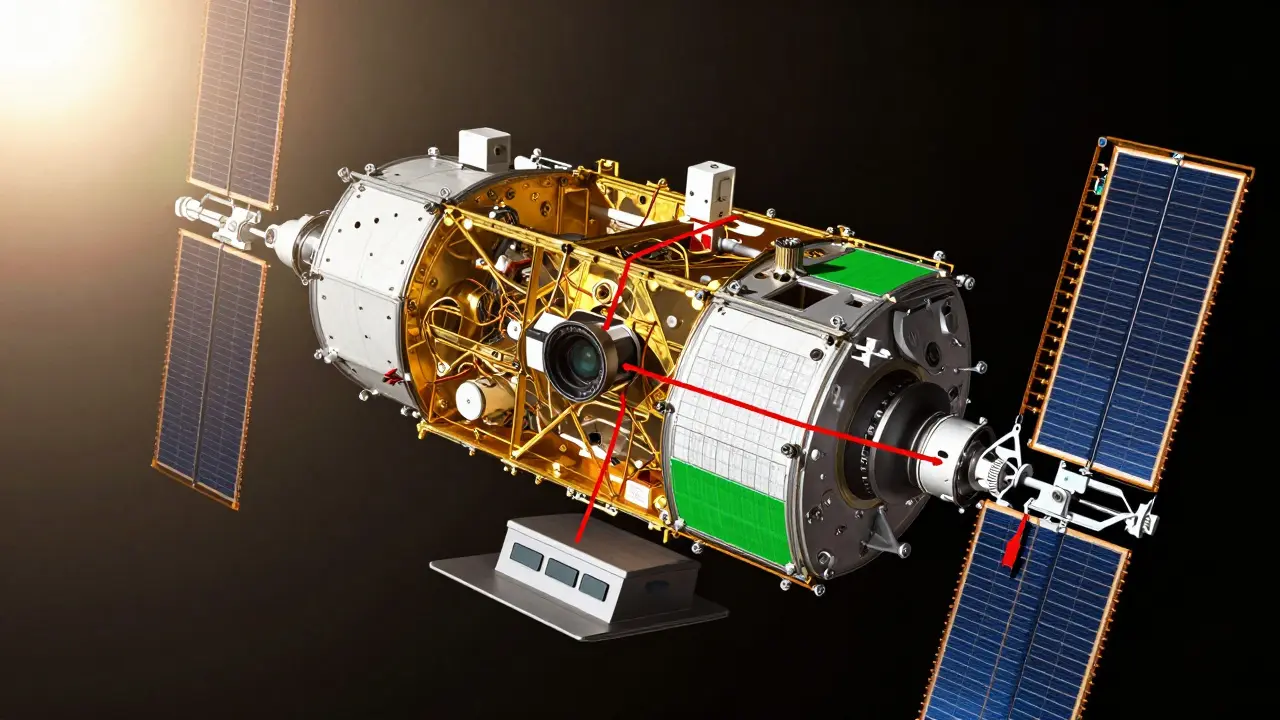
When you launch a satellite into orbit, you're not just sending up a box of sensors and cameras. You're sending up a tightly balanced machine where every gram and every watt matters. Missions fail not because the science is bad, but because someone forgot to account for the power draw of a single heater or added an extra 200 grams of cabling. That’s where mass and power budgets come in - the invisible rules that decide what gets to fly and what gets left on the ground.
Why Mass and Power Aren’t Just Numbers
Think of a spacecraft like a backpack you’re carrying on a week-long hike. You’ve got a strict weight limit - say, 15 kilograms - and a limited battery for your headlamp and GPS. If you pack too much food, you can’t carry your emergency shelter. If you bring a high-power radio, your battery dies in two days. Spacecraft work the same way. Every instrument, every wire, every heater adds weight and drains power. And unlike on Earth, you can’t stop at a store to buy more. The launch vehicle can only carry so much. A typical small satellite might have a total mass budget of 50 kilograms. That includes the structure, the solar panels, the batteries, the computers, the antennas, the propulsion system - and only then, whatever’s left, goes to the science instruments. If your camera weighs 8 kg and your budget says 6 kg, you’ve got a problem. No exceptions. Same with power. Solar panels generate electricity, but only when they’re in sunlight. In eclipse - when the spacecraft passes into the planet’s shadow - everything runs on batteries. If your instruments suck up more power during science mode than the batteries can recharge, you’ll lose data. Or worse, the system shuts down to protect itself.How Power Budgets Are Built
Power budgets don’t start with guesswork. They start with a list. Every single component on the spacecraft gets written down. Not just the big stuff - the computer, the radio - but the tiny sensors, the motors that point the antenna, the heaters that keep the batteries from freezing. Each one has a power rating. A camera might use 12 watts when it’s taking a picture, 1 watt in standby, and 0.1 watts when it’s off. A computer might draw 8 watts continuously. A heater might kick on for 30 minutes every orbit. Add them all up per mode, and you get the full picture. Spacecraft operate in modes:- Sunlit mode: Solar panels charging, instruments running full tilt.
- Eclipse mode: No sunlight. Everything runs on batteries. Science stops. Communication drops. Only survival systems stay on.
- Survival mode: Just enough power to keep the spacecraft alive - no science, no data downlink.
- Science mode: Instruments fully active. This is when the mission does its job.
- Burn mode: Thrusters firing. Power spikes. Other systems might shut down temporarily.
Mass Budgets: The Weight Game
Mass is even more unforgiving than power. Every extra kilogram means more fuel needed to lift it. And fuel adds mass. Which means you need even more fuel. It’s a vicious cycle. A typical small satellite might have a launch mass of 50 kg. Of that, 15 kg might be propellant. 10 kg is the structure, avionics, and thermal control. 5 kg is the solar arrays and batteries. That leaves 20 kg for the science payload. If your main instrument is 18 kg, you’ve got 2 kg left for everything else - connectors, mounting brackets, shielding, cables. No wiggle room. Engineers use historical data to estimate mass. If a similar instrument on a past mission weighed 4.2 kg, you start there. Then you add 15-30% contingency. Why? Because new designs always get heavier. A prototype might be 4 kg. The flight model ends up 5.1 kg. That’s normal. But if you didn’t plan for it, you’re over budget. And mass isn’t just about weight. It’s about where it sits. If all the heavy stuff is on one side, the spacecraft wobbles. That throws off pointing accuracy. A science instrument needs to stare at a target for hours. If the spacecraft shakes because the mass isn’t balanced, the data is useless.
How Instruments Fit In
Instruments aren’t plug-and-play. They need to be treated like full subsystems. Here’s what you need to know about each one:- Mass: Total weight, including mounting hardware, shielding, and connectors.
- Power: Peak draw, average draw, standby draw. Duty cycle matters. A spectrometer that runs 5 minutes per orbit uses far less power than one running 20 minutes.
- Heat: Every electrical device generates heat. Too much heat, and you need bigger radiators. That adds mass. Too little, and components freeze. Thermal engineers have to design around it.
- Data: How much data does it produce? A high-res camera can generate 10 GB per day. Does your onboard storage handle that? Can your radio downlink it before the next pass?
- Timeline: When does it operate? During day or night? During eclipse or sunlit? Does it conflict with another instrument?
Small Satellites and the Power Trade-Off
CubeSats and smallsats have it worse. A 3U CubeSat might have a total power budget of 15 watts. That’s less than a LED bulb. Solar panels are maybe 20 cm x 20 cm. Batteries are tiny. There’s no room for error. DeepSpace-2, a NASA Mars lander, solved this by ditching shared solar panels. Instead of one big panel feeding all systems, it split power into two independent circuits. Each had its own maximum power point tracker (MPPT). That cut losses from diodes and wiring. Then, they added a power-sharing switch. If one side had extra power, it could flow to the other. No waste. No overloading. Pure efficiency. For small satellites, every watt saved means you can add another sensor. Or extend the mission. Or reduce the battery size - which saves mass. It’s a chain reaction.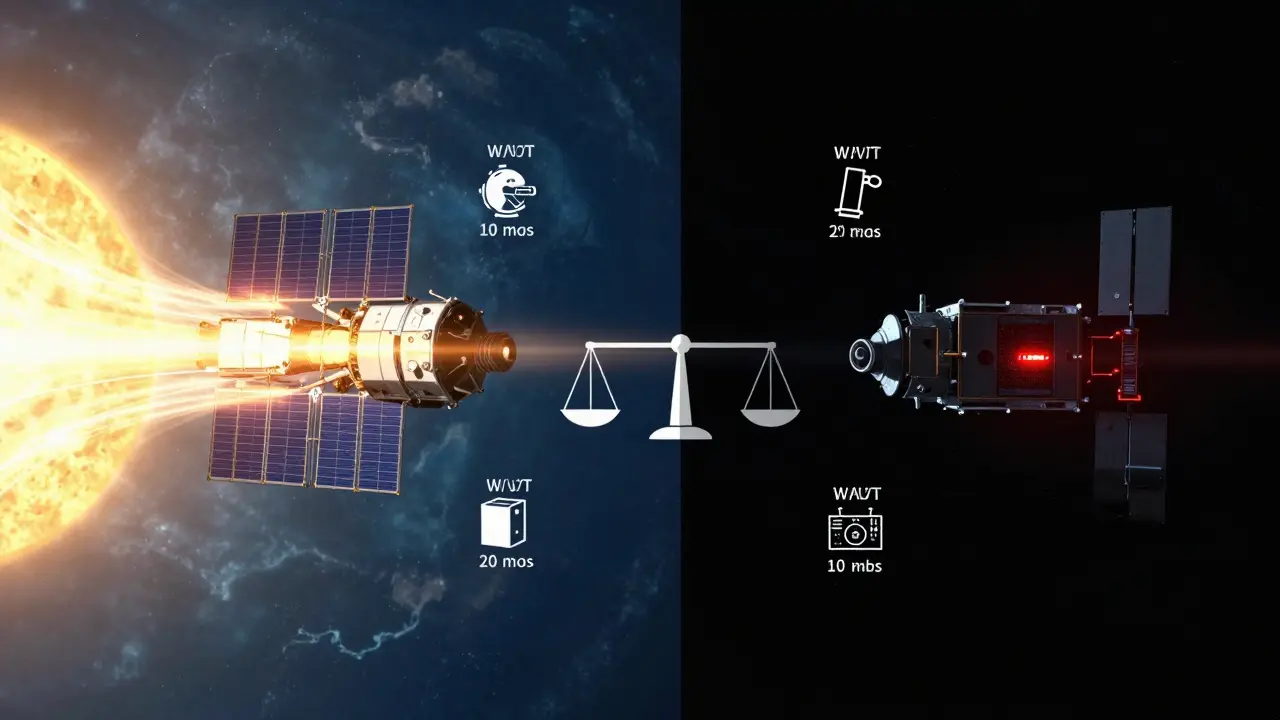
Tools of the Trade
No one does this by hand anymore. Engineers use spreadsheets - yes, Excel - but with custom templates. These tools track:- Power per subsystem per mode
- Energy used per orbit
- Energy generated per orbit
- Battery charge balance
- Mass per component
- Contingency margins
The Real Test: Mission Operations
Budgets aren’t set in stone. Once the satellite is up, engineers tweak them. If a sensor is drawing more power than expected, they reduce its duty cycle. If a heater is overheating, they turn it off during sunlit hours. The budget becomes a living document. One Mars orbiter had a camera that was supposed to take 100 images per day. After launch, they realized it was using 30% more power than predicted. Instead of replacing it, they changed the schedule. Now it takes 70 images per day - still more than any previous mission - and the power system stays balanced. That’s the beauty of budgets. They’re not constraints. They’re tools. They let you make smart trade-offs. You might lose a little science, but you gain a longer mission. Or better data. Or both.Final Thought: It’s Not About What You Can Add - It’s About What You Must Keep
The most successful missions aren’t the ones with the most instruments. They’re the ones where every gram and every watt had a job. Where the power budget didn’t just add up - it balanced. Where the mass distribution didn’t just fit - it optimized. You don’t build a spacecraft to carry instruments. You build it to carry a mission. And the only way to do that is to know, down to the watt and the gram, what you’re carrying - and why.What happens if a spacecraft exceeds its power budget?
If a spacecraft exceeds its power budget, the system can’t sustain operations. Batteries drain faster than they recharge, leading to power shortages during eclipse. This can force the spacecraft into survival mode - shutting down science instruments, communications, and even attitude control. In worst cases, the spacecraft enters a fault state and may lose contact. Mission teams often respond by reducing instrument usage, delaying data downlinks, or switching to lower-power operational modes. If the imbalance persists, the mission may be shortened or abandoned.
Can you increase a spacecraft’s mass budget after launch?
No. The mass budget is fixed at launch. Once the spacecraft is in orbit, you can’t add mass. Any extra weight would require more propellant to maneuver, which isn’t available. That’s why every gram is accounted for before launch. If a subsystem turns out heavier than planned, engineers must reduce mass elsewhere - for example, by using lighter materials, removing non-essential components, or reducing structural margins. There’s no room for error after liftoff.
Why do power budgets differ between Earth orbit and deep space missions?
Power budgets differ because solar energy drops with distance from the Sun. Near Earth, solar panels generate about 1,360 watts per square meter. At Mars, that drops to roughly 590 W/m². At Jupiter, it’s only 50 W/m². That means a mission to Jupiter needs solar arrays 27 times larger than one for Earth orbit to generate the same power. Alternatively, missions to the outer solar system often use radioisotope thermoelectric generators (RTGs) instead of solar panels. Power budgets must be recalculated from scratch for each mission profile.
How do engineers estimate power consumption before building the hardware?
Engineers use historical data from past missions, component datasheets, and thermal-electrical simulations. For example, if a similar computer on the Cassini mission drew 8 watts at 20°C, they start with that number. Then they adjust for temperature - colder environments improve efficiency, while hotter ones increase draw. They also apply derating factors - if a component is rated for 10 watts, they assume it will use 12-15% more in real conditions due to aging, wiring losses, and voltage fluctuations. These estimates are refined as prototypes are tested.
Do power and mass budgets affect how long a mission lasts?
Absolutely. A well-balanced budget ensures the spacecraft can operate for its full planned lifetime. If the power budget is too tight, batteries degrade faster due to deep discharges. If mass is over budget, the spacecraft carries less propellant, limiting its ability to adjust orbit or maintain attitude. Both lead to premature mission end. Successful missions like the Mars Reconnaissance Orbiter and Sentinel-6B lasted years beyond their design life because their budgets were conservative, well-tracked, and allowed for operational flexibility.
8 Responses
This is why I hate space missions. They spend billions to send up a camera that can't even take a decent selfie because some engineer forgot to account for a 20-gram heater. I mean, really? We can't build a satellite that doesn't shut down because it got cold? We're literally in the 21st century and still treating space like a science fair project.
And don't even get me started on the 'power budget' nonsense. It's not a budget-it's a death sentence for innovation. If you're that tight on watts, maybe you shouldn't be launching anything at all.
You're missing the point entirely. This isn't about being lazy or cheap-it's about physics. You can't just add more power because you 'want' to. The solar panels have a maximum output. The batteries have a maximum capacity. The launch vehicle has a maximum lift. You think NASA doesn't want to send up a 500-watt laser scanner? They do. But if it drains the battery in 12 minutes during eclipse, the whole satellite dies. That's not a choice. That's thermodynamics.
And mass? Every extra gram means more fuel. More fuel means more mass. More mass means more fuel. It's a loop you can't escape. This isn't engineering-it's solving a 4D puzzle with no room for error.
The phrase 'every gram and every watt matters' is not hyperbole. It is literal truth. To refer to these constraints as 'budgets' is to trivialize the precision required. There is no 'wiggle room.' There is no 'maybe.' There is only the equation: mass + power + thermal + data = mission success or catastrophic failure.
And yet, here we are, in a culture that celebrates 'just add more battery' as a solution. This is why spaceflight remains so rare. Because people mistake discipline for deprivation.
Look, I get it. You're all proud of your spreadsheets and your 15-watt CubeSat power budgets. But let's be real-this is just NASA's way of saying 'we don't have enough money.' You're not designing for efficiency. You're designing for austerity. And then you call it 'brilliant engineering.'
Meanwhile, China's launching satellites with 10x the power and 3x the mass and they're still beating us to the punch. You think they're doing math? No. They're just building. And guess what? Their satellites don't die in eclipse. They just keep going.
Maybe the real problem isn't the budget. Maybe it's the mindset.
This is one of the most elegant examples of systems engineering I've ever seen. The fact that every component-from a 0.1W standby sensor to a 40W lidar pulse-is tracked, scheduled, and balanced is incredible. It’s not about limitations. It’s about intentionality.
And the real genius? The fact that these budgets evolve. A mission that starts with 70 images per day and ends up with 90 because they optimized the duty cycle? That’s not failure. That’s mastery. Well done to the teams who make this possible.
I’ve spent years working on satellite systems across three continents, and I can tell you this: the real magic isn’t in the math-it’s in the collaboration. Engineers from thermal, power, structural, and science teams sitting in a room for months, arguing over 30 grams and 2 watts, not because they’re being stubborn, but because they know that 30 grams could mean the difference between a 5-year mission and a 2-year one.
And it’s not just about the hardware. It’s about the culture. In the U.S., we treat these budgets like sacred texts. In Europe, they’re more flexible. In Japan, they’re almost spiritual. But every culture gets to the same place: a satellite that survives, operates, and delivers. That’s not luck. That’s human ingenuity.
Also, shoutout to the team that designed DeepSpace-2’s dual MPPT system. That’s the kind of innovation that changes everything.
All this talk about budgets and wattage is just a fancy way of saying 'we don't know how to build better.' Why not just launch a bigger rocket? Why not use nuclear power? Why not just... I don't know... build a satellite that doesn't die when it goes into shadow?
This whole post reads like an excuse. 'Oh, we can't do more because of physics.' Bull. Physics didn't stop the Apollo missions. Physics didn't stop the Hubble. Physics doesn't care about your Excel sheet.
It is deeply troubling that this culture of constraint is being romanticized as 'brilliant innovation.' The fact that we have reduced the entire enterprise of space exploration to a spreadsheet of permissible watts and grams is a moral failure. We are not engineers-we are accountants in orbit.
When we prioritize efficiency over ambition, we sacrifice the very essence of exploration. Would we have landed on the Moon if we had to 'budget' for the weight of the lunar module? Would the Voyager probes have reached Neptune if we had insisted on 'power optimization' over 'scientific curiosity'? The answer is no. And yet, here we are, designing satellites that can't even run their own cameras for more than 10 minutes at a time.
There is a difference between discipline and defeatism. This is defeatism dressed up in graphs.