
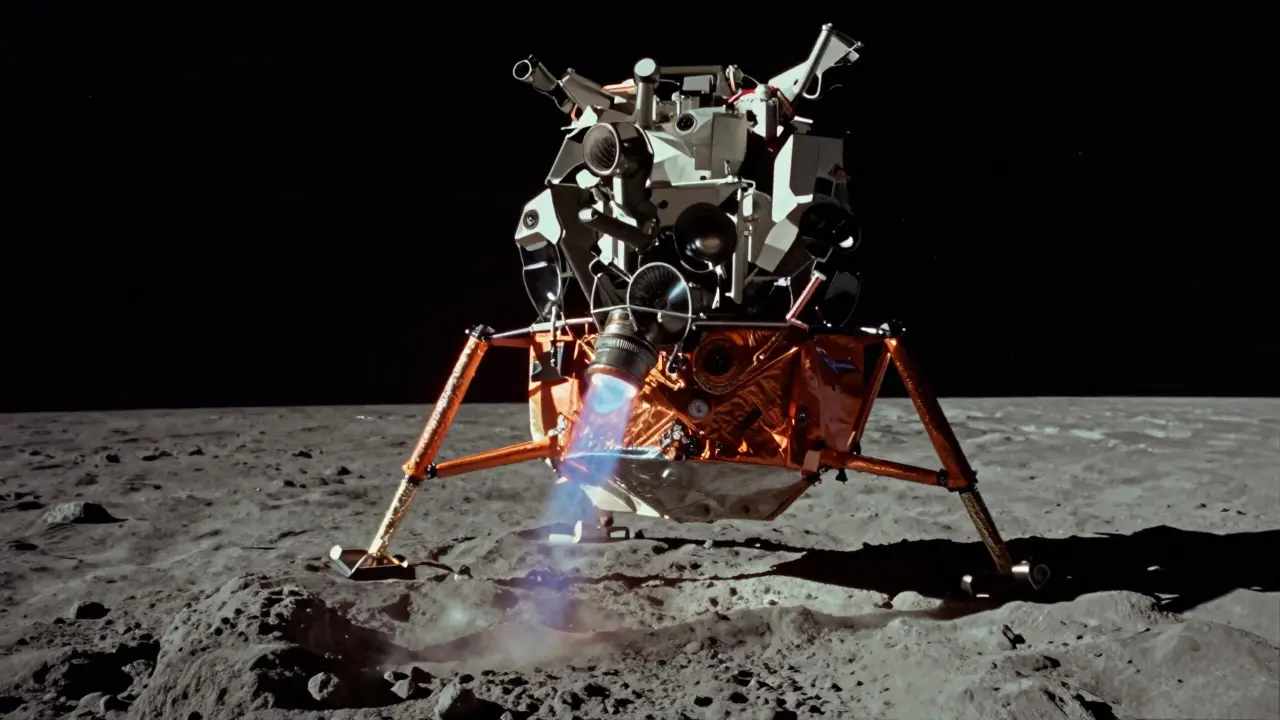
The Challenge of Landing on the Moon
Lunar Landers are far more than just spacecraft; they represent the culmination of some of the most complex engineering achievements in human history. The fundamental challenge of visiting the Moon lies in its lack of atmosphere. Unlike Mars or Earth, where you can use parachutes to slow down, the Moon offers no air resistance to help you brake. This means every meter per second of speed must be burned off using rocket engines alone.
The technology required to transition from orbit to surface involves precise control of velocity, attitude, and position under extreme conditions. If the engines fail or the guidance goes wrong, there is no second chance. We have seen this play out through decades of missions, from the massive Apollo program to the small, agile commercial rovers launching today. Understanding how these machines work reveals a fascinating blend of physics, chemistry, and computing power.The Heart of the Mission: Descent Propulsion
The critical component that makes a soft landing possible is the Descent Propulsion System, often abbreviated as DPS. This engine does something incredibly difficult: it varies its thrust continuously. Early rocket engines were mostly on or off. You lit them, and they burned at a fixed power until fuel ran out. But to land on the Moon, you cannot crash-burn straight down. You need to hover. You need to drift sideways to find a flat spot. You need to stop completely just feet above the regolith.
The legendary Apollo Lunar Module relied on a specific version of this tech called the VTR-10 engine. Developed by Space Technology Laboratories (TRW) and invented by Gerard W. Elverum Jr., this engine could throttle between 10 percent and 100 percent power while keeping the combustion stable. Imagine trying to balance a spinning top on your finger while pushing it harder and softer depending on how shaky your hand gets-that’s essentially what the computer had to do with the engine in real time. The propellant combination used Aerozine 50 fuel mixed with dinitrogen tetroxide oxidizer. These chemicals ignite on contact, meaning no spark plugs were needed, adding another layer of reliability to the system.
How Throttling Changes Everything
The ability to throttle isn't just a luxury; it's a necessity for safety. During the Apollo missions, the DPS operated in three distinct modes. First, there was Auto mode, where the computer managed both the throttle and the ship's attitude. Then came Attitude Hold, allowing the pilot to manage the throttle while the computer kept the craft level. Finally, Manual mode gave the astronaut full control to dodge boulders or craters that the sensors hadn't flagged yet.
This flexibility was vital because the landing site wasn't always perfect. Every time an astronaut moved the joystick to adjust the thrust, the Automatic Guidance Computer (AGC) had to recalculate where the lander would touch down within seconds. The engine responded instantly. Without this specific capability-the first of its kind in deep space-landing two humans on the Moon would have been nearly impossible. It allowed the module to settle gently rather than hitting the ground like a stone dropped from a building.
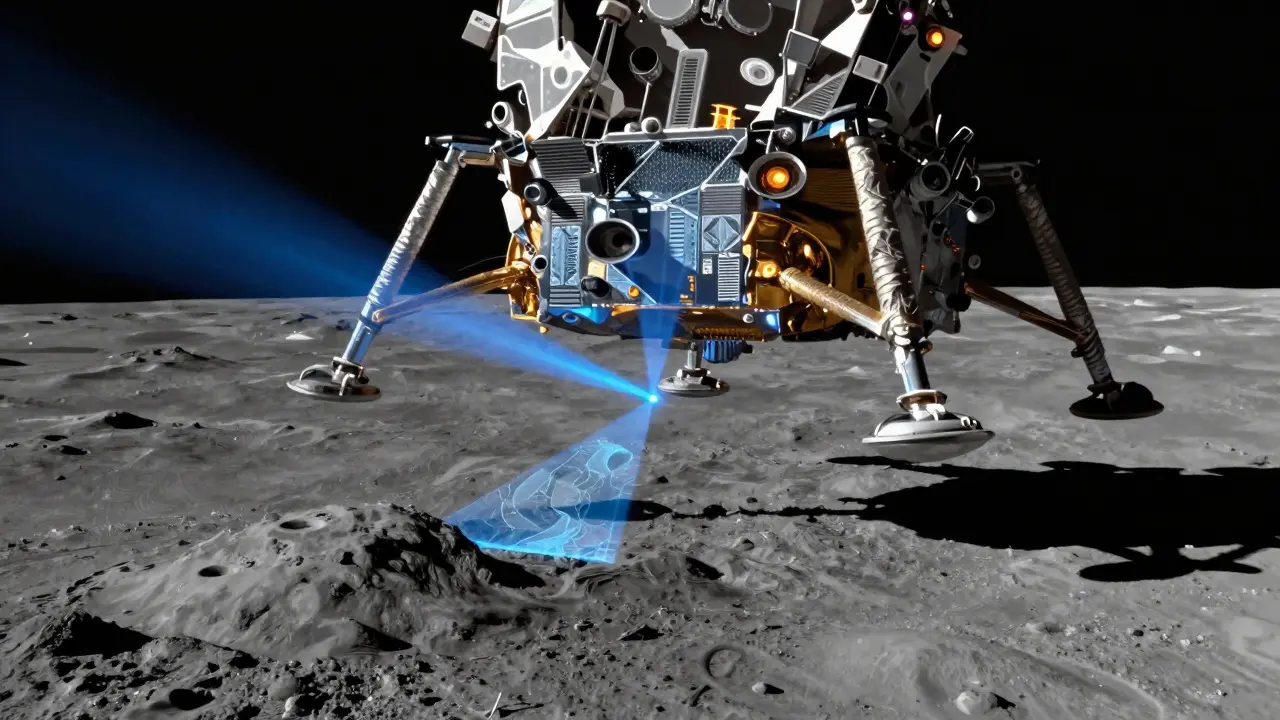
Fuel Choices: Old Reliable vs. New Clean
When we look at modern designs, we see a shift in the type of fuel being used. While the Apollo era favored hypergolic fuels like Aerozine 50 because they store well and start reliably, newer commercial concepts are looking toward cryogenic options. For instance, the IM-1 Lander successfully completed a powered descent using liquid oxygen and liquid methane. This combination burns cleaner and can offer higher performance.
However, switching fuels comes with trade-offs. Storable hypergols sit quietly in tanks for years, ready to fire whenever needed. Cryogenics boil off over time if not insulated perfectly, requiring active thermal management. Modern mission architects often weigh these factors carefully. Some reference designs still stick with storable propellants for long-duration missions, while others prioritize the efficiency of methane-oxygen mixes for one-way cargo trips.
| Propulsion Type | Fuel Combination | Throttling Capability | Mission Profile |
|---|---|---|---|
| Apollo DPS | Aerozine 50 / N2O4 | 10-100% Continuous | Crewed Exploration |
| Modern Commercial (e.g., IM-1) | Liquid Oxygen / Liquid Methane | Variable (High Thrust) | Robotic Cargo Delivery |
| Future Multi-Stage | N2O4 / Aerozine 50 | 13.4:1 Ratio | Heavy Payload Transport |
Guidance Systems: Seeing in the Dark
You cannot steer what you cannot see. While we might think of the Moon as having plenty of light, knowing exactly where you are relative to the surface requires more than just looking out the window. A Landing Radar helps determine height, but it doesn't tell you which way is north. That job falls to the Inertial Measurement Unit (IMU).
These devices rely on ring-laser gyroscopes to track movement. They are rugged, stable, and don't depend on external signals like GPS, which simply don't exist on the Moon. A standard setup includes automatic star scanners attached directly to the IMU case. These scanners lock onto known stars to align the gyros before descent begins. If this alignment is off by even a tiny fraction, the lander could drift miles off-target.
Even with redundancy, things go wrong. One notable commercial mission encountered issues where laser rangefinders didn't activate before launch. Instead of scrubbing the mission, controllers improvised. They utilized Lidar equipment meant for a separate NASA technology demonstration aboard the lander to guide the descent. This highlighted a crucial reality: backup systems must be versatile enough to step up when the primary plan fails.
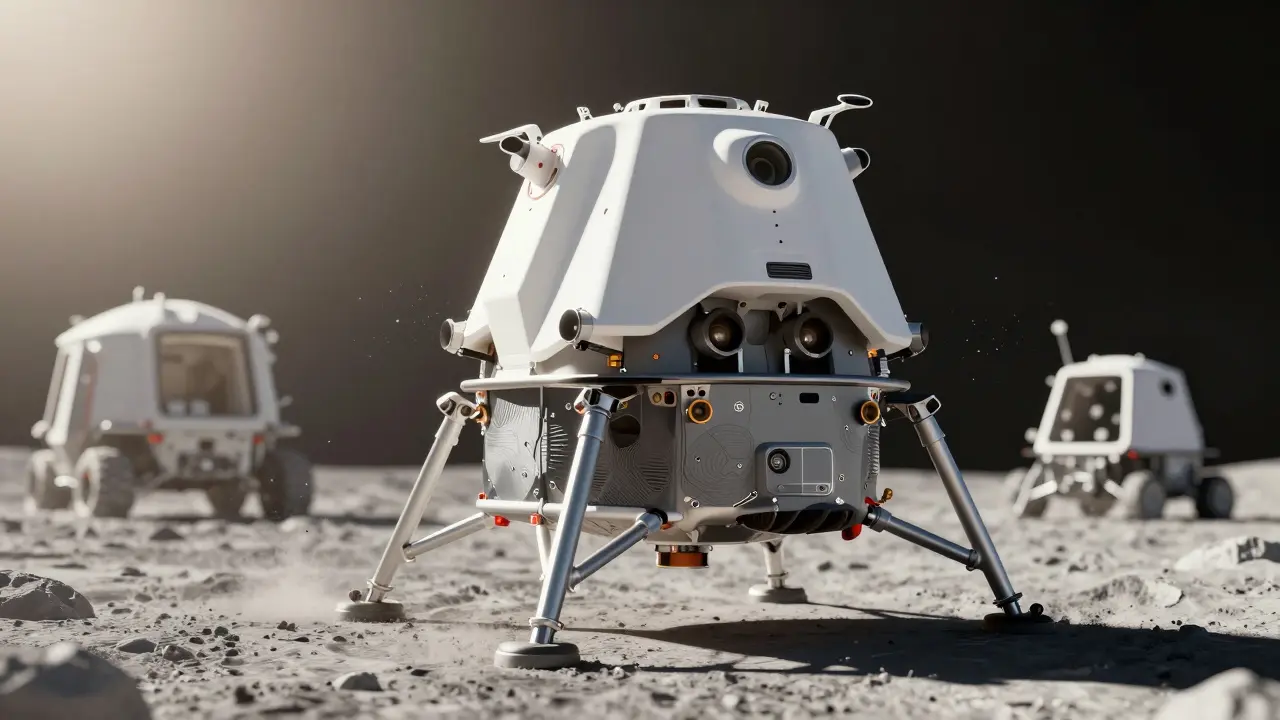
The Math of Orbital Altitude
It seems intuitive that staying lower in orbit saves fuel. However, mission planners deal with complex math regarding delta-V, or the change in velocity required to move the ship. As orbital altitude increases above 1,000 kilometers, the requirements for changing planes decrease drastically. But, the total mass of the lander increases substantially because climbing back up from a low orbit takes significant energy.
For a multi-stage lander designed to carry both ascent and descent elements, the total gross mass in orbit might reach approximately 18,903 kilograms depending on payload requirements. Designers must calculate whether landing from a high, stable orbit is worth the extra fuel cost compared to the flexibility of accessing different polar regions. High-inclination orbits allow the vehicle to reach the Moon's poles, which are prime targets for water ice mining, but getting into those paths requires specific launch windows.
Touchdown and the Final Shock
The final second of the journey is arguably the most dangerous. The propulsion system brings you close, but mechanical landing gear takes the impact. Entry, Descent, and Landing (EDL) technologies focus heavily on absorbing shock. The systems must guarantee stability as the wheels or legs hit the dust.
Terminal descent rates are strictly controlled. Descend too fast, and the legs buckle or the electronics smash. Too slow, and the lander might float away in microgravity or burn the last drop of fuel. NASA's Langley Engineering organization actively tests these concepts, looking for advanced hypersonic entry systems that minimize drag while maintaining control. The goal is always the same: keep the science instruments intact.
Where We Go From Here
We are witnessing a renaissance in these technologies. The legacy of the Apollo DPS remains foundational, proving that continuous throttling is the gold standard. Yet, we are seeing new architectures emerge. With the Artemis program setting sights on sustainable presence, landers will carry heavier payloads than ever before. The integration of artificial intelligence for hazard avoidance is also becoming standard practice, reducing the reliance on manual piloting and increasing the safety margin for crewed missions returning later this decade.
10 Responses
America built the real machines back in the day. These modern folks are just copying old plans and calling it new. We did the hard work so they could play with toys.
Oh my god. You really think Apollo was flawless. It had many issues that were ignored. People died testing these systems you idolize. You ignore the safety failures completely. The throttling was amazing yes. But the cost in human life was high. We do not talk about the crashes enough. Your view is very dangerous today. We need safer tech now not old tricks. Hypergolic fuels are toxic and scary stuff. Methane burns cleaner for us. You keep saying we are weak. Weakness comes from ignoring physics. Physics does not care about your flag here. NASA made mistakes like everyone else. Modern systems fix those mistakes slowly. Stop acting like 1969 was perfect heaven. It was risky business then. You just want to fight wars on rocks. We need science not ego trips. Please read before typing nonsense.
landing gear seems simple till dust gets everywhere
The dust problem is a major ethical issue in design philosophy. Safety margins must be absolute for any crew member. We cannot risk lives on assumptions about regolith behavior. The mechanical shock absorbers define success or failure here. Engineers must respect the environment above all profit. This mindset shift is crucial for future colonies.
i cant believe how hard it is to land!! why not just drop it?? oh wait bad idea lol!!!
Dropping payloads is inefficient and reckless behavior for manned missions. Gravity acceleration ensures destruction upon impact without control. We require precise velocity management for survival. British heritage values proper terminology. Please learn the correct words. Descent requires active braking mechanisms always.
You sound like a textbook written for children honestly. Real engineers know gravity is just part of the equation. The art lies in the timing of the burn sequence itself. Most people dont understand the nuance of thrust vectoring. They see rockets and think fire and noise. We deal with milliseconds and tolerances here. Its boring for most folks who watch tv shows. I prefer the silence of orbital mechanics over crowd cheering.
Just a small note on capitalization at the start of sentences. dont needs an apostrophe to form the contraction correctly. tv should technically be capitalized as well for clarity. The rest of your point on tolerance is accurate. Keep up the technical discussion though.
Your understanding of delta-V calculations is incorrect regarding polar orbits. High inclination paths cost significantly more energy per kilogram. You ignore the mass penalty in your assessment entirely. Reference data from recent commercial missions proves otherwise clearly. Standard planning tools show massive inefficiencies there.
I get that math can be tough to visualize sometimes. Everyone makes mistakes when calculating fuel weights. We are all learning together with every new launch attempt. Thanks for pointing out the orbital mechanics details there. It helps us see the full picture now.