

When people talk about the environmental cost of blockchain, they usually point to one thing: electricity bills. But looking only at power consumption is like judging a car's fuel efficiency by ignoring how much steel went into making it. To truly understand the footprint of these systems, we need a broader lens. That’s where Life Cycle Assessment (LCA) comes in.
LCA is a standardized method for measuring the environmental impacts of a product or service from start to finish-from raw material extraction to disposal. When applied to digital infrastructure, it reveals that the story of blockchain sustainability is far more complex than just kilowatt-hours. It involves hardware manufacturing, water usage for cooling, land transformation, and even the software protocols that keep networks secure.
This guide breaks down what LCA actually measures when analyzing blockchains, compares the massive shifts seen in major networks like Bitcoin and Ethereum, and explains how blockchain technology itself is being used to make supply chains greener. We’ll look at the data, the methodologies, and the real-world implications for anyone interested in sustainable tech.
The Two Sides of Blockchain LCA
It helps to split this topic into two distinct directions because they serve different purposes. First, there is the assessment of blockchain systems. Here, researchers treat the blockchain network as the product being analyzed. They calculate its carbon emissions, resource depletion, and waste generation. Second, there is the use of blockchain for LCA. In this case, the immutable ledger acts as a tool to improve data collection and transparency across traditional supply chains.
Most public attention focuses on the first direction-how dirty are cryptocurrencies? However, the second direction is gaining traction in industries like fashion, food, and manufacturing. Companies are using distributed ledgers to record verified environmental data, ensuring that claims about "carbon-neutral" products can be traced back to actual sensor readings rather than marketing estimates. Both approaches rely on the same core principle: you cannot manage what you do not measure accurately.
How LCA Works for Digital Systems
Traditional LCA follows four steps defined by ISO 14040 and ISO 14044 standards: goal definition, inventory analysis, impact assessment, and interpretation. Applying this to something intangible like code requires specific adjustments. You have to define the "functional unit"-for example, the impact of processing one transaction or validating one block.
The inventory phase is where most of the work happens. Analysts gather data on:
- Hardware production: The mining of metals, silicon fabrication, and assembly of Application-Specific Integrated Circuits (ASICs) or graphics cards.
- Operational energy: Electricity consumed by servers, nodes, and miners over time.
- Cooling requirements: Water usage for heat dissipation in large mining farms.
- End-of-life handling: E-waste disposal or recycling of obsolete equipment.
Once this data is collected, impact assessment methods like ReCiPe 2016 convert physical flows into environmental indicators. These include Global Warming Potential (measured in kg CO₂-equivalent), fossil resource scarcity, freshwater ecotoxicity, and human health damage. This multi-dimensional view prevents "burden shifting," where solving one problem (like reducing carbon) accidentally creates another (like increasing toxic waste).
Bitcoin: The Hardware vs. Energy Debate
Bitcoin is often the primary subject of blockchain LCAs due to its scale. Early studies, such as the comprehensive analysis from Aalborg University published in 2019, estimated that the network consumed around 31.29 TWh of electricity annually, resulting in a carbon footprint of roughly 17.29 million tonnes of CO₂-equivalent. At that time, the conclusion was clear: operational energy use dominated the environmental impact, while the production of mining hardware played a minor role.
However, newer research challenges this view. A 2024 study focusing specifically on the life cycle of ASIC mining equipment found that if miners switch to low-carbon electricity sources, the relative importance of hardware production skyrockets. In scenarios with green energy grids, the manufacturing of chips can account for up to 80% of the total life cycle impact. This includes the energy-intensive process of refining rare earth metals and the chemical treatments used in semiconductor fabrication.
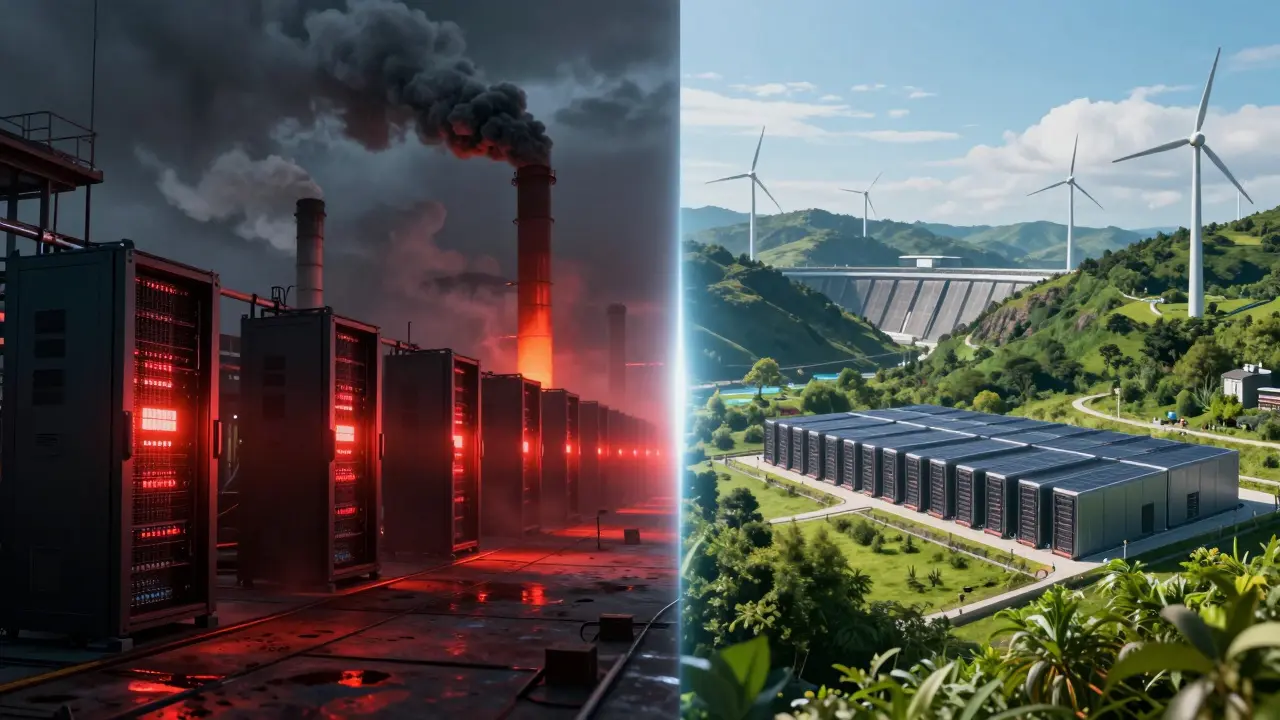
This shift highlights a critical nuance in LCA: context matters. If a miner operates in a region powered by coal, their operational emissions dwarf the hardware costs. But if they move to a hydroelectric-rich area, the hidden environmental debt embedded in the machine itself becomes the dominant factor. It suggests that future sustainability strategies must address both grid decarbonization and circular economy practices for hardware recycling.
| Factor | Fossil-Fuel Dominant Grid | Renewable-Dominant Grid |
|---|---|---|
| Primary Impact Driver | Operational Electricity Consumption | Hardware Production & Disposal |
| Carbon Intensity | High (>800 g CO₂/kWh) | Low (<50 g CO₂/kWh) |
| Key Mitigation Strategy | Relocate to cleaner grids | Improve device lifespan & recycling |
| Water Usage Concern | Moderate (cooling) | High (if local hydro resources strained) |
Ethereum’s Merge: A Case Study in Protocol Change
If Bitcoin shows us the complexity of hardware and energy trade-offs, Ethereum's transition offers a dramatic example of how software design dictates environmental outcomes. For years, Ethereum relied on Proof-of-Work (PoW), similar to Bitcoin, requiring massive computational power to secure the network. Then, on September 15, 2022, the network executed "the Merge," switching to Proof-of-Stake (PoS).
The results were immediate and staggering. According to data from the Cambridge Centre for Alternative Finance (CCAF) in mid-2026, Ethereum’s annual electricity consumption dropped from terawatt-hours to approximately 7.87 gigawatt-hours. That is a reduction of about 99.95%. The associated carbon emissions fell to roughly 2.37 kilotonnes of CO₂-equivalent per year. To put that in perspective, the pre-Merge energy use was comparable to the total annual electricity consumption of countries like Ireland or Norway. Post-Merge, it is less than a small town.
From an LCA perspective, this demonstrates that consensus mechanisms are not just technical choices-they are environmental levers. By removing the need for competitive mining hardware, Ethereum eliminated the vast majority of its operational energy demand. While validators still run nodes that consume electricity, the scale is orders of magnitude lower. This has made Ethereum a benchmark for sustainable blockchain design, proving that high security does not inherently require high energy expenditure.
Beyond Carbon: Water, Land, and Local Impacts
Most public debates focus on greenhouse gases, but a robust LCA looks wider. A 2025 analysis in *ACS Sustainable Chemistry & Engineering* highlighted that Bitcoin mining also exerts significant pressure on water and land resources. Large-scale mining facilities often require substantial amounts of water for cooling systems. In arid regions, this can strain local aquifers and compete with agricultural or municipal needs.
Land use is another often-overlooked factor. Building massive server halls requires clearing land, disrupting ecosystems, and increasing impervious surfaces that affect local drainage. Furthermore, the location of mining operations influences regional air quality. Studies examining "behind-the-meter" mining in the United States-where mines connect directly to power plants-found that burning fossil fuels locally for crypto validation can increase smog formation and acidification risks in those specific communities, even if the global carbon metric remains static.
These localized impacts matter because they affect human health and biodiversity directly. An LCA that only reports global warming potential misses the picture of a community dealing with increased noise pollution, heat islands, or water scarcity caused by nearby mining farms. Comprehensive assessments must therefore include midpoint indicators like freshwater ecotoxicity and particulate matter emissions.

Using Blockchain to Improve Supply Chain LCA
While we assess the footprint of blockchains, we are also seeing them deployed to assess the footprints of other things. Traditional supply chain LCAs suffer from data silos. Manufacturers, suppliers, and logistics providers often keep their environmental data private, leading to incomplete or guessed-at inventories. Blockchain offers a solution through immutable, shared ledgers.
In a blockchain-enabled LCA architecture, Internet of Things (IoT) sensors-such as smart meters tracking energy use or flow meters monitoring material throughput-record data directly onto the ledger. Because the data is timestamped and cryptographically secured, it cannot be altered retroactively without detection. This builds trust among stakeholders who might otherwise hesitate to share sensitive operational details.
For example, a clothing brand could use a permissioned blockchain to track the cotton farming, dyeing, weaving, and shipping stages of a garment. Each step adds verified data points regarding water usage, chemical inputs, and transport emissions. Consumers could then scan a QR code to see the genuine, tamper-proof life cycle profile of their purchase. This moves sustainability reporting from vague corporate promises to verifiable, granular evidence.
Challenges and Future Outlook
Despite the promise, integrating blockchain into LCA workflows is not without hurdles. The technology itself consumes resources. Running nodes, especially on public networks, requires energy and storage space. There is a risk of "burden shifting," where the effort to digitize and verify data generates more environmental impact than the inefficiencies it aims to solve. Practitioners must carefully select low-energy consensus mechanisms, such as Proof-of-Authority or private PoS chains, to minimize this overhead.
Data standardization remains another barrier. Different companies use different metrics, units, and accounting boundaries. For a blockchain to function effectively as an LCA tool, all participants must agree on common data schemas and reference databases, such as ecoinvent. Without this alignment, the ledger becomes a repository of incompatible numbers rather than a unified source of truth.
Looking ahead, the trend is toward hybrid models. Public blockchains will likely continue to optimize for energy efficiency through protocol upgrades, while enterprise applications will leverage private ledgers for precise, auditable environmental tracking. As regulatory pressure mounts-seen in regions scrutinizing fossil-fueled mining-the demand for transparent, scientifically rigorous LCAs will only grow. The goal is no longer just to reduce emissions, but to prove it beyond doubt.
What is the main difference between LCA of blockchain and blockchain for LCA?
LCA of blockchain analyzes the environmental footprint of running a blockchain network, including energy use and hardware waste. Blockchain for LCA uses the technology as a tool to collect, store, and verify environmental data across supply chains, improving transparency and accuracy in traditional sustainability reporting.
How did Ethereum's "Merge" affect its environmental impact?
The Merge transitioned Ethereum from Proof-of-Work to Proof-of-Stake, reducing its annual energy consumption by approximately 99.95%. This dropped its electricity use from terawatt-hours to under 8 gigawatt-hours, significantly lowering its carbon footprint and demonstrating that consensus mechanism changes can drastically improve sustainability.
Why is hardware production important in Bitcoin LCA?
In early studies, operational energy dominated Bitcoin's impact. However, as miners adopt renewable energy, the relative impact of manufacturing ASICs increases. Recent research suggests that in green-grid scenarios, hardware production-including metal mining and chip fabrication-can account for up to 80% of the total life cycle environmental burden.
What are the non-carbon impacts of blockchain mining?
Beyond CO2 emissions, blockchain mining impacts include water usage for cooling, land transformation for facility construction, and local air pollution from behind-the-meter fossil fuel use. These factors contribute to issues like freshwater stress, smog formation, and ecosystem disruption, which are captured in comprehensive LCA frameworks like ReCiPe 2016.
Can blockchain help verify sustainability claims?
Yes. By integrating IoT sensors with permissioned blockchains, companies can create immutable records of environmental data throughout a supply chain. This prevents tampering and allows consumers and regulators to verify claims about carbon neutrality, ethical sourcing, and waste management with greater confidence than traditional self-reported audits.