

Imagine buying a house without a stack of paperwork, without waiting weeks for a title search, and without worrying that someone else might claim ownership. That’s the promise of blockchain-based land title systems - and it’s not science fiction. Real governments and agencies are testing these systems right now, and the results are starting to show up in places like Georgia, Sweden, and even parts of Australia. This isn’t about replacing lawyers or notaries. It’s about fixing a system that’s been broken for centuries.
How Land Titles Work Today - And Why It’s Broken
Right now, when you buy land, you’re not just buying dirt. You’re buying a paper trail. A chain of deeds, mortgages, easements, and liens, all stored in filing cabinets, sometimes in basements, sometimes in dusty county offices. If you want to prove you own something, you need to dig through decades of records. One mistake - a typo in a name, a missing signature, a lost document - and the whole chain can unravel.
That’s why fraud happens. Someone forges a deed. Someone steals an identity. Someone claims ownership of land they never bought. In some countries, up to 70% of land records are incomplete or inaccurate. Even in places like the U.S. and Australia, title disputes still cost millions every year. And the process? Slow. Expensive. Full of middlemen.
What Is a Blockchain Land Title System?
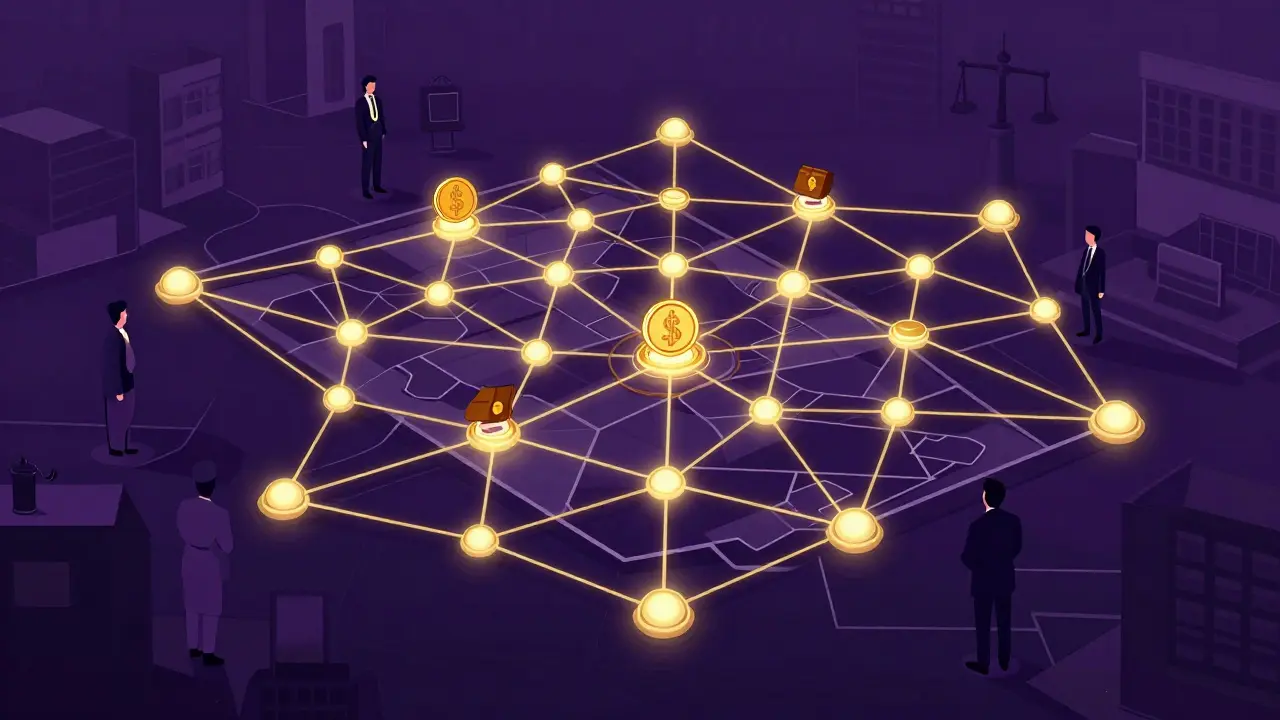
A blockchain land title system - sometimes called a blocktitle system - replaces paper records with digital tokens stored on a public, tamper-proof ledger. Think of it like a shared Google Sheet that no one can delete or alter without permission. Every time a property changes hands, the transaction is recorded as a new block. It’s time-stamped. It’s verified by multiple computers. And once it’s there, it’s permanent.
The system works with three core parts:
- Object: The land itself - its boundaries, coordinates, legal description.
- Right: What you own on that land - full ownership, lease, easement, mortgage.
- Subject: The person or entity holding that right - you, your bank, a developer.
Each of these is linked together on the blockchain. When you sell your house, the system doesn’t just update a name. It automatically transfers the digital token representing ownership from your wallet to the buyer’s. No notary. No escrow agent. No waiting for a clerk to file paperwork.
The Real Benefits - Beyond the Hype
People talk about blockchain like it’s magic. But the real value is simpler: it removes the friction.
1. No more title searches
Before blockchain, checking if a property had liens or disputes meant hiring a title company to comb through archives. Now, anyone with access can see the full history in seconds. Want to know if there’s a mortgage? A zoning restriction? A neighbor’s right-of-way? It’s all there. Transparent. Searchable. Instant.
2. Fraud drops to near zero
You can’t forge a blockchain entry. To fake a transfer, you’d need to hack the entire network - not just one server. And since only the person with the private key can initiate a transfer, impersonation becomes nearly impossible. If your key is stolen, the system flags it. The government can freeze the transaction. The buyer gets a warning. It’s not perfect, but it’s a lot better than handing over a deed with no way to verify it.
3. Transactions in hours, not weeks
In traditional systems, closing a land sale can take 30 to 60 days. With blockchain, it can take under 24 hours. Smart contracts do the rest. When the buyer’s payment clears, the contract automatically updates the title. The seller gets paid. The buyer gets the deed. No delays. No surprises.
4. Lower costs
No title insurance company? No escrow fees? No courier charges? That’s the promise. A 2022 pilot in Sweden cut land transfer costs by 85%. In Georgia, the government saved $1.2 million in a single year just by moving records online.
The Blockchain Estate Registry - A Real-World Example
One of the most advanced implementations is the Blockchain Estate Registry (a blockchain-based land title system developed by Stateside Agency that operates on the Ethereum blockchain, allowing governments to maintain control while enabling secure, transparent property transfers). It’s not a startup fantasy. It’s used by real agencies.
Here’s how it works:
- Property records are tokenized - each parcel becomes a unique digital asset.
- Government agencies keep approval rights. They can veto transfers if fraud is suspected.
- Buyers and sellers use secure digital wallets to sign transactions.
- Smart contracts handle payments and title updates automatically.
- Every change is publicly visible but encrypted for privacy.
It’s built for governments - not crypto enthusiasts. That’s why it’s gaining traction. Cities don’t need to go fully decentralized. They just need better tools.
The Big Problems No One Talks About
Here’s the truth: blockchain doesn’t fix bad data. If the original record is wrong, the blockchain just locks in the mistake.
1. The "Garbage In, Garbage Out" Problem
Most land registries today are messy. Missing deeds. Unclear boundaries. Oral agreements never written down. If you scan that into a blockchain, you’re not fixing history - you’re digitizing chaos. That’s why pilot programs start with clean, well-documented parcels first.
2. Adverse Possession - The Legal Blind Spot
In many places, someone can legally own land just by living on it for years - even without a deed. That’s called adverse possession. But blockchain only recognizes transfers recorded on the chain. If someone’s been living on land for 15 years, but never filed paperwork, the system won’t know they’re the real owner. And if the legal owner shows up with a paper deed, the blockchain can’t override it. Courts still have the final say.
3. Jurisdictional Chaos
Every state, every country, has different rules. Some require recording deeds. Others use title insurance. Some recognize easements by usage. Blockchain can’t code every legal nuance. You can’t build a global system that works in California and Nigeria the same way. That’s why hybrid models are winning: blockchain for new transactions, paper records for legacy cases.
What Happens When Keys Are Lost?
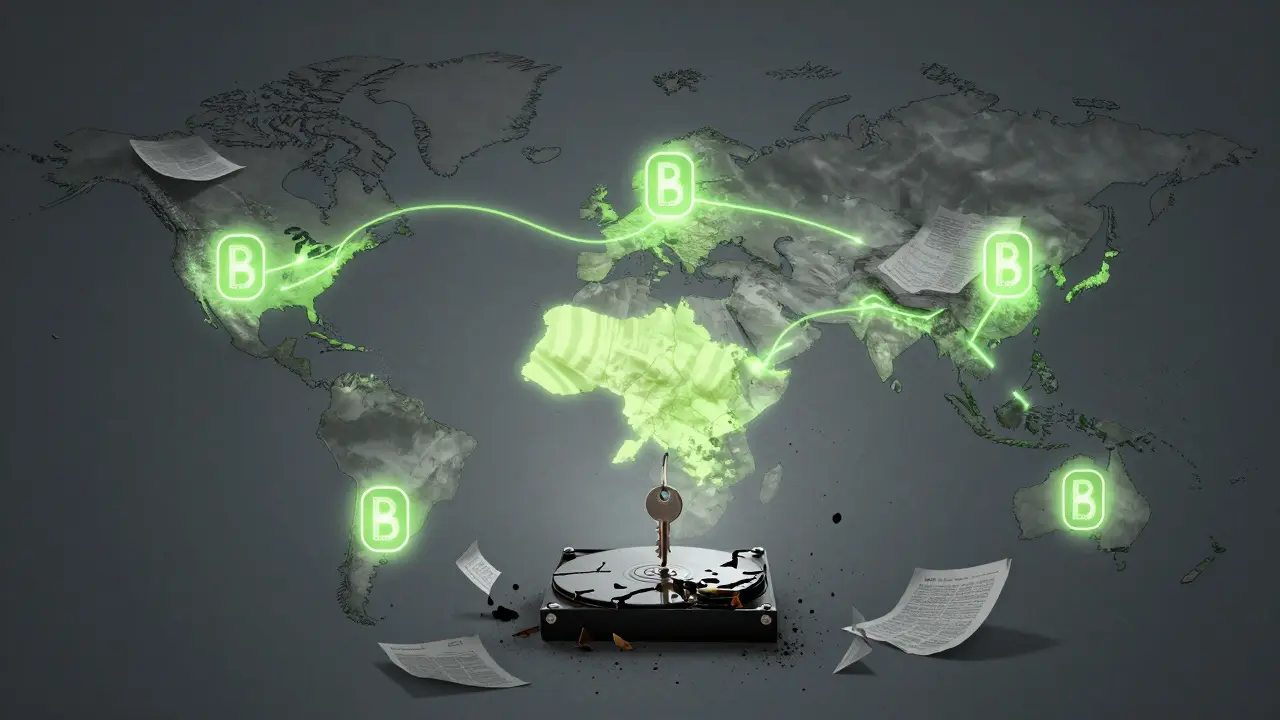
Blockchain relies on private keys. Lose your key? You lose your property. No one can recover it. No password reset. No help desk.
This isn’t theoretical. In 2023, a farmer in Ukraine lost access to his digital land title after his hard drive failed. He had no backup. The system couldn’t restore it. The government had to step in - and created a court-backed recovery process. Now, systems like the Blockchain Estate Registry include backup protocols: multi-signature approvals, recovery agents, and government override options. It’s not perfect, but it’s better than leaving people with nothing.
Why This Matters for Investors and Homeowners
For investors, blockchain opens up fractional ownership. You can buy 10% of a vineyard, 5% of a warehouse, or 1% of a commercial lot - and prove it instantly. No more complex LLC structures. No more co-signers. Just tokens on a ledger.
For homeowners, it means peace of mind. No more title insurance premiums. No more surprise liens after you’ve moved in. No more waiting months to sell. And if you’re in a country where land ownership is unstable - this could be the difference between having rights and having nothing.
The Future Isn’t All or Nothing
Blockchain won’t replace every land registry tomorrow. But it’s already changing how they work.
The smartest approach? Hybrid systems.
- Use blockchain for new transactions - fast, secure, transparent.
- Keep paper records for legacy claims - until they’re resolved.
- Let courts handle disputes - because law still matters more than code.
World Bank and American Land Title Association both agree: blockchain is a tool, not a revolution. It doesn’t fix bad laws. But it does make good laws work better.
As of 2026, over 12 countries have active pilot programs. Australia is testing a version in South Australia. Ghana is rolling out a national system. Ukraine uses it for war-damaged property claims. This isn’t a fringe experiment anymore. It’s the next step in property law.
Can blockchain completely replace traditional land registries?
Not yet. Most blockchain land systems today work alongside traditional registries. They’re best at recording new transactions, not rewriting history. Legacy records - especially those with gaps or disputes - still need paper trails and court oversight. The goal isn’t to erase the old system, but to make the new one faster, safer, and more reliable.
Is blockchain land title legal?
Yes - in places that have updated their laws to recognize digital titles. Countries like Georgia, Sweden, and parts of Australia have passed legislation allowing blockchain records to have the same legal weight as paper deeds. In the U.S., it varies by state. Some states allow it as a supplement. Others still require paper filings. The legal framework is catching up - slowly.
What happens if someone hacks the blockchain?
Blockchain itself is nearly impossible to hack - it’s distributed across hundreds of computers. But the weak link is the user. If someone steals your private key, they can transfer your property. That’s why systems now use multi-factor authentication, recovery agents, and government oversight. If a suspicious transfer happens, authorities can pause it while they investigate. It’s not foolproof, but it’s far safer than paper deeds.
Can I buy land on blockchain as an investor?
Yes - and it’s already happening. Platforms like the Blockchain Estate Registry allow fractional ownership. You can buy a share of a commercial property, a farm, or even a piece of land in a foreign country - and verify your ownership instantly. No need for trusts, LLCs, or lawyers. Just a digital wallet and a verified identity.
Does blockchain solve land disputes?
It reduces them - but doesn’t eliminate them. Blockchain makes it easier to prove who owned what when. But disputes over boundaries, easements, or adverse possession still require human judgment. Courts still decide who has the real right. Blockchain just gives them better evidence. Think of it as a tool for judges, not a replacement for them.
What Comes Next?
The next five years will be critical. If governments can solve the legal gaps - especially around adverse possession, jurisdictional rules, and key recovery - blockchain could become the global standard for land ownership. If they don’t, it’ll stay a niche tool for new developments.
One thing’s clear: the old way of tracking land is crumbling. Paper records are slow. They’re vulnerable. They’re expensive. Blockchain isn’t perfect - but it’s the best alternative we have. And for the first time in centuries, property ownership might finally become as clear, reliable, and accessible as a bank account.
12 Responses
Been thinking about this for a while. The real win isn't just speed or fraud prevention-it's inclusion. In rural India, land records are a nightmare. Families lose plots because grandpa's deed was never filed. Blockchain could give them a real shot at ownership without needing a lawyer or a connection. Not perfect, but way better than what we have now.
Still, the key recovery issue keeps me up at night. What happens to the farmer who loses his phone? No backup? No recourse? That's not innovation-that's exclusion dressed up as tech.
Oh wow, another blockchain utopia post. Let me guess-you think this will magically fix India’s 70% incomplete land records? You do realize most villages still use pencil and paper, right? And you think a blockchain wallet is gonna help someone who can’t read? This isn’t progress-it’s tech-bro colonialism wrapped in Ethereum.
Also, ‘smart contracts’? Please. Last I checked, courts still decide who owns what. You can’t code out centuries of customary law with a few lines of Solidity. And don’t even get me started on adverse possession. You think a digital token overrides 15 years of someone living on and farming land? LOL.
Madhuri’s point about literacy is valid, but let’s not throw the baby out with the bathwater. The solution isn’t to force blockchain on everyone-it’s to layer it smartly. Start with urban centers. Use it for new transactions. Let governments digitize clean parcels first. Then expand.
And yes, key recovery is a problem-but it’s solvable. Multi-sig wallets, government-backed recovery agents, biometric authentication tied to Aadhaar. These aren’t sci-fi ideas. They’re being piloted in Georgia and Ukraine. The tech exists. We just need the political will to implement it responsibly.
This is the future and I’m here for it. Imagine buying a piece of farmland in Odisha with a tap on your phone. No middlemen. No bribes. No shady brokers. Just you, your digital wallet, and a blockchain that remembers everything. It’s not magic-it’s justice.
And for those saying ‘but what about the poor?’-this is exactly why we need it. The poor get screwed hardest by paper records. They don’t have lawyers. They don’t have time. But they have phones. Give them the tool, not the lecture. Blockchain doesn’t need to solve everything overnight. It just needs to start somewhere. And it already is.
I’ve seen firsthand how messy land records are in my village. My uncle lost a plot because a clerk misfiled a deed in 1998. Took 7 years to prove ownership. If this system had been around then, it would’ve saved him everything-time, money, sanity.
Yes, there are flaws. Keys get lost. Old records are garbage. But we don’t need perfection. We need progress. And this? This is the most practical, scalable upgrade we’ve had in decades. Let’s not let perfect be the enemy of good.
There’s a comma missing after ‘Ethereum’ in paragraph 3. Also, ‘blocktitle’ isn’t a real term-it’s made up. And ‘Stateside Agency’? No such entity exists on record. This reads like a PR draft from a startup that never got funding.
Also, ‘blockchain can’t code every legal nuance’-true. But you also say ‘smart contracts handle payments and title updates automatically.’ That’s a contradiction. If it can’t handle legal nuance, how can a smart contract? You’re conflating automation with legality. Fix that.
I love how this is already being used in Ukraine for war-damaged property. That’s powerful. People who lost homes because of war now have a way to prove what was theirs without relying on crumbling archives.
And yeah, it’s not perfect. But if this helps even one family get back their land, it’s worth it. We don’t need to solve every edge case before we start. We need to start, then fix as we go. Progress over perfection, always.
It is imperative to note that the assertion regarding the 85% cost reduction in Sweden is misleading. The cited study was conducted under highly controlled conditions involving only newly surveyed parcels in urban areas with pre-existing digital infrastructure. Extrapolating this to developing nations with legacy systems is not only statistically unsound-it is ethically dubious.
Furthermore, the notion that private keys can be securely managed by individuals without formal education in cryptography is a dangerous fallacy. This proposal, as articulated, represents a form of technological paternalism disguised as innovation.
Blockchain land titles? Yeah right. Who do you think controls the blockchain? The same banks that foreclosed on your grandma? The same governments that disappeared people during the Emergency? This isn’t transparency-it’s surveillance with a fancy UI.
And don’t tell me about ‘government oversight.’ That’s just a backdoor. Once they have your digital identity tied to your land, they can take it anytime. They already do it with Aadhaar. This is just the next step. They’re not fixing the system-they’re digitizing control.
While the conceptual framework presented herein is commendable for its ambition, it is fundamentally flawed in its ontological assumption that technological infrastructure can supplant legal precedent. The legal system is not merely a repository of paperwork-it is a living, evolving ecosystem of jurisprudence, precedent, and social contract.
Moreover, the conflation of ‘transparency’ with ‘public accessibility’ is a gross misrepresentation. Public visibility does not equate to legal validity. A blockchain entry is merely a digital artifact; its legal force derives solely from statutory recognition, which varies wildly across jurisdictions. To suggest otherwise is to misunderstand both law and technology.
Been reading up on this for months. Honestly, I’m surprised it’s not more widely discussed. The fact that Georgia and Sweden are already doing this quietly-without fanfare-is telling. They’re not trying to revolutionize the world. They’re just trying to stop people from losing their homes because of a lost file.
And yeah, the key loss thing is scary. But solutions are emerging. Multi-signature recovery. Trusted third parties. Even government-appointed ‘digital guardians’ for elderly owners. It’s not perfect, but it’s moving. And that’s more than we’ve had in 50 years.
Let’s be real. This whole thing is a distraction. Real estate fraud happens because of corruption, not because of paper records. If you think blockchain will fix that, you’re naive. The same officials who steal land today will just learn to manipulate the digital system. They’ll forge signatures, bribe validators, create fake wallets. The tech doesn’t change human greed-it just gives it a new interface.
And let’s not forget: most land disputes aren’t about ownership. They’re about power. Who gets to decide what ‘ownership’ means? The government? The courts? The blockchain? You think a smart contract will resolve a 30-year family feud over ancestral land? Please. That’s not innovation. That’s delusion.