
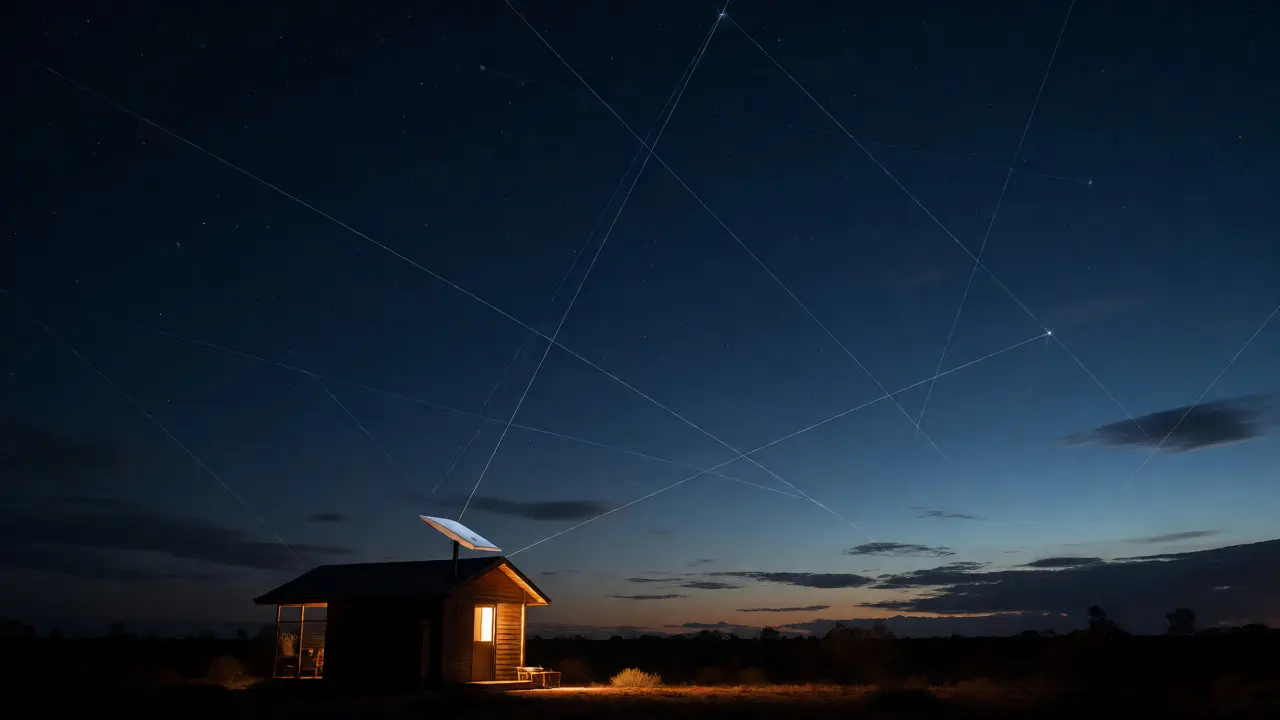
You’re sitting in a remote cabin in the Australian outback, trying to upload a high-res video. Your phone connects to a Starlink dish, which talks to a satellite overhead. But here’s the thing most people miss: that satellite doesn’t just beam your data straight down to a ground station in Sydney. It might pass it sideways to another satellite flying over Antarctica, then to one over the Pacific, and so on. This "sideways" communication is called an Inter-Satellite Link (ISL), and it’s the backbone of modern mega-constellations.
For decades, satellites were lonely nodes. They talked to Earth, but rarely to each other. Today, with thousands of satellites in Low Earth Orbit (LEO), they form a dynamic mesh network in space. The big engineering debate isn’t whether we need these links-it’s how to build them. Do you use radio waves (RF) or light (lasers)? As of late 2026, the answer is usually both, but for very different jobs. Let’s break down how this works, why lasers are winning the bandwidth war, and why radios aren’t going anywhere.
The Two Ways Satellites Talk
At its core, an ISL is just a network cable in space, except there’s no cable. There are two main physical layers used to create these connections: Radio Frequency (RF) and Free-Space Optical (FSO), commonly known as laser links.
Radio Frequency (RF) ISLs use microwave or millimeter-wave signals, similar to what your Wi-Fi router uses, but much more powerful and directional. These systems rely on directional antennas and established modulation techniques. They have been around since the early days of satellite comms, meaning the tech is mature, robust, and relatively easy to acquire. If you’ve ever tried to aim a flashlight at a moving target while riding a bike, you know pointing is hard. RF beams are wider, making them forgiving of small aiming errors.
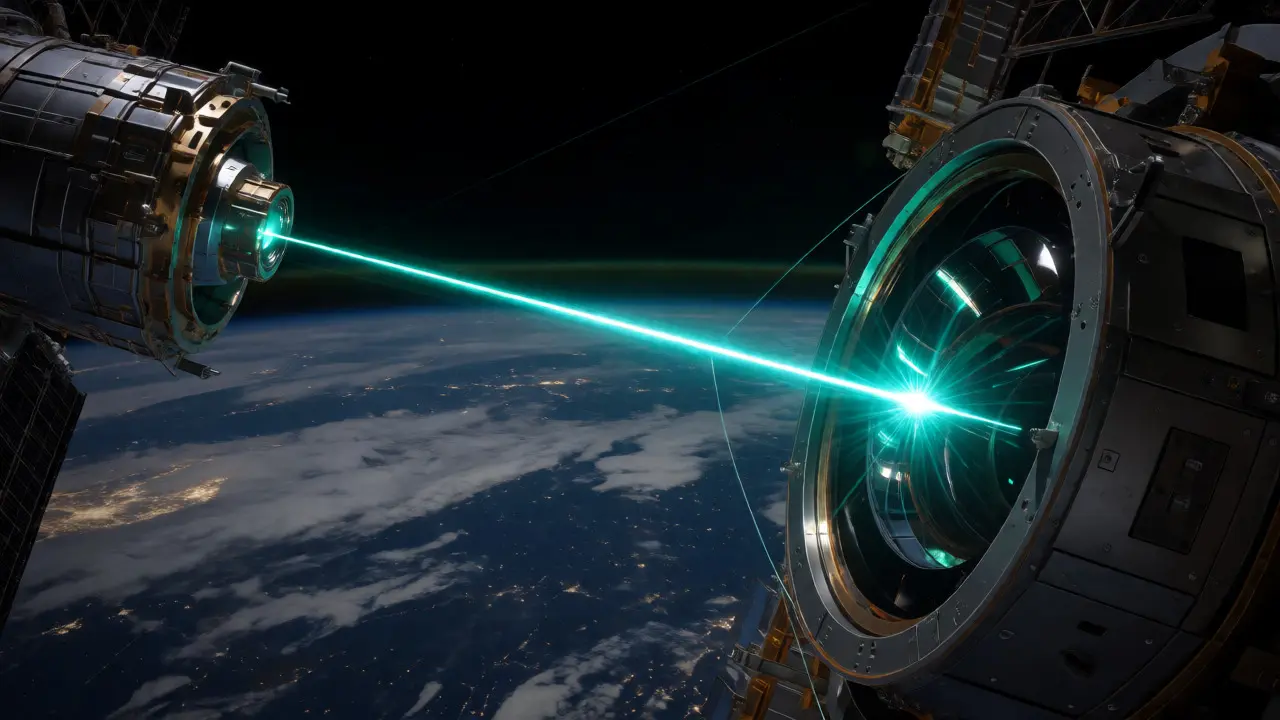
On the other side, we have Laser Inter-Satellite Links (LISLs). These use modulated infrared light transmitted through telescopes. Think of it as fiber-optic internet without the glass fiber. The beam is incredibly narrow-often microradians wide-which allows for massive data rates with less power. However, that narrowness makes alignment a nightmare. Both spacecraft must point their telescopes at each other across thousands of kilometers while traveling at 7.5 km/s. This requires precision Pointing, Acquisition, and Tracking (PAT) systems.
Why Lasers Are Taking Over the Backbone
If you look at SpaceX’s Starlink or Amazon’s Project Kuiper, you’ll see lasers dominating the inter-satellite mesh. Why? It comes down to physics and economics.
First, bandwidth. An optical link can carry gigabits per second (Gbps) easily. Starlink’s current generation satellites feature three optical terminals per unit, capable of up to 200 Gbps each. In contrast, comparable RF systems often struggle to hit 1-10 Gbps without bulky, heavy antennas. NASA’s Laser Communications Relay Demonstration (LCRD) has shown that optical systems can provide better than an order-of-magnitude higher data rates than RF while using less power and mass.
Second, spectrum congestion. RF frequencies are licensed and crowded. With thousands of new satellites launching every year, the radio spectrum is becoming a noisy place. Lasers don’t require frequency licenses from bodies like the FCC because they operate in unlicensed optical bands. This removes a huge regulatory bottleneck for constellation operators.
Third, security and interference. A laser beam is so narrow that intercepting it is nearly impossible unless you’re directly in the path. RF signals spill over, creating potential interference between neighboring satellites. For defense applications and secure government data, this low probability of intercept is a major selling point.
The Case for Keeping RF Around
So, if lasers are faster and cleaner, why do we still use RF? Because space is messy, and lasers are picky.
Acquisition time is the biggest hurdle for optical links. Establishing a laser connection can take seconds or even minutes, whereas RF links can lock on almost instantly. In a dynamic mesh where satellites constantly enter and exit line-of-sight, this delay matters. If a route breaks, you need a backup fast. RF serves as that reliable fallback.
Then there’s resilience. While space-to-space laser links avoid atmospheric issues (since they stay above the clouds), they are vulnerable to solar radiation and thermal distortion. Sunlight entering the receiver aperture can blind the sensor, requiring complex sun-exclusion angles. RF is generally more tolerant of harsh environmental conditions and structural vibrations on the satellite bus.
Finally, heritage and interoperability. Many existing military and scientific satellites use standard RF protocols. Building a hybrid network allows new LEO constellations to talk to legacy GEO (Geostationary) satellites or older defense assets without forcing everyone to upgrade their hardware overnight.
How the Network Actually Works
A constellation with ISLs isn’t a static grid; it’s a time-varying mesh. Imagine a spider web being shaken constantly. Satellites move, links appear and disappear, and geometry changes every second. Routing data through this mesh is harder than routing it through a terrestrial fiber network.
Traditional shortest-path algorithms fail here because the "shortest" geometric path might not be the fastest due to link availability or queueing delays. Researchers now use dynamic routing protocols that account for Link Setup Delay and contact duration. For example, a 2026 study showed that optimizing for these factors could reduce mean worst-case delay by about 13% in simulated LEO scenarios.
| Feature | Laser (Optical) ISL | RF (Microwave) ISL |
|---|---|---|
| Data Rate | High (10-200+ Gbps) | Moderate (100 Mbps - 10 Gbps) |
| Beam Width | Narrow (high directivity) | Wide (lower directivity) |
| Acquisition Time | Slow (seconds to minutes) | Fast (milliseconds to seconds) |
| Spectrum Licensing | Not required | Required (FCC/ITU coordination) |
| Security | Very High (hard to intercept) | Moderate (susceptible to jamming) |
| Complexity | High (requires precise PAT) | Lower (mature technology) |
Real-World Deployments and Standards
This isn’t just theory. Companies like Tesat Spacecom and Mynaric are manufacturing thousands of laser terminals annually. Tesat recently opened a facility in Germany capable of producing 100 units per month, driven by orders for Telesat’s Lightspeed constellation.
Amazon’s Project Kuiper prototypes demonstrated bidirectional optical links at 100 Gbps over 1,000 km, proving the tech scales beyond SpaceX. Meanwhile, ESA’s European Data Relay System (EDRS) has been using laser links to relay data from Sentinel satellites to ground stations since 2014, achieving speeds up to 1.8 Gbps.
Standardization is catching up too. The Consultative Committee for Space Data Systems (CCSDS) has published recommendations for optical physical layers and coding synchronization. This helps ensure that a laser terminal built by Company A can talk to a satellite built by Company B, fostering a healthier market.

Challenges You Can’t Ignore
Despite the hype, deploying ISLs is risky. The primary challenge is Pointing, Acquisition, and Tracking (PAT). If a satellite’s attitude control system jitters even slightly, the laser beam misses the receiver. This leads to link drops. Engineers spend years designing vibration isolation platforms and fine-steering mirrors just to keep that beam locked.
Cost is another factor. While prices are dropping, optical terminals are still expensive. Industry forecasts suggest costs may fall to $680,000-$920,000 per unit by 2030 if production volumes exceed 10,000 units annually. Until then, RF remains the budget-friendly option for smaller satellites or non-critical links.
Lastly, debris and collision avoidance. When a satellite maneuvers to avoid debris, it breaks all its ISLs. Re-establishing those links takes time. A robust network must handle frequent topology changes without collapsing service quality.
What’s Next for Satellite Networking?
We are moving toward hybrid architectures. Future constellations will likely use lasers for high-capacity backbone traffic between satellites and RF for user access, command-and-control, and emergency backups. ESA’s HydRON concept envisions a fully optical network connecting multiple orbits, extending terrestrial fiber networks into space.
As launch costs drop and terminal manufacturing scales, expect laser ISLs to become the default for any new large-scale LEO constellation. But don’t write off RF yet. It’s the safety net that keeps the lights on when the lasers blink.
Do laser inter-satellite links work through clouds?
Space-to-space laser links do not pass through clouds, so weather does not affect them. However, optical feeder links (from satellite to ground) are heavily affected by cloud cover and atmospheric turbulence. This is why ground stations are often distributed globally to find clear skies.
Why is RF still used if lasers are faster?
RF is easier to acquire and track, especially during initial link setup or when satellites are maneuvering. It also doesn't require the extreme precision pointing that lasers do, making it more robust for contingency communications and interacting with legacy satellites.
Are laser links secure against hacking?
Physically, yes. The beam is so narrow that intercepting it requires being directly in the line of sight, which is difficult. However, logical security (encryption) is still needed to protect the data content once received.
How many lasers does a Starlink satellite have?
Current operational Starlink V2 satellites typically contain three optical inter-satellite links. This allows them to connect to neighbors in the same orbital plane and adjacent planes, forming a global mesh.
What is the main technical challenge for laser ISLs?
The main challenge is Pointing, Acquisition, and Tracking (PAT). Maintaining a microradian-level beam alignment between two objects moving at 7.5 km/s relative to each other requires extremely precise mechanics and control algorithms.