

Imagine a massive blast of protons and ions screaming toward Earth at nearly the speed of light. This isn't a sci-fi movie plot; it's a Solar Particle Event (SPE), a violent eruption of radiation from the sun that can fry satellite electronics, disrupt global communications, and expose flight crews to dangerous radiation doses. The real danger isn't just the event itself, but how slow we are to react to it. If a satellite operator doesn't know a storm is hitting in ten minutes, they can't protect their billion-dollar asset. That is why we need a tight, automated loop between the people spotting the storm and the people steering the ships.
The Core Challenge of SPE Alert Integration
Integrating space weather alerts is basically the art of turning raw scientific data into a "do this now" instruction for a pilot or a technician. Right now, we have the data, but the Solar Particle Events integration process is often fragmented. The goal is to move from a world where a scientist sends an email to a world where a system automatically triggers a protective protocol.
To make this work, government bodies like the Department of Commerce (DOC) and the Department of Defense (DOD) work with NASA to create situational awareness. They aren't just looking for a "storm warning"; they are looking for specific metrics-proton flux, energy levels, and arrival times-that tell them exactly which systems are at risk. This coordination is managed by the Space Weather Operations, Research, and Mitigation (SWORM) Subcommittee, which acts as the air traffic control for radiation threats.
How We Protect Spacecraft from Radiation
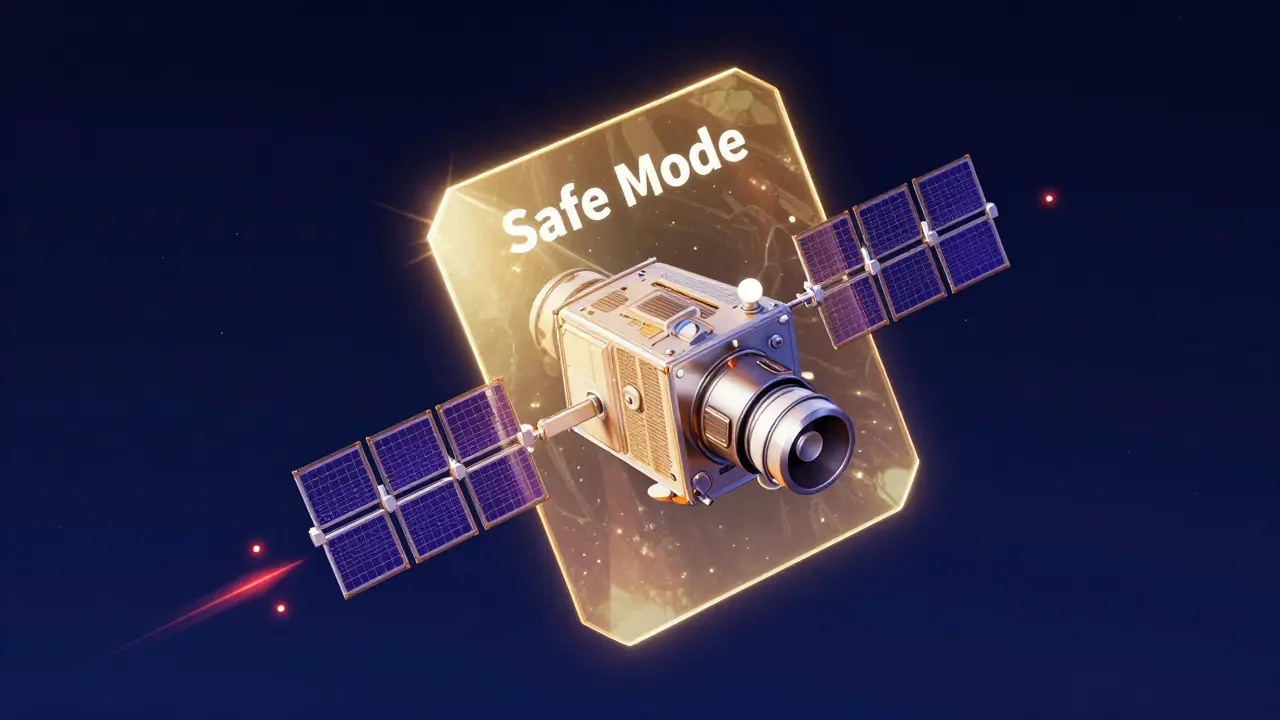
When an SPE alert hits, satellite operators don't just sit and watch. They follow a set of operational protocols designed to minimize the "attack surface" of the spacecraft. The most common move is triggering a Safe Mode (or Safe Hold). In this state, the satellite shuts down non-essential instruments and puts itself in a stable, low-power configuration. It's like turning off the lights and locking the doors during a hurricane.
But protection goes beyond just flipping a switch. Operators may perform orbit adjustments to change the spacecraft's exposure or manage payloads to ensure critical sensors aren't staring directly into the solar wind. Modern systems are now using AI models to predict these events faster, giving operators a larger window to react before the radiation hits the hardware.
| Strategy | Action Taken | Primary Goal |
|---|---|---|
| Safe Mode / Safe Hold | Power down non-essential systems | Prevent electronic burnout (Latch-up) |
| Payload Management | Reorient sensors or disable high-gain antennas | Prevent sensor saturation/damage |
| Orbit Adjustment | Slight shift in trajectory or altitude | Minimize duration in high-radiation zones |
| Data Fusion | Combining real-time solar monitors with AI models | Earlier and more accurate warning lead times |
The High Stakes for Aviation
While satellites are the most obvious victims, airplanes-especially those flying polar routes-are incredibly vulnerable. At high altitudes, the atmosphere provides very little shielding against solar protons. This is where the integration of alerts is currently lagging. Most pilots and airlines simply don't have a standardized way to receive or act on space weather data.
The Federal Aviation Administration (FAA) is trying to bridge this gap. The vision is to make space weather briefings as standard as checking the wind speed or cloud cover. If an SPE is imminent, flight paths could be diverted to lower latitudes, where the Earth's magnetic field provides more protection. This requires a shift in culture; aviation needs to treat solar radiation as a tangible operational risk, not just a scientific curiosity.
Moving from Research to Real-World Operations
One of the biggest hurdles is the "valley of death" between a research paper and an operational tool. A scientist might develop a brilliant new model for predicting SPEs, but if that model doesn't fit into a pilot's dashboard or a satellite's command system, it's useless. This is why the Space Weather Prediction Testbed (SWPT) was created.
The SWPT uses a framework called R2O2R (Research-to-Operations-to-Research). It's a feedback loop: researchers build a tool, operational forecasters use it in the real world, and then they tell the researchers what actually worked. To support this, the U.S. is investing heavily in hardware. For instance, the Space Force recently contracted SpaceX for the USSF-178 mission to launch the WSF-M2 vehicle, which provides the global sensing data needed to feed these prediction models.
Global Coordination and Standards
The sun doesn't care about national borders. A solar flare hitting the Earth's magnetic field affects everyone. Because of this, the International Space Environment Services (ISES) works to ensure that warnings are sent in a standardized format. If the U.S. uses one data format and Europe uses another, critical seconds are lost in translation during a crisis.
Programs like the Single European Sky ATM Research (SESAR) are pushing for these standards to be baked into the aviation infrastructure. The goal is a global network of ground-based neutron monitors that feed real-time data into a shared pool, allowing any country's flight control to see the radiation levels in their airspace instantly.

Pitfalls and Future Hurdles
Despite the progress, we still have a few glaring holes. First is the education gap. Many aviation professionals aren't trained to interpret space weather alerts. Second is the cost-benefit struggle. Rerouting a flight is expensive, and without a clear "minimum requirement" from regulators like the FAA, many companies will gamble on the risk rather than play it safe.
We also need to look at the interconnectedness of our grid. An SPE doesn't just hit a plane; it can trigger geomagnetic storms that knock out power grids on the ground. Operational protocols must evolve from "protect this one satellite" to "protect the entire system of systems." This means tabletop exercises-simulated disasters where agencies like NOAA and NASA practice their response-are no longer optional; they are a necessity for survival in the modern age.
What exactly is a Solar Particle Event (SPE)?
An SPE is a sudden increase in the flux of energetic protons and electrons emitted from the sun, usually following a solar flare or a coronal mass ejection. These particles travel at relativistic speeds and can penetrate spacecraft hulls and aircraft fuselages, causing radiation damage to electronics and biological tissue.
Why do satellites need to enter "Safe Mode" during these events?
High-energy particles can cause "single-event upsets" or latch-ups, where a bit of memory flips or a circuit shorts out. By entering Safe Mode, operators shut down non-critical systems and minimize the power load, reducing the chance of a permanent hardware failure that would kill the satellite.
How does space weather affect commercial flights?
The primary risk is radiation exposure for crew and passengers, particularly on long-haul flights over the poles where the atmosphere is thinner and the magnetic field is weaker. Additionally, SPEs can disrupt the high-frequency (HF) radio communications used by pilots to talk to air traffic control.
Who is responsible for issuing these alerts?
In the U.S., the NOAA Space Weather Prediction Center (SWPC) is the primary authority. They coordinate with the Department of Defense and NASA to disseminate alerts to commercial operators and national security assets.
What is the R2O2R framework?
R2O2R stands for Research-to-Operations-to-Research. It is a collaborative cycle where scientific research is turned into operational tools, and the real-world performance of those tools is then fed back to researchers to improve the next version of the model.
Next Steps for Implementation
If you are managing orbital assets or aviation logistics, the path forward involves three clear steps. First, audit your current communication chain: how long does it take for a NOAA alert to reach your decision-maker? If it's more than a few minutes, you have a gap. Second, move toward standardized data formats (like those suggested by ISES) to ensure your systems can read alerts automatically without human transcription. Finally, invest in crew and staff training. A tool is only as good as the person who knows why they need to use it.