
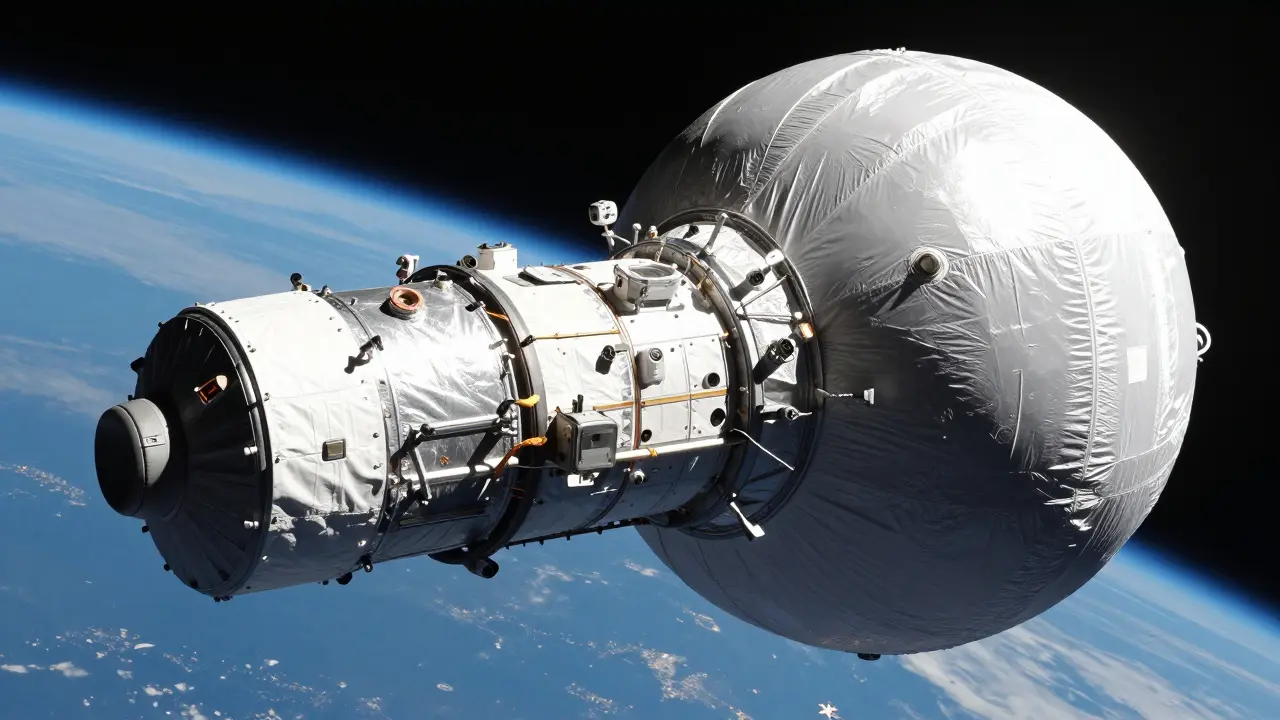
For decades, we've been stuck with rigid metallic cans. They're safe, but they're heavy and limited by the diameter of the rocket fairing. Inflatable tech flips the script. By packing the living space tight for the ride up and expanding it in the vacuum of space, we can suddenly afford to send laboratories, gardens, and bedrooms to the Moon or Mars without needing a rocket the size of a skyscraper.
The Secret Sauce: Materials Stronger Than Steel
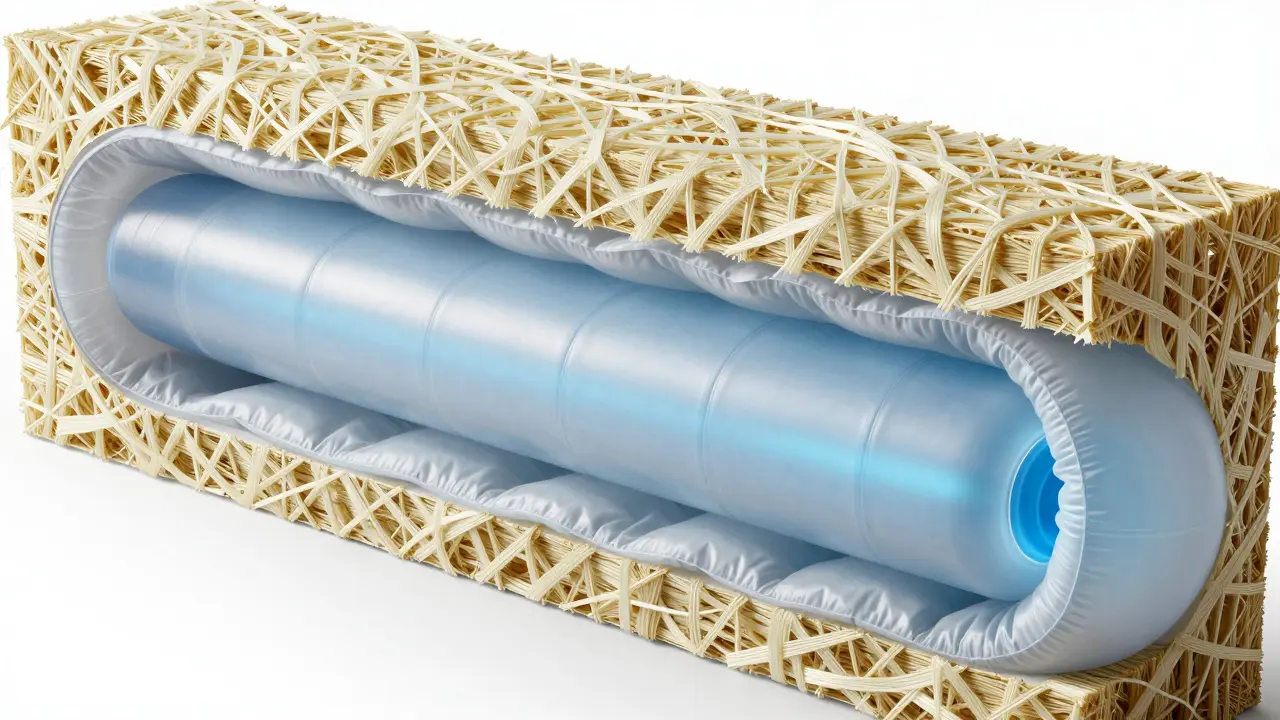
You might wonder why a fabric wall wouldn't just pop or leak. The answer lies in a complex, multi-layered skin. The most advanced versions, like those developed by Sierra Space, don't rely on a single sheet of plastic. Instead, they use a sophisticated sandwich of materials designed for different jobs.
The real hero here is Vectran, a liquid crystal polymer fiber used as the primary restraint layer in expandable habitats. This stuff is incredible-it's five times stronger than steel and ten times stronger than aluminum. When the habitat inflates, the Vectran weave takes the brunt of the internal pressure, acting like a structural exoskeleton.
To keep the air inside and the structure safe, the walls follow a three-layer logic:
- The Bladder: An inner layer made of Urethane that acts as the airtight seal.
- The Liner: A middle layer of Nylon fabric that protects the delicate bladder from punctures or abrasion.
- The Restraint Layer: The outermost Vectran weave that prevents the whole thing from expanding too far and bursting.
Safety isn't a guess here; it's backed by brutal testing. Engineers have performed 'burst tests' where they over-inflated prototypes until they literally exploded. These tests showed that the structures can handle six times the pressure required for human life. If a habitat is rated for 14.7 psi (Earth sea level), it can actually withstand nearly 90 psi before failing.
| Feature | Rigid Metallic Habitats | Inflatable Habitats (e.g., LIFE) |
|---|---|---|
| Launch Volume | Fixed (limited by rocket size) | Compact (expands after launch) |
| Mass-to-Volume Ratio | High (Heavy for the space provided) | Low (Lightweight for huge volume) |
| Material Strength | Aluminum/Titanium | Vectran Composite / Polymers |
| Deployment | Immediate (Ready on arrival) | Gradual (Inflation phase required) |
The LIFE Habitat: A Three-Story Home in the Stars
The gold standard for this tech right now is the LIFE Habitat (Large Integrated Flexible Environment). Developed by Sierra Space, the LIFE system isn't just a room; it's a fully realized architectural plan for deep space. The primary design is a three-story structure about 27 feet in diameter.
Why go to three stories? Because psychology matters in space. When astronauts spend months in a cramped tin can, stress levels spike. The LIFE habitat provides enough room for four people to sleep comfortably, but it also integrates specialized zones that make it feel like a real base:
- Science Labs & Robotics: Dedicated workstations for microgravity research and semiconductor manufacturing.
- Medical Bays: A proper sick bay and hygiene quarters, essential for long-term health.
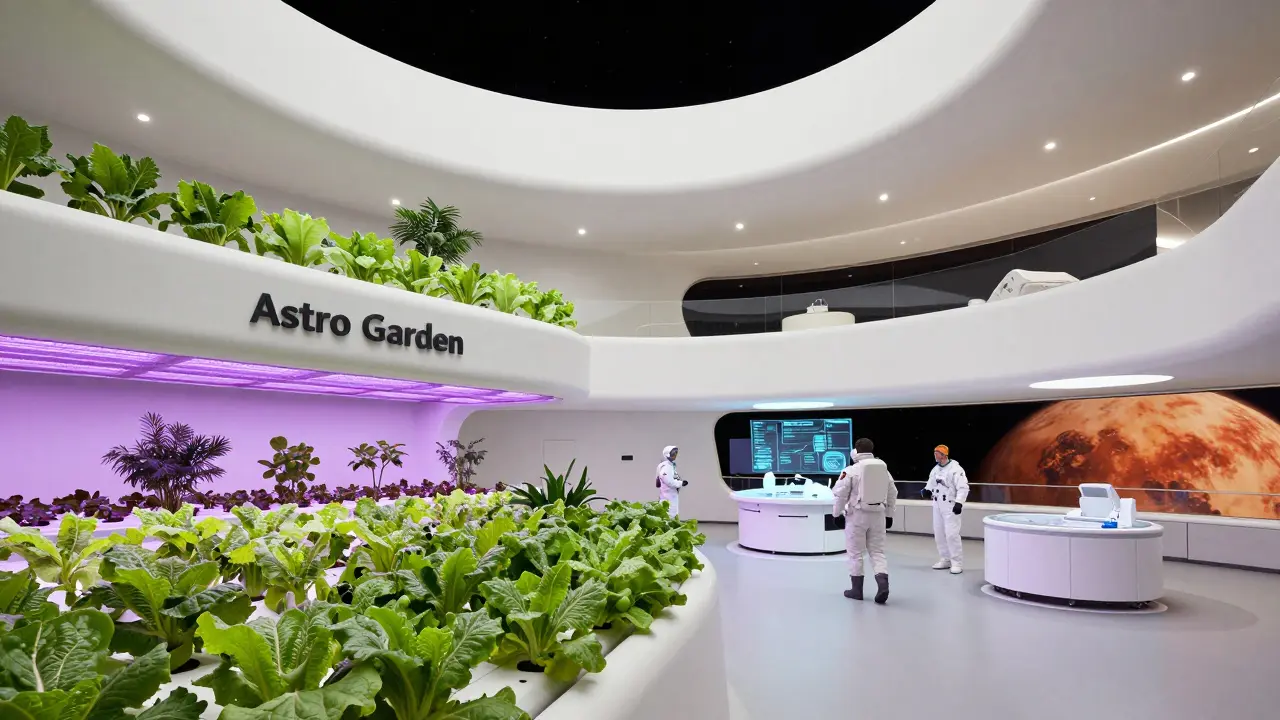
- The Astro Garden: A plant-growth system that allows crews to grow fresh produce. This isn't just for food; plants provide a psychological link to Earth that is vital for mental health on a Mars mission.
- Exercise Zones: Large enough areas to house the heavy equipment needed to prevent muscle atrophy in zero-G.
To get this ready, Sierra Space used a smaller version called the LIFE 10. With 285 cubic meters of volume and a 9-meter diameter, it served as the proving ground to see how humans actually move and work inside a flexible wall environment before scaling up to the full three-story version.
From Concept to Orbit: Who is Building This?
This isn't science fiction-we've already done it. The BEAM (Bigelow Expandable Activity Module) was attached to the International Space Station (ISS) as a tech demo. It proved that expandable modules could withstand the harsh environment of LEO (Low Earth Orbit) and protect crews from radiation and micro-meteoroids.
Now, the industry is moving toward commercialization. Orbital Reef, a planned commercial space station, intends to use multiple LIFE habitats as its core architecture. This shifts the space station model from a government-built fortress to a flexible, scalable business park in orbit.
Other heavy hitters are in the race too. Lockheed Martin is refining their own inflatable concepts to replace heavy metal hulls. ILC Dover focuses on the critical transitions-the airlocks and shelters-that allow astronauts to move between these inflatable bubbles and the lunar surface. Even startups like Max Space are targeting the 'Moon-to-Mars' pipeline with their own expandable designs.
Practical Logistics: The Mission Planner's Dream
If you're planning a mission to Mars, every kilogram costs thousands of dollars in fuel. Rigid habitats are a nightmare for logistics because they're mostly empty space during the launch. You're essentially paying to rocket a giant bubble of air to another planet.
Inflatable habitats change the math. They allow a 'pack-and-grow' strategy. You can fit a massive living volume into a standard 5-meter fairing. Once the craft reaches its destination, you inflate it, and suddenly you have a base that can support a full scientific crew without requiring ten separate launch missions to assemble the pieces.
This adaptability also makes them perfect for different surfaces. On the Moon, these habitats could be partially buried under lunar regolith (moon dust) to protect the crew from extreme radiation and temperature swings, combining the strength of the inflatable shell with the natural shielding of the planet's soil.
Are inflatable habitats actually safe compared to metal ones?
Yes. While 'inflatable' sounds fragile, the materials used (like Vectran) are significantly stronger than the aluminum used in traditional modules. They are tested to burst points six times higher than operational pressure and have already been successfully deployed and tested on the International Space Station via the BEAM module.
How do they prevent leaks in the vacuum of space?
They use a multi-layer system. An internal Urethane bladder acts as the primary airtight seal, while a middle layer of Nylon protects that bladder from punctures. The outer Vectran layer provides the structural strength to keep the internal pressure stable.
Can you grow food inside these structures?
Absolutely. The LIFE habitat specifically includes the Astro Garden system, designed to produce high yields of fresh produce while minimizing power and weight. The increased volume of inflatable habitats makes large-scale hydroponics much more feasible than in cramped rigid modules.
What happens if a micro-meteoroid hits the wall?
The composite multi-layer skin is designed to absorb and dissipate the energy of small impacts. Because the layers are flexible and dense, they can often stop debris better than a rigid sheet of metal, which can crack or puncture more easily under high-velocity impact.
Will we see these on Mars in our lifetime?
It is highly likely. With NASA's Next Space Technologies for Exploration Partnerships program and the development of the LIFE habitat, the technology is moving from prototypes to operational readiness. These habitats are viewed as the primary way to establish a permanent human presence on the Martian surface within the next decade.
Next Steps for the Space-Curious
If you're following the progress of these habitats, keep an eye on the Orbital Reef project. It will be the first real-world test of how a commercial economy functions inside these expandable shells. For those interested in the materials side, looking into the properties of liquid crystal polymers will give you a better idea of why Vectran is replacing steel in the stars.
Whether you're a hobbyist or a future space architect, the shift toward flexible infrastructure is the biggest change in space design since the Apollo era. We're moving away from 'survival pods' and toward actual 'living spaces,' and that all starts with a very fancy, very strong balloon.
15 Responses
this sounds like a great way to make space travel more accessible for everyone... love the idea of gardens in orbit
big balloons in space huh sounds like a perfect way to hide the real tech they arent telling us about... probably just a cover for some deeper surveillance project they want us to think is a bedroom
It is absolutely laughable that anyone believes these "engineered marvels" are for science. They are clearly designed for rapid deployment of elite bunkers while the rest of us are left in the dust. Also, the author's use of colloquialisms in a technical explanation is borderline offensive to the English language.
We strive for the stars only to build bubbles of air to keep our fragility at bay... Is this not the ultimate metaphor for the human condition? We are but ghosts in a Vectran shell, drifting through a void that doesn't know our names. The tragedy of the Astro Garden is that we try to bring the soil of a dying world to a new one, clinging to the ghost of a green Earth while we float in a cold, uncaring vacuum. It is a desperate, beautiful, and utterly futile attempt to stave off the cosmic loneliness that defines our very existence. Why must we build walls, even flexible ones, when the universe is infinite? We are simply rearranging the furniture in a room that has no ceiling and no floor, pretending that a three-story habitat makes us any less small. The weight of the void is heavier than any aluminum hull could ever be, and no amount of liquid crystal polymer can shield the soul from the crushing realization that we are anomalies in a silent graveyard of stars. We are just children playing with balloons in the dark, hoping the air doesn't run out before we find a reason to be there. Such is the vanity of man, to think a garden in a bubble is a home.
The psychological aspect is the most critical part here. We can't just talk about psi and polymers without addressing the mental toll of isolation. If we don't prioritize the human spirit over the hardware, these habitats will just become high-tech prisons.
Do you have any photos of the inside? I want to see where the beds go.
Omg, finally some actual desing thaught in space! It's just so tragic that most people still think in terms of metal cans... like, please get with the program, the aesthetic of a flexible volume is just so much more avant-garde and frankly more humane for the poor souls trapped up there!!
I suppose it's fine, as long as the workers making these materials are actually paid a fair wage.
Waste of money. Canada could do it better.
lol a giant space balloon... sounds like a great way to accidentally pop everything!!!!
The table is barely formatted and the logic is basic. You're acting like this is a revolution when it's just a material swap. The math on the radiation shielding is completely glossed over and it's honestly embarrassing that people fall for this hype.
seems cool i guess
The transition from survival to living is a necessary evolution. However, the arrogance of assuming we can simply 'pack and grow' a civilization without understanding the deep metaphysical shift of leaving Earth is a dangerous oversight.
Vectran isn't a magic bullet. The thermal expansion coefficients of the interface between rigid and flexible modules are a nightmare that this post conveniently ignores.
everyone just calm down it's a cool piece of tech and it'll be great to see some green plants in space