
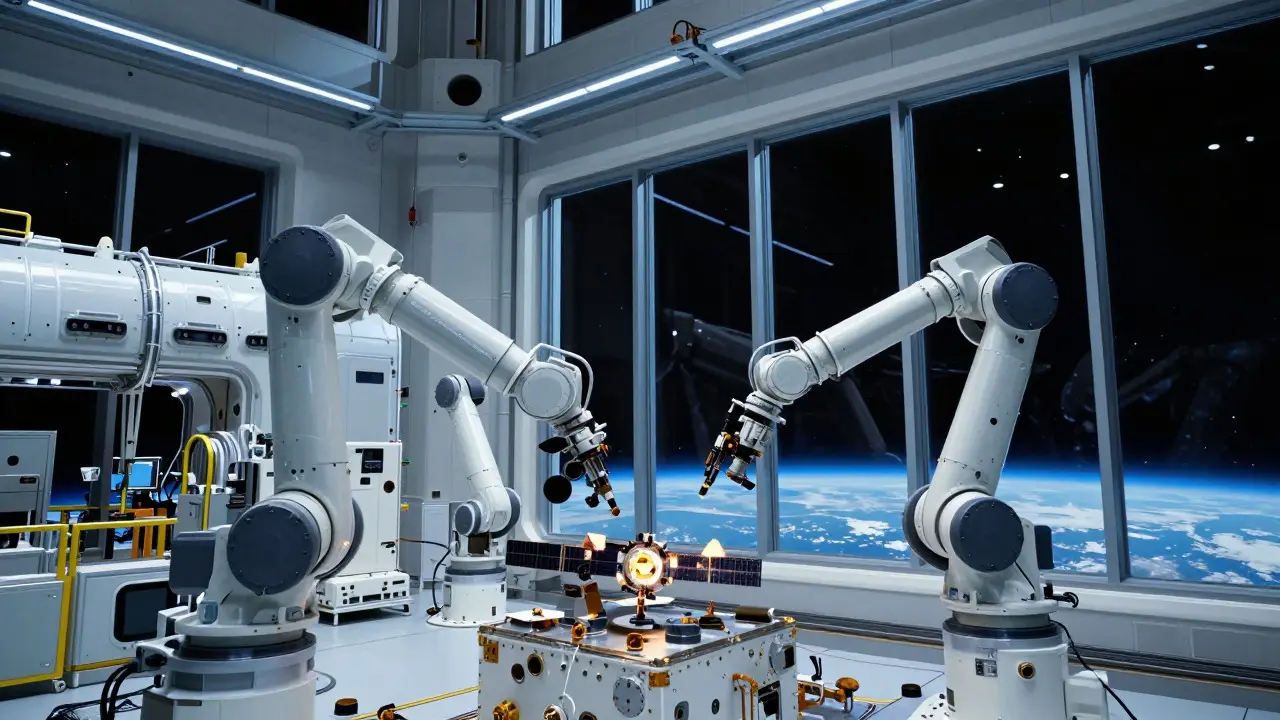
Imagine a factory that never sleeps, where gravity doesn't pull your products down, and raw materials float into place for assembly. This isn't science fiction anymore. By mid-2026, we have moved past the era of simple experiments on the International Space Station (ISS). We are now looking at modular production lines in orbit, which are reconfigurable manufacturing systems designed to operate autonomously or with minimal human intervention in low Earth orbit. These aren't just single-purpose labs; they are evolving into flexible industrial ecosystems capable of producing high-value pharmaceuticals, advanced semiconductors, and satellite components directly in space.
The Shift from Experiments to Industrial Modules
For years, space manufacturing meant sending a scientist up to watch a protein crystal grow. Today, the focus has shifted to In-Space Manufacturing, Assembly, and Servicing (ISMA), a paradigm where standardized modules replace custom-built spacecraft. The core idea is simple but powerful: instead of launching a fully assembled, fragile satellite from Earth, you launch lightweight, modular parts and assemble them in orbit using robotic arms and AI-driven digital twins.
This approach mirrors the "Industrie 4.0" revolution on Earth, where smart factories use data to optimize production in real-time. Projects like Space Factory 4.0, developed by the Technical University of Munich, explicitly apply these terrestrial principles to space. They propose robotic assembly stations that can reconfigure themselves based on the specific satellite being built. Similarly, the EU-funded PERIOD project aims to demonstrate a fully functioning satellite manufactured on the ISS Bartolomeo platform, proving that orbital factories can reduce costs and increase reliability by leveraging the space environment rather than fighting against it.
Key Players and Operational Facilities
Who is actually building these factories? The landscape is dominated by commercial entities partnering with government agencies. Redwire Corporation is currently the industry leader, operating the first permanent commercial additive manufacturing facility on the ISS. Formed by consolidating several space tech firms, Redwire has turned the ISS into a testbed for various production modules.
Let's look at what they are running right now:
- Additive Manufacturing Facility (AMF): As of early 2023, this polymer-based 3D printer had produced over 200 tools and parts onboard the ISS. It acts as a basic production line, converting digital designs into physical assets on demand.
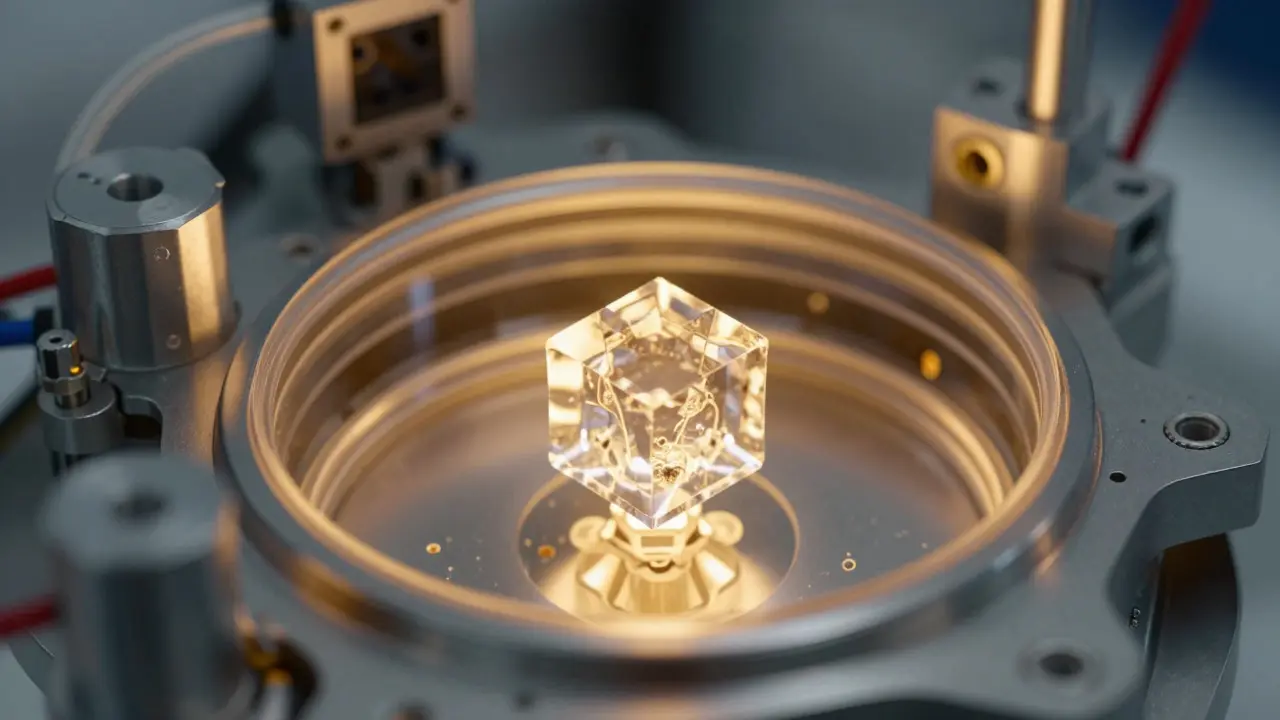
- Pharmaceutical In-space Laboratory (PIL-BOX): By March 2025, this module had processed 28 units, growing high-value seed crystals for protein-based drugs. Microgravity allows for purer crystal structures, which is critical for developing new medications.
- MSTIC Semiconductor Facility: Launched in February 2024, this autonomous system produced 18 thin-film semiconductor samples. Early results show improved crystal microstructure compared to Earth-made equivalents, hinting at better performance for future electronics.
- Ceramics Manufacturing Module (CMM) & Turbine Superalloy Casting Module (TSCM): These specialized modules handle advanced ceramics and superalloys, demonstrating that high-temperature processes can be adapted for space.
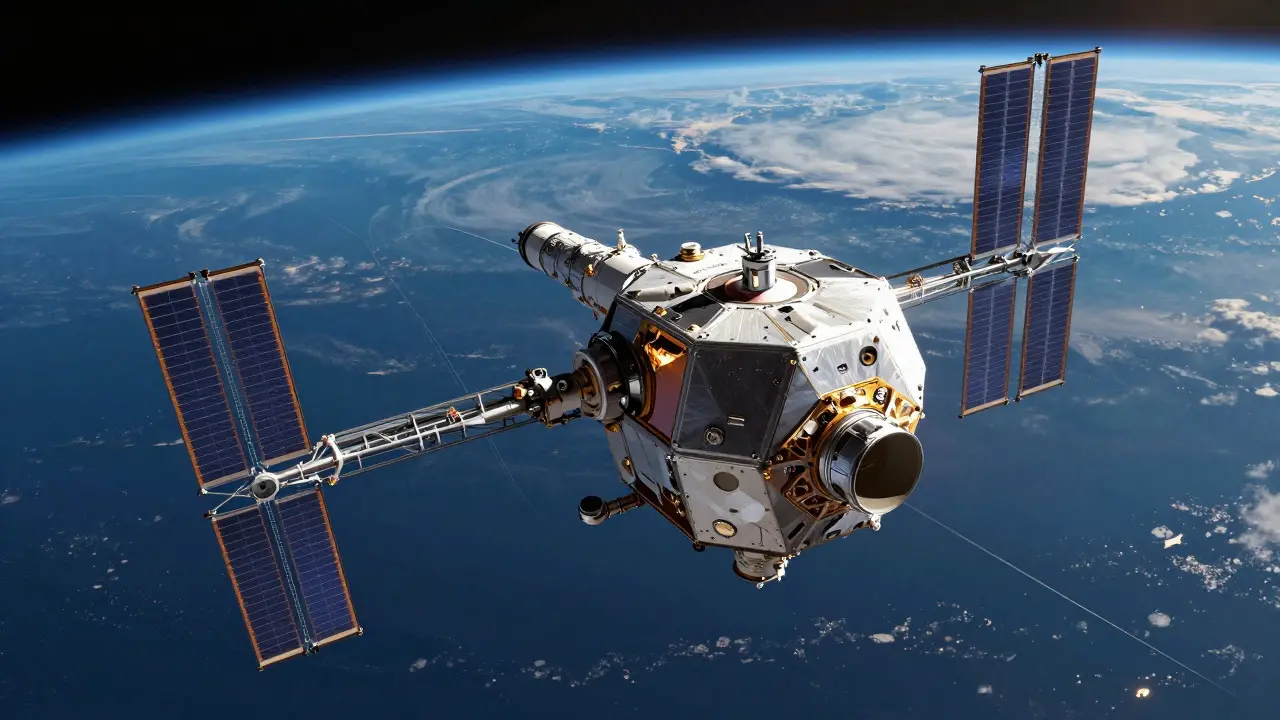
Beyond the ISS, companies like Interstellar Space Technologies are developing autonomous, free-flying factories in Low Earth Orbit (LEO). Unlike ISS-hosted modules, these dedicated satellites operate without crew, focusing on continuous manufacturing of high-performance materials like next-generation semiconductors, which are then returned to Earth via cargo missions.
How Modular Production Lines Work in Orbit
The architecture of an in-orbit factory relies heavily on Digital Twin Technology. A high-fidelity virtual model of the factory runs continuously on Earth, synchronized with sensor data from the physical hardware in space. AI systems analyze this data to optimize robotic assembly sequences and predict maintenance needs before failures occur.
In a typical modular setup, raw materials and standardized components are delivered via cargo spacecraft. Robotic manipulators, guided by AI, pick up these parts and integrate them into larger structures. For example, in satellite assembly, the "production line" consists of reprogrammable robotic cells rather than fixed conveyor belts. This flexibility allows the same platform to build different types of satellites depending on market demand.
| Approach | Platform | Primary Output | Human Intervention |
|---|---|---|---|
| ISS-Hosted Modules (e.g., Redwire) | International Space Station | Pharmaceuticals, Tools, Semiconductors | High (Crew support required) |
| Autonomous Free-Flying Factories | Dedicated LEO Satellites | Advanced Materials, Fibers | Low (Fully automated) |
| Robotic Assembly Platforms | External ISS Platforms (Bartolomeo) | Satellite Structures | Medium (Remote operation) |
Challenges and Constraints
Despite the progress, significant hurdles remain. The ISS is not a traditional factory floor. It has strict limits on power, volume, and safety. High-temperature processes like superalloy casting must be carefully contained to protect the station and its crew. Upmass and downmass limitations mean that every kilogram of material launched and every gram of product returned costs a fortune, restricting throughput.
Furthermore, reliance on crew time for setup and maintenance creates bottlenecks. While NASA’s In-Space Production Applications (InSPA) program funds demonstrations, scaling up to commercial viability requires moving beyond the ISS. This is why projects like Interstellar Space Technologies’ autonomous platforms are critical-they aim to remove human constraints entirely, allowing for 24/7 operation in dedicated environments optimized for industrial throughput.
The Economic Case: Why Manufacture in Space?
You might ask, why bother? The answer lies in the unique physics of microgravity. Without buoyancy, convection, or sedimentation, materials behave differently. ZBLAN optical fiber, for instance, was the first commercial product manufactured in space and sold on Earth. Its clarity is superior because gravity-induced defects are eliminated during the drawing process.
Similarly, pharmaceutical crystals grown in space often exhibit higher purity and uniformity, leading to more effective drugs. Semiconductors produced in microgravity show improved electronic properties. For satellite manufacturers, assembling large structures in orbit bypasses the size constraints of rocket fairings, enabling more powerful and complex spacecraft than could ever be launched fully assembled.
Future Outlook: From ISS to Commercial Stations
As of July 2026, the trajectory is clear. NASA continues to fund U.S. businesses through multi-year contracts, such as the $25 million IDIQ agreement with Redwire for biotechnology facilities. However, the long-term vision involves transitioning from the aging ISS to commercial space stations in the late 2020s and early 2030s. These private stations will likely host larger, more integrated modular production lines, serving both space infrastructure needs and terrestrial markets.
The ecosystem is expanding rapidly. Directories like FactoriesInSpace list dozens of companies exploring niche applications, from regolith printing for lunar bases to continuous fiber production. The combination of AI-driven automation, digital twins, and the physical advantages of microgravity suggests that in-space factories will become a cornerstone of the emerging "space for Earth" economy.
What is the difference between an in-space lab and an in-space factory?
An in-space lab typically focuses on research and experimentation, often requiring significant human oversight to collect data. An in-space factory, particularly one with modular production lines, emphasizes automated, repeatable manufacturing processes aimed at producing commercial goods or infrastructure components with minimal human intervention.
Which company is leading in-space manufacturing today?
Redwire Corporation is widely recognized as the industry leader, operating multiple permanent manufacturing modules on the ISS, including facilities for 3D printing, pharmaceuticals, and semiconductors. Other notable players include Interstellar Space Technologies, which focuses on autonomous free-flying factories.
What products are currently being made in orbit?
Current products include ZBLAN optical fibers, high-purity pharmaceutical seed crystals, thin-film semiconductors, and custom tools or parts via 3D printing. Future products may include large satellite structures and advanced ceramic components.
How does microgravity improve manufacturing quality?
Microgravity eliminates forces like buoyancy, convection, and sedimentation. This allows for the creation of materials with fewer defects, such as clearer optical fibers, purer drug crystals, and more uniform semiconductor layers, resulting in higher performance products.
When will we see fully autonomous space factories?
While ISS-based modules still require some crew support, companies like Interstellar Space Technologies are already developing autonomous platforms. Widespread adoption of fully autonomous factories is expected to grow alongside the deployment of commercial space stations in the late 2020s.