
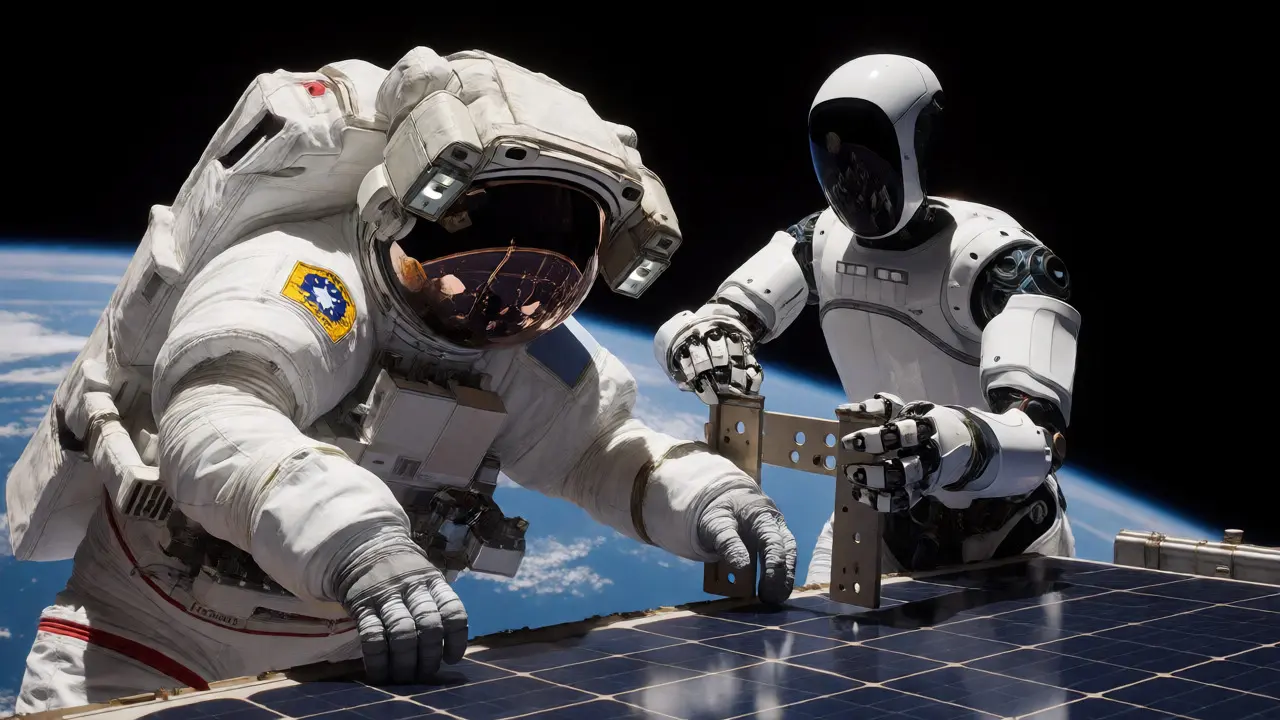
Imagine floating outside the International Space Station, your gloved hands fumbling with a bolt while your partner holds a heavy panel. Now imagine a third member of that team-a robot-handing you the right wrench before you even ask. This isn't science fiction; it's the future of human-robot interaction during spacewalks. For decades, we've relied on two-person teams and clunky robotic arms controlled from inside the ship. But as missions get longer and more complex, that model is hitting its limits. We need partners that can think, adapt, and work alongside us in the vacuum of space.
The Rise of the EVA Squad
Back in 2003, engineers at NASA’s Johnson Space Center (JSC) tested a radical idea: the "EVA squad." Instead of just two astronauts and one arm, they mixed humans with humanoid robots, free-flyers, and cranes. Dr. Robert Ambrose, who led these tests, described the goal simply: get twice as much done per spacewalk. The core of this experiment was Robonaut, a humanoid robot designed to function as an astronaut equivalent. Unlike previous robots that needed special fixtures to grab onto, Robonaut had human-like hands. It could use the same tools, touch the same surfaces, and fit into the same tight spots as a suited crew member. This shift marked a move away from robots as isolated machines toward robots as integrated team members.
This concept relies heavily on what researchers call proximate interaction. Goodrich and Schultz’s 2007 framework highlights that when humans and robots share a small, high-risk workspace, communication and trust become critical. You can’t just shout commands over a radio if there’s a delay or noise interference. The robot needs to understand intent through gestures, body language, or simple voice cues. It’s about creating a shared mental model where both parties know who is doing what, reducing the cognitive load on the astronaut who is already fighting against fatigue and bulky suits.
Three Ways Humans Control Robots in Orbit
How do you actually tell a robot to hand you a screwdriver while you’re upside down? NASA formalized three distinct roles for humans working with these systems: teleoperator, monitor, and co-worker. Each requires a different level of autonomy and physical proximity.
- Teleoperator: Here, the human is essentially piloting the robot. Using exoskeletal controllers or data gloves, an astronaut inside the station maps their own arm movements directly onto the robot’s joints. It’s like wearing a VR suit that lets you feel what the robot feels. This is useful for precise tasks, like mating connectors, where human dexterity is still superior to current AI.
- Monitor: In this mode, the robot handles semi-autonomous tasks, like inspecting insulation or checking hoses. The human watches for alerts and steps in only if something goes wrong. This aligns with adjustable autonomy principles, allowing the crew to focus on higher-level decision-making rather than micromanaging every movement.
- Co-worker: This is the ultimate goal. An astronaut and a robot share the same workspace, dividing tasks naturally. The robot might hold a heavy component steady while the human tightens bolts. Studies on cooperative manipulation show that when force distribution is managed well, stability improves, and coordination becomes seamless. It’s less about commanding a machine and more about collaborating with a colleague.
Key Systems Making It Happen
Several real-world systems are pushing this technology forward. Beyond Robonaut, which flew to the ISS as R2 to test tool handling, other projects are exploring unique interaction methods.
The European Robotic Arm (ERA), mounted on the Russian segment of the ISS, introduced external control interfaces. Previously, astronauts had to go inside to command the arm. Now, they can control it from outside during a spacewalk. ESA engineers reported that this reduced preparation time significantly. It allows the arm to act as a true assistant, moving payloads or positioning platforms while the crew works nearby. It’s a practical example of how hardware design changes operational workflows.
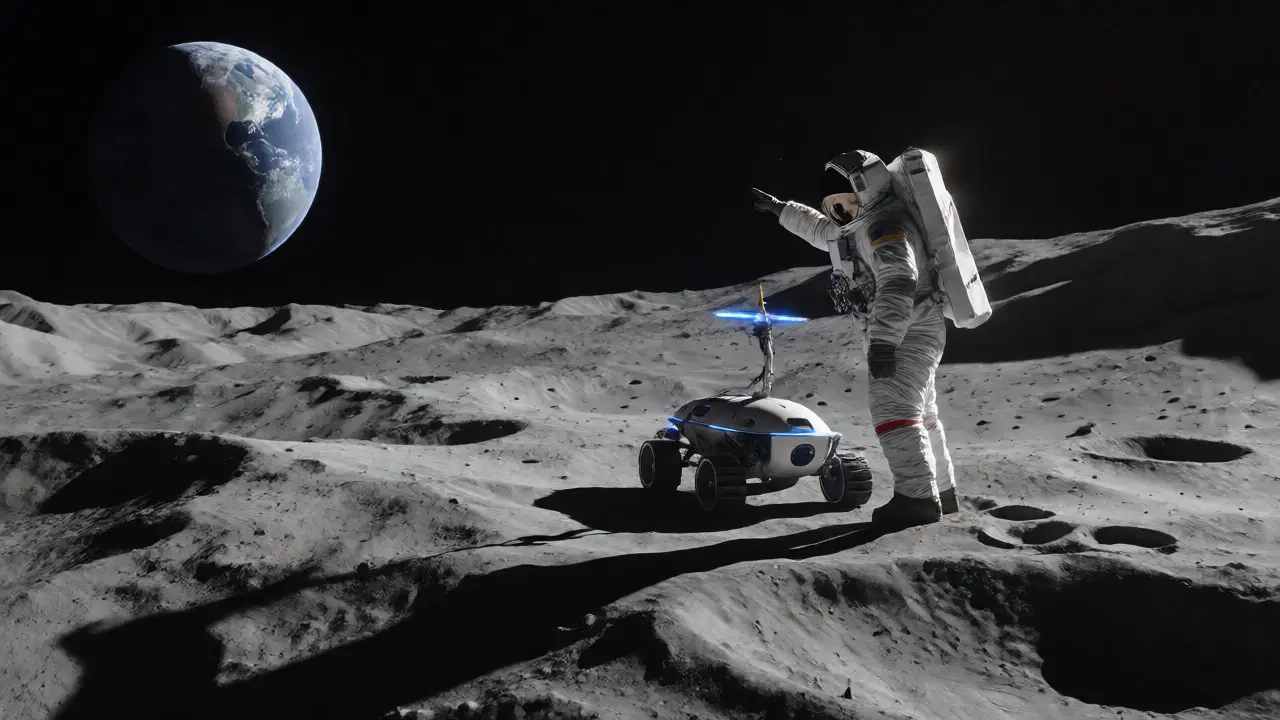
Then there’s the EU-funded MOONWALK project, which developed gesture-controlled helper rovers for planetary exploration. Imagine walking on the Moon with a rover following you. Instead of holding a joystick, you raise your arm to signal "stop" or point to indicate direction. MOONWALK used inertial measurement units (IMUs) embedded in the suit to track limb movements. Airbus called their 2016-2017 trials the first demonstration of collaboration between an astronaut and a gesture-controlled rover. This frees up the astronaut’s hands for sampling or repairs, letting the robot handle logistics.
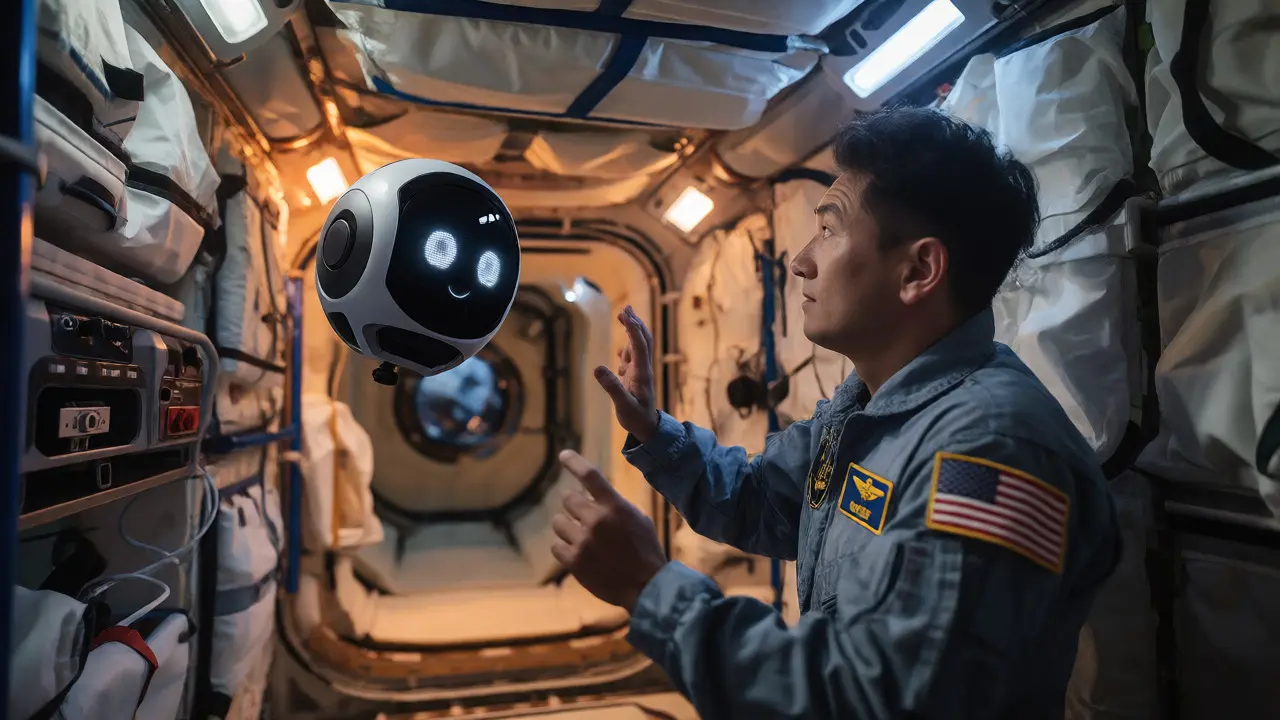
Inside the cabin, CIMON, a free-flying AI assistant, uses natural language processing to guide astronauts through procedures. While CIMON operates indoors, its tech is relevant to EVAs. Future EVA robots will likely speak to us, understanding context and adapting to our preferences. If you say, "I’m struggling with this valve," a smart robot wouldn’t just wait for a command; it might suggest a tool or offer to hold the part steady.
Why Collaborate? The Productivity Math
Why bother with all this complexity? Because traditional EVA methods are inefficient. Two astronauts plus one arm can only do so much in a limited oxygen window. By adding robotic partners, you expand the team without adding life-support burdens. A robot doesn’t breathe air or sweat. It can work in hazardous conditions or perform repetitive tasks without fatigue.
| Configuration | Human Risk Exposure | Task Parallelism | Tool Compatibility |
|---|---|---|---|
| Traditional (2 Humans + 1 Arm) | High (both exposed) | Low (sequential tasks) | Specialized fixtures required |
| EVA Squad (Humans + Humanoid Robots) | Reduced (robots take hazards) | High (parallel workflows) | Standard EVA tools usable |
| Gesture-Controlled Rover Assist | Medium (one human focused on nav) | Medium (logistics handled by robot) | N/A (transport role) |
JSC tests showed that organizing tasks into squads allowed parallel work streams. One pair could repair a solar array while another pair inspected a hull breach, doubling output. Furthermore, because robots like Robonaut use standard tools, you don’t need to redesign spacecraft interfaces. This compatibility is crucial for long-term sustainability.
Challenges and Safety Concerns
It’s not all smooth sailing. Proximate interaction introduces new risks. If a robot malfunctions near an astronaut, it could cause injury. Safety certification for autonomous behaviors in close quarters is rigorous. Gesture controls must be robust enough to ignore accidental movements. Telepresence systems can cause disorientation or operator overload if latency is too high.
There’s also the issue of trust. Astronauts need to know exactly what the robot will do next. Ambiguity in instructions leads to errors. Best practices emphasize clear role allocation and adjustable autonomy. If the situation gets chaotic, the astronaut should be able to switch the robot to a safe mode instantly. Designing interfaces that minimize cognitive load is key. If an astronaut has to think hard about how to command the robot, the efficiency gains vanish.
The Future: AI Colleagues in Vacuum
Looking ahead to the late 2020s and 2030s, we expect robots to become standard partners for lunar and Martian missions. The 2023 International Astronautical Congress highlighted that assisting with spacewalks and repairs is a primary target for space robotics. We’re moving toward unified EVA squads where robots understand spoken instructions, interpret gestures via suit sensors, and coordinate loads with haptic feedback.
The integration of AI brings contextual awareness. A robot won’t just follow a script; it will learn from each crewmember. If you prefer a certain grip or workflow, the robot adapts. This social HRI aspect makes robots more acceptable and easier to integrate into daily routines. As we build bases on the Moon and Mars, having a robotic teammate who can anticipate your needs will be essential for maintaining infrastructure and conducting science efficiently.
Can robots really use the same tools as astronauts?
Yes, this is a core design feature of advanced humanoid robots like Robonaut. They are built with anthropomorphic hands capable of gripping standard EVA tools, such as power drills and wrenches. This eliminates the need for specialized grapple fixtures on spacecraft, simplifying logistics and training for both humans and robots.
How do astronauts control robots during a spacewalk?
Control methods vary by mission phase. Inside the spacecraft, astronauts often use telepresence systems with exoskeletons or data gloves to map their movements onto the robot. During actual spacewalks, emerging technologies allow for gesture-based control using sensors in the suit, direct manual guidance, or voice commands via AI assistants like CIMON.
What is the main benefit of human-robot collaboration on spacewalks?
The primary benefit is increased productivity and safety. By allowing robots to handle hazardous, repetitive, or heavy tasks, human astronauts can focus on complex diagnostics and decision-making. Tests have shown that "EVA squads" combining humans and robots can complete up to twice as many tasks per session compared to traditional two-person teams.
Are there any risks to working closely with robots in space?
Yes, proximity poses risks such as accidental collisions or entanglement with tethers. There is also the challenge of operator fatigue and potential system latency. To mitigate this, systems employ adjustable autonomy, allowing astronauts to quickly take full control or shut down the robot if unsafe behavior is detected.
Will robots replace astronauts on future spacewalks?
Unlikely in the near term. Current consensus among experts is that robots will augment rather than replace humans. Their value lies in extending human capabilities-providing strength, endurance, and precision-while humans provide judgment, adaptability, and creative problem-solving skills that AI still lacks.
11 Responses
Oh, here we go again with the 'future is now' hype cycle that absolutely nobody asked for. You're telling me a robot is going to hold my panel while I'm trying not to die in a vacuum? Please. The latency alone would make it more of a liability than an asset. We've been hearing about Robonaut since before some of you were born, and yet, where are they? Still stuck in labs collecting dust because actual engineers know that dexterity in a pressurized suit is hard enough without adding a glitchy AI into the mix. This isn't collaboration; it's just another way for management to cut costs by pretending we don't need human intuition. It’s sad, really, watching tech bros try to solve problems that require human judgment with algorithms that can’t even handle a simple handshake without crashing.
I totally get where you're coming from with the skepticism, honestly, because it does feel like every few years there's a new announcement about humanoid robots on the ISS, but then nothing seems to change overnight, which is frustrating for everyone involved who wants progress. However, if you look closely at the MOONWALK project data and the ERA arm upgrades, the shift isn't just about replacing humans but about reducing the cognitive load during those high-stress moments when your oxygen is ticking down and your hands are shaking from cold. The proximate interaction framework mentioned in the post is actually pretty solid research-wise because it addresses the trust issue directly, rather than just throwing hardware at the problem and hoping it works out in the end. It’s less about the robot being smarter than us and more about it being predictable enough that we can stop worrying about its next move and focus on the task at hand, which is a huge win for safety protocols in my opinion.
Actually, the latency argument is outdated if we’re talking about local processing on the robot itself, which is what modern edge computing allows for. The real bottleneck has always been the communication bandwidth between Earth and orbit, not the robot’s internal reaction time. Also, dismissing Robonaut ignores the fact that R2 successfully completed tool-handling tasks autonomously on the ISS years ago. The challenge isn't technical feasibility anymore; it's operational integration and certification timelines, which are bureaucratic hurdles, not engineering failures. People often confuse slow adoption with technological impossibility, which is a fundamental misunderstanding of how aerospace systems evolve compared to consumer tech.
Interesting take. I think the key here is the 'monitor' role mentioned in the post. It seems like the sweet spot is letting the robot do the boring stuff while the human handles the critical decisions. That feels like a natural evolution rather than a replacement.
Agreed. The monitor role is crucial because it keeps the human in the loop for safety without micromanaging every movement. This aligns well with current best practices in autonomous systems design where adjustable autonomy is preferred over full automation or full manual control. It balances efficiency with risk management effectively.
YES!! This is exactly what i’ve been saying for YEARS! The productivity math doesn't lie!! If we can double output per EVA session that changes EVERYTHING for long duration missions!!! Stop worrying about whether the robot looks cool and start worrying about how many bolts we can fix before our air runs out!!! Its not about sci fi fantasy its about survival logistics and this post gets it right finally!!!
the part about trust stood out to me. working with something that might malfunction nearby is scary enough on earth let alone in space. hope they keep testing the safety modes rigorously.
Lazy critique: The table compares apples to oranges. A gesture-controlled rover isn't doing the same job as a humanoid arm. Also, 'standard EVA tools usable' is a massive oversimplification given glove thickness constraints. But sure, let's pretend it's seamless.
Haha, nice try, Brannen. The comparison highlights different use cases within the broader 'EVA Squad' concept. One is for manipulation, one is for transport/logistics. They aren't meant to be identical, just complementary. But hey, thanks for keeping the engagement alive with your usual nitpicking, buddy!
To add to the discussion on certification, the ISO standards for collaborative robotics (cobots) are currently being adapted for space environments. The lack of gravity changes friction dynamics significantly, so standard terrestrial cobot safety models don't apply directly. This is why the transition is slower than people expect. It's not just code; it's physics compliance.
This is such a hopeful read. I love the idea of having a teammate that anticipates needs. It makes the isolation of space seem a little less lonely knowing there could be a supportive presence there, even if it's made of metal and circuits. Great article!