
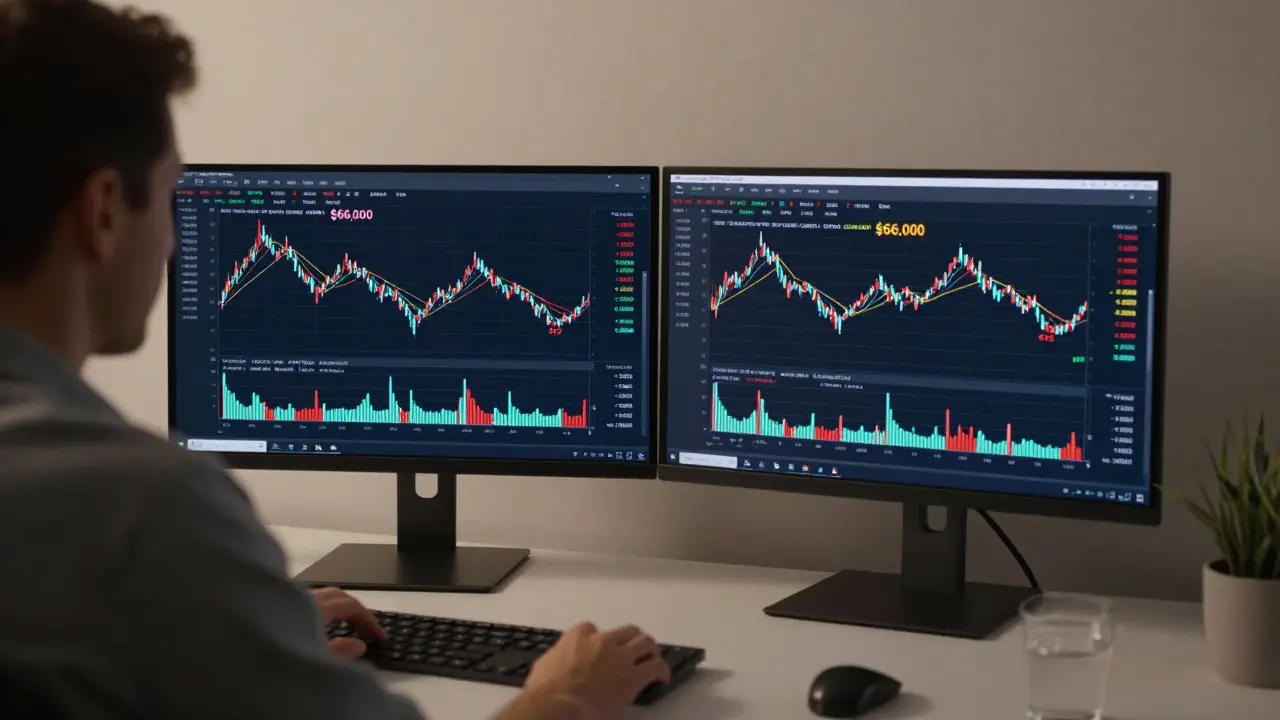
When you trade crypto, you're not just guessing which coin will go up. You're betting real money on a market that can swing 20% in a single day. That’s why risk-reward ratio and position sizing aren’t optional-they’re the difference between growing your portfolio and losing it all. Most new traders focus on finding the next big pump. But the real edge comes from knowing how much to risk on each trade and how to protect your capital when things go sideways.
What Is a Risk-Reward Ratio?
The risk-reward ratio tells you how much you stand to gain compared to how much you could lose on a single trade. It’s written as a ratio, like 1:3 or 2:1. The first number is your risk-the amount you’re willing to lose. The second number is your reward-the profit you’re aiming for.
Let’s say you buy Bitcoin at $60,000. You set a stop-loss at $57,000 (your risk) and a take-profit at $66,000 (your reward). That’s a $3,000 risk and a $6,000 reward. Your ratio is 1:2. For every dollar you risk, you’re aiming to make two back.
Why does this matter? Because crypto is noisy. You won’t win every trade. But if you stick to a 1:3 ratio and win just one out of every three trades, you still come out ahead. Here’s how:
- Trade 1: Lose $1,000
- Trade 2: Lose $1,000
- Trade 3: Win $3,000
Net result? You made $1,000. Even with a 33% win rate, you’re profitable. A 1:1 ratio? You’d need to win more than half your trades just to break even. In crypto’s wild swings, that’s nearly impossible.
How to Set a Realistic Risk-Reward Ratio
You can’t just pick any numbers. Your ratio has to match the market. If you set a $10,000 profit target on a coin that only moves $2,000 in a week, you’re setting yourself up for failure.
Start with technical levels. Look at support and resistance zones. If a coin keeps bouncing off $120 and struggles to break $150, those are natural targets. Your stop-loss should go just below support-say, $115. Your take-profit just below resistance-$145. That gives you a $5 risk and a $25 reward: a 1:5 ratio.
Use volatility to guide you. In a high-volatility market, aim for higher ratios-3:1 or 4:1. In a slow, sideways market, 1:2 might be enough. Don’t force big wins where none exist.
Also, match your ratio to your style. Day traders often use 1:2 or 1:3. Swing traders might wait for 1:5 or higher. If you’re holding for weeks, your stop-loss needs more room to breathe. A tight stop on a weekly chart? You’ll get stopped out by noise.
Position Sizing: How Much Should You Risk Per Trade?
Even the best risk-reward ratio won’t save you if you bet too much. Position sizing is about controlling how much of your total portfolio you risk on a single trade.
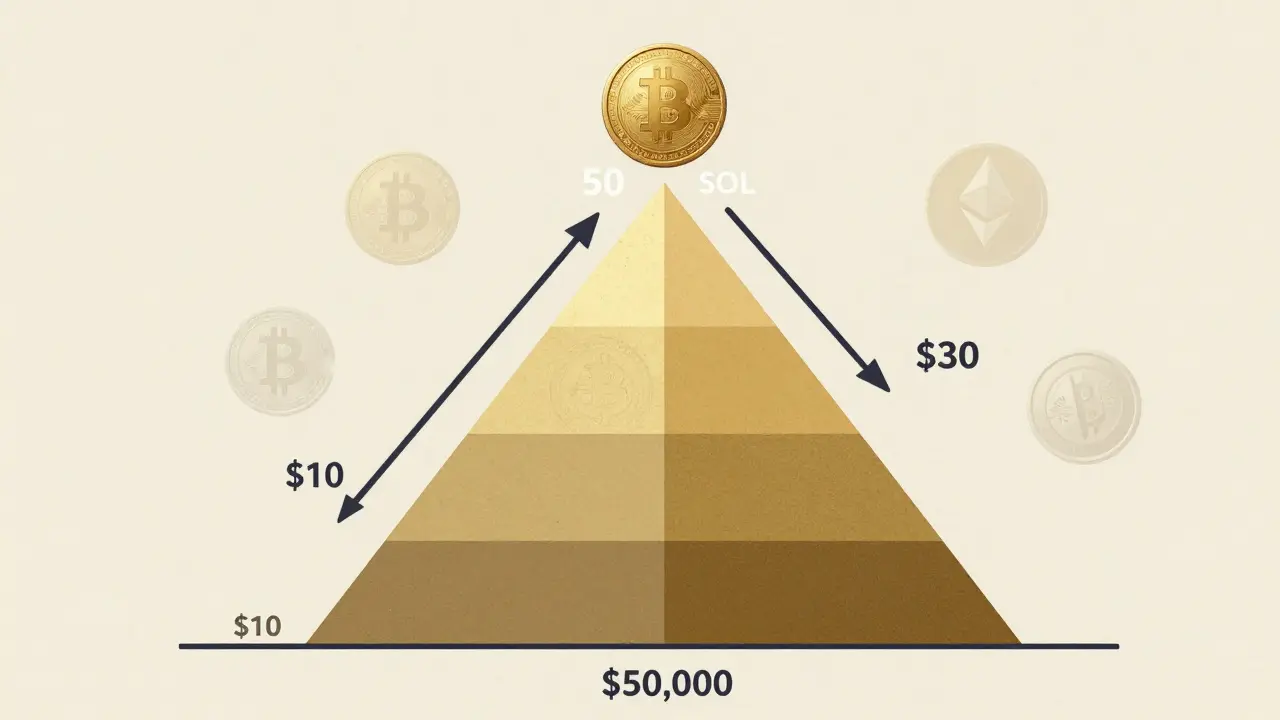
The golden rule? Never risk more than 1-2% of your total portfolio on one trade. If you have $50,000 in crypto, that’s $500 to $1,000 max per trade.
Why so little? Because losing 10 trades in a row is not rare in crypto. If you risked 10% per trade, ten losses wipes you out. At 2%, you’d still have 80% left to recover.
Here’s how to calculate it:
- Decide your max risk per trade (e.g., 1% of $50,000 = $500)
- Find your stop-loss distance (e.g., $100 below entry)
- Divide your max risk by the stop-loss distance: $500 ÷ $100 = 5 units
- Buy 5 units of the coin
Example: You want to buy Solana at $150. Your stop-loss is $140 (a $10 risk). You’re willing to lose $500 max. $500 ÷ $10 = 50 Solana. You buy 50 SOL. If it hits $140, you lose $500. If it hits $180 (a $30 gain), you make $1,500. That’s a 1:3 ratio with controlled risk.
How Crypto Fits Into a Broader Portfolio
Most people don’t trade crypto in isolation. You probably have stocks, bonds, or real estate too. Adding crypto to a traditional portfolio can actually lower overall risk-if you do it right.
Research from VanEck shows that adding just 3% Bitcoin and 3% Ethereum to a 60/40 stock-bond portfolio improved risk-adjusted returns more than any other tweak. The Sharpe ratio (a measure of return per unit of risk) nearly doubled. Even better? Maximum drawdown only rose slightly.
That’s because crypto doesn’t move the same way as stocks. When the S&P 500 drops, Bitcoin might rise-or at least not fall as hard. That diversification effect is real.
For conservative investors: Stick to 3-5% crypto. For aggressive ones: Up to 10-20% can work, as long as you’re using position sizing and stop-losses. But never go all-in. Even Bitcoin can drop 50% in six months. If crypto is 30% of your portfolio, that’s a gut-punch.
Common Mistakes and How to Avoid Them
Here’s what most traders get wrong:
- Ignoring stop-losses - “I’ll wait it out.” That’s how you turn a 10% loss into a 50% one.
- Chasing high ratios with no logic - Setting a 1:10 ratio on a coin that’s only moved $20 in a month? You’re not smart-you’re delusional.
- Over-leveraging - Using 5x or 10x leverage on a 1:2 ratio? You’re playing Russian roulette with your account.
- Not adjusting for volatility - Using the same stop-loss on Bitcoin and a low-cap altcoin? Bad idea. Altcoins swing harder.
- Position sizing by gut - “I feel good about this coin.” Feelings don’t pay bills.
The fix? Write down your plan before every trade. Entry price. Stop-loss. Take-profit. Position size. Risk percentage. If you can’t write it, don’t trade it.

Putting It All Together
Here’s a simple framework you can use today:
- Set your max risk per trade at 1-2% of your total portfolio.
- Use technical analysis to find realistic support and resistance levels.
- Calculate your stop-loss distance and target profit distance.
- Divide profit by loss to get your ratio. Aim for at least 1:2.
- Use the formula: Max risk ÷ stop-loss distance = number of units to buy.
- Set your stop-loss order. Don’t rely on manual selling.
- Review your ratios monthly. If you’re winning 60% of trades with 1:1 ratios, you’re leaving money on the table.
Crypto doesn’t reward luck. It rewards discipline. The traders who last aren’t the ones who caught the biggest moonshots. They’re the ones who lost small, won big, and never let one bad trade ruin their month.
What’s a good risk-reward ratio for crypto trading?
A minimum of 1:2 is recommended for most traders. That means for every dollar you risk, you aim to make at least two dollars. Many experienced traders aim for 1:3 or higher, especially in volatile markets. Ratios below 1:1 are risky because you need to win more than half your trades just to break even-which is hard in crypto’s unpredictable swings.
How much of my portfolio should I allocate to crypto?
For most investors, 3-5% is a safe starting point. If you have a high risk tolerance and understand the volatility, up to 10-20% can make sense-but never more. Research shows that adding 6% total crypto (3% Bitcoin, 3% Ethereum) to a traditional 60/40 portfolio improves returns without significantly increasing risk. Going beyond 20% increases drawdowns faster than returns.
Should I use stop-loss orders in crypto?
Yes, absolutely. Crypto markets can gap down 20% overnight due to news, regulatory changes, or liquidity crunches. Manual selling doesn’t work in these situations. A stop-loss order automatically closes your position at a set price, locking in your risk. It’s not about being scared-it’s about being smart.
Can I use the same position size for Bitcoin and a small altcoin?
No. Bitcoin is more stable. Altcoins can swing 30-50% in a day. If you use the same stop-loss distance on both, you’re risking way more on the altcoin. Adjust your position size based on volatility. A tighter stop on a low-cap coin means buying fewer units to keep your risk the same.
Is a 1:1 risk-reward ratio ever acceptable?
Only if you have a very high win rate-70% or more. In crypto, win rates above 60% are rare. A 1:1 ratio forces you to be right more often than the market allows. It’s better to wait for higher-reward setups. If you’re forced into a 1:1 trade, reduce your position size to cut your risk in half.
Next Steps
Start small. Pick one trade this week. Write down your entry, stop-loss, and target. Calculate the ratio. Size your position using the 1-2% rule. Set the stop-loss order. Then watch what happens. You’ll learn more in one trade with this system than in ten trades without it.
Track your results. After 10 trades, look at your win rate and average ratio. If you’re winning 40% of trades with a 1:2.5 ratio, you’re doing better than 90% of traders. Keep going. Discipline compounds.
14 Responses
Love this breakdown. Simple, clean, and actually useful. I’ve been using the 1-2% rule for months now and it’s saved me from a few total wipeouts. Stop-losses aren’t optional-they’re your seatbelt.
I really appreciate how you framed this-not as some get-rich-quick scheme, but as a disciplined framework. Too many people treat crypto like a slot machine, but the math here is undeniable. I’ve been backtesting ratios on my past 50 trades, and guess what? The ones with 1:3+ ratios and proper position sizing made up 87% of my total profit. The rest? Just noise. Also, I’d add that volatility-adjusted stops are critical. A 5% stop on Bitcoin is fine, but on a meme coin? You need 15-20%. Otherwise, you’re just giving your money to the market makers. And yes, writing it down before every trade? Non-negotiable. I keep a Notion doc. It’s boring, but it works.
Ugh. Another ‘math is king’ post. Newsflash: crypto doesn’t care about your ratios. It’s all about who’s pumping, who’s dumping, and who’s got the inside scoop. I saw a guy lose $200k last week because he was ‘following his 1:3 ratio.’ Meanwhile, I bought a coin at $0.002 and sold at $0.05 in 48 hours. No stop-loss. No spreadsheet. Just vibes. You’re overcomplicating it.
Only Americans write guides like this. In China, we just HODL. In Russia, we use leverage. In India, we trade on Telegram. You think your 1:2 ratio matters? Crypto’s global. Your ‘discipline’ is just cultural bias wrapped in Excel.
Actually, this is solid. I’ve been trading since 2017 and I still use this exact system. One thing I’d add: always factor in gas fees. If you’re trading small altcoins on Ethereum, a $50 risk might cost you $15 in fees. That changes your ratio. I use Solana and Polygon for low-cost trades. Also, don’t forget to log your emotional state. If you’re FOMOing, don’t trade. Even with perfect ratios, emotion kills.
Wow. A crypto post that doesn’t say ‘moon’ once. Refreshing. I’m skeptical of ‘rules’ but… this actually makes sense. I tried the 1% rule last month. Lost 3 trades in a row. Then hit one 1:4. Made back all losses + 20%. Funny how math works. Still think position sizing is the most underrated thing in trading. Everyone wants to be Warren Buffett. No one wants to be the guy who loses $500 and lives to trade another day.
This is one of the clearest explanations I’ve read on risk management in crypto. As someone from South Africa, where inflation is rampant and savings are eroded daily, the concept of preserving capital is not theoretical-it’s survival. I’ve seen friends lose everything because they ignored position sizing. This guide is not just advice; it’s a lifeline. Thank you for writing this with clarity and humility.
Oh wow. You wrote an entire essay on how to not lose money. How… quaint. I mean, I respect the effort, really. But let’s be honest-you’re just trying to justify not going all-in on PEPE. Meanwhile, I made 17x on a coin that didn’t even have a whitepaper. Your ‘1:3 ratio’ is just fear in spreadsheet form. Real traders don’t calculate-they *feel*.
ratios are for losers. if you need a spreadsheet to trade you should be flipping burgers. i bought shiba on a tweet and sold for 100x. no stop loss. no math. just vibes. also btc is a ponzi. gold is the real money. and the fed is printing to steal your wealth. also why are you even reading this you're probably a banker.
This helped me a lot. I used to risk 10% per trade. Lost twice. Now I do 1%. Got back to even in 3 weeks. Simple. No drama. Just stick to it. You don’t need to be smart. Just consistent.
So you’re telling me I need to *plan* my trades? Like, with *numbers*? And *not* just scream ‘LFG’ into the void? How… 2018 of you.
There’s an epistemological tension here, isn’t there? The post presumes markets are predictable through quantitative frameworks-yet crypto’s essence is non-linear, emergent, and driven by collective irrationality. A 1:3 ratio assumes linearity where none exists. The true edge isn’t in the ratio-it’s in recognizing that the ratio itself is a social construct, a narrative we tell ourselves to avoid the existential void of uncertainty. Still… I use 1:2.5. Because even philosophers need to eat.
if you're not leveraged 5x you're not serious. 1% risk? that's what your aunt uses for her retirement fund. you think bitcoin's gonna go to 100k with baby steps? no. it's gonna gap up and you better be all in or you're already behind. also stop-losses are for weaklings. real traders hold through hell.
Yeah but what if the whole system’s rigged? What if the ‘technical levels’ you’re using are just manipulated by whales? What if your ‘1:3 ratio’ is just feeding into their pump-and-dump cycle? I’m not saying don’t trade. I’m saying maybe the game’s designed so you lose slowly while they call it ‘discipline’.