

There is a specific moment in every trader’s life when the screen stops looking like data and starts looking like an enemy. You take a loss. Maybe it was small. Maybe it was huge. But instead of closing the chart, you feel a surge of heat in your chest. Your fingers twitch toward the mouse. You want to get that money back right now. This is not just bad luck; this is trading tilt, defined as an emotionally dysregulated state triggered by losses that leads to impulsive decision-making and account damage. If you ignore it, the pattern follows a predictable path: Loss → Panic → Revenge → Ruin. The good news? You can rewire this response. By replacing panic with protocol, you can shift that sequence to Loss → Protocol → Reset → Patience.
The Anatomy of Tilt: Why Willpower Fails
Most traders believe tilt is a failure of discipline. They think if they just "toughen up," they will stop making emotional mistakes. Neuroscience suggests otherwise. Tilt is not a character flaw; it is a biological hijack. When you lose money, your brain perceives a threat, triggering the amygdala-the fear center-to override the prefrontal cortex, which handles logic and planning. In this state, your subconscious patterns take over. These patterns are not fixed, but they are powerful. Top traders do not rely on willpower to fight them; they reprogram their subconscious through automatic execution protocols.
Tilt manifests differently depending on your trading style. For swing traders, who operate on daily timeframes and hold positions for hours or days, tilt often looks like rapid-fire revenge trading. They might see a price reverse near a target, enter a new position immediately, and then watch it reverse again. The cycle repeats within minutes. For position traders, who hold assets for weeks or months, tilt is slower but more insidious. It shows up as obsessive chart-checking, building narratives to justify a losing trade, or refusing to exit until the pain becomes unbearable. Both styles suffer from the same root cause: the inability to detach emotion from execution.
The 10-Minute Reset Protocol for Swing Traders
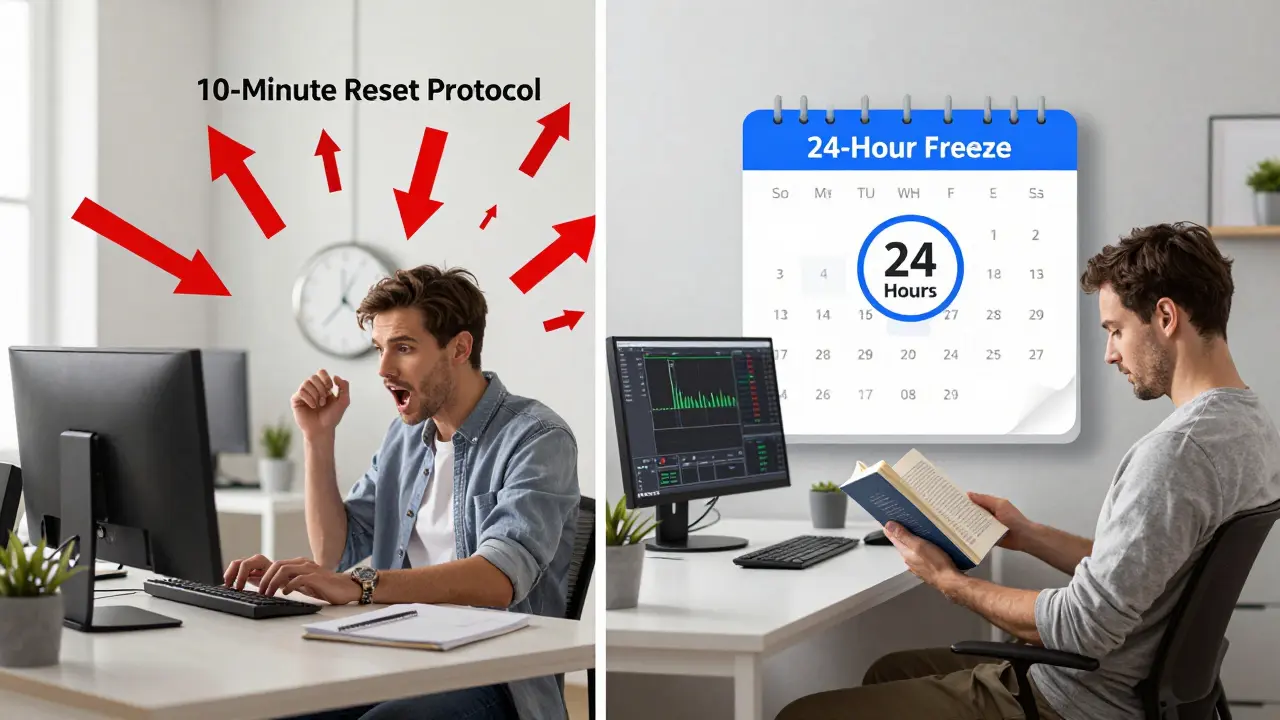
If you are a swing trader taking multiple positions per week, speed is your enemy during a loss. Emotional hijacks cascade quickly. To stop them, you need the 10-Minute Reset Protocol. This method is designed to interrupt the physical stress response before it turns into a bad trade.
- Trigger the Timer: The moment a trade closes at a loss, set a 10-minute timer. No exceptions.
- Digital Detox: Close all charts immediately. Put your phone on airplane mode. You cannot see the market while you reset.
- Physical Release: Engage in high-intensity physical activity. Do 30 punches in the air, 20 squats, or take a brisk walk around the block. You must complete the activity fully. This burns off the adrenaline spike caused by the loss.
- Cognitive Reframe: Sit somewhere comfortable. Close your eyes. Shift your focus from "What did I lose?" to "What is the next A+ setup?" Return to analytical thinking.
- Return with Restraint: When the timer goes off, open your charts. Commit to trading only A+ setups. Zero revenge trades allowed.
This protocol works because it forces a physiological break. After 5-15 repetitions, your body begins to crave the physical release component. The protocol becomes automatic, bypassing the need for conscious effort.
The 24-Hour Freeze for Position Traders
Position traders face a different challenge. Because their trades span weeks, the emotional investment is deeper. A loss feels like a personal failure rather than a statistical variance. For these traders, the 10-minute reset is insufficient. You need the 24-Hour Reset Protocol.
This protocol implements a non-negotiable trading freeze triggered the moment a position closes for a loss or you make an emotional exit. Here is how to execute it effectively:
- Close the Platform: Shut down your trading software completely. No "just checking" the price. That loophole destroys the protocol.
- Remove Visual Cues: Move trading apps off your phone’s home screen. Place them in folders on secondary pages. Out of sight, out of mind.
- Set Accountability: Inform a trading buddy, spouse, or accountability partner that you are in a freeze status. Social pressure helps enforce the rule.
- Write the Post-Mortem: Within two hours, complete a structured written analysis of the loss. Why did it happen? Was it a setup error or a market anomaly?
- Disconnect Fully: Spend the evening doing something immersive-gym, reading, or strategic learning. REM sleep is critical here. It processes emotional memory and consolidates lessons, allowing you to wake up with improved perspective.
On the morning after the 24-hour period, scan your watchlist only. Do not search for opportunities. Wait exclusively for A+ setups. Most traders find that after 3-5 uses, the 24-hour rule becomes a natural reflex.
Capital Preservation: The Reduced Size Protocol
Sometimes, even with a mental reset, your confidence is shaken. If you have suffered losses exceeding 2R (two times your typical risk unit), you need structural protection. The Reduced Size Protocol mandates reducing your normal position size. If you usually risk 4% per trade, drop it to 2% for the next three trades.
You only return to normal sizing if those three reduced-size trades are profitable. If they are not, you stay at the lower risk level. This prevents catastrophic account damage while you rebuild confidence. Before entering any new position following a significant loss, apply the Clarity Test: "If I had zero P&L this month, would I still take this trade?" If the answer is no, you are still tilted. Walk away.
| Feature | 10-Minute Reset | 24-Hour Freeze |
|---|---|---|
| Target Audience | Swing Traders | Position Traders |
| Duration | 10 Minutes | 24 Hours |
| Primary Action | Physical Exercise (Squats/Punches) | Total Digital Disconnection |
| Recovery Mechanism | Adrenaline Burn-off | REM Sleep & Cognitive Processing |
| Adoption Timeline | 5-15 Repetitions | 3-5 Applications |
Prevention: Daily Discipline Frameworks
Reset protocols are reactive; prevention is proactive. Professional traders establish daily routines that minimize the chance of tilt occurring in the first place. Start with pre-market preparation. Thirty minutes before trading, review the economic calendar for volatility risks. Set a maximum daily loss limit-for example, 3% of your account. Clear your workspace of distractions.
During the session, stick to A+ setups only. If you experience two losses in a row, reduce your position size by 50%. Never scroll social media while active orders are open. Post-session, journal every trade. Rate your emotions on a scale of 1-10. Track your proprietary Tilt Score, which combines VIX spikes, put/call ratios, and retail order flow. A score above 80 indicates market panic (potential buy opportunities), while below 20 suggests complacency (prepare for pullbacks). Understanding market-wide emotion helps you contextualize your own feelings.

Advanced Measures for Serial Tilters
If you find yourself tilting repeatedly despite these protocols, you may need extreme measures. Consider disabling market orders in your broker settings, allowing only limit orders. This adds friction to impulsive entries. Set broker-enforced daily loss limits that automatically shut down your platform at a specific threshold, such as -3%. Restrict your trading days to Monday, Wednesday, and Friday only. Less exposure means fewer opportunities for emotional decay.
You can also use the Tilt Blacklist strategy. Verbally state, "I'm about to make a bad decision." Then, open a written list containing prohibited behaviors: "No revenge trades," "No FOMO above VWAP," "No size increases after losses." Read it aloud. Close all charts. Do 10 pushups. This verbal and physical interruption breaks the trance of tilt.
Journal-Based Recovery and Voluntary Protocols
Amateur traders wait until their account is damaged before seeking help. Professional traders implement voluntary recovery protocols preventatively. Use a five-step journal framework post-loss. Watch your feelings without judging them. Recognize the urge to revenge trade. Choose the protocol. Execute the reset. Record the outcome. Over time, this systematic tracking creates awareness. You begin to recognize the early signs of tilt-the tightness in the shoulders, the racing heart-before they escalate into bad decisions. Identification is the first step to blocking the mechanism.
What is the difference between swing trader tilt and position trader tilt?
Swing trader tilt is fast and impulsive, often leading to immediate revenge trades within minutes of a loss due to high-frequency decision-making. Position trader tilt is slower, manifesting as obsessive monitoring, narrative-building to justify losses, and prolonged hesitation to exit, lasting days or weeks.
How long does it take for reset protocols to become automatic?
For swing traders using the 10-Minute Reset, it typically takes 5-15 repetitions for the physical release to become a craving. For position traders using the 24-Hour Freeze, it usually takes 3-5 applications for the behavior to become a natural reflex.
What is the Clarity Test in trading?
The Clarity Test is a self-assessment question asked before entering a new trade after a loss: "If I had zero P&L this month, would I still take this trade?" If the answer is no, the trader is likely still emotionally tilted and should not trade.
Why is physical exercise important in the 10-Minute Reset Protocol?
Physical exercise like squats or punching burns off the adrenaline and cortisol spike caused by the stress of a loss. This physiological reset interrupts the emotional cascade, allowing the prefrontal cortex (logic) to regain control over the amygdala (fear).
What are some extreme measures for traders who struggle with chronic tilt?
Extreme measures include disabling market orders (using only limit orders), setting broker-enforced daily loss limits that auto-shutdown the platform, restricting trading to specific days (e.g., Mon/Wed/Fri), and using a verbal Tilt Blacklist to interrupt impulsive thoughts.
14 Responses
Love this approach to trading psychology. The physical reset idea is brilliant because it addresses the biological response rather than just trying to think your way out of a panic state.
The distinction between swing and position trader tilt is spot on. I've definitely fallen into the obsessive chart-checking trap when holding longer positions, and it's exhausting.
This is weak sauce for amateurs who can't handle the real markets. Real traders don't need squats; they need skin in the game and absolute dominance over their emotional variance. The market doesn't care about your feelings or your little reset protocols. You either execute with precision and kill the competition or you get liquidated. Stop coddling yourself with these baby steps and start treating every trade like a life-or-death mission for your capital. Weakness is not tolerated in high-frequency environments.
One must acknowledge that the suggestion of 'physical release' through such pedestrian activities as air punching is somewhat quaint, if not entirely laughable, in the context of sophisticated quantitative analysis. While the neuroscientific basis regarding the amygdala's hijacking of the prefrontal cortex is undeniably accurate, the proposed solution reeks of amateurish self-help platitudes rather than rigorous institutional discipline. A truly discerning practitioner would implement algorithmic safeguards that remove human agency from the equation entirely, thereby eliminating the possibility of such vulgar emotional interference. Relying on one's ability to perform squats after a loss is akin to relying on luck; it is structurally unsound and intellectually bankrupt. The elite do not 'reset'; they simply do not engage in trades that induce such primitive stress responses in the first place.
They want you to feel guilty so you buy their course next. The whole concept of 'tilt' is manufactured by brokers to keep you engaged and losing. If you are tilting, it is because the market is rigged against you by central banks and insider algorithms that you cannot see. Do not trust your eyes, do not trust the charts, and certainly do not trust a timer. The only safe move is to stay away until the system collapses under its own weight.
you people are missing the point completely the reduced size protocol is the only thing that actually matters here because if you blow up your account there is no reset possible. most retail traders fail because they ego trade and refuse to cut risk even when the setup is mediocre. i have seen too many smart guys lose everything because they thought they were right instead of following the math. stop listening to gurus who sell dreams and start respecting the volatility of the market. your brain is lying to you every single day so you need hard rules not soft suggestions. if you cannot follow a simple rule to reduce size then you are not a trader you are a gambler and you deserve to lose.
I really appreciate the practical steps here, especially the accountability partner part. It’s so easy to isolate yourself when you’re losing, but having someone to check in with makes a huge difference in staying grounded.
Oh sure, let's all just go do pushups like we're in a boot camp instead of analyzing the macro trends. Because nothing says 'professional trader' like sweating through your shirt after a bad tick. But hey, if it works for you, knock yourself out. Just don't come crying to me when the algorithm eats your lunch while you're busy doing squats.
hey man this is pretty solid advice honestly. i tend to forget to step away after a loss and just keep staring at the screen hoping it comes back. the 10 minute rule sounds like something i could actually stick to without feeling crazy. thanks for sharing this stuff it helps a lot.
The jargon around 'amygdala hijack' is technically correct but practically useless if you don't have a concrete plan. This post provides exactly that. The Clarity Test is a game-changer for avoiding FOMO entries.
It is frankly amusing how many people treat trading like a spiritual journey rather than a statistical exercise. Your 'tilt' is merely a lack of proper risk management and an inability to accept variance. Suggesting that one should 'burn off adrenaline' implies that the problem is physiological rather than intellectual. If you are emotionally compromised, you are not fit to trade period. The solution is not a timer; it is education and rigorous backtesting until your strategy is robust enough that losses do not trigger such primitive responses. Until then, stay out of the market and study.
You all sound so naive. I lost my entire savings last month and now I'm broke and depressed and you're talking about squats? This article is insulting to anyone who has actually felt the pain of ruin. There is no protocol for grief. There is no reset for poverty. You are lucky you can afford to talk about 'A+ setups' while the rest of us are eating ramen. Get real.
I find that the aspect of REM sleep mentioned in the twenty-four-hour freeze protocol is particularly insightful, as it underscores the importance of allowing the subconscious mind to process the emotional data associated with financial loss without the interference of immediate gratification seeking behaviors, which often leads to a more profound understanding of the underlying causes of the trade failure and subsequently fosters a more resilient psychological framework for future engagements with the market, thereby reducing the likelihood of repetitive errors stemming from unaddressed emotional triggers.
What a delightful tapestry of wisdom woven here, truly illuminating the dark corridors of our collective psyche when faced with the crimson glow of a losing trade. One might ponder whether the act of physical exertion serves not merely as a biological reset but as a ritualistic cleansing of the soul, shedding the heavy cloak of regret like a snake molting its skin, thus emerging renewed and ready to dance with the volatile spirits of the market once more, armed with the clarity that only comes from stepping away from the chaotic theater of numbers and reconnecting with the quiet rhythm of one's own breath.