

Imagine spending billions of dollars building a satellite constellation, only to find out you have no legal right to use the airwaves. It sounds like a nightmare, but it happens. Without proper spectrum coordination, your signal is just noise in someone else’s channel. The International Telecommunication Union (ITU) is the global referee for this game. They don’t just hand out licenses; they manage a complex system of international treaties and technical filings that determine who gets to talk to whom from space.
If you are planning a satellite mission, understanding this process isn't optional-it's survival. This guide breaks down how to navigate the ITU filing procedures, avoid costly interference disputes, and secure your place in the Master International Frequency Register (MIFR).
Key Takeaways
- National administrations, not private companies, file with the International Telecommunication Union (ITU).
- The process typically takes 7-9 years for geostationary satellites, starting with an Advance Publication Information (API) notice.
- You must bring your network into use within 7 years of notification or lose your priority rights.
- Coordination requests trigger bilateral negotiations to prevent harmful interference between networks.
- Non-mandatory coordination applies to many non-geostationary (NGSO) systems, but proactive coordination is still critical.
Who Actually Files with the ITU?
Here is the first big surprise for most engineers and executives: you cannot file directly with the ITU. Private operators, whether you are a massive broadband provider or a university CubeSat team, do not deal with the ITU as individuals. Instead, you work through your national administration.
In the United States, that’s the Federal Communications Commission (FCC). In the UK, it’s Ofcom. In France, it’s ANFR. These bodies act as the legal "administrations" recognized by the ITU Constitution. When you want to launch a satellite, you apply for a national license first. But that license only protects you domestically. To get international protection against interference from other countries, your national administration files on your behalf with the ITU Radiocommunication Bureau (BR).
This two-step process means you need strong relationships with both your local regulator and their international counterparts. If your national administration doesn't prioritize your filing, your timeline slips. And in the world of satellite spectrum, time is literally money-or rather, orbital slots.
The Three Stages of ITU Filing
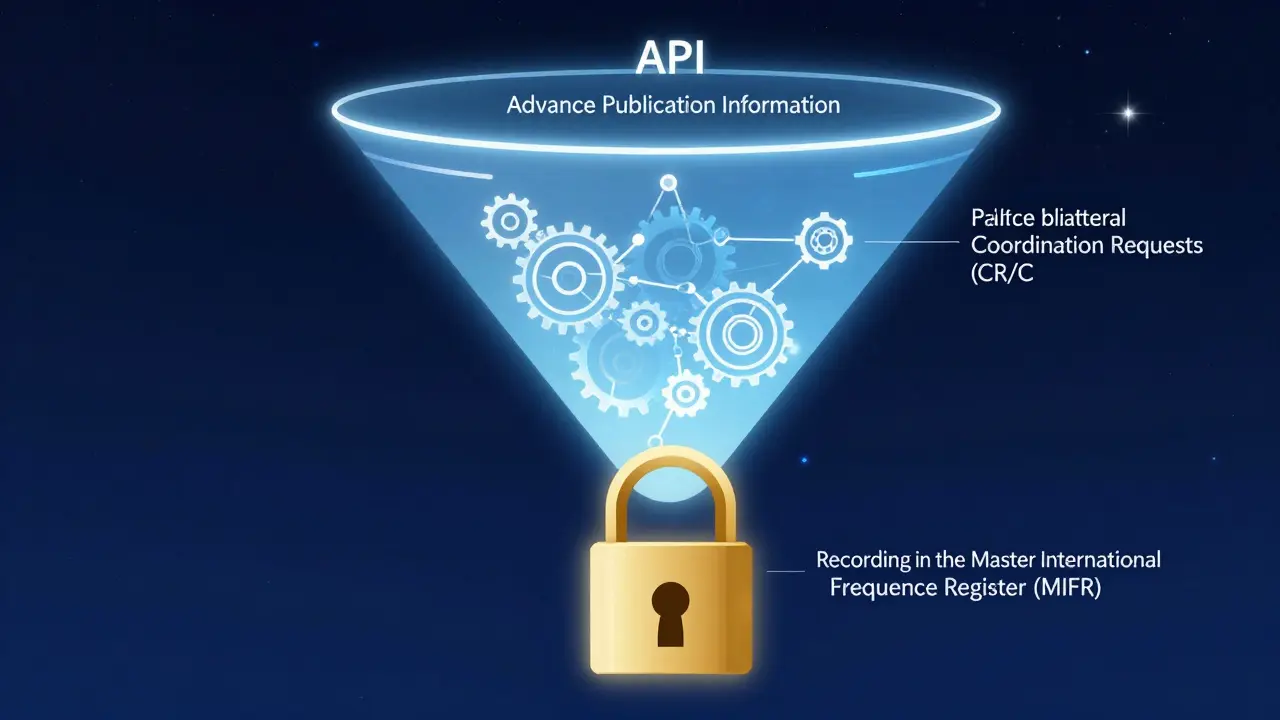
The ITU process is structured like a funnel. You start broad, then narrow down to specific technical details, and finally lock in your rights. There are three formal stages:
- Advance Publication Information (API): This is your early warning shot. It tells the world you plan to use certain frequencies and orbits. It’s not a binding commitment yet, but it reserves your spot in line.
- Coordination Request (CR/C) or Notification: Here, you submit detailed technical data. The ITU identifies which other networks might be affected by yours. You then enter into bilateral negotiations with those "coordination counterparties" to ensure your signals won’t interfere with theirs.
- Recording in the MIFR: Once coordination is complete and conditions are met, your assignment is entered into the Master International Frequency Register. This gives you international legal protection under the Radio Regulations.
For geostationary (GSO) satellites in fixed-satellite service (FSS) or broadcasting-satellite service (BSS), this entire cycle can take 7-9 years. Yes, nearly a decade. For non-geostationary (NGSO) constellations, like LEO broadband networks, the process can be slightly faster due to non-mandatory coordination rules, but it remains lengthy and complex.
Mandatory vs. Non-Mandatory Coordination
Not all satellite services face the same hurdles. The ITU Radio Regulations distinguish between mandatory and non-mandatory coordination based on the orbit type and frequency band.
| Orbit Type | Service Example | Coordination Status | Typical Timeline |
|---|---|---|---|
| Geostationary (GSO) | Broadcasting (BSS) | Mandatory | 7-9 years |
| Geostationary (GSO) | Fixed Service (FSS) | Mandatory | 7-9 years |
| Non-GSO (LEO/MEO) | Broadband Constellations | Often Non-Mandatory* | 3-5 years** |
| Any | Amateur/CubeSats | National + ITU Notification | Varies widely |
*Non-mandatory means the ITU does not require bilateral agreements before recording, but voluntary coordination is still highly recommended to avoid operational conflicts.
**Timelines vary significantly based on complexity and administrative efficiency.
Even if coordination is technically "non-mandatory," skipping it is risky. As the number of mega-constellations grows, the sky is getting crowded. Voluntary coordination helps you negotiate power limits and separation angles that keep your network running smoothly without constant interference complaints.
The "First Come, First Served" Myth
Many people think the ITU system is strictly "first come, first served." That’s partially true, but it’s more accurate to say "first filed, first protected-provided you actually build it."
Once your API is published, you have a window to move forward. However, there is a strict due diligence rule: you must bring your network into use within 7 years of your initial coordination or notification. If you miss this deadline, the ITU will suppress your filing. Your slot goes back into the pool, and someone else can grab it.
This rule prevents "warehousing," where companies file for huge chunks of spectrum just to hold them for future sale or leverage. While some administrations still submit broad "umbrella" filings to preserve flexibility, the pressure to demonstrate actual deployment has increased. The ITU cannot reject a filing simply because it covers a large frequency range, as long as it complies with the Radio Regulations. But they will cancel it if you don’t show proof of operation.
Technical Data: The Heart of the Filing
Your filing isn’t just paperwork; it’s a technical blueprint. You’ll use tools like SpaceCap to submit precise data, including:
- Center frequencies and bandwidths
- Polarization types (linear, circular)
- Antenna gain patterns and beam shapes
- Power flux density (PFD) levels
- Orbital ephemerides (for NGSO) or longitude (for GSO)
The ITU BR uses this data to run compatibility analyses. They look for geometric and spectral overlaps with existing networks. If your proposed beam points at the same location as an incumbent broadcaster using similar frequencies, you’ve got a problem. You’ll need to adjust your parameters-maybe lower your power, shift your frequency, or tilt your antenna-to meet the interference thresholds defined in ITU-R Recommendations.
Getting these numbers wrong early on can derail your project. That’s why pre-ITU technical analysis is so important. Model your link budgets and interference scenarios thoroughly before you ever hit "submit."
Challenges for Small Satellites and CubeSats
The current ITU framework was designed in an era of large, expensive geostationary satellites with decades-long lifespans. Today, we’re launching thousands of small satellites with missions lasting only 1-3 years. The mismatch is glaring.
A 2016 study by Utah State University highlighted that small satellite teams often lack awareness of ITU procedures. They assume a national license is enough. It’s not. For global operations, you need ITU recognition. But the standard 7-year timeline makes no sense for a CubeSat that might be obsolete in two years.
University teams and startups face steep learning curves. They often delay launches or change frequencies late in development because they started the filing process too late. My advice? Start spectrum planning during the satellite bus design phase. Don’t wait until the hardware is built. Engage regulatory consultants early, even if it feels expensive. The cost of a consultant is tiny compared to the cost of a delayed launch or a grounded mission.
Proactive Strategies for Success
So, how do you win in this slow-moving system? Here are practical steps:
- Start Early: Begin frequency selection 4-5 years before launch for major missions. For smaller projects, aim for at least 2-3 years.
- Monitor Competitors: Subscribe to the BR IFIC (International Frequency Information Circular). It publishes new filings weekly. Know who your potential counterparties are before they contact you.
- Pre-Coordinate: Reach out to key administrations and operators informally before submitting formal requests. Building goodwill can speed up negotiations.
- Hire Experts: Spectrum law is a niche field. Consider hiring specialized regulatory attorneys or firms experienced in ITU filings. They know the pitfalls and can draft robust CR/C documents.
- Integrate Regulatory Planning: Make spectrum management part of your core engineering team, not an afterthought for compliance.
The satellite industry is evolving rapidly. With WRC-23 and future conferences refining the rules, the landscape will continue to shift. But one thing remains constant: the ITU process is unavoidable. Treat it with respect, plan meticulously, and protect your spectrum rights from day one.
Can I file for spectrum directly with the ITU as a company?
No. Only national administrations (like the FCC in the US or Ofcom in the UK) can file with the ITU. Private operators must work through their country's designated regulatory body.
How long does the ITU filing process take?
For geostationary satellites, it typically takes 7-9 years from the initial Advance Publication Information (API) to final recording in the MIFR. Non-geostationary systems may be faster but still require several years.
What happens if I don't launch my satellite within the required timeframe?
You must bring your network into use within 7 years of notification. If you fail to do so, the ITU will suppress your filing, and your spectrum rights will be lost.
Is coordination mandatory for all satellite types?
No. Coordination is mandatory for geostationary satellites in FSS and BSS bands. Many non-geostationary (LEO) systems fall under non-mandatory coordination, but voluntary coordination is still strongly advised to avoid interference.
What is the MIFR?
The Master International Frequency Register (MIFR) is the official database maintained by the ITU. Recording your assignment here grants you international legal protection against harmful interference from other countries' networks.
Do I need a national license if I have ITU recognition?
Yes. ITU recognition provides international protection, but you still need a domestic license from your national regulator to operate legally within your own country. Both are required for full compliance.
How can small satellite operators speed up the process?
There is no fast track, but starting early, hiring experts, and performing thorough pre-coordination can minimize delays. Some administrations offer streamlined processes for small satellites, so check with your local regulator.