

Imagine stepping outside your car into a vacuum where the air is instantly sucked out of your lungs. That is the reality for an astronaut during a spacewalk, or Extravehicular Activity (EVA). Without a suit, survival lasts only seconds. The Portable Life Support System (PLSS) is the backpack-sized miracle that keeps them alive. It isn't just a tank of air; it is a complex chemical plant on their back, constantly recycling breath to keep oxygen levels high and deadly carbon dioxide low.
We often think of spacesuits as static shells, but they are dynamic environments. The core job of the PLSS is simple in theory but brutal in execution: deliver breathable oxygen and remove waste gas. If this balance fails, the consequences are immediate and fatal. Understanding how these systems work reveals the engineering tightrope walked between mass, power, and human physiology.
The Core Challenge: Managing a Closed Loop
In a typical EVA, an astronaut might spend 6 to 8 hours working, plus a safety buffer of 30 to 60 minutes. During this time, the suit acts as a sealed chamber. You breathe in oxygen, your body uses it, and you exhale carbon dioxide (CO₂), water vapor, and heat. In a room, open windows dilute this waste. In a suit, there are no windows. The PLSS must capture every molecule of exhaled CO₂ before it builds up to toxic levels.
Human metabolism produces roughly 0.8 to 1.2 kg of CO₂ per day at moderate activity. In the confined volume of a spacesuit-only a few hundred liters compared to the hundreds of cubic meters on the International Space Station (ISS)-this gas accumulates rapidly. Even small increases in inspired CO₂ partial pressure, just a few millimeters of mercury above normal, can cause headaches, confusion, and cognitive decline. Long-term exposure leads to hypercapnia, a condition that can be lethal. Therefore, the CO₂ removal subsystem is not optional; it is as critical as the oxygen supply itself.
Oxygen Supply: From Tanks to Regulators
Where does the oxygen come from? On large platforms like the ISS, oxygen is generated by splitting water molecules using electricity (electrolysis). However, a backpack cannot house massive electrolyzers. Instead, PLSS relies on stored oxygen. Historically, and currently, this means high-pressure tanks holding pure oxygen at pressures ranging from tens to hundreds of bar.
This oxygen doesn't flow freely into the suit. A regulator carefully meters it to maintain a specific suit pressure, typically around 4 to 5 psi (approximately 28-34 kPa). This is significantly lower than Earth's sea-level pressure. Why so low? High pressure would make the suit rigid and hard to move in. By keeping the pressure low but the oxygen fraction high (near 100%), the suit remains flexible while still providing enough oxygen to saturate the astronaut's blood. This delicate balance ensures arterial oxygenation remains adequate without crushing the wearer.
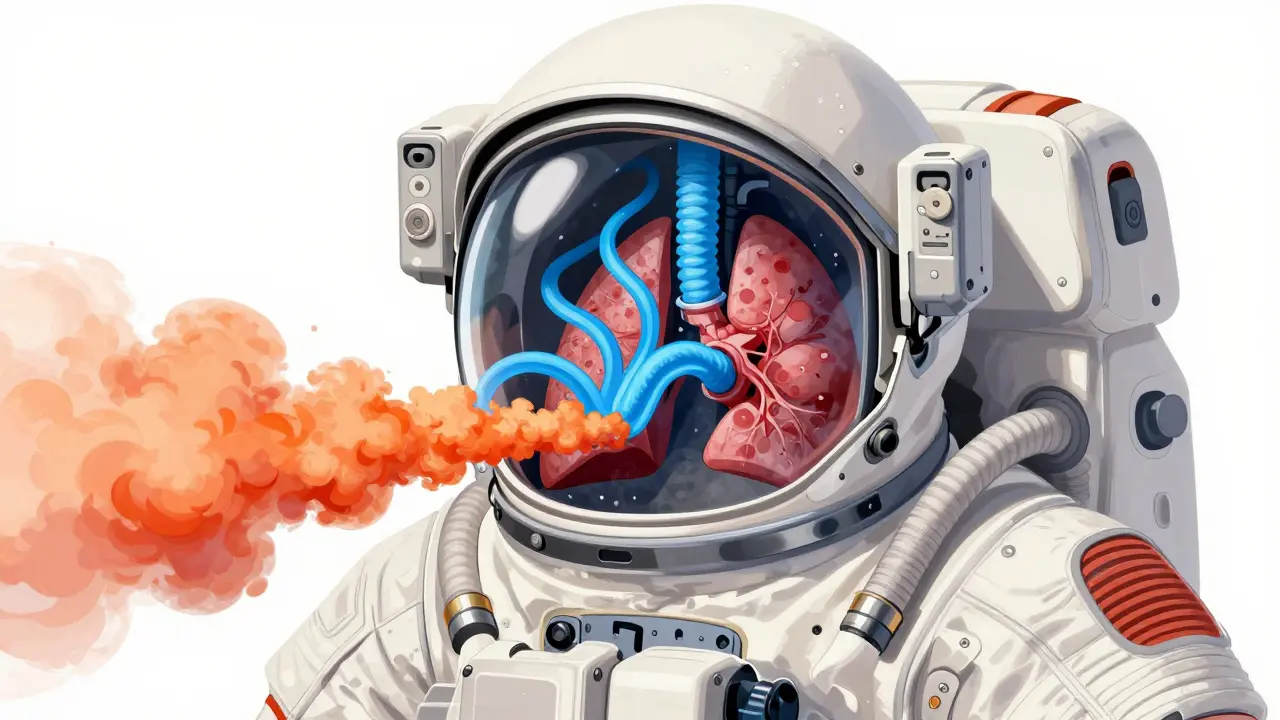
Carbon Dioxide Removal: The Lithium Hydroxide Era
For decades, the standard method for removing CO₂ was chemical absorption using Lithium Hydroxide (LiOH). You likely know LiOH as a white powder or pellet found in replaceable cartridges. When an astronaut exhales, the air passes through these cartridges. The LiOH reacts chemically with the CO₂ and moisture in the breath to form lithium carbonate and water. This reaction effectively locks the CO₂ away, preventing it from being re-inhaled.
This technology dates back to the Apollo missions in the late 1960s. It is reliable, proven, and simple. Companies like Sierra Space still use modernized versions of LiOH cartridges for current commercial missions. However, LiOH has a major flaw: it is consumable. Once the lithium hydroxide turns into lithium carbonate, it is dead weight. It cannot be regenerated in space. For a short 6-hour moonwalk, this is manageable. But for long-duration missions to Mars, carrying enough LiOH for dozens of EVAs adds prohibitive mass to the launch vehicle.
| Technology | Regenerable? | Complexity | Best Use Case |
|---|---|---|---|
| Lithium Hydroxide (LiOH) | No (Consumable) | Low | Short-term EVAs, Near-Earth missions |
| Solid Amines / Zeolites | Yes | Medium | Long-duration exploration, Repeated EVAs |
| Cryogenic Capture | Yes | High | Future deep-space systems |
The Shift to Regenerative Systems
To solve the mass problem of consumables, engineers are moving toward regenerable sorbents. Materials like zeolites, metal oxides, and solid amines can trap CO₂ and then release it when heated or depressurized. Imagine a sponge that soaks up water and then squeezes dry when warmed. These materials allow the same cartridge to be used over and over again.
A promising development is the use of Dual-Function Materials (DFMs), such as Na₂O/Ru/Al₂O₃. Recent research in 2024 showed that these materials can capture CO₂ from wet air as effectively as traditional ISS-grade zeolites, which usually require the air to be dried first. This is a game-changer for PLSS. Traditional systems need extra fans and beds to dry the air before scrubbing, adding weight and power drain. DFMs could eliminate the drying stage entirely, simplifying the backpack design significantly.
These regenerable systems often use a dual-bed setup. While one bed scrubs CO₂ from the astronaut's breath, the other bed heats up to release its trapped CO₂ into the vacuum of space. Then they switch roles. This continuous cycle allows for longer mission durations without needing to swap heavy cartridges.
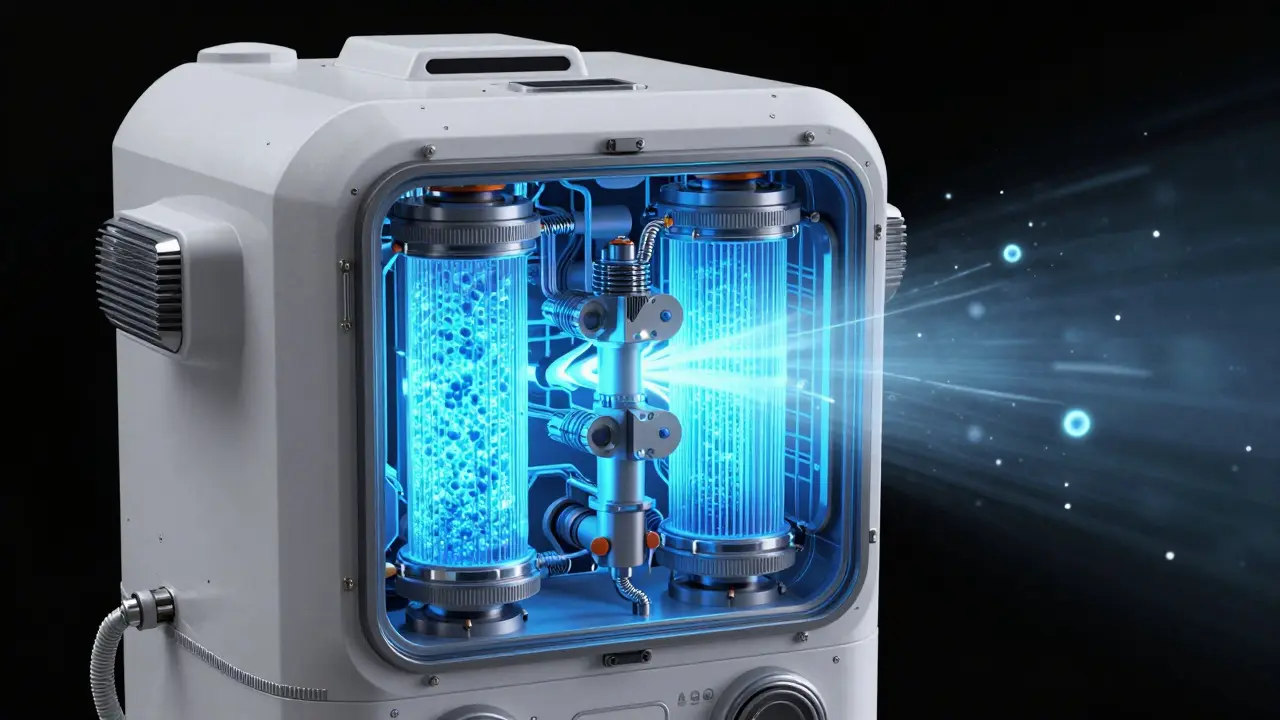
Closed-Loop Future: Turning Waste into Breath
Removing CO₂ is step one. Step two, the holy grail of life support, is converting that waste back into oxygen. This is known as closed-loop life support. Currently, we see this on a large scale with ESA’s Advanced Closed Loop System (ACLS) on the ISS. The ACLS captures CO₂, reacts it with hydrogen in a Sabatier reactor to create water and methane, and then electrolyzes the water to produce fresh oxygen. This system recycles about 50% of exhaled CO₂, saving roughly 400 liters of water per year.
Fitting this complexity into a backpack is the next frontier. Future PLSS designs for lunar and Martian exploration aim to miniaturize these concepts. Imagine a suit that not only scrubs your breath but also converts your exhaled CO₂ into water and oxygen, reducing the amount of consumables you need to launch. While cryogenic capture methods-which freeze CO₂ out of the air stream-are also being studied, solid sorbent and DFM-based systems are currently seen as the most viable path for near-term portable units due to their lower power requirements and simpler mechanics.
Integration and Safety
All these components-tanks, regulators, fans, scrubbers, and radiators-must fit into a package under 40 kg. The PLSS circulates air continuously through the helmet and torso. Sensors monitor pressure, oxygen levels, and CO₂ concentration in real-time. If a scrubber saturates or a fan fails, alarms sound immediately. Emergency reserves of high-pressure oxygen ensure the astronaut has enough time to abort the EVA and return to the airlock safely.
The transition from umbilical-tethered suits in the 1960s to today's self-contained PLSS represents a leap in autonomy. As we look toward Artemis missions and beyond, the focus shifts from mere survival to sustainability. The goal is no longer just to keep an astronaut alive for six hours, but to support weeks of surface operations with minimal resupply. The evolution from single-use LiOH cartridges to smart, regenerable materials marks the beginning of this new era in portable life support.
How long does a standard spacesuit oxygen supply last?
A standard Portable Life Support System (PLSS) is designed to support an astronaut for approximately 6 to 8 hours of active work, plus an additional 30 to 60 minutes of contingency reserve. This duration depends on the astronaut's metabolic rate and the efficiency of the oxygen delivery system.
Why can't spacesuits use the same air recycling as the ISS?
The ISS Environmental Control and Life Support System (ECLSS) is large, power-hungry, and fixed to the station. A PLSS must be lightweight (under 40 kg), compact, and wearable. Miniaturizing complex systems like electrolyzers and Sabatier reactors for a backpack is a significant engineering challenge, though research is ongoing to make closed-loop systems smaller.
What happens if the CO2 scrubber fails?
If the CO2 scrubber fails, carbon dioxide levels in the suit will rise rapidly. This causes hypercapnia, leading to headaches, confusion, and eventually unconsciousness or death. Suits have sensors that detect rising CO2 levels and alert the astronaut and ground control immediately, allowing for an emergency abort of the spacewalk.
Is Lithium Hydroxide still used in modern spacesuits?
Yes, Lithium Hydroxide (LiOH) is still widely used because it is reliable and proven. However, it is a consumable resource. For future long-duration missions to the Moon or Mars, agencies are transitioning to regenerable sorbents like solid amines and zeolites to reduce the mass of supplies needed.
How does a spacesuit prevent overheating?
While the primary focus here is gas exchange, the PLSS also manages thermal control. Air circulated through the suit picks up body heat and humidity. This warm, moist air passes through heat exchangers and radiators in the backpack, which dump the heat into space via radiation, keeping the astronaut cool.